Category: Dailies
Take a lesson from Colonel Jessup, Tomko
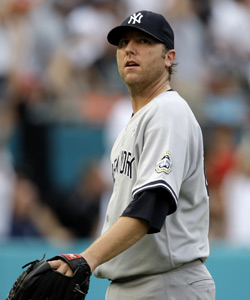 THE LAST TOMKO IS COMIN’ DOWN THE LINE
Yesterday, the intrepid Peter Abraham reported that Brett Tomko was bitter about being designated for assignment:
“I don’t think I got a fair shot,” he said. “I pitched great in spring training and didn’t make the team. I pitched great in the minors, got called up and didn’t get much of a chance. I understand other guys are pitching great. But it could have been different. I can’t see the point in coming back.”
In response, Joe Girardi said, “A lot of it was circumstances… We played a lot of tight games and we went with the guys we were using in those innings. It’s tough sometimes because you want to use everyone and get everyone innings.”
This was very gracious of Joe; I imagined him saying something more like Jack Nicholson’s Colonel Jessup in “A Few Good Men”:
“I have neither the time nor the inclination to explain myself to a man who rises and sleeps under the blanket of the very freedom I provide and then questions the manner in which I provide it. I would rather you just said ‘thank you,’ and went on your way.”
Tomko might very well have said “thank you” to Girardi and Brian Cashman for giving any chance at all to a 36-year-old with who had not posted an ERA under 4.48 since 2004 and had an ERA of 5.07 and a record of 22-41 over his previous four seasons. Tomko has never been a good pitcher, and that he had 14 good innings at Scranton is meaningless when held against the nearly 1800 innings of his big-league career.
As rarely as Tomko pitched, there was good reason for Girardi’s reluctance to use him: you can’t have a reliever who gives up more than two home runs for every nine innings pitched. Close games get un-close in a real hurry and bad games get worse. Tomko can’t even blame Yankee Stadium II for his longball problems, as four out of five cannonades came on the road. Such results would seem to call for more humility. That’s not Tomko’s way–his career will be remembered more for tiffs with Jack McKeon, Don Gullett, Lou Piniella, and Felipe Alou than for his pitching.
MEANWHILE, THE COMPETITION II
In talking about the Adam LaRoche trade to the Red Sox, I forgot to take into consideration Rocco Baldelli as a right-handed alternative to J.D. Drew, but fortunately the Red Sox made another deal so I get to revisit the fellows from the Fens.
Theo Epstein’s second deal of Wednesday involved dumping shortstop Julio Lugo, who had been designated for assignment. Lugo sometimes hits well for a middle infielder, but doesn’t always–see his utter disappearance as a member of the Dodgers and Red Sox during the second half of 2006 and all of 2007–but he doesn’t give his team enough offense to make up for the fact that he’s a mediocre fielder.
Lugo still makes for a good pickup for the Cardinals because they’re locked in a tight race in a slack division (or maybe that’s a slack race in a tight division) and any little advantage they can claim could make an outsized difference. Due to Khalil Greene’s various problems and the general failure of various substitutes, Cards shortstops are batting only .251/.307/.356. Any good stuff in there was contributed by Brendan Ryan (.294/.328/.382, which is better than nothing without being great), but Ryan can’t be counted on to hit the rest of the way–he’s currently in a pretty good slump right now. A .271/.335/.390 career hitter, Lugo should be able to keep the Cardinals overall production at short on the good side of what they’ve done to date.
The Red Sox are picking up the rest of Lugo’s contract, which runs through the end of next season. In return, the Sox get a player they can’t really use right now, outfielder Chris Duncan, brother of Shelley. A left-handed power hitter who hasn’t hit for power since having back surgery (if not before), Duncan is a defensive disaster in the outfield, so even if he were to start hitting Terry Francona would have a hard time figuring out where to place him. He’s headed for Pawtucket right now, and he needs it–over the last two seasons, Duncan has played 163 games, or just over one full season, and he’s hit .237/.337/.361 with 11 home runs in 482 at-bats. A corner outfielder who does that is flirting with professional extinction.
20-GAME WATCH: ATHLETICS AT YANKEES
W-L RS/G RA/G AVG OBP SLG AB/HR SB CS HR/9 BB/9 K/9
A’s 9-11 5.0 4.6 .297 .354 .439 37 21 7 1.1 3.9 7.9
Yankees 15-5 5.4 4.6 .281 .370 .463 24 8 10 1.2 3.5 6.9
The numbers above make the A’s look like a better offensive team than they are; they’re distorted by their just-completed series with the Twins in which they twice scored in double figures. The A’s hit .376/.444/.573 in those three games, .281/.336/.412 in the other 17 games in our sample. That’s still a nice uptick from the team’s seasonal rates of .250/.321/.378. I credit the surge to the team’s sending Jason Giambi to the disabled list with a critical case of not being able to play baseball.
Despite the recent flurry of hitting, the main thing this A’s team has going for it is a young pitching staff which has exceeded expectations. If the Nationals had gotten this kind of performance out of their staff of randomly selected 22-year-olds, they’d be a borderline contender in the NL East. The A’s have the opposite problem, not enough hitting to support a surprisingly effective group. Thanks to the four-game series, the Yankees will get to sample the entire rotation with the exception of Trevor Cahill. New Jersey native Vin Mazzaro goes tonight (weather permitting), and he’s going to have problems in YS II–although his fastball reputedly sinks, he’s been pitching like a scary fly ball type and giving up home runs, with four balls leaving the yard in his last 14 innings, which is a rate that would frighten even Tomko.
Friday’s starter, lefty Brett Anderson, came to the A’s as part of the Dan Haren trade (ah, Dan Haren). Just 21, Anderson is a fastball-slider-occasional curve/change guy who throws in the low 90s and up. He’s taken a step forward in his last five starts, going 4-1 with a 1.15 ERA (including a shutout of the Red Sox). Opposing batters have hit .150/.216/.187 with no home runs in those starts. The Yankees have faced some very good pitchers in the last month–John Lannan, Josh Johnson, Tommy Hanson, Derek Lowe, Jarrod Washburn, Roy Halladay, Jared Weaver, John Lackey, Justin Verlander, Edwin Jackson–Anderson is a challenge worthy of that group.
Lefty Gio Gonzalez was acquired from the White Sox as part of a package for Nick Swisher. He’s a fastball-curveball guy who was a first-round supplemental pick back in 2004, which suggests that scouts saw great promise in him. Certainly his career minor league strikeout rate of 10.3 per nine innings bears out that evaluation. Gonzalez brought the strikeout rate with him to the Majors, but his control stayed in the sticks. He’s walked 6.2 per nine innings in his brief career, which is the prime reason, along with a Tomko-licious
16 home runs in 61 innings, that he has an 8.41 ERA. He allowed four home runs in just 2.2 innings to the Twins in his most recent start.
Finally, 25-year-old Dallas Braden, a veteran on this staff, goes Sunday. Braden is your standard low-velocity lefty, and he’s a fly ball guy too. Despite the latter tendency, he doesn’t allow many home runs, but some of that may be due to park effects. His changeup makes him very tough on his fellow lefties–they’re hitting just .174/.225/.223 off of him this year. Joe Girardi doesn’t really have a good righty platoon bat on his bench, but if he did, Sunday would be a good day to play him. Maybe Shelley Duncan is free that afternoon…
Meanwhile, the competition …
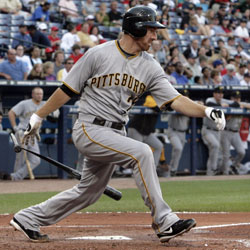 The Red Sox made themselves a nice low-key deal today, picking up first baseman Adam LaRoche from the Pittsburgh Pirates for two lower-echelon prospects. LaRoche is no star, but he does have home run power and has a career-long tradition of being a second-half hitter, batting .296/.357/.544 hitter in the second half. The Sox haven’t hit all that well this year, with Kevin Youkilis and Jason Bay having the team’s only outstanding seasons at bat. In addition, Mike Lowell has been slowed by his recovery from hip surgery and has missed over 20 games. Since Youkilis came through the minors as a third baseman, the Sox can slide him over there and continue to get above-average production at the hot corner, but until now the benefit was small given the options to replace Youkilis at first. Mark Kotsay, Jeff Bailey, and Aaron Bates represent a drastic falloff from the ideal first baseman.
LaRoche should solve that problem, but it will be interesting to see how often he plays when Lowell is available. With David Ortiz locked in at designated hitter (his hot June seems to have bought him more time to live down his horrible first two months), the Sox have no room to get LaRoche at bats anywhere but first base–it’s too bad he can’t take the odd turn in right field for J.D. Drew, who is 6-for-44 over his last 12 games and hasn’t had a hit since before the All-Star break. As LaRoche is a career .249/.308/.435 hitter against lefties, the Red Sox won’t miss much if he sits against them, so there is something like the makings of a three-sided platoon here, with Youkilis bouncing around and Lowell taking some time off against right-handers. The overall upgrade in offense is very minor if LaRoche doesn’t have his usual second-half explosion, but his value would be a lot greater if Lowell must again hit the disabled list.
One alternative scenario could arise if the Sox see part of the benefit of this move as defensive. That is, the team feels Lowell’s defense at third has been so compromised by the surgery that they’re better off with Youkilis, no Mike Schmidt himself, playing there more often. The main thing wrong with that picture is that LaRoche isn’t a great fielder either.
The upshot for the Yankees here, in terms of the division competition, is that the Sox will no longer fall to the replacement level at first when Lowell is out and that they and other Sox opponents will see a few more late-inning at-bats for a left-handed hitter who can put the ball out of the park now and again as opposed to Kotsay, a player who has very little left to give. The impact of this could be small or it could be great. Consider that with Lowell out last October, Kotsay was Boston’s playoffs first baseman, and he killed them, going 10-for-40 in two rounds but failing to take a walk, hit a home run, or drive in a baserunner. In the ALCS, the Rays embarrassed him with good fastballs. If the Sox manage to avoid that fate–assuming the first-place Yankees allow them to get that far–they’ll have accomplished something.
The Sergio Mitre experiment
WHAT IS WRONG WITH THIS PICTURE?
Tim Wakefield hit the DL with back stiffness today, so the Red Sox brought up Clay Buchholz to take his spot. The Yankees had a hole in their rotation, so they brought up Sergio Mitre. There’s a huge gap between a 28-year-old with a 5.36 ERA and a 24-year-old with a 5.35 ERA.
As I wrote about Mitre a few weeks ago, he’s a heavy ground-ball type who has never found consistency in the Majors due in large part to control problems — a pitch-to-contact type can’t walk three or four batters per nine innings and expect to succeed. There are simply too many balls in play with runners on base for the pitcher to garner consistent results. That said, Mitre’s control in the Minors this year has been tremendous, with just seven free passes in 54.1 innings, or 1.2 per nine innings. If he retains that kind of control in the Majors and still has his groundball mojo as well, he can be the late-career Greg Maddux.
The main reason that this will remain just a fantasy is that Mitre almost always showed god control in the Minors. His career rate in 110 games is 2.2 walks per nine innings. In the big leagues he’s either twitchier or more advanced batters manage to lay off his more borderline offerings. When batters have swung, they’ve hit .298/.361/.435. The light power is a token of his groundball approach. Unfortunately, the singles/walks combo has been damaging enough.
The Mitre experiment is worth trying, but if the early results aren’t good the Yankees can’t hang on for as long as they did with pointless reliever Brett Tomko, who was finally DFA’d to make room for Mitre. Pitchers can reinvent themselves, but when it doesn’t happen there’s little point in chasing. That’s something the Red Sox are proving with John Smoltz. Wakefield’s injury buys Smoltz some time, but until today the biggest favor the Sox were doing for the Yankees was pursuing the last ounce the 42-year-old had to give instead of trying to get the first ounce out of Buchholz. Now they’ll do both, still an advantageous situation for the New Yorkers. Should Buchholz establish himself before Wakefield is ready to come back or Daisuke Matsuzaka is ready to give his shoulder another try, the Sox will have enviable depth for the rest of the season.
The sweet Snell of success
YOU NEED A SCORECARD, DUDE
At one point in the run-up to the Old Timer’ Day festivities, I was standing on the third base line near a bunch of Yankees players that included Jesse Barfield, Oscar Gamble, and Ken Griffey, Sr. Behind me, some guy in the stands was shouting, “Hit one, Cecil!” He yelled that over and over again. I couldn’t figure out if he (A) thought that Cecil Fielder had come back to Yankee Stadium for Old Timers’ Day–he hadn’t, and though some of the aforementioned Yankees weigh a few stone more than in their glory days, none looked anything like Big Daddy and none were wearing his number; (B) assumed that because the Detroit Tigers were in town, Fielder had somehow come along with his old organization (nope); (C) that he was somehow making fun of my weight (seems like an esoteric way of going about it); (D) was having an acid flashback to 1997; or (E) had somehow gotten hold of a beer vendor at 10 AM. A little later, Mike Mussina and David Cone were standing on exactly the same spot, and I kept expecting the guy to yell, “Throw one, Jack Morris!” or “Strike ’em out, Willie Hernandez!” or “Run for another term, Jim Bunning!”
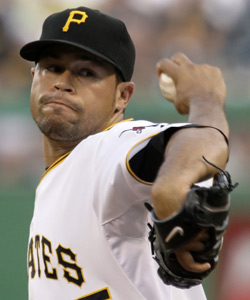 SNELL MAIL
Over the weekend, Baseball Prospectus’s John Perrotto reported that the Yankees have interest in Ian Dante Snell, the Pirates’ punching bag who was recently demoted to Indianapolis. This seems a bit odd at first, given that since posting a 3.76 ERA in 2007, Snell’s one truly solid year, his walk rate has exploded and his strikeout rate dropped, a big reason why he’s put up a 5.40 ERA in 245 innings going back to last year. On further examination, acquiring Snell starts to make a little more sense. First, if you’re down to trying out Sergio Mitre in your starting rotation, you have to show interest in everybody. Second, at 27 years old, Snell isn’t too old to get back on track, assuming there’s nothing seriously wrong with his arm. There’s also a psychological aspect to consider: six years in Pirates drag might be enough to ruin anyone’s approach. Finally, Snell has looked great in four starts at Triple-A Indianapolis. He’s allowed just one earned run in 26.1 innings, and in his first start after going down he struck out 17 Toledo hitters in seven innings. The strikeout numbers since then haven’t been nearly so dramatic, but clearly there’s something alive in Snell waiting to be woken up.
TAKING THE OUTFIELD TEMPERATURE (AN ONGOING SERIES)
Since the end of April:
Johnny Damon: .273/.358/.517
Brett Gardner: .303/.391/.455
Melky Cabrera: .271/.328/.396
Nick Swisher: .206/.336/.363
As you know, I’ve been a supporter of Nick Swisher’s from the moment he was acquired, but what he’s doing right now is not adequate. The average right fielder is batting .266/.341/.439. Unfortunately, it doesn’t seem as if too many players of that quality are going to be made available by the trading deadline. One wonders if Brian Cashman has shown any interest in Josh Willingham of the Nationals.
20-GAME WATCH: ORIOLES VS. YANKEES
|
Team
|
W-L
|
RS/G
|
RA/G
|
AVG
|
OBP
|
SLG
|
AB/HR
|
SB
|
CS
|
HR/9
|
BB/9
|
K/9
|
| Orioles | 9-11 | 5.2 | 5.3 | .263 | .329 | .404 | 41 | 9 | 4 | 1.2 | 3.4 | 6.0 |
| Yankees | 15-5 | 5.9 | 4.5 | .292 | .379 | .481 | 24 | 7 | 8 | 1.1 | 3.5 | 7.1 |
Extraordinary that the Yankees are 15-2 when not playing at Anaheim… As I observed the last time the Yanks and Orioles tilted, there are a few reasons why the latter make more interesting viewing than they have in recent years, beginning with their young outfield of Nolan Remold, Adam Jones, and Nick Markakis. None is older than 25, all are playing reasonably well (though not as well as they had been early in the season), and presumably will maintain their value long enough that if management is able to bang the rest of the roster into shape, they might be around to contribute to a competitive team. The Orioles also have some new faces on the pitching side, and even if they aren’t all world beaters, at least they’re not inflicting more laborious Daniel Cabrera and Adam Eaton starts on the world.
All three of the starters the Yankees face this week are under 30. On Monday night, the Yankees face the most interesting member of the group in David Hernandez, a 24-year-old who first came up at the end of May. A fastball/slider/changeup guy, Hernandez throws in the low 90s. In the Minors, he got a ton of strikeouts, 10.4 per nine innings since signing in 2005, but his Major League rate has been less than half that. He’s also still working on the whole control thing, and the Yankees will stress him by taking pitches if they’re smart. Hernandez had a quality start in each of his last two appearances. The opponents were the Angels and the Mariners, teams that don’t work counts.
Tuesday’s starter is Rich Hill, who once looked like he would be something special for the Cubs but has since fallen on hard times, which is kind of a redundant thing to say given that he pitches for Baltimore. He’s become spectacularly wild, and has made just three quality starts this year. His most recent start was among the three, a six inning, two-run outing against the Blue Jays on July 11. He walked just one. Finally, Wednesday’s starter is rookie Jason Berken. Berken has made one quality start this year. Unfortunately for the Orioles, it came in his second big league start. Since then, he’s been routinely pummeled, and has gotten out of the fifth inning just once. In eight June-July starts, opposing batters are hitting .325/.388/.503.
What do all three of these pitchers have in common? The Yankees have never seen them before.
Sunday: Brunch and serious memories
MY JOB IS STILL EASIER THAN YOURS…
…Which is not bragging, but the opposite: I ain’t complaining about the arduous work I have to do. Still, I was just chatting with my colleague Jon Lane about what time I have to get out to Yankee Stadium II to do my annual set of interviews on Old Timer’s Day, and he was speculating 9 a.m. This is depressing in that it takes me about two hours to get up to the ballpark, so it’s going to be an early Sunday morning. On the positive side, I’ll get to enjoy breakfast fare in the press dining room, which I am told includes Eggs Benedict a la Babe Ruth (poached egg on an English muffin and hollandaise sauce, topped with a broiled horse shank).
I’m already feeling my fatigue, but it should still be a fascinating time. The Yankees always do a terrific job of assembling a memorable roster for these occasions. The usual Hall of Famers will be in attendance — Yogi Berra, Whitey Ford, Goose Gossage, and Reggie Jackson — but I’m looking forward to talking to a couple of the first-timers, “Hit Man” Mike Easler and relief ace Lindy McDaniel. It’s fascinating that the former relief ace is making his first trip back at the age of 73. He played with many future Hall of Famers in a career that covered 21 seasons and three decades, and was an important part of the lost-years Yankees just before George Steinbrenner bought the club. He was then traded for Lou Piniella, which turned out to be one of the bigger robberies in franchise history. Luckily for me, most of the writers will be more concerned with more recent players who are returning for the first time, fellows like Chad Curtis and Charlie Hayes. I typically get the literal old timers to myself, and that’s the way I like it.
I JUST FEEL LIKE SAYING THIS
The Yankees had Babe Ruth for 15 seasons. They won seven pennants. 15-7=8. The Yankees had the best player in baseball by a country mile, and sometimes the two best players, but they still went home in October more than half the time. In 1920 they had Ruth and the best pitching staff in the league, but the non-Babe parts of the offense were weak. The same thing could be said of the 1924 offense, plus the pitching staff was just decent, not great, and the club got beaten by a Senators team that had one of the great pitching staffs of the period. Ruth missed half the season in 1925, the offense couldn’t pick up the slack (even with Lou Gehrig, Bob Meusel, and Earle Combs having good years), and the pitching staff was just mediocre. From 1929 to 1931, the Yankees were outclassed by a dominant A’s team that couldn’t hit with them but had by far the better pitching staff (there is no Lefty Grove in the history of the Yankees, nor, with the possible exception of Ron Guidry in 1978 and a couple of Lefty Gomez seasons, any starting pitcher who is even close). Weak pitching was again the problem in 1933. The staff began to come around in 1934, but not enough to win a pennant.
20-GAME WATCH: TIGERS VS. YANKEES
(SITTING ON A CORNFLAKE, WAITING FOR MAGGLIO)
After the Angels’ sweep, I’m out of the prediction business for awhile…
|
Team
|
W-L
|
RS/G
|
RA/G
|
AVG
|
OBP
|
SLG
|
SB
|
CS
|
HR/9
|
BB/9
|
K/9
|
| Tigers | 12-7 | 4.7 | 4.3 | .260 | .325 | .444 | 9 | 5 | 1.1 | 3.7 | 7.7 |
| Yankees | 13-7 | 6.1 | 5.0 | .285 | .375 | .465 | 13 | 7 | 1.2 | 3.1 | 7.3 |
The 2009 Yankees are not unlike those 1929-1931 Yankees that couldn’t beat out the A’s. They can scorch the ball anywhere, but their pitching staff does the same favor for the opposition. The Tigers do not have a good offense, and are hitting a tragically weak .245/.307/.395 on the road, averaging 4.1 runs a game while doing so. If they start blasting balls into outer space during this series, you not only have further proof of YS II’s pinball qualities, but also of the state of the pitching staff. .. Watch out for Curtis Granderson, a career .291/.408/.523 hitter against the Yankees.
The future of Carl Crawford
CRAWFORD’S STRIPES
I’ve seen some suggestions, both here in the comments and elsewhere, that the next Yankees left fielder should be Carl Crawford, MVP of last night’s All-Star Game. There is nothing wrong with dreaming about Crawford, who is a terrific, entertaining player, a burner on the bases and in the field. Yet, his path to the Bronx is far from assured.
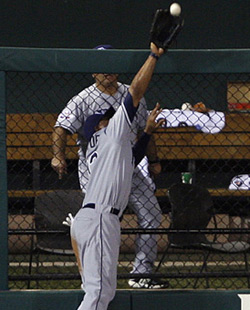 The first problem with projecting Crawford in pinstripes is the assumption that he will be a free agent this winter. That is not necessarily the case. The Rays hold a $10 million club option. If they choose not to exercise it, they would have to pay Crawford a $1.25 million buyout. The marginal cost to the Rays of retaining Crawford, then, is $8.75 million, or just $500,000 more than he’s making his season. That would seem to argue for another year of Crawford in Florida unless the combination of the weak economy and Tampa’s attendance issues — the reigning AL champs’ sales are up, but only by about 2,300 tickets a game — has put the team in a position where it has to cut salary to the bone.
That outcome seems unlikely for two reasons: First, the Rays have a few dollars in useless salaries coming off the books after this season. Troy Percival, Jason Isringhausen and Chad Bradford will combine to make $8 million this year. If the Rays replace them internally, something they’ve already been forced to do with two of the three, then Crawford’s salary is mostly covered. Secondarily, $10 million is high for a left fielder in the present economic environment, but not outlandishly so. It’s less than Raul Ibanez will make next year, or Adam Dunn, and just $1 million more than Milton Bradley. The Rays could absorb the $8.75 million next year, then attempt to re-sign Crawford to a lesser contract based on the new economic realities, or they could pass and take the first-round draft pick. Alternatively, they could pick up Crawford’s option than attempt to trade him a year from now. In short, there is no guarantee that Crawford will even be available to the Yankees.
A more difficult question, but not spectacularly more difficult, is whether the Yankees would really benefit from signing Crawford. Crawford is a very good player who has the potential to be a very bad one. His game is largely based around speed, with only a bit of power and patience thrown in. His batting average is driven by hitting on turf — he’s averaged .302 on the fake stuff versus .285 on grass. Since he doesn’t walk much, his on-base percentage on grass is only .324. His average is also driven by his speed. Nearly 10 percent of Crawford’s hits every year are of the infield variety. At some point, through age or the inevitable knee injury, he’s going to lose half a step, and when he does, close to 20 hits a year will disappear, as will the high stolen base totals, the triples and the stellar outfield defense. That will leave Crawford’s team with a player not too different from the one he was during his injury season last year. Crawford hit .273/.319/.400. That’s not helpful in an offensive era in which the average player can be counted on to do better than that.
You can’t know when Crawford will hit that wall, the one that waits for all players whose productivity is based on speed, but given that the team that signs him as a free agent will have to agree to a multi-year deal that carries the player at least into his early 30s (Crawford turns 28 in August), it’s likely that it will happen on his next employer’s dime. Signing any player, at any stage of his career, is always a gamble, but some gambles are lower percentage risks than others. As much fun as Crawford can be, he seems like one of those, a chance for an acquiring team to get burned. Just Crawford’s career road rates, the non-turf .285/.323/.423 alluded to above, suggests he could retain his speed and still disappoint in the wrong park. In other words, he’s probably more valuable where he is now than he would be almost anywhere else. Before clamoring for Crawford, it would be best to be sure of what one is getting. As the old saying goes, speed kills. In this case, the victims might include those paying a thirty-something Crawford’s salary.
Beware of the Rays
 THE ALL-STAR GAME
I figured I’d hold off on today’s entry until after the game. That would have been a timely decision had the game started before 8:45, but alas, the pregame rolled on like a matinee of “Gone With The Wind.” The game itself went by briskly but uneventfully.
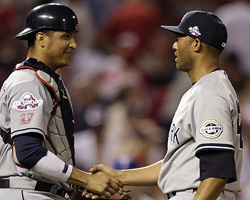
Then Mariano Rivera came in and I was riveted. Is it wrong that Rivera reminds me of the fragility of things and the cruel passage of time? I keep thinking, “He’s almost 40. He can’t be this good forever, so cherish his every appearance.” That makes really savor each pitch, but it also makes every appearance bittersweet.
Maybe there’s a medication you can get that can ease your feelings of sadness over the ending of Rivera’s career before it has ended…
WHY CAN’T THE WIND BLOW BACKWARDS?
The Yankees are 0-9 against the Red Sox and will face them another 10 times this season, but perhaps the real team to be concerned about is the Tampa Bay Rays. The Yankees will visit them for three games starting in about two weeks and then host them for four games in September, including a split doubleheader. The two clubs will then see the season out together with a three-game series in St. Petersburg during the first week of October. The Yankees are 4-4 against the Rays so far, but last year’s AL pennant winners, currently third in the Wild Card standings, 3.5 games behind the front-running Yankees, could surge in the second half and threaten for a postseason berth.
Looking at the Rays’ projected won-lost record, extrapolated from their total runs scored and allowed totals, they have cheated themselves of somewhere between four and seven wins. Victimized by a pitching staff that hasn’t lived up to last year’s performance, the Rays have lost more close games than they’ve won. That can change very quickly. The Rays could experience a run of good luck or timely hitting (perhaps the same thing), or some of the changes they’ve made to the starting rotation, removing Andy Sonnanstine from the Major League rotation, bringing Scott Kazmir back from the disabled list, and promoting David Price, could pay off. They could also help themselves in a big way by grabbing a bullpen arm at or before the trading deadline.
On the offensive side of the ball, the Rays stack up very well with the Yankees, even if they’ve scored fractionally fewer runs per game this season (5.4 for the Rays vs. 5.6 for the Yankees). Take it position by position:
First Base
Rays: .236/.367/.531. Yankees: .277/.381/.542. The difference favors the Yankees, but it’s small, about nine runs over a full season.
Second Base
Rays: .273/.373/.425. Yankees: .307/.339/.488. Despite having to compensate for Akinori Iwamura’s wholly unnecessary knee injury, the aggregate of Tampa’s second basemen, principally Iwamura and Ben Zobrist, have out-produced Robinson Cano by a few runs. Such is the power of on-base percentage.
Third Base
Rays: .288/.366/.545. Yankees: .222/.345/.412. The Alex Rodriguez component of the foregoing is .247/.407/.519. We’ll see if he passes Evan Longoria by the end of the year. The aggregate A-Rod subs have hit .184 with no home runs, so Tampa leads by about 20 runs here.
Shortstop
Rays: .347/.393/.536. Yankees: .314/.386/.453. Jason Bartlett is having a crazy good year, and when he put in three weeks on the disabled list, subs Zobrist and Reid Brignac hit quite well. Jeter is having a nice season, but he’s just not hitting at that level. By the end of the year, this should be much closer as Bartlett fades (.400 batting averages on balls in play just don’t last) — unless Jeter fades too.
Catcher
Rays: .234/.264/.342. Yankees: .280/.335/.444. Dioner Navarro is just killing the Rays at the plate. Even though Jorge Posada subs Francisco Cervelli, Jose Molina, and Kevin Cash haven’t hit well, they’ve still been better than Navarro. You almost have to try to be that bad. Navarro was on a little hot streak going into the break, and perhaps he’ll rebound in the second half. For now, the Yankees have something like a 20-run advantage here, and the more Posada they can pile on the better.
Left Field
Rays: .311/.375/.456. Yankees: .272/.348/.497. The Yankees have gotten seven more doubles and eight more home runs in roughly the same number of trips to the plate, and that power advantage helps offset Carl Crawford’s high batting average and stolen bases. In terms of run generation, this is close to being a tie.
 Center Field
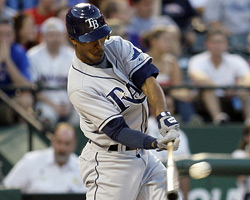
Rays: .240/.329/.396. Yankees: .289/.356/.432. B.J. Upton’s miserable start was highly damaging, but he had a terrific June (.324/.395/.562, 10 doubles, five home runs and 14 stolen bases), and if he hits up to his capabilities the rest of the way he’ll turn this position into a net positive. The Yankees’ just-good-enough production at the position gives them a roughly seven-run lead on the Rays. Again, that will change, because the Brett Gardner/Melky Cabrera combination is unlikely to improve on its current showing, whereas Upton is fairly likely to have a .380 OBP in the second half.
Right Field
Rays: .274/.364/.456. Yankees: .252/.360/.457. The Rays play someone different here every day, but each part has been very good, with Zobrist, Gabe Gross (.301/.400/.451),and Gabe Kapler contributing. Rays’ right fielders have gotten a few more runs out of right field than the Yankees have, but that could change if Nick Swisher remembers how to hit or Gross remembers that he’s not Country Slaughter.
Designated Hitter
Rays: .255/.365/.401. Yankees: .272/.369/.534. An easy win for the Yankees, who are getting some of the best DH production in the business from Hideki Matsui plus assorted guest starts. Pat Burrell has been a spectacular disaster for the Rays and there’s no end in sight. They only have to live with him for the rest of this year and next, but the experience will cost them $16 million.
Boston’s offense doesn’t measure up in this crowd given David Ortiz’s struggles, Mike Lowell’s age and health issues, absent shortstops, and so on. They’re more of a pitching team this year. They beat the Yankees there, the Rays beat the Yankees on offense. It will be interesting to see if the Yankees have enough of what each team doesn’t have to survive the crunch.
Yankees facing severely depleted Angels
20-GAME WATCH: YANKEES VS. ANGELS
It’s an inevitable part of any season that the Yankees have to go to Anaheim. Sadly, the MLB schedule doesn’t offer any NFL-style options, where you might not see a rival ream for a few years. Over the last five years, the Yankees have gone 7-15 against the former Disney vassals. That’s a fairly amazing number given the Yankees’ overall records in those years. In one ballpark, a team that averages 90-something wins a year becomes a 100-game loser.
Due to injuries and disappointing performances, the Angels have been playing a lineup far different from the one they contemplated at season’s outset. They’ve remained competitive anyway. Let’s look at the 20-game picture:
W-L RS/G RA/G AVG OBP SLG SB CS HR/9 BB/9 K/9
YANKEES 14-6 5.5 3.8 .280 .371 .442 15 7 1.1 3.0 7.9
ANGELS 12-8 6.0 5.3 .275 .352 .440 16 6 1.6 3.6 7.4
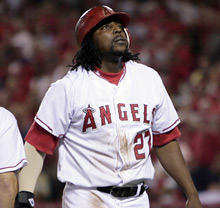 The Yankees aren’t going to see Vladimir Guerrero and Torii Hunter, as they’ve both hit the disabled list. Scot Sheilds is unavailable. Kelvim Escobar is there too, though that’s no surprise — his spot on the DL is a rental with an option to buy. Howie Kendrick is back from the minors but has yet to win his spot back from Maicer Izturis, who is peaking at .302/.352/.422. Catcher Mike Napoli, one of the best surviving bats on the team, doesn’t play every day, although with the DH spot freed up by Guerrero’s absence, the Yankees may get an extra serving. Kendry Morales is having a strong year at first, certainly a stronger year than this page ever expected him to have; Bobby Abreu is doing his usual fine job of getting on base; another former Yankee, Juan Rivera, has been mostly healthy for once and is killing the ball at .313/.353/.531. In his last fifteen games he’s slugging .645 with six home runs.
On the pitching side, the Yankees will see Joe Saunders, Jared Weaver, and John Lackey. Saunders has been hammered in three of his last four starts, allowing 19 runs in 21.1 innings. Most intriguingly for a power-hitting team like the Yankees, he’s allowed nine home runs in those starts. Weaver’s work of late has also been patchy. As recently as June 15, he had an ERA of 2.05. Since then, he’s four starts and been battered to the tune of .296/.358/.510, allowing 20 runs in 23.2 innings. He’s still awfully hard on right-handers at .176/.232/.255, but the Yankees have so many left-handers and switch-hitters that they should be less vulnerable than most other clubs. Finally, Lackey is normally one of the best pitchers in baseball, but has had injury problems and hasn’t been himself all year. He seemed to be coming around in a series of four starts beginning in mid-June, posting a 2.70 ERA in 30 innings, but three of the four starts were against light-hitting teams, the Giants, Diamondbacks (both DH-free games), and Orioles. His last start was against the Rangers, and he was thrashed.
The Yankees are facing a severely depleted Angels club. Neither their starters nor their pen has been particularly effective. Their offense is down to just a few above-average pieces. The defense, normally a plus, is among the least efficient in the game. They may still be winning, but they’re doing it with mirrors. For once, the Yankees may be able to make a strong showing in Anaheim.
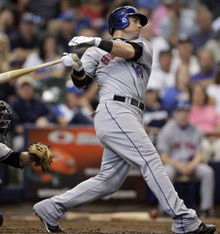 Jeff Francoeur for Ryan Church: Mets bought themselves another fixer-upper opportunity, but Francoeur may be too stubborn to be fixed, in spite of all his great physical tools. As for the Braves, Church is not a great player, and he’s five years older than Francoeur, but he’s an upgrade on the out machine that Francoeur had become. In a light division, small improvements of this nature can help swing the standings in a team’s favor. The Braves really impress with their willingness to reshape their team on the fly this year. They tried to jump Jordan Schafer ahead of schedule. That didn’t work so they dealt for Nate McLouth. Kelly Johnson has been sent down in favor of Martin Prado. Tom Glavine was released so that young Tommy Hanson could pitch, and now they’ve ditched one of baseball’s worst hitters. They’re not living with their failures, they’re deleting them. You can’t ask more from a general manager.
The Mariners picked up two minor league pitchers from the Royals for Yuniesky Betancourt. They had to send some cash along, but still managed to delete a contract that ran through 2011 with a 2012 buyout and promised to do very little for them over that span. Betancourt is a classic triple threat: he doesn’t hit, doesn’t run, and doesn’t field. Even if the pitchers, who are a couple of years off, never develop, they’ve wisely decided that they can pay Ronnie Cedeno less to make the same outs. If they’ve freed up enough cash to add a bat, they might even stay in their divisional race. The Royals might be one of the only teams in baseball that Betancourt can help, although they’ll dearly for the privilege. With Mike Aviles out for the year and spectacularly disappointing before that, they’ve had a parade of shortstops, none of whom has distinguished themselves. Overall, Royals shortstops have batted .208/.234/.281 this year. That’s miserable, and it has no doubt cost the Royals quite a bit in the win column, but you still have to question the deal from their point of view. They’ve gone from pathetic to miserable, which probably isn’t enough of an improvement to win the division, and they’ll be stuck with Betancourt for at least two and a half years. Unless the Mariners are paying all of his contract, it seems like a heavy price to pay for a bid at mere respectability.
A quick note on Halladay
 Without endorsing the idea of the Yankees acquiring Roy Halladay, I want to point out that one universal theme of the commentary regarding such a trade, that the Jays would be unlikely to deal Halladay to a divisional rival like the Yankees, is one of those stock things that writers say without really thinking it through. Anyone who writes that must not watch YES much, because the obvious counterpoint is a fixture in the booth. How do they think David Cone got to be associated with the Yankees?
On July 28, 1995, the Blue Jays traded David Cone to the Yankees under very similar circumstances. The general manager at the time was Gord Ash, not J.P. Ricciardi, but I guarantee you his preference wasn’t to send Cone across the water to New York, but he did. The Yankees had prospects to deal (none of them worked out, unfortunately) and they were willing to risk Cone leaving as a free agent (he did declare for the market, but was re-signed about five weeks later). Halladay isn’t a free agent until after the 2010 season, but the expense of his current contract is going to scare off a lot of teams given the economic environment. A team that picks him up tomorrow is going to be on the hook for half of this season and all of next year, which comes out to something like $23 million. It could be that the pool of bidders will be small enough that Ricciardi will have no choice but to look closely at the Yankees.
That’s if the Yankees are interested. I don’t know if they are, or if they even should be, but being division-mates with the Jays hasn’t stopped them in the past and won’t stop them now.
A QUICKER NOTE ON ACEVES VS. MITRE
Good call by the Yankees plucking Alf Aceves out of the bullpen to make Thursday’s spot start against the Twins. As outlined in an earlier entry, Mitre’s Major League track record is spotty enough that Thursday would have to be rated a throwaway game, regardless of his current minor league record. Pitchers are the ballplayers most likely to reinvent themselves, but a 5.36 career ERA is what it is… kind of like Brett Tomko’s 4.69.
The only disturbing aspect to the decision is that it exposes Joe Girard’s proffered rationale for stranding Aceves and Phil Hughes in the bullpen, that they could not be “stretched” in time, as a canard. Why not just give an honest answer, which would have been something like, “We’re having a pretty fun time with the current bullpen composition and we just don’t want to mess with it?” That might not have been the correct answer to the problem of the spot start, but it would have been truthful.
With Aceves sprung, possibly for more than one start, the Yankees do have to identify an option to replace his very productive relief work. Right now they’re carrying a pen that is two pitchers short of a full load, given that Brian Bruney isn’t exactly trustworthy right now and Brett Tomko doesn’t have any function beyond trash-time relief, if that.
I’d still like an explanation of why it’s more valuable to the pennant-winning effort to have Tomko in the Majors and Mark Melancon and his 2.50 ERA in the minors. I know he walked five guys in three innings in the majors, but at Scranton he’s walked just two batters per nine innings, the same rate he had last year. Meanwhile, the same minor league staff that allowed him to throw nearly 100 innings last year, after the pitcher already had Tommy John surgery, is using him for two and three innings and appearance. If the Yankees don’t use him soon, he might break before he can be used.
AN EVEN QUICKER QUESTION (UNANSWERABLE FOR NOW) ON SABATHIA
Is it meaningful that CC Sabathia’s strikeout rate is his lowest since 2003?
THE NEVER-ENDING STORY
Brett Gardner, May to present: .312/.414/.496.
Melky Cabrera, May to present: .265/.319/.395.
Gardner starts again tonight. All hail Joe Girardi.
SO LONG TO FRANCISCO CERVELLI
He’s athletic and mobile and therefore fun to watch… but as a hitter he wasn’t any better than Jose Molina. The difference between the two is that Cervelli has a small chance to be better than that, whereas Molina is what he is. Cervelli’s 48 percent caught stealing rate is something special, and if he continues to throw like that he’s almost guaranteed to have a long Major League career even if his bat stays exactly where it is right now.
Midterm grades continued …
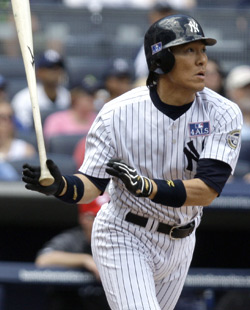 HIDEKI MATSUI-DESIGNATED HITTER
Joe Girardi has treated Hideki Matsui as one of a number of parts instead of a star, giving him a lot of rest (this aside from the enforced time off during interleague play). Matsui has been up and down but has hit for good power this year — even during his May-June low point (.227/.317/.454 in 49 games) he still socked eight doubles and eight home runs. Even with all the rest, he’s on pace for the second-highest home run total of his American career. Some of that is Yankee Stadium II at work, but not all. As usual, platoon issues are minimal (he’s slugging .652 against southpaws). Even his sluggishness on the bases hasn’t hurt too much. GRADE: 85/100
CC SABATHIA-LEFTY STARTER
One of the problems with signing players off of career years is that your expectations are inflated. CC Sabathia finished the first half with an ERA of 3.85, consistent with his AL career mark of 3.83. That said, Sabathia hasn’t been his most consistent this season, giving the Yankees a quality start only half the time (discounting his injury-truncated start against the Marlins). He’s been quality in 60 percent or more of his starts every year but one since his rookie season. Part of the shortfall, if that’s not too extreme a term, is his 4.55 ERA at home — on the road, CC has been the same old Sabathia, with a 3.19 ERA. GRADE: 87/100
ANDY PETTITTE-LEFTY STARTER
In his post-game interviews, Girardi always says that Andy Pettitte pitched well regardless of the results. Chalk it up to sentimentality. Pettitte has a strong 8-4 record, but that’s not quite a fair representation of his performances as he’s been quality a little less than half the time, picking up wins despite allowing 12 hits in 6.2 innings to the Twins, or allowing nine baserunners (but just one run) in five innings against the Indians. His battles with control has been perplexing given his age and his experience; right now his walk rate is the highest since 1999. GRADE: 82/100
A.J. BURNETT-RIGHTY STARTER
After a bumpy start, A.J. Burnett has performed at the highest level of any Yankees starter, giving the club 10 quality starts in 16 tries and closing out the first half with four terrific starts in a row (caveat: two of the four were against a highly-depleted Mets club). Bumped down slightly for that troublesome walk rate, Burnett leads the league in free passes. GRADE: 89/100
JOBA CHAMBERLAIN-RIGHTY STARTER
Short starts, wildness, tentative pitching, and Joba Chamberlain has still given the Yankees a quality start in half his starts, which is a touch better than average. His last two starts have been on the rough side but aren’t any reason to write him off as a starter. Pitching at home has been a problem, and something odd is going on with his approach to right-handed hitters, as they’re hitting .293/.360/.503 against him — last year it was .209/.297/.273, and in 2007 it was .156/.224/.244. Is it the decreased velocity? Is his slider not biting? Darned if I know, but it sure is interesting, and a bit frustrating, too. GRADE: 81/100
CHIEN-MING WANG-RIGHTY STARTER
Chien-Ming Wang’s physical problems seem to have destroyed his mechanics, and though he pitched better after coming off of the disabled list, all better really meant was a 6.50 ERA instead of 16.00. He has yet to make a single quality start in nine tries — even Steve Trout got one in the same number of chances — and now that he’s back on the DL, it will be some time before he does, if he even gets the chance. He did pitch two good games in relief, and it’s possible the Yankees should have left well enough alone. GRADE: 55/100
MARIANO RIVERA-CLOSER
The great Mariano Rivera’s home-run rate is his highest since 1995, which is to say in his whole career as a reliever, and it’s not just a function of Yankee Stadium II. Still, Rivera has blown just one save, and overall has been one of the most effective relievers in the Majors this year. The one place where he’s struggled is in tie situations, which has frustrated Girardi’s attempts to use him to the greatest advantage. Alas, no one is perfect, not even Rivera. Bumped downward because as good as he’s been, his “A+” standard is years like 2005. He may yet get there; in 14 games covering June and July he’s held batters to .163/.196/.245. GRADE: 94/100
ALFREDO ACEVES-RIGHTY MIDDLE RELIEF
A revelation. It will be interesting to see if Alredo Aceves remains Mo-like, which is to say that he keeps killing left-handed hitters. They’re currently hitting .155 against him. In retrospect, leaving him off of the Opening Day roster looks like a major mistake. GRADE: 96/100
PHIL COKE-LEFTY SPOT RELIEF
Phil Coke has given up a few more home runs to lefties than you would like, but his overall line against them (.176/.203/.382) is pretty darned good, and he’s holding righties down as well (.167/.297/.296). Since allowing runs in back-to-back appearances on May 26 and 31, he’s pitched 15.2 innings over 17 games and allowed just one run on five hits and four walks. He’s even pitched well at Yankee Stadium II. One wonders if the eighth-inning bridge the Yankees have been looking for has been wasted on one-batter appearances. GRADE: 97/100
PHIL HUGHES-RIGHTY MIDDLE RELIEF
His starting work was spotty (5.45 ERA), but Phil Hughes did give the team two more quality starts than Wang did. We’ve only seen 14.2 innings of Hughes the reliever, but he’s been dominant, with opposing averages of .120/.170/.220, which works out to just six hits allowed in 14.2 innings. Hughes gets a confidence booster and the Yankees get a lights-out reliever. It’s the best of both worlds. GRADE: 83/100
DAVID ROBERTSON-RIGHTY MIDDLE RELIEF
David Robertson has done a fine job of breaking in. He’s particularly hard on right-handed hitters, whom he’s held homerless in 45 at-bats. When his curveball doesn’t curve against lefties, though, it’s a souvenir. Numbers that are likely a small sample mirage: His .125/.286/.150 rates at home. Now all he has to do is get out of the trash-time role. GRADE: 82/100
 Pinstriped Bible