Category: Dailies
The draft is upon us
HIDE YOUR WIVES AND DAUGHTERS
We’re just a few hours away now. The Yankees pick 29th in the first round, the result of Gerrit Cole stiffing them last year. The thing to remember here is that you don’t get a third try — if the Yankees swing and miss here, they go hungry. Mock drafts are only worth so much, particularly when you’re talking about a team that’s picking 29th, but both Baseball America‘s Jim Callis and Baseball Prospectus‘ Kevin Goldstein have linked the Yankees to Texas high school outfielder Slade Heathcott (not Heath Sladecott, as my brain insists on remembering it).
Again, this is all guesswork because any of 28 prior decisions could dramatically alter who is available at the bottom of the round. Because he’s a local product, I’d like to see Millville High, New Jersey outfielder Mike Trout become available to the Yankees, but he’s been a rising commodity these past few weeks and it seems unlikely. “Local” is kind of stretching it — Millville is closer to Delaware than New York — but you don’t get too many high first-round picks out of the Garden State, though we can balance out such illustrious overdrafts as Willie Banks, Jeff Kunkel and Pat Pacillo with Mo Vaughn, Craig Biggio, and Willie Wilson. Also, I figure that fate owes the Yankees something on players named “Trout.”
The last time the Yankees bought a fish it didn’t go so well. It was 22 years ago, but the wounds have yet to heal — if you weren’t there, it was something like all three years of Carl Pavano packed into a season-destroying 14 games. Maybe they’d be better off with Sladecott, or Heathcliffe, or whatever his name is, so long as he represents a land-based species.
To “land-based” we should add “position-based.” Though teams draft (or should draft) the best available talent rather than for need, the Yankees’ system is still overbalanced on the pitching side. Given that the Yankees even taste some early picks because of the Cole debacle, it’s probably best just to say “good luck” and, paraphrasing Woody Guthrie, “Take it easy, but for gosh sakes, take something!”
Notes from around the league
NO YANKEES TONIGHT
What a drag. Although it would have been nice if they Ernie Banks-ed it on Saturday, they pushed the sucker off into the future instead. And thus, a few quick notes on the landscape:
? It was a great week for youth, with Andrew McCutchen, and Gordon Beckham coming up, and Tommy Hanson officially due up on Sunday, and let’s throw in Matt Wieters, who made his debut a week ago today. All ranked among the top 50 or so prospects in the game, and three of the four are closer to the top than the bottom (McCutchen is the least promising of the bunch, but it’s a tough crowd).
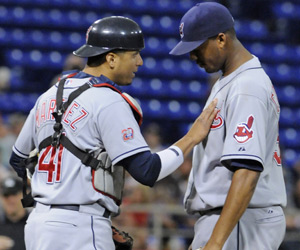 ? It was more than past time for the Indians to send Fausto Carmona to the Minors. He was wonderful in 2007, but his 2008 was bad and his 2009 has been miserable, with the former’s five walks per nine innings turning into six walks per nine. Carmona can still induce those grounders, but he wasn’t getting the double plays when he needed them, perhaps because he was more likely to pass the batter than get him out. Resultantly, just two of his 12 starts have earned the quality start seal of approval. His 2008 and 2009 combined: 10-13 in 34 starts, 6.10 ERA (including a shutout!), 181.1 innings, 195 hits, 111 walks, 94 strikeouts.
? Billy Butler of the Royals is batting .288/.348/.440, which would be great if he were a shortstop, but it’s not that exciting coming from a first baseman/designated hitter. Butler is only 23, so he could find another gear, but right now he’s Shea Hillenbrand.
? If the Yankees were to bail out on Hideki Matsui before the end of the year, would you be comfortable with it if the reason were that it would allow them to block the Red Sox off of Nick Johnson? Part two of that question is, would it be worth it for the Yankees to get into a prospect bidding war with the Red Sox in order to accomplish that goal?
? It’s sad that the era of making “great man” movies ended 60 years ago, before Paul Muni or Edward G. Robinson could portray Branch Rickey.
? As much as the Orioles have improved their club of late with graduates of the farm system and the occasional perspicacious trade acquisitions (Adam Jones, this means you), they’re still desperate for a quality shortstop. Whoever the next great, or even decent, Orioles shortstop is, he’s not presently in the organization.
? Rumor has the Braves wanting to add Brad Penny, which seems like insurance for the kids. Their rotation has been the least of their problems. Nate McClouth isn’t a great bat; the reason he was a great add for the Braves is that despite this he’s still leaps and bounds above any other outfielder the Braves have played.
? Given their many injuries and lack of organizational depth, by the time the Yankees see the Mets next week they might be starting Wayne Garrett and John Milner again. Parenthetically, Omar Minaya was nuts to put so much faith in former Yankees farmhand Omir Santos. He’s going to be far below the replacement level with the bat when all is said and done. He’s close now, actually … The Mets have played 12 games since Jose Reyes left the lineup, and though they’re 7-5 in those games, they’ve hit .252/.336/.378. We should probably only give them half-credit for their three-game sweep of the Nationals.
? I keep hearing how after Randy Johnson there will be no more 300 game winners forever, but with health (the big caveat for everyone) CC Sabathia is going to have a shot at it. If he averages only 15 wins a year over the duration of his Yankees contract, he’ll hit his mid-30s with something like 220 wins. It would be a steep climb to 300 from there, but not any steeper than Johnson’s. As with the Big Unit, Sabathia is a weird physical specimen, so it’s hard to project his chances of staying healthy into old age.
? “Up” was a terrific picture, and one that will speak more to the adults than the kids, though the kids will dig it, too. Next spring, when people are debating the Academy Awards and this film has been ghettoized in the “Best Animated Film” category, it’s a good bet that no, erm, inanimate film will have been better.
MORE FROM ME
Wholesome Reading has been updated with new entries, and there will be more throughout the weekend. Warning: Politics and fish! I’ll be back here if breaking news demands it, or if I just feel lonely for you.
The around (and about)
AMERICAN LEAGUE
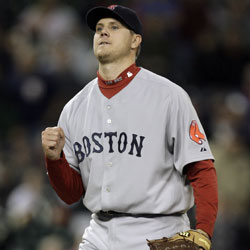 Red Sox 5, Tigers 1: The Tigers loaded the bases with no outs in the bottom of the ninth, but Jon Papelbon struck out the side to get out of it. Not much new there, but Daisuke Matsuzaka’s solid start (five innings, one run) bodes well for the Sox in the future. Throw in four scoreless innings of relief overall, and it was a big day for Boston.
Blue Jays 6, Angels 4: Fourteen strikeouts for Roy Halliday on 133 pitches. That’s a career high for the good Doctor, surpassing a 130-pitch effort last August 9. If it bothered him then, he didn’t show it–his ERA was 2.77 going in and 2.95 after… With this loss, the Angels once again get sucked back to .500. Halladay can make any team look bad, but this is a woeful offensive team. A healthy Vlad Guerrero, or one 10 years younger, would solve a lot of problems, as would a basic hitting reeducation course for Howie Kendrick, who has taken the Mickey Hatcher not-walking-as-your-path-to-Nirvana program way too seriously.
Rays 6, Royals 2: In which Andy Sonnanstine shows he can pitch a little, allowing two solo shots but no free passes. The Rays’ bullpen even showed up for this one. Ben Zobrist keeps on hitting at second, and Matt Joyce has done quite well in his return from the minors, so the Rays are covering all their injuries but shortstop, and Reid Brignac might show a little bit of pop yet–his translations for this year at Triple-A say .268/.335/.451, while PECOTA… Well, PECOTA isn’t nearly as cheerful. At least everyone agrees the kid can field.
Twins 4, Indians 3: The Indians might have lost Asdrubal Cabrera for awhile when he bent his left shoulder on Brandon Harris’s buttocks. And this just in: I’ve run out of superlatives for Joe Mauer, who went 3-for-3 with a home run and is now batting .431/.516/.873.
Athletics 5, White Sox 0: Another rookie pitcher comes up for the A’s, doesn’t pitch well exactly, but doesn’t allow a run. Beware of next time. The Sox were damaged on their end by a Wilson Betemit error, and we know what that’s all about in these parts.
Mariners 8, Orioles 2: Erick Bedard raises his trade profile a bit more with another solid outing, Ichiro gets another couple of hits (26 straight), and Junior Griffey finds a good day left in his kit bag… In his last 20 games, Nick Markakis is 18-for-85 (.212).
NATIONAL LEAGUE
Braves 6, Cubs 5: Definition of a heartbreaking loss: your starter throws nearly seven innings of no-hit ball, that goes by the boards, as does the lead, as does, well, everything, and at the end of 12 innings you get to watch the Braves dance at home plate. Jeff Francoeur’s home run moves his OBP up to .275. Georgia rejoice. Gregor Blanco replaced Jordan Schafer in center field, checking a rookie checker’s attempt to jump a few squares.
Pirates 3, Mets 1: Johan Santana pitched well, but not up to his usual standards, while Zach Duke held a depressingly anorexic Mets lineup to eight singles and a whole lot of outs on balls in play–the Mets didn’t strike out once, but a few quality defensive plays kept them honest, including a Nate McLouth throw to get Jeremy Reed at home that tailed well up the line, exactly where it needed to be. Sometimes it’s better to be lucky than good.
Nationals 10, Giants 6: Busy day for Washington, as the Nats fired pitching coach Randy St. Claire and also got word that starting catcher Jesus Flores might miss the rest of the season. Finally, the staged a come-for-behind win courtesy of the Bay Area Bullpen Collective. As for the Jints, they can look in the mirror. Tim Lincecum on the mound, six runs in the bank, that’s like ’27 Yankees time for this offense–they need to win on nights like that.
Marlins 10, Brewers 3: Dan Uggla hit his 100th home run, becoming the fastest second baseman to reach the century mark. Uggla isn’t a great player, nor is he having a good year. Still, this is a guy who few thought could play, and he has 100 career home runs, about 100 more than several prospects with higher profiles.
Astros 3, Rockies 2: Third straight win for Houston, as they tie it up against Huston Street and Miguel Tejada hits a walk-off against Fogg in the 11th, as if Fogg had any business pitching in an important spot, or any spot, in the Major Leagues. At .362/.388/.546, you have to admit that Tejada is having a heck of a season for a 35-year-old with a questionable chemical history.
Cardinals 5, Reds 2: Four strong innings of relief from the Cards’ pen, one of those off days for Bonson Arroyo, and a Reds’ offense that was hurting from the loss of Joey Votto goes 5-for-30. Willy “E. Coyote” Taveras: .260/.318/.328 and a career leadoff man who has never scored more than 83 runs in a season. Who thought that was a good idea?
Phillies 10, Padres 5: A potentially season-saving debut by starting pitcher Antonio Bastardo (Got Bastardo?), who could bolster a rotation that has lost Brett Myers for the year and isn’t getting quite what it had planned from Cole Hamels… Another huge night for Raul Ibanez, two home runs, and Ibanez is now slugging a Ruthian .716–Great Scott. On the Padres’ side, Adrian Gonzalez hit yet another home run, and Jake Peavy leaves after one with the flu, which sounds like a cover for his bad ankle or might really be the flu… And hopefully not THAT flu.
Dodgers 6, Diamondbacks 5: A win for Jeff Weaver out of the pen as the Dodgers, absolutely neutered by Dan Haren, came back. As I’ve said before, it’s an unfair universe.
One more chance for Wang
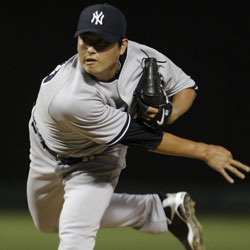 WANG RIDES AGAIN, ONE DAY AT A TIME
Chien-Ming Wang has been sprung from the bullpen. He will start on Thursday against the Rangers. Phil Hughes will take his place in the bullpen. At this writing, the reasoning behind the decision has yet to be reported, but we can safely assume that the Yankees have been sufficiently intrigued by Wang’s work in relief to give him the shot. At the same time, Hughes gets the benefit of a little more experience working in relief and remains on hand to pitch if Wang’s return needs to be aborted.
The upside of the move is clear: at his best, Wang was a consistent starting pitcher who gave the Yankees a fair chance to win about 60 percent of the time. As I have written many times here, the secret of Wang’s success is that his sinker has been so good that not only do batters hit very few home runs off of him, they hit relatively few extra-base hits at any time. If Wang’s control is sharp and he keeps the walks to a minimum, the opposition has to pile up many singles in a row to score more than one run in an inning.
That said, Wang’s very low strikeout rates mean that everything has to be working right for him to win, including the inner defense. As we’ve seen this year, if he’s not at his best, batters don’t swing and miss, they swing and annihilate. Very few pitchers have had any kind of long-term success with Wang’s strikeout rates–a reader in the comments for yesterday’s entry cited Rick Reuschel, Jamie Moyer, Greg Maddux and Paul Splitorff, but all of them except Splitorff had decisively higher strikeout rates in leagues in which batters were harder to strike out (and I’m betting that Spitorff would edge ahead as well given a similar era adjustment), and in any case these are outliers, four pitchers out of, well, everybody.
Hughes has been fascinating so far. He’s averaging eight strikeouts per nine innings, one of the reasons that the Yankees are second in the league in strikeout rate. His walk rate has been a tad high. He has not been consistent, of course, and the Yankees are looking for consistency in a close race. All Yankees tyro pitchers are on an inning-to-inning lease, but given the highly competitive nature of the AL East this change can’t be looked at as a symptom of the team’s typical impatience. Though the Red Sox have had an indifferent record of late, the Blue Jays have been in a tail spin, and the Rays are still struggling to find consistency, you can’t assume that these clubs are just going to fall away and leave the Yankees alone in first place. It makes sense to reach for the arm that you think is going to give you a quality start six out of ten tries instead of four or five times out of ten tries.
Regardless of what Wang does now, the future belongs to Hughes and his strikeouts, to the way that a high-strikeout pitcher can take the weight off of a defense (with an aging Jeter and a crippled A-Rod, this is only going to become more of an issue over time). Eventually the Yankees are going to have to make a commitment to him and let him mature enough to find that consistency, or decide that he’s not going to find it and move on.
They also need to be prepared to abandon this experiment just as quickly as they started it, and for the same reasons. Wang has pitched six times this year. He was creamed the first four times and pitched well the last two. This is not exactly a plethora of evidence that Wang is ready to be a dominating starter. If the AL East is too competitive to let Phil Hughes grow up in public, then it’s also too competitive to let Wang try to reestablish himself as a starter. Forget the two 19-win seasons. They have little relevance to 2009. That was then, this was now, and if Wang isn’t the same guy then there’s no room to let him flounder based on a memory. All luck to him, of course, and all respect for past accomplishments as well, but just like Hughes, Wang should be guilty until proven innocent.
THE CAPTAIN
Having hit in sixteen straight games (.429/.487/.600), Derek Jeter’s overall numbers have risen to the point that, if he simply maintains his current overall level of production, he will have enjoyed a very nice comeback season, his best with the bat in three years. There are, of course, many games yet to go, so you can’t count on that happening, but after last year’s injuries, the concomitant decline in production, and rapidly encroaching old age, it’s good to see that this future Hall of Famer may have another top-quality season in him.
Actually, top-quality is a bit of a misnomer as Jeter’s current level of production doesn’t stand out from any of several other seasons he’s had–he’s always been a consistent player, with a couple of notable exceptions. One of those, of course, was 1999, when Jeter had what was one of the top five or so seasons by a shortstop since the 1950s. There’s Alex Rodriguez’s 1996 and 2000, Nomar’s 1999 and 2000, Robin Yount’s 1982, Alan Trammel’s 1987, and Jeter’s 1999.
Note that with the exception of Yount, the MVP voters missed on every dang one of them.
Show some love for the glove
RECORD-SETTING DEFENSE
The Yankees’ new record for consecutive games without an error doesn’t mean much to me, because official scoring in baseball has spectacularly low standards and has become almost totally subjective. What is interesting about the record is the way the Yankees have been climbing the defensive efficiency ladder. Defensive efficiency is the percentage of balls in play that a team turns into outs. Over the last several seasons, almost uniformly going back to the last century, the Yankees have ranked toward the bottom of the Majors in this category. Their players had so little range that the pitchers were giving up hits on balls that other teams might have put in the back pockets. Everything gets distorted: The pitchers look worse than they really are, the team goes crazy trying to sign pitchers when it really needs fielders and hitters, and the whole club spins off its axis.
If memory serves, the last time the Yankees led the league in this category was 1998. Since then, there’s been a lot of “Past a diving [your name here]!” in the play by play. That has changed a great deal this season, particularly due to the addition of Mark Teixeira, who is a revelation on the fielding job after so many years of Jason Giambi. Another key factor has been Nick Swisher, who hasn’t made many spectacular plays but gets to many more balls than Bobby Abreu was inclined to pursue in right field. Right now, the Yankees are fourth in the American League at 70.7 percent, a number almost indistinguishable from that of the league-leading Rangers (71.3 percent; the Brewers lead the Majors at 72.4 percent). It’s an old but true baseball adage that you can’t win by giving the opposition extra outs. Usually, that adage refers to errors, but it should apply to every ball hit within the fences and between the lines. The Yankees haven’t cared much about this in the recent past, but with Teixeira’s help a change has come. It and the team’s current hot streak are not coincidental.
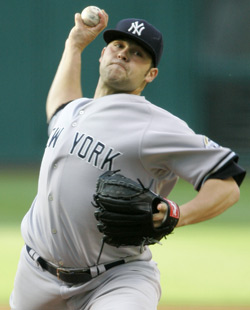 JOBA CAN PITCH THE EIGHTH — AS A STARTER
And that’s all I have to say about that. He won’t get there in most starts, of course, but the point is that if he is capable of this kind of upside, the Yankees owe it to themselves to keep running him out there until he gives some definitive reason that he can’t. The performance of OTHER pitchers, like the eighth-inning relievers, have nothing to do with him. The bullpen is its own problem with its own solution set. You don’t take a pitcher who is capable of giving you 21 or even 24 outs a night with an ERA below 4.00 out of the rotation because you can’t find another guy who can give you three, no matter how “important” the spot. That’s idiotic. All of the outs are important. We just perceive protecting late leads to somehow be a bigger deal than holding the opposition scoreless in the first or the third or the sixth, but a run is a run is a run, and you never know which one is going to beat you. More to the point, you can’t protect leads you don’t have, and a strong starting pitching staff is the tool that is most likely to buy you the time to generate that lead. Secondary point: It’s much easier to find a guy to give you three outs than it is to find the one that will give you 21, even if the Yankees are having trouble finding that guy right now.
And yet another point, one that I alluded to yesterday: As good as Chien-Ming Wang has been as a starter in his career, his stuff and approach do not correlate with long-term success. I don’t care if you have a sinker so heavy that Superman can’t lift it — eventually the lack of strikeouts, the lack of a solid inner defense, or both is going to eat you alive. In Wang’s case, his injury of last season may have altered his delivery, stuff or strength in a minute way, hard to perceive with the naked eye, but significant enough that he can no longer balance on the point of a needle the way he used to. Putting him in the bullpen, while perceived by many fans and commentators as a waste or an insult of some kind, may in fact allow him to make changes in his approach that will save his effectiveness and ultimately his career. A Wang who isn’t worried about marshalling his stuff and can throw harder over a shorter span of time while still getting groundballs may be able to get outs in a way that a six- or seven-inning version of Wang can no longer aspire to.
Right now, there’s no reason for the Yankees to make a change except that some people are arguing for it. Wang is pitching well in the bullpen, they say, so let’s make him a starter. Chamberlain is pitching well as a starter, so let’s make him a reliever. That way lies madness.
Parenthetically, I was pleased that Joel Sherman made very much the same argument I did yesterday about using Mariano Rivera in a tied game on the road. Within that piece there’s also a promising note about the Yankees vowing not to resign Hideki Matsui after the season, 100 percent the correct decision.
Why Veras, and why not Joba the starter?
 OPENING PUNCH
Is Jose Veras still on the roster? If so, why? Please answer in complete sentences, then exchange papers with your seatmate and discuss.
AS THE JOBA TURNS
As Joba pitches tonight, and the Joba to the Bullpenites sharpen their runcible spoons, whether the lad pitches a no-hitter or gets torched, please keep in mind that Rome (famed Three-I pitcher Jimmy-Bob Rome) was not built in a day. At 23, Chamberlain is allowed some inconsistency before he finds himself, and the long-term gain is worth the short-term pain. The Yankees can find solid eighth-inning relief without sacrificing such a useful starting asset. In fact, though a great deal has been made of Joba’s shortened outings, I would argue that a dominant five-inning starter is worth the added strain on the bullpen — Joba’s not there yet, but I wanted to throw that out there. Very few starting pitchers, even the Hall of Famers, achieved instantaneous consistency in the Majors. This is an obvious point, but one that bears repeating (and repeating).
As for Sunday’s loss, which some have wanted to attribute to the lack of a Joba type in the pen, allow me to do them the service of pinning the Medal of Failure where it belongs: on the manager and conventional thinking. You know the culprit: the resistance to using Mariano Rivera in a tie game on the road, saving him for a save opportunity that the other pitchers and the offense may never create. The fallacy is in thinking there is no save opportunity in such situations.
That is a complete misreading. The “save” is in allowing the game to keep going. On the road from the ninth inning on, every time the home team bats you’re in a sudden death situation. You want your best arm out there to keep the game alive, not the worst. If Rivera pitches an inning on Sunday and holds the Indians scoreless, the Yankees get to bat in the top of the 10th. Maybe they score one run and then they have to think about keeping Rivera in or going for another pitcher. If that pitcher blows the lead, at least you got to play that long. Alternatively, maybe you score 10 runs in the top of the 10th and a closer is no longer relevant. With the Indians’ messy bullpen, that outcome is a realistic possibility, and now you’re up by so many runs that even Nick Swisher could finish out the game for you.
The loss on Sunday wasn’t about the wildness of Dave Robertson and Phil Coke, but about the fact that they shouldn’t have been there in the first place, not when the Yankees had a better option. Yanking Joba out of the rotation to cover for a failure of thinking makes very little sense.
In our next sermon, we’ll explore why Chien-Ming Wang the reliever may be a completely different animal from Chien-Ming Wang the starter, and how equating the two could lead one to misinterpret his strong relief pitching as an argument for a return to the starting rotation.
MOOSE VS. THE GUY WITH THE BAT
Made the mistake of listening to sports talk radio on my way to the dentist today. One topic was the comparison of Juan Marichal and Mike Mussina, the former a Hall of Famer who never won a Cy Young award. This comp was made out to be a terrible insult to Marichal, but (1) this was overly concerned with the pitcher’s won-lost totals, which are external to the pitcher and a function of when Marichal pitched — if you don’t acknowledge that it was easier for a good pitcher to win 20 games in Marichal’s time than it was for Mussina in his then you’re not being fair; you might as well ding Marichal for the fact that he never won 30 games, but Lefty Grove and Dizzy Dean did, and (2) misses other differences between the 1960s and the 1990s — adjusted for context, Marichal and Mussina had almost exactly the same ERA.
MORE FROM ME
Wholesome Reading has lots of additions from over the weekend, with more coming throughout the day.
The around (and about)
 Red Sox 8, Blue Jays 2: A comeback start for Jon Lester, with the lefty striking out 12 in six innings and allowing just one run on three hits and a like number of walks. On May 18, the Jays were in first place, 3.5 games up, with a record of 27-14. Since then, thanks to a nine-game losing streak, they’re 2-10. Reality bites — hard. Next up for the Red Sox: at Tigers. Next up for the Jays: hosting the Angels. It should be another good week for the Yankees, assuming they can win a few. Notice was paid to Terry Francona shaking up his lineup, a cosmetic change that sometimes leads to a seemingly psychological boost.
Tigers 3, Orioles 0: You have to feel for the Rays, who would be far more competitive with Edwin Jackson (eight innings, two hits, no runs, 2.30 ERA) on their team, but they made an economic decision they have to live with. The Rays have enjoyed the highest increase in per-game attendance this year, but that only means they rank ninth in the league instead of 12th. Thus are pennant races determined — it’s not just smarts, but also what you have in the bank, with perhaps the latter outweighing the former. The Tigers continue to allow the fewest runs per game (4.31) in the league, which allows them to win even on days like Sunday when Jim Leyland benched some key regulars. Bonus: Fernando “Caesar” Rodney has been an effective closer. Orioles’ silver lining: two good starts for rookie Jason Berken, though it probably doesn’t mean much in the long term. Luke Scott went 0-for-3, ending a rather ridiculous May in which he hit .432/.479/.1.000 in 13 games sandwiched around a DL stay.
Twins 3, Rays 2: In which the Rays give up the decisive run on a little looping liner over Ben Zobrist’s head. Former Yankee Sean Henn picked up his first hold of the season in this one. The Rays have the No. 2 offense in the AL, the Yankees No. 1. Both found on Sunday that sometimes you just don’t get the safeties when you need them. It happens.
White Sox 7, Royals 4: The Pale Hose are just one game below .500, and with a visit from Oakland up next, they’re likely to get back over in the short term. Define “short term” as until they host the Tigers for five games in four days a week from today. Less than 20,000 in KC to see Zack Greinke pitch against John Danks. Shameful.
Athletics 5, Rangers 4: On October 13, 2002, Adam Kennedy hit three home runs in the fifth game of the ALCS against the Twins. Yesterday he popped two against the Rangers, including the game-winner, bringing his season rates to .390/.462/.622 in 21 games. This from a fellow who wasn’t even in the Majors to start the year after having been thoroughly mediocre for the last six years and for the bulk of the rest of his career. This has always been the mystery of the player was the first-round pick of the Cardinals way back in 1997: on some days, he can be the guy he was in that playoff game, or was yesterday. On most days he can’t, but everyone knows he can. Hence the frustration.
Angels 9, Mariners 8: The M’s had this one in the bag until they actually had to pitch. That part didn’t work out too well. Six unanswered runs in the first three innings should have made the rest academic, but the Angels worked away and David Aardsma buckled in the ninth. Comedy relief included Ichiro Suzuki going 4-for-5 with a couple of doubles and a home run to raise his rates to .354/.386/.454, his 24th straight game with a hit. If Ichiro keeps this up, 2009 will be one of those years where Mr. Mariner lives up to his rep. Average during the streak: .406, three home runs in 106 at-bats.
Mets 3, Marlins 2: It’s not often you see a pitcher exit a shutout because he really, really has to get to the bathroom….
Astros 2, Pirates 1: Sixth save of the season for LaTroy Hawkins, backing Mike Hampton, as the Astros team up for a win out of 2001 or 2004 or any other year when Hampton and Hawkins were vaguely healthy and effective and people had more money than they do now. That would probably rule out 1893, what with the panic and all. Andy LaRoche in May: .330/.411/.457, now hitting .299/.371/.420 overall… The Pirates recalled Steven Jackson today. We’ll see if Joe Girardi erred in not getting the guy into a game before the Yankees cut him loose.
Phillies 4, Nationals 2: Methuselah Moyer wins No. 250, and may he win 250 more. Josh Willingham popped two for the Nats, and it’s hard to visualize his still doing double-duty as a Senate page after the trading deadline. If the Nats play one game above water the rest of the way, they would finish at 70-92. Their next series, at home against San Francisco, offers an interesting contrast, the pitching impaired versus the hitting impaired. My money is on the latter.
Brewers 5, Reds 2: Fifteen games in now and Trevor Hoffman still hasn’t allowed a run, and closing out this one allowed the Brewskis finally to pass the Cardinals and take first place. Mike Cameron popped home run number eleven, and his power is an important component of what’s been working for the Brewers. A bit unexpected, too: Cameron is hitting .284/.379/.550, and he’s never touched those numbers in a full season. Craig Counsell since Rickie Weeks went down: 11 games, 50 PA, .306/.320/.306. Anyone spot the problem here?
Padres 5, Rockies 4: A change of managers is a superficial patch for a team that can’t hit. Adrian Gonzalez blasts No. 20, leads the NL in home runs. If a player from that team in that park leads the league for the season, it will have been a minor miracle — 15 of the 20 have been hit on the road. Since joining the Padres, Gonzalez has hit .268 with a home run every 24.5 at-bats at home, .305 with a homer every 14.9 at-bats on the road. With a contract that calls for $3 million this year, $4.75 million next year, and $5.5 million the year after, he should be the most desirable trade possibility in baseball right now. Not only is he cheap, but if the acquiring team plays in a fair park and gets 250 post-trade at-bats, they could get 15-20 home runs out of the bargain.
Giants 5, Cardinals 3: When the starting pitcher (Adam Wainwright) has an off day, the Cards lack the offensive heft to counterpunch. This team desperately needs a bat. When I see “Wainwright,” I can never help hearing, “General Wainwright is a right guy.” And if you know what that refers to, you’re either pretty old, a history buff, or both. Here’s a toast to General Wainwright’s guys, holding out on that island (and after), real American heroes.
Braves 9, Diamondbacks 3: Garret Anderson hit his first home run of the season, raising his rates to .266/.294/.358. Kelly Johnson has hit in seven of eight games, batting .342 with seven doubles, a triple, and two home runs. No walks, though. Seems like it was at this time last year that I was wondering where Johnson left his walks… The real news of the game was Kris Medlen’s very solid start and a rare poor one by Max Scherzer.
Dodgers 8, Cubs 2: Over in the first inning, with former home run machine Eric Milton holding the Cubs in check. That’s not the feat it used to be, of course. Rafael Furcal is batting .245/.308/.304 with three stolen bases in six chances. When do you think Joe Torre drops him out of the No. 2 spot? My guess is never… As I typed these words, a John Mellencamp song came on the XM and I actually liked it. I’m shaken to my core. I was fooled by the long instrumental opening, I swear! Excuse me while I go look for some strong, abrasive soap….
Three pitchers, two rotation spots
 BEWARE THE SWINGMAN
Chien-Ming Wang, Joba Chamberlain, Phil Hughes. Three pitchers for two rotation spots. Each time one pitches well, or pitches badly, or pitches at all, the argument starts up again as to how to best dispose of each of them. The drumbeat becomes insistent, as if there had to be an answer right now, as if there’s a switch for each player, with position A “starter,” and position B, “bullpen,” and as long as the switch is hovering between the two something is not right in the universe.
In truth, there is a third setting, “neither,” which worked for baseball for years and year, in an era in which a stifling uniformity hadn’t removed the possibility for all creativity or initiative in the way teams are run and constructed, before a self-defeating overspecialization of relief pitching had caused Major League staffs with detritus that would previously never have escaped the minors. Players objected to the uncertainty and the suppression of their individual numbers, but the Yankees won approximately 14 pennants by keeping that switch in neutral.
With more quality pitchers than they had rotation spots, Yankees managers Joe McCarthy and Casey Stengel planned a more complicated pitching staff, using certain pitchers against certain teams, skipping the lefties in Fenway Park, or going out of their way to use them in Detroit, letting them rest against the clubs that hit them well. It worked terrifically. The 1939 Yankees, on the short list for greatest team of all time, used nine starters. Red Ruffing and Lefty Gomez largely stayed in rotation, but every once else swung between the rotation and the bullpen. Only Ruffing threw more than 200 innings, this in a season where the league leader in innings pitched came in just under 300. Most of those pitchers found out they were starting when they reached the clubhouse and found a ball under the cap in their locker.
In the 1950s, Casey Stengel initially had a rock-solid rotation fronted by the famous trio of Allie Reynolds, Vic Raschi, and Eddie Lopat, augmented by Tommy Byrne, and soon joined by Whitey Ford. Starts were distributed in a fairly standard manner. As those pitchers faded, the rotation became more elaborate. In 1953, the world-champion Yankees had only one pitcher, Whitey Ford, make 30 starts. Twelve other pitchers took turns. The 1954 rotation is like a Jackson Pollock painting. In most seasons thereafter, the Dynasty staffs look a lot like that of 1939, with two pitchers — usually Whitey Ford and somebody — staying in rotation and everyone else being called upon as needed. In 1958, Ford made 29 starts, Bob Turley made 31, and no else made 20. Ford and Turley both pitched over 200 innings; no one else pitched even 140 innings.
The insight here is that some pitchers are better in 150 innings than they would be in 200, but would be wasted throwing only 80 innings out of the bullpen. Thus you have a sixth starter, or a seventh. Present-day baseball doesn’t have a place for that kind of pitcher, though Joe Torre did have one for awhile in Ramiro Mendoza. Everyone is a specialist, either a starting specialist or a relief specialist. That’s fine for some — you want to get every inning you can out of CC Sabathia — but as for almost everyone else on the planet, one-size-fits-all solutions, or even two sizes, are too limiting.
Now, in the interest of full disclosure, here’s what I don’t know in presenting this argument:
1. How changes in the schedule affect a team’s ability to play fast and loose with its pitchers.
2. How changes in pitcher usage affect a team’s ability to swing their pitchers.
3. The impact of swinging on pitcher health.
4. Whether the pitchers would stage an outright rebellion over such variable usage.
Factor #2 is of particular interest. The complete game is now virtually dead. While the great Yankees managers, particularly Stengel, were willing to go to the bullpen as necessary, they were still far more likely to let a starter finish up a game than any manager would be today. Just pitching a year at random, the 1958 Yankees threw 53 complete games. This was just a bit above average for that season. Last season, the Yankees had one. This means that while McCarthy or Stengel could anticipate that roughly once or twice a week nine of their ten pitchers would get a complete rest, meaning the swingers who recently started wouldn’t be called on to relieve, thereby allowing them to rest or leaving them available for the next spot start. That is obviously impossible today.
Assuming that these factors can be dealt with, or safely ignored, the Yankees really don’t need to be making aggressive decisions about Wang, Chamberlain, or Hughes short of just doing what seems most productive on a day-by-day basis. That any of them have a specific role on the team should be of greater interest to the pitchers themselves than a dispassionate Yankees management. That means that any of them could be a starter, a reliever, or both. Remember, just because things are presented as they way there are doesn’t mean they’re the way they have to be. Pitcher usage in baseball has always been highly mutable. We haven’t yet reached optimal usage, and in some ways may be running away from it. Those saying that the Yankees are not using their pitchers the right way need to stop being so dualistic and realize that there is no right way, only the way they’re being used right now.
MORE FROM ME
Wholesome Reading continues to be wholesomely updated with new entries, and will be throughout the weekend. Warning: politics!
A pinstriped win, no matter what
NO MATTER WHAT
HAPPENS, IT’S GOOD FOR THE YANKEES
The next two weeks are going to be a fascinating, possibly
decisive time for the Yankees. First, they should have Jorge Posada back on
Friday, which means they’ll have something like their full offensive complement
for the first time all year–Brett Gardner
substituting for Melky Cabrera for the next several days
notwithstanding, though Brett is actually out-hitting Melky in May,
.357/.449/.619 to .321/.348/.429, so you can’t say the lineup is suffering too badly
for his absence.
The Yankees then take their reconstituted offense into
battle against the Indians, a team that’s no pushover but has real pitching
problems–even during their recent little winning streak, they were pounded more
often than not. Following four games at Cleveland,
where the Indians are 10-11, they go home for three against the Rangers, a
dangerous team but one that is not nearly so dangerous on the road due to their
low on-base percentage. Yes, their power hitters are going to knock a few balls
out of Yankee Stadium II, but so will the Yankees, and they should have more
runners on when they do so.
The Rangers are followed into New York by the Rays, 12-16 on the road and
suffering from a rapidly unraveling pitching staff. After that series, the Yankees go to Boston, where they get another chance to make
some kind of statement against the Red Sox. Before the Red Sox get to that
point on their journey, the Sox have three games at Toronto, which means that no matter what
happens, one team next to the Yankees in the standings will be losing. Then it’s
off to Detroit,
where the Tigers are a tough 15-7 and currently lead the American League in
lowest run average. Finally, they entertain the Rangers at home while the
Yankees are grappling with the Rays. This could be the moment where the Red Sox
see the race slipping away. Their starting pitching is surprisingly poor. Josh
Beckett has now had five straight quality starts, but there are still problems
beyond him, like getting Daisuke Matsuzaka under control, Jon Lester fixed, and
figuring out how to get rid of Brad Penny so one of the kids can come up and
presumably have an ERA under 6.00. They have let David Ortiz kill them all
season long, and replacing him is going to be a painful and divisive thing to
do. This organization is endlessly resourceful, and they won’t just fall apart,
but they have real problems right now.
As for the Jays,
after the Red Sox, they host the Angels for three and the Royals for three,
both winnable series but neither sure things, followed by four games at Texas, which won’t be
easy at all.
THE BULLPEN: A QUICK
WORD
Remember Larry Andersen for Jeff Bagwell. Better by far to
give Mark Melancon a long look before dealing the farm for a Jose Veras
replacement.
MAKE IT STOP!
Are we done with Angel Berroa yet? Has anyone yet explained
his purpose? Does he have incriminating photos of someone?
It’s a small thing, a very small thing, the 25th
man, but then, remember what Joe Torre did with Homer Bush in 1998. Flexibility,
or for that matter a useful hitter off the bench, would allow the Yankees to
win more games. This would seem… obvious.
THE AROUND (AND
ABOUT)
Giants 6, Braves 3:
Randy Johnson threw six strong innings for victory No. 299 (one run, three hits,
no walks, five strikeouts). You’d rather not see him back into 300, and some of
his recent starts have been rough. He’s an amazing physical specimen: in 52
innings, he’s got 54 strikeouts, 9.35 per nine innings. The man is 45 years
old, and there are many, many 25-year-olds who don’t get that many batters to
swing and miss. Only 12 pitchers have thrown as many as 100 innings in a season
at Johnson’s age or older. At 45, Nolan Ryan struck out 8.98 batters per nine
innings. Phil Niekro struck out 6.10 as a 46-year-old Yankee in 1985. There
have been five geriatric seasons in the 5.00s, including Satchel Paige’s 5.93
in 1952. (Paige was a lot further above his league average than Niekro was
above his.) Johnson has the second-largest differential between his rate and
the league strikeout rate after Ryan.
Angels 3, White Sox 1:
Everyone pitched well, even Gavin Floyd and someone with the last name of
“Weaver.” These things happen. In fairness to the last-mentioned, he currently
ranks second in the league in ERA, about a run and a half behind Zack Greinke.
Obligatory former Yankees watch: Bobby Abreu went 2-for-3, as did Juan Rivera,
who is now batting .293/.335/.415, which is kind of like current Brett Gardner,
but without the speed and defense or the promise of improvement.
Padres 8,
Diamondbacks 5: After a miserable, miserable, rehearsals-for-retirement
start, Brian Giles has hit .295/.407/523 over his last 14 games, throwing in
nine walks. It’s something, though 14 games is hardly definitive. Good to see
the Padres bounce back over .500 after their recent winning streak was
terminated; usually a fringe team that starts acting dominant for a couple of
weeks will quickly demonstrate the way gravity works (as in, what goes up must
come down).
Twins 4, Red Sox 2:
Solid work all around by Twins pitching in this one, including three innings of
scoreless relief, 1 1/3 by Jose Mijares, a rookie lefty with a
ninth-inning-worthy fastball-slider combo currently working the middle frames…
Another two-hit day for Ellsbury; if you get your batting average up high
enough, eventually it won’t matter if you don’t walk or hit for power. Said
batting average is higher still than your current .307; see Dernard Span–the
difference is a few more extra-base hits and about 14 more walks in exactly the
same amount of playing time.
Mets 7, Washington 4: A
wild, wild night for Johan Santana, who still seems on pace to win that elusive
third Cy Young award. Three straight wins for the Mets with a lineup that for
the Yankees would be missing Derek Jeter, Johnny Damon, and Jorge Posada. It’s
the Nats, of course, so thank the Lords of Good Timing, but all credit to the
Mets for being able to execute… And Daniel Murphy, who banged a home run off a
rather idiotically placed sign.
Reds 6, Astros 1:
Seventh straight loss for the Astros, who are starting to get to the place
where a 100-loss season becomes a real possibility–something that has never
happened in what has been a generally successful franchise despite never having
had a champion. From 1969 through last year, the club had won 175 more games
than it had lost… It’s not clear who they can trade, as the few exciting
players are signed to outsized contracts, and they have no impact-level
prospects, so the journey of the ‘Stros, not just through the rest of this
year, but into the next, is going to be an interesting one. As C-3PO said,
there’ll be no escape for the princess this time… Remember I was talking about
Phil Hughes and quality start percentage a couple of days ago? Bronson Arroyo
is at 60 percent, but his ERA is over 5.00–in his three losses, his ERA is
13.83.
Indians 12, Rays 7:
The Rays continue to lead the AL
in runs scored per game, but their pitching is like Cerberus’s chew-toy. That
they are hitting so well despite their injuries and a B.J. Upton who ranks as
one of the most futile hitters in the biz is amazing. The regression of the
hurlers is less so, and was widely predicted, though I for one was not so quick
to believe it. I certainly had higher hopes for control artist Andy Sonnanstine,
who has not been so controlling this year. As we saw with Ian Kennedy, a
similar pitcher last year, this model of hurler is either all right or all
wrong–their (lack of) stuff doesn’t allow for a middle ground. The good news
for the Rays is they have some alternatives, such as David Price (now up with
the club) and Wade Davis (not yet).
Marlins 6, Phillies 2:
Sometimes even the champions lose to a pitcher named Burke Badenhop, though not
often. Forty-five thousand watched this one at Philadelphia, and as Casey Stengel liked to
say, the attendance was robbed. If Ryan Howard was hitting better than
.227/.303/.455 (four home runs, 88 at-bats), they’d at least have more to talk
about during these Badenhop bow-downs.
Mariners 6, Athletics
1: Nomar Garciaparra heads back to the disabled list. Just thought I would
point out the biggest non-news of the day. I’d also like to point out that
Mariners infielders are hitting .236/.280/.375 as a group, and that’s counting
Russell Branyan. With his fourth cought stealing, Ichiro equals his total for
all of 2008.
Dodgers 8, Rockies 6:
Andre Ethier had better hurry and find his stroke, because if Juan Pierre is
still hitting .400 when Manny comes back, even I’m going to have a hard time
arguing that he should be benched–that Pierre has allowed the Dodgers to feel
so little pain over Ramirez’s banishment is one of the stories of the year. The
story of the game was that Joe Torre’s pen bent but didn’t break.
Cubs 5, Pirates 2:
Notable mainly for Carlos Zambrano’s ejection-worthy explosion and the
relocation of the Cubs to a game over .500.
Tigers 8, Royals 3:
Another strong start for Rick Porcello, though the low strikeout rate is still
troubling. Kyle Farnsworth threw a scoreless inning in the loss, his usual spot
for scoreless innings.
Orioles 12, Blue Jays
10: Add Nolan Reimold to the list of possibly invigorating youth the
Orioles are now playing with–next year, the AL East could be an even more
difficult place to win a pennant than it is now, though pitching is still going
to be a problem by the Bay. As for the Jays, by the All-Star break we’re not
going to remember they were ever in the race.
Cardinals 3, Brewers
2: In which the Cardinals take control, largely due to their busy bullpen,
though Todd Wellemeyer was solid for five. You wonder if LaRussa’s hardworking
relievers can keep up the pace for the rest of the year, though to be fair he
has spread out the work… Albert Pujols has just one home run in the last two
weeks.
MORE FROM ME
Wholesome
Reading
continues to be wholesomely updated with new entries, and I’m about to start an
argument with a commenter. Warning: politics!
Too many double plays
LET’S KILL TWO!
If the Yankees hitting into three key double plays on Tuesday night bugged you, if you were awake to be bugged, then know that it’s about par for the course for these Yankees, who have gone for the two-outs-on-one-swing sale in about 11.6 percent of their opportunities this year, the seventh-worst rate in the majors this year. The Mariners lead the majors, hitting into a double play in 13.6 percent of their chances. This is kind of amazing, as the Mariners also have the lowest on-base percentage in the majors. They reach base less than anyone else, then kill the few runners they get faster than anyone else.
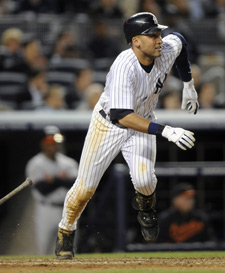 What’s fascinating about the Yankees’ poor performance in double play situations is that for the most part, it’s not the regulars who are doing the damage. This year, the average AL batter is hitting into a twin killing 10.6 percent of the time (the NL rate is almost exactly 10 percent). For example, Derek Jeter has hit into four double plays in 25 opportunities, which is 16 percent. That looks bad, but it’s not, really — one fewer and he’d be right at the league average. The same goes for Melky Cabrera, who has also pounded into four DPs in 25 chances. Brett Gardner, with two in 17 chances, is at the league average, which is surprising given his speed, but less so when one considers that he hits more ground balls than any Yankee except Derek Jeter. The worst Yankees regular is Robby Cano, who has hit into five in 28 chances, or 17.9 percent, but again, that’s not a horror-movie number — Geovany Soto and Mike Lowell are at 30 percent in a significant number of chances (29 and 40, respectively). Several Yankees have actually done a terrific job at staying out of the double play. Nick Swisher, last night’s DP villain, has hit into only two in 33 chances. Johnny Damon has only two. Hideki Matsui and Mark Teixeira are both around six percent.
It’s actually the guys who haven’t played much, or played too much due to injuries, that are driving the Yankees’ into a high number of twin killings at bat. Together, Cody Ransom, Xavier Nady, Kevin Cash, Angel Berroa, Jose Molina, and Francisco Cervelli have hit into 11 double plays in 44 chances, or 45 percent. There’s not much that Joe Girardi can do to address the situation except not play those guys — he already calls as many or more hit-and-run plays as any manager in the game. Unfortunately, he hasn’t always had the choice not to play them, and the existence or continuation of Ransom, Cash, Berroa, and Molina as Yankees was the general manager’s call — but now we’re away from talking about the double play and once more in the realm of depth, so never mind.
In the short term, it’s little consolation that the Yankees blew a chance to take first place in part because of missed offensive opportunities, but at least you can be sure that it was a bit of a poorly timed fluke on the part of two of the three. There’s also an “on the other hand,” which is that when Jorge Posada comes back the team’s double play rate will actually pick up, because Posada runs like the 37-year-old catcher he is. Fortunately, Posada does other things with the bat that more than make up it. You can’t say that about the 11-for-44ers above.
THE AROUND (AND ABOUT)
Orioles 7, Blue Jays 2: Just over 10,000 showed up at Camden Yards to see the Orioles deal the Jays their eighth straight loss. During the streak, Jays batters are hitting .251/.306/.331, which is very bad but isn’t too different from what Padres hitters did during their recent winning streak. Of course, the Padres had great pitching, whereas the Jays have allowed nearly six runs a game. No doubt you’ve heard that Matt Wieters finally comes up on Friday. With Wieters, Adam Jones, and Nick Markakis the Orioles are finally changing, and none too soon… I’ll talk more about Wednesday’s game in our next entry, but it should be noted that the Jays dropped their ninth straight to the Orioles in daytime action, the pen being unable to follow up Roy Halladay’s strong start. The Jays are now just four games over .500 and the division is wide open.
Mets 6, Nationals 1: The Nats DFA’d Daniel Cabrera. As Bill Ladson reported at MLB.com, GM Mike Rizzo said, “I looked at the execution of the performance and it wasn’t up to par. I was tired of watching it.” You have to appreciate a candid GM. Among other things, this should inoculate the Yankees from having to face the spectacularly tedious Mr. Cabrera during interleague play (as Bob Uecker said in “Major League,” “Ball three… Ball four… Ball eight…”). Adam Dunn homered again… Just sayin’. Another home run for Gary Sheffield, and he’s now batting .291/.430/.535. Talk about getting something for nothing, and a needed something now that the Mets are in the position of having to play 20-year-old prospect Fernando Martinez, who hasn’t actually looked very prospect-y in years.
Reds 6, Astros 4: Another three-hit night for Miguel Tejada, but that was most of the fun as Roy Oswalt is no longer the lucky rabbit of yore. Among the most unexpected events in baseball this season: a Laynce Nix renaissance in left field for the Reds, which is kind of like a Rod Stewart renaissance taking over for the late Joe Strummer in a Clash reunion tour. It’s just not something you’d ever think about.
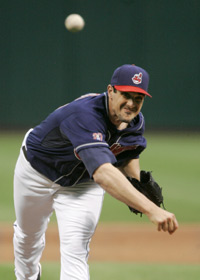 Indians 5, Rays 1: Can’t tell a lie — Carl Pavano killed. Four Indians hit home runs, three of which probably shouldn’t have been in the lineup, but sometimes you win with your worst foot forward. Both of these clubs lost key players yesterday, with Jason Bartlett hitting the DL with a sprained ankle, and Grady Sizemore may take a seat with a left elbow that’s feeling poorly. The Indians shuffled Matt LaPorta off the roster to get another center fielder up to the bigs, so my criticism of them yesterday was in error.
Phillies 5, Marlins 3: The much-denigrated (at least by me) Joe Blanton had one of the best starts of his career, shutting out the Marlins for seven frames, striking out 11. That has far more to do with the Marlins with Blanton, as their defining characteristic as an offense is the strikeout. Make that double if Hanley Ramirez’s groin sidelines him for more than 30 seconds.
Cubs 6, Pirates 1: Cut short by rain, and you can expect that Lou Piniella danced in it, maybe more like Roger Daltrey closing out “Quadrophenia” than Gene Kelly — this win got the team that was going to end the 100-year-old dry spell to the break-even point. Elements of the Cubs that haven’t disappointed this year: Kosuke Fukudome, Ted Lilly, Johnny Evers. Evers in particular has done exactly what was expected of him.
Cardinals 8, Brewers 1: The Cards are pitching at about 20 percent above league average, the mark of not only a good pitching team, but a staff on the verge of having a great season. Whether the Cards can improve that much more I don’t know, but in this division they might not have to. Extra-credit to Adam Wainwright for his solo home run, thereby batting in as many runs as he allowed in seven innings.
Twins 5, Red Sox 2: One of the season’s great flukes — Nick Blackburn striking out seven Red Sox. Blackburn never strikes out seven anybodies. Jacoby Ellsbury has a 21-game hitting streak going, during which he’s batting .333/.366/.417. During the streak, he’s stolen 10 bases, been caught four times, and has driven in four runs.
Royals
6, Tigers 1: How does Jose Guillen have a .412 OBP? Not “how”– that’s like asking where babies come from–I mean, “Why?” …KC shortstops, principally Mike Aviles (now on the DL) are hitting .183/.214/.250 this year. With anything from the position, they might be leading the division right now. It also hurts that David DeJesus is having the worst season of his career. Haven’t mentioned another fine Zack Greinke start, and I won’t, except to say that for some, “potential” is a curse. It’s grand to see someone survive it.
Dodgers 7, Rockies 1: And there was much gnashing of teeth in Denver given the club’s .400 winning percentage, or maybe it was just losing to Eric Milton (and congratulations to the former Yankees’ draftee for making it back). Andre Ethier in May: .190/.298/.266, following up a .306/.423/.553. Shades of Melky ’08! That’s not to suggest that Ethier won’t be back, but that Melky should have been, or maybe that we just don’t know what turns a hitter on or off–the recipe is probably something like one-third mental, one-third physical, and one-third luck (sprinkle lightly with shredded cheese, serve over pasta).
Diamondbacks 6, Padres 5: Thus endeth the Padres’ winning streak, as Max Scherzer strikes out 10 in seven innings… Mark Reynolds is just off of last year’s 204-strikeout pace; he’d finish with 202 in the same number of at-bats. Scherzer is only 2-7 in his brief major league career, but his ERA is 3.21, and he’s K’d 119 in 106.2 innings. Of the current roster, Scherzer and Justin Upton will be part of the next great ‘Backs team, but you can’t be certain of anyone else. At .173/.220/.313, Chris Young has to be one of the biggest failures to launch in recent baseball history, a kid who came up with all the tools but didn’t develop a centimeter from where he started.
White Sox 4, Angels 2: Big day for the Nix family, as Jayson hit two home runs to go with Laynce’s one. What is it with that family and the letter “y?” Big Scrabble fans? Bart Colon’s win pushed his quality start percentage up to 33 percent, still well below average… Bobby Abreu hit his first home run of the season.
Athletics 4, Mariners 3: The A’s did all their scoring in one frame, Jason Giambi driving in two runs on a single as the Seattle pen tossed away six shutout innings from Jarrod Washburn. With Kenji Johjima off for a long stay on the DL, the M’s didn’t call up Jeff Clement, batting .309/.382/.533 at Triple-A Tacoma. The guy has his limitations — he’s an offensive catcher with a big swing — but given that the M’s are by far the worst offensive club on the circuit , you’d think they would go for a little more offense. Oddly, for a team that can’t hit, the Mariners have tried the fewest hitters in the American League. They’re standing pat, even though their lineup looks a lot like that of the ’54 Pirates.
Giants 4, Braves 0: And nothing to say about it except, “Lincecum!” Also, every time I load up the news on the Internet, there’s something about “Jon and Kate.” I have not the foggiest who they are, and don’t think I’m going to try to find out. Jon, Kate, Bread, Circuses — there are bigger fish to fry, like baseball (?).
 Pinstriped Bible