Category: Dailies
Much ado about nothing
 Via mlb.com:
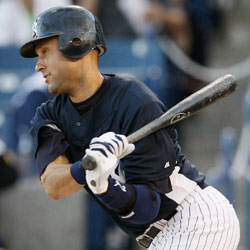
Girardi said Thursday that he will use the rest of Spring Training to try out Derek Jeter as his leadoff hitter and move Damon to the No. 2 hole, believing that the Yankees may have accidentally happened upon something to increase production.
Probably not, Joe. Assuming something like consistency out of both hitters, the main change will be that, if you persist with that batting order through all 162 games, Jeter will bat about 20 more times than Damon. The lineup synergies don’t really exist, although there could be a placebo effect. The fun thing about this decision is that we will now get into the “after, therefore because” territory of logical fallacies. If Jeter hits .350, some people will cite the move as a reason. If he hits .250, the move will be the reason too. In the former case, he’ll be getting more fastballs. In the latter, he’ll be trying too hard to work the count. The same thing will go for Damon, and for the offense as a whole–if the Yankees are more potent this year, it will be cause of this change. It almost certainly won’t be, and if you think about it, there’s no reason that it should be–why should flipping one spot in the batting order lead to a vastly different outcome? It’s like saying that if you fry an egg with your left hand on the skillet instead of your right, the egg will taste better. It’s an insignificant change.
It is with matters such as this that we keep busy during our time here on planet Earth.
SO IS IT GARDNER?
Yesterday, Ken Rosenthal reported that the Yankees “appear open to moving Cabrera.” This would seem to be an amazing bit of non-news, but if accurate, it does suggest that Brett Gardner will get the bulk of center field time going forward. Meanwhile, Cabrera is having a fine spring–in today’s game he went 2-for-4 to raise his batting average to .313 and also swatted his first home run (as did Nick Swisher, but enough about that). Melky’s skill and tool set is such that he’s going to have to hit over .300 to contribute, and if you believe he can do that in the regular season, grand. Be aware, however, there are very few true .300 hitters. Even for those batters who often reach the mark, there is a lot variance in there–some years of .285, which in Melky’s case would not be all that valuable, some years of .310, which would be. You end up taking the good with the bad with batting average-based players.
There are some teams who are so poor in the outfield that it makes sense for them to take a look at Melky’s spring, believe a little in spite of themselves, and take a flier on catching a rebound year. The Yankees are not in that position–they have better choices in Gardner and even Swisher. It now falls to Brian Cashman to figure out which teams are window shopping (the White Sox?) and see if he can get them to give up a bit more than they would prefer.
OFF TO RUTGERS
Tonight at 6 PM. Scroll down for details; hope to see you there.
Remembering Johnny Blanchard
 FAREWELL, JOHNNY BLANCHARD
Johnny Blanchard had a tough road to the Major Leagues with the Yankees. Three things got in his way: Yogi Berra, Elston Howard and the United States government.
The lefty-swinging Blanchard turned pro as an 18 year old in 1951, and broke out the next year at Joplin, batting .301 and leading the league with 30 home runs and 112 RBI. It seemed like the Yankees had another potential impact player on their hands, but at that moment the military swooped in and claimed Blanchard for two years. These would be two crucial missed years in his development, as the Yankees were in the process of deciding if Blanchard was an outfielder or a catcher, and Blanchard could have used the time to cement his backstopping skills.
Instead, with the gap in training and the roadblocks that were Berra and Howard, Blanchard spent his time in the upper Minors both catching and playing the outfield — in the Majors he would prove to be a Casey Stengel-style super-sub, not only catching but playing first base, left field and right field as well. Though Stengel would only have Blanchard for parts of two seasons, and there was less room in Ralph Houk’s scheme for such players than there was in Stengel’s, the Old Man might have gotten Blanchard 400 plate appearances a year. Houk got him about 250, and it’s very difficult for a player to achieve any consistency in such sporadic playing time.
After his hitch, Blanchard picked up where he left off, at least offensively, batting .281 with a league-leading 34 home runs for Binghamton of the Eastern League in 1955. He got a brief call-up that September, but he seemed to stagnate a bit at that point. A return to what was essentially the Double A level at Birmingham didn’t do anything for his development, and a two-year stay at Denver in the American Association, while superficially productive, don’t impress given what we know about playing at altitude. The Yankees were seemingly not impressed either, or felt that with Berra and Howard there was simply no room, so Blanchard was 26 by the time he got a sustained shot at a Major League job. Even as Berra began to transition to part-time catching and outfield work, there weren’t many opportunities to play. Blanchard was set to have been baseball’s greatest power-hitting bullpen catcher.
This would be how he was remembered if he hadn’t had such a terrific season for the 1961 Yankees. He was an important part of that championship, a 109-53 ballclub, batting .305/.382/.613 and socking 21 home runs in just 243 at-bats. Everything went right for him. He killed the ball whenever he started, and though not a great pinch-hitter in his career, he was great that year, going 7-for-26 with four home runs. On July 21, 22 and 26 he set a record by homering in four consecutive at-bats — a ninth inning pinch-hit grand slam at Fenway Park that erased an 8-7 deficit, another ninth-inning shot the next day, this one a solo shot that tied the game at 9-9 (the Yankees would go up 11-10 later in the inning and win the game). Houk didn’t find a reason to use Blanchard in the next four games, but he started on the 26th at home against the White Sox and pitcher Ray Herbert. Blanchard batted fifth behind Roger Maris and Mickey Mantle. After Mantle hit a two-run shot in the first, Blanchard followed him with a solo shot of his own. That was home run No. 3. The fourth game leading off the fourth inning. Not bad work for a part-time player.
Blanchard also had a terrific World Series in 1961. In Game 3 he pinch-hit for the pitcher in the top of the eighth with the Yankees trailing, 2-1. A solo shot changed that, allowing for a Maris shot leading off the top of the ninth to give the Yankees a decisive 3-2 lead. With Mantle hurting, Blanchard started Game 5 in right field, batting cleanup. The game was all Yankees, going into the books as a 13-5 victory. Blanchard keyed the rampage with a two-run homer in the first, and added two other hits in the ballgame.
You might imagine, and Blanchard might have imagined too, that ’61 would have meant more playing time, or at least more of a regular platoon role, but it didn’t work out that way. Howard and Berra were still around, and Houk didn’t see Blanchard as an asset behind the plate anyway, largely shifting him to the outfield in subsequent seasons. Simultaneously, the big home runs of ’61 worked against Blanchard’s approach at the plate. “I was going for the downs, swinging for the long ball,” he told Peter Golenbock. “I’m not up there to punch the ball around. No, I didn’t need that.” This did mean more home runs — he hit 29 in 464 at-bats split across 1962 and 1963, but it also meant that he hit only .228; a line drive might be caught or land safely, but a fly ball that doesn’t leave the park is almost always an out.
Blanchard’s approach also meant the end of his pinch-hitting prowess. Few players are consistent in that role, but Blanchard’s big swing seemed to ensure that he wouldn’t be one of the few who are. He batted .120 as a pinch-hitter in 1962, .071 in 1963, and .258 in 1964, albeit with just one home run. He barely played in the last three World Series of the Yankees dynasty. In May, 1965, he and pitcher Rollie Sheldon were dealt to the Kansas City Athletics for the punchless reserve catcher Doc Edwards. It was a pure giveaway, one that exemplifies just how emphasis was placed on batting average in those days; despite the low averages, inability to hit left-handers, and lack of definitive position, Blanchard’s power and versatility made him a very useful player, particularly at Yankee Stadium. Even as his career with the Yankees declined, he still had his moments. When Maris went out of the lineup in mid-1963, Blanchard got most of the starts in right field, batting .302/.357/.603 with six home runs and 17 RBI in 17 games.
His was not a great career, and on another team, it might not have been a particularly memorable one, but the great thing about the Yankees is that they’ve had so many spotlight moments that players like Blanchard, who never established themselves as stars in the traditional sense, were still able to become historic players through their important roles in the pageant of 26 championships. Blanchard goes to his reward in good company, and the Yankees were in good company with him.
ONE LAST APPEARANCE FOR NOW
Those of you who live in the glorious Garden State, tomorrow beginning at 6 p.m., Jay Jaffe, Cliff Corcoran and I will be appearing at the Rutgers University Bookstore (Ferren Mall,
One Penn Plaza, New Brunswick, N.J. — just across the street from the train station, for anyone who wants to take mass transit) to talk baseball and sign books and veal cutlets. We will also be joined by my pal Allen Barra, whose biography of Yogi Berra I have already recommended to you. He’ll be signing those too, I imagine. If I know Allen and myself it will be a fun, rambling evening of baseball talk. Hope to see you then, because after that I plan to wrap myself in blankets for awhile and heal up my annual tour cold — and write more! More! More! More!
Secretly building trade value
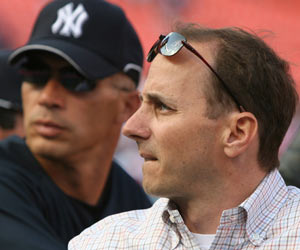 I HAVE THIS FRIEND NAMED ADAM … And whenever I write here that Brian Cashman or Joe Girardi say something completely indefensible, something like, “Xavier Nady is the starting right fielder,” he writes me and says that I’m too quick to criticize and that there’s a secret plan afoot that will set matters aright. Adam hasn’t actually issued his usual warning this time around, but he must have gotten through to me in the past (maybe it was regarding Kyle Farnsworth, though I’m still not certain), so I have decided, in my best Pollyannaish way, to believe that Mr. Girardi is building Mr. Nady’s trade value. There are teams out there, hungry, less discriminating National League teams, that might like to have an X-Man of their very own. There is a master plan at work of such savage cunning that the terms “Pinstriped Weaselry” don’t do it justice. You heard it here first: some club is gonna get suckered.*
(*The foregoing may prove to be a work of pure fantasy. Management is not responsible for any personal items left unattended in your vehicle.)
Meanwhile, my pal Rob Neyer proves that great minds think alike:
So, let’s see … younger, better against right-handed pitching, better fielder, better baserunner … gee, why would you want to give that guy a regular job?
Oh, don’t worry; it’s not as bad as all that. Considering all the Yankees’ creaky old geezers, there should be plenty of at-bats for a (relative) whippersnapper like Nick Swisher. These sorts of things do tend to find their natural balance, eventually. But with the questions about Alex Rodriguez’s availability and the tough competition in their division, one might reasonably wonder if “eventually” will come soon enough.
THE AROUND (AND ABOUT)
When I saw the headline, “MLB bans Pichardo 50 games”, the chain of association rapidly led me back to the Royals righty of the last decade Hipolito Pichardo, and thence to the short-lived Yankees lefty Hipolito Pena, who I recall as being distinctly more hippo-like than his listed 6’3″/165 pounds. The Yankees received Pena from the Pirates in 1988 in exchange for Orestes Destrade, an underpowered first baseman (later broadcaster) who the Yankees seemed to have no use for, given that it seemed like Don Mattingly had the better part of 10 good years left. No disrespect meant — I’m sure it means something noble in Spanish, but forget being a boy named Sue, I can’t think of anything more frightening than being a boy named Hipo … Seth McClung actually pitched well for the Brewers last year. That’s hard to believe, but it’s harder still to accept that he might sub as closer for Trevor Hoffman … It’s difficult to think of a player, aside from a Buck Weaver or Shoeless Joe Jackson, who has fallen as hard and fast as Andruw Jones … With third baseman Jack Hannahan likely to be squeezed off of the Oakland roster, the Yankees could take a run at the glove man. He won’t hit much but is a lefty bat and a strong fielder … The White Sox may regret signing Gavin Floyd to a four-year, $15.5 million contract. The same luck on balls in play that affected Swisher in a negative fashion last year benefitted Floyd. He’s due to regress and in a hurry … If I took all the decisions I’d ever made because they seemed like good ideas at the time and stacked them one on top of the other, I could climb that pile and just scrape the bottom of the moon with my fingertip.
ONE LAST GO AT PHILADELPHIA
Final warning, and aren’t you relieved: Jay Jaffe and I will be at the Penn Bookstore at the University of Pennsylvania (3601 Walnut St.) this evening at 5 PM. I hope to see some new and familiar faces there tonight.
What, this movie again?
 In today’s New York Daily News, Mark Feinsand writes:
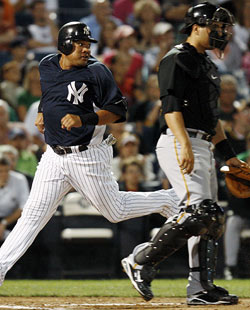
[Melky] Cabrera, who looked to be fighting for a roster spot more than a starting job, stayed the course and tried to let his play speak for itself. Apparently, his strategy worked.
“In this game, things aren’t always going to go the way you want that day or the next day — or maybe for a week — but Melky didn’t panic,” Joe Girardi said. “He just kept doing his thing, which is a sign of maturity.”
[snip]
“I’m happy with the way Melky is playing; he’s really started to swing the bat,” Girardi said. “They’ve both played at a very high level. Gardy started a little quicker, but to me, they’re both playing at a very high level right now. It’s been a fun competition to watch.”
As Einstein said, and every man of woman born has since repeated, the definition of insanity is doing the same thing over and over again and expecting a different result. Cabrera has been a regular player for three years now, and the Yankees have received three years of below average, declining results. He does not hit for a high average, and since he has little power and no particular love of taking ball four, he produces almost nothing at the plate.
The counter argument here is that Cabrera, now 24, was a young big leaguer and still has room to develop. Perhaps, but (1) at 24 he likely has sailed past the point that a breakout can reasonably be expected and (2) if there is a breakout, where is it to come? Should we expect a player who has never hit more than eight home runs in a season to whack 25 of them this year? Should we expect a fake switch-hitter who cannot bat right-handed (.251/.319/.329 career) to become a reliable .310 hitter? Should the Yankees project that a player who has averaged 50 walks per 162 games played to add another 25 of them to the back of his baseball card?
Now, these things could happen. Cabrera hit for power last April before quitting completely, and maybe whatever alchemy allowed him to be a slugger for one month could reconstitute itself over six months. Not likely, but it could happen. He could hit .300 just on luck. That happens too — every year some player sees an abnormally high (or, in the case of Nick Swisher last season, low) percentage of the balls he hits fall in. He could take more walks based on the understanding that if he doesn’t make every effort not to throw away his at-bats, he will forfeit millions in future salary.
If these things happen, swell — the universe is a capricious place. It giveth and taketh away and sometimes gives us cash bonuses we don’t deserve after we’ve helped cause a global financial meltdown. Such unpredictability is what makes life here so exciting. Betting on such events, however, is never a wise policy, especially when one requires offense to win a pennant, and particularly when one’s MVP just had his hip operated on and your team will require every iota of additional offense to support its gold-plated pitching staff.
It is hoped, and perhaps it is even probable, that Joe Girardi is not entirely serious in what he is saying, and he is merely trying to keep both players pumped or to stoke Cabrera’s trade value by exaggerating his performance this spring. We know that Girardi isn’t stupid and that he can be disingenuous. In this case, he may be letting the latter quality do some of Brian Cashman’s work for him. If that is true, then he’d better hope that potential partners don’t look too closely, as this spring Cabrera has batted .250/.341/.361. It’s more of the same-old, same-old, a movie we’ve seen before.
Post-script: today’s game in Fort Myers, Fla., wrapped up as I tossed these words onto the page. Brett Gardner went 1-for-3 with a stolen base. Cabrera did not play.
ONE FELLOW WHO DID PLAY
Austin Jackson. He hit his second home run of the spring and is now batting .303. Jackson has played consistently well this exhibition season, but I’ve been reluctant to say anything about it because generally he’s been coming into games late and doing his damage against roster fodder. That said, something is better than nothing, and you would have to think that he’s positioned himself to get an early jump on a Major League career should any injuries befall the Major League outfield cadre. That’s a fantastic development for the Yankees as — here’s one cliché that is completely true — you can never have too much depth.
NO ONE EVER LEARNS ANYTHING
I don’t like to single out other writers in this space so I’m going to be oblique here, but there was a piece published today that praised Hanley Ramirez of the Marlins for accepting a change in batting order position from leadoff to third, while castigating Jose Reyes of the Mets for reacting with less enthusiasm to a similar proposal from his manager. There’s a very simple problem with this line of thinking: Ramirez isn’t necessarily right and Reyes is definitely not wrong. The difference between the most optimal, second-most optimal, and eight-most optimal batting order in terms of generating offense is very, very small. To conceive of batting orders in this way is an act of ignorance and naivety. The batting order is more accurately viewed as a mechanism through which the manager distributes playing time. The leadoff hitter will play (come to bat) more than any other player on the team. The No. 2 hitter will have approximately 20 fewer turns than the leadoff hitter. The No. 3 hitter will have 20 fewer turns than the No. 2 hitter, and so on down the order.
Take last year’s Yankees team as an example. The leadoff spot came to the plate 762 times. The second place in the order batted 14 fewer times. The third spot batted 32 fewer times. If we drop down to number nine, we see a gap of 140 plate appearances from first in the order to last. Jerry Manuel of the Mets was proposing that one of his worst hitters, Luis Castillo, bat 40 or so more times this year than Reyes, one of his best hitters. Fredi Gonzalez is proposing a similar reduction in Ramirez’s playing time. Whatever the small effect of batting order changes, there is no way to justify voluntarily giving up the equivalent of eight to ten games worth of times at bat for one of your best hitters.
These days it is rare that a piece by a fellow toiler in these fields seems so wrongheaded that I am obliged to write about it, but this one got to me, being an excuse to take a cheap shot at Jose Reyes over an idiotic suggestion by his manager.
THE PLACE WHERE MY FEET ARE
None too soon for my somewhat fragile constitution, the book tour comes to a close next week with two appearances. First, Jay Jaffe and I will be in Philadelphia on Tuesday the 24th at 5 p.m., at the Penn Bookstore at the University of Pennsylvania (3601 Walnut Street, Philadelphia). Second, Jay, Cliff Corcoran, and I will be at the Rutgers University bookstore (Ferren Mall, One Penn Plaza, New Brunswick, N.J.) on Thursday the 26th beginning at 6 p.m. On both occasions we’ll be talking baseball in any of its multifarious forms. I am very much looking forward to seeing you.
Joba psychology, revisited
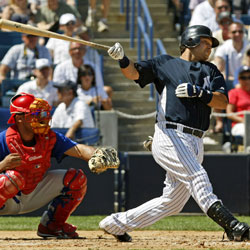 In case you didn’t check out today’s action, Joba Chamberlain pitched three shutout innings. Can we stop panicking now? There’s something truly weird about the Psychology of Joba, by which I mean not what goes on in his head, but what seems to go on in ours when he pitches. It seems like a sizable percentage of the population might feel more at ease if he was simply sealed in plastic and never allowed to pitch again. If you don’t use him, he can’t get hurt. There is a kind of denial at work here. Injury risk can be mitigated, but short of a perfect prescience, they cannot be prevented.
In other news from the game, Nick Swisher went 3-for-4 and Xavier Nady went 2-for-4. Swisher’s spring on-base percentage is now .389, Nady’s .267. I don’t expect anyone around the Yankees to care, because consistency at hitting usually trumps consistency at getting on base, even though better to start with the latter and hope for the former than the other way around. There’s still some time, though, for Swisher to show enough for the Yankees to make the right decision.
Finally, Brett Gardner knocked a triple today, took a walk, and scored two runs. Spring Training statistics are meaningless for the most part, especially this year when camps have been decimated by the WBC, but if consistency of hitting is part of what Gardner had to show, he’s done that so far, and he’s also demonstrated far more thump than before with six extra-base hits–the guy continues to lead the Yankees in home runs this spring. Again, that’s not something to get too excited about, as Angel Berroa is tied for second with two, and also leads the club with a .429 average. Heck, the Ransom of A-Rod is batting .400. It doesn’t promise much of anything, but it’s all good to see.
Another one from the comments
And from a frequent commenter, letsgoyankees, this one on this morning’s entry regarding the dynasty teams:
I agree with almost every point you made except pitching and defense. These (today’s) Yankees have great pitching and a very good defesne! Weren’t we lin the top three last year in errors (correct me if I’m wrong!)? Think about it…A-Rod, Tex, and Jeet all have gold gloves (that’s right, I said I think Jeet is still a good shortstop.I’ve argued it in the past and I’m not changing my stance now.) and Cano is pretty good. Yes, he makes a lot of errors, but only because he has great range. He’ll fix the error porblem. At cathcer we’re suspect with Posada but with Molina we have perhaps the best defensive catcher in the league! Our centerfielder, be it Gardner or Melky, will be an excellent defender. And Damon (minus the chicken arm) and Nady aren’t terrible. And our pitching staff speaks for itself. Our defense is pretty darn good!
Letsgo, you’ve got to let go of errors. Not making errors is part of having a good defense, but a bigger part is simply how many balls in play a team turns into outs. If the pitcher doesn’t strike out the batter or give up a home run, and the batter puts the ball between the lines, what happens next? For most of this century, the Yankees have not been very good at collecting those pesky grounders and flies. Commonly referred to as defensive efficiency (DEF), this is the most basic aspect of defense and also the one that, if improved, can yield the most dramatic results: in 2007, the Rays ranked dead last in the majors in turning balls in play into outs. They shuffled some players around and jumped to first in the majors–you know what happened next. In 2008, the Yankees were 25th in the majors; in 2007 they ranked 13th; in 2006 it was 8th; in 2005 it was 22nd; in 2004 it was 20th; in 2003 they ranked 28th; in 2002, 23rd; in 2001, 25th; in 2000 they ranked 13th.
And that leaves me with these questions: if the Yankees defense has been so good, why are so many balls finding holes? If Derek Jeter is such a great shortstop, why don’t the balls he gets to show up in the numbers? It can’t be all balls over Bobby Abreu’s head–the responsibility has to be shared out, to varying extents, around the diamond.
A quicky from the comments
 “Remember when the Yanks were winning the World Series that we never had an MVP winner on our team (1996-2000)? We had guys who knew how to perform as a team.”
Steve, could you get your Webmaster to fix it so that any time somebody types some version of those quoted sentiments, they automatically get an electric shock through their Web connection? Thanks! — lorodov
I’m pretty sure your suggestion would have been legal just a few months ago but wouldn’t pass muster with the current Justice Department. Congratulations: you’ve actually made me miss the old guys. I didn’t think that was possible… I’m trying to figure out the best way to say that the MVP vote is just a poll of a bunch of guys who write about baseball and may or may not reflect the best player in the league in a given year, often not. That no Yankees player received an MVP award in the years 1996-2000 is not evidence that they received no MVP-level performances during those years, but that the voters had their heads up their — how to put this politely — fundaments.
Bernie Williams played at an MVP-level in the four years under examination — a center fielder who hit .324/.410/.551 in the years in question, winning a batting title and (deserved or not) four Gold Gloves as well. In two of those years, 1996 and 1998, the award went to the cranky corner outfielder Juan Gonzalez, who had a ton of home runs and RBIs, but when you look at Williams’ more important defensive position and superior ability to reach base it rapidly becomes apparent that Bernie was the superior player.
Derek Jeter would have been deserving of an MVP award in any of the three years from 1998 to 2000, and I will always contend that he should have won it in 1999 rather than Pudge Rodriguez’s double play machine. Rodriguez was not one of the 10 best hitters in the AL that year. Jeter was, at least by one measure, the best.
Jorge Posada’s 2000 season (.287/.417/.527, 151 games) lacked the RBIs usually associated with an MVP winner, but was of that quality given that it was produced by a catcher. Tino Martinez’s 1997 had all the hallmarks of an MVP season — 44 home runs, 141 RBIs. He finished a distant second in the balloting to Junior Griffey.
There were several players throughout, including Paul O’Neill (through 1998), who made star-level contributions to those Yankees teams. They were very deep clubs, with talent spread nicely around the roster, but they weren’t some gutty version of the Pittsburgh Pirates, grinding it out with a bunch of mediocre players. These were Cadillacs, not K-Cars, and we haven’t yet discussed the pitching or the defense, the latter of which was surprisingly effective in those years, far, far more effective than anything the current unit has done or will do.
Sure, the media liked to celebrate Scott Brosius, Joe Girardi, and the like, and no doubt they played their part, but without the big guys they would have “known how to win” right into fourth place. The Yankees need their stars. In the absence of Alex Rodriguez, the Yankees are down on just one on offense. Citing the 1996-2000 teams as evidence that one is enough fails the exam before you even pick up your pencil.
MORE FROM ME…
…After today’s game. In the meantime, this week my travels take me to Washington, DC, where I’ll be doing two events on Wednesday. First, Jay Jaffe and I will be hosted by the Georgetown Lecture Fund at Georgetown University at 4:30 p.m. This event is open to the public, if public I have. The location is McShain Lounge at McCarthy Hall (Building 42), 27th and O Street NW.
Following rapidly on the heels of that, Jay, Clay Davenport, and I will be traveling to one of my favorite tour events, the great independent Politics & Prose bookstore, for a 7 p.m. chat ‘n’ sign. The address: 5015 Connecticut Avenue NW. They usually have pizza and beer available. I’m not sure that that will be the case this year, but we can hope.
Finally, I’ve continued and will continue to update Wholesome Reading. Warning: Politics (and a Harold Reynolds reference)!
Notes from around the league
 RANDOM BITS FOR A RANDOM FRIDAY
… Because I definitely feel 13th after a very busy week.
? The Cubs signed Esteban German to a Minor League contract, so those that wrote suggesting he’d make a good depth addition for the Yankees and a possibly useful Alex Rodriguez substitute, forget it. I don’t think it’s a huge loss unless he’s going to go back to walking 50 times in half a season.
? Remember last week I said that A-Rod’s injury wasn’t the last injury, just the first, and the Yankees would have to survive the cumulative weight of those losses? Now, we have Robinson Cano’s sore shoulder and Damaso Marte’s pectoral muscle. In both cases, the injuries could be nothing or could be something. There’s no reason to worry too much about Marte because the Yankees have the pitching depth to get by without any one reliever, but Cano would force the Yankees to fall back on some pretty weak choices. For any team, as ever, the emphasis must be on the farm, the farm, the farm, the farm, or eventually you’re going to get hit and not be able to cope. Thank you, Uncle WBC!
? Has anyone who was lukewarm on the Mark Teixeira signing before the event yet conceded that in the absence of A-Rod that signing may very well save the offense, and thereby the season? By the way, Chase Utley had the full-on version of the surgery that Rodriguez is splitting in two back in November. He has yet to get into a game.
? A-Rod replacement speculation: the guy the Yankees should be looking to make a force majeure kind of move on is J.J. Hardy of the Brewers, who may lose his job to Alcides Escobar at some point in the near future. He can hit enough to play third and is young enough to play short after, just in case, you know, the Yankees ever have any defensive weakness at that position.
? Before someone asks about catcher Rob Bowen, who the A’s are shopping, there is no evidence he would out-hit Jose Molina. Yes, Molina is a better hitter than somebody.
? Big loss for the Rays in having Fernando Perez hit the bench for three months with a dislocated left wrist. Perez isn’t an impact player but is a nice complimentary part. Matt Joyce hasn’t played yet due to his own injuries, and B.J. Upton is still working his left shoulder back into shape. Gabe Kapler is going to end up playing a lot more than might be good … Too much of Justin Ruggiano and his amazing capacity to strike out, too.
? Transcript from today’s chat, with lots of Yankees questions, some politics, and scattered other baseball musings.
? Those of you in the District of Columbia, I’ll be making two appearances there next Wednesday, along with BP compadres, Clay Davenport and Jay Jaffe. First, I’ll be hosted by the Georgetown Lecture Fund at 4:30 p.m. (open to the public). Following closely on the heels of that talk will be one of my favorite yearly events, a trip to the Politics & Prose bookstore at 7 p.m. For address info, see this page.
Odds and ends for a Thursday
MAYBE THE BEST THING EVER WRITTEN
Ken Davidoff vs. A-Rod’s detractors. It’s all quite obvious, really, but for some people it requires repetition.
BILL HALL AND OTHER DISCONTENTS
Apologies for yesterday’s skip day — I find I cannot sleep my first night in a hotel, and so I got home from the gig and collapsed straight away and at great length. All those who wished crab cakes for me in the comments, sorry to disappoint, but I played it conservatively — one of those combos you never want to hit in life is, “bad shellfish/300 miles from home.” As much as I love Maryland’s signature dish, I just couldn’t risk it.
Continuing on the “Find a sub for A-Rod” beat, I note this article from the Milwaukee-Wisconsin Journal Sentinel regarding rookie Casey McGehee’s pursuit of the Brewers’ third base job. McGehee, 26, hasn’t done much in the minors to suggest that he could start in the Majors — he’s a career .279/.332/.409 hitter in nearly 700 games — but he does have a decent glove, so Ken Macha might be a little infatuated with having a guy at that corner who can make a few plays.
What this means is that Bill Hall, who was once rumored to be headed to the Yankees as part of a deal for Mike Cameron, could be in play again. Hall has been slowed by a calf injury this spring, he’s owed about $18 million over this year and next (plus a 2011 buyout), and he hasn’t done anything exciting with the stick in three years. However, we’re talking about third basemen who might out-perform Cody Ransom, so our threshold is extremely low. A reasonable projection for Hall would be somewhere around .250/.310/.425, or about what he did in 2007. You could also pencil in a great many strikeouts and some frustrating errors at third base.
Still, the Yankees would get a few home runs, decent production against left-handers (.278/.355/.493 career), and the versatility of a player who has also spent whole seasons starting at shortstop and center field. That last might yet come in handy.
YET ANOTHER REASON SPRING TRAINING STATS ARE MEANINGLESS
Kevin Cash is hitting .385 (5-for-13). He’s a career .184 hitter, with cause.
WE COULD USE MORE BOOKS LIKE THIS (WELL, I COULD)
Just received my copy of Allen Barra’s new biography, Yogi Berra: Eternal Yankee. I was all set to read it and give you a thoroughgoing critique of the work, but when I cracked open the book at random, I landed on this passage: “Steven Goldman, author of the brilliant analysis of Casey’s evolution as a manager, Forging Genius…”
So I guess any pretense of writing an objective review is out the window. I will, however, still read and report to you on the book, because it really fills a needed hole in our understanding of those great Yankees teams. Whereas Yogi has written or collaborated on many books about himself, and there have been a few notable tomes on those teams as a whole, or on other members (mostly numerous volumes on Mickey Mantle), the definitive book on Berra, one of the greatest catchers of all time and an indispensable member of those championship teams, had never been written.
Yogi is famous for his personality, but when you look at those dynasty teams, the gap between Berra and the next-best catcher in the league was often no smaller than the Grand Canyon. Casey, once asked the secret of his success, said, “I never play a game without my man.” The man to whom he was referring was Lawrence Peter Berra, and he was right.
TONIGHT, TONIGHT, TONIGHT
Yeah, it’s a bad Phil Collins song, but it’s what I’ve got right now. I’ll be in Manhattan this (Thursday) evening talking any topic you wish to throw my way, along with my Baseball Prospectus colleagues Kevin Goldstein, Jay Jaffe, Cliff Corcoran, and Neil deMause at 6 p.m. at the Barnes & Noble at 5th Avenue and 18th St. be there or be… somewhere else, I guess.
For those choosing that latter option, you have another chance on Friday, and from a safe distance, as I’ll be doing a live chat beginning at 1 p.m. EST at Baseball Prospectus. As always, if you can’t hang out as the chat is ongoing, you can still submit questions ahead of time at the same link.
Depth perception one hard lesson
 THE ONE AFTER 909
As you know by now, Alex Rodriguez and the Yankees will roll the dice on “hybrid” surgery (first thought: they’re turning him into a Prius?) and will hope to have the big guy back in six to nine weeks. We’ll see how that works out. Until then, the Yankees will have to walk on eggshells, because Rodriguez’s is only the first injury, not the last. What happens when you have Cody Ransom and Donald Duck in the lineup? As they say on the subway, “Stand clear of the closing doors.”
The lesson of Rodriguez’s injury is one that we’ve discussed here time and again over the years: You can spend all the money you want, sign all the big-name expensive contracts in the world, but if you don’t have good depth in the form of young players, your team is going to suffer. After years of having nothing on the farm at all, the Yankees now have a good supply of pitchers, something from which they will benefit as soon as the season’s first arm is scragged. The team has been unable to find the same success with position players, particularly as the club’s history with first-round picks (when it has them at all) rivals that of the New York Jets for sheer waste.
In today’s New York Post, George King quotes Brian Cashman: “But you have to remember Erick Almonte for (Derek) Jeter, and last year we went with Jose Molina and Chad Moeller (for Jorge Posada) until Pudge Rodriguez fell into our laps.” The GM is right that the Yankees might survive one injury, but the lesson of last season is that they couldn’t survive two or more. Maybe Molina/ Moeller/I-Rod would have been survivable if Robinson Cano and Melky Cabrera had hit, but they didn’t. Their production was tantamount to their being absent.
One hopes that Ransom plays well — he’s certainly paid his dues — but he’s not going to be the straw that breaks the offense in any case. The replacement to fear is the one after Ransom.
A QUICK TO THE MATS WITH READER COMMENTS
Wanted to snag this response to Friday’s dash through the lineup’s possibilities:
Hey Steve, you sure are a negative guy. How can you possibly know what each player will or will not do for the Yankees. How can you say Damon should have a down year? How can you know that Nady and/or Swisher will not be lights out?
Give me a break!!!!!!!!!! — Yankeegirl224
Thanks for commenting, Yankeegirl. I’ve written this before: life is not a movie that you’ve never seen before. In fact, it presents all kinds of situations analogous to those that have come before. If you’re aware of the past, you can draw inferences about what’s going to happen next. No, I cannot say with absolute certainty what each player is going to do this year, but given 25 years of seeing how hitters behave first-hand, plus another 80 or so years of historical evidence, I can make some informed guesses. Let’s go back through what I wrote and look at the rationale for each — rationales that I’ve frequently explained throughout the winter, by the way.
1B Mark Teixeira: Solid producer, typically scrapes the underside of MVP-level production but could easily rise to that level with a good season.
I expect you don’t have a problem with that one. Teixeira is a very good hitter, and with some good luck or some slight tweak in his performance, like a mildly improved line drive rate, he could exceed expectations.
2B Robinson Cano: Has to hit .300 to contribute. He might do that, he might not.
Can’t argue here. This is just factual. Because Cano doesn’t walk and isn’t what you would call a slugger, when he doesn’t get his average above a certain level, he eats outs without giving the team much in return. I believe he has a decent-sized rebound in him, but whether he reaches the point of actually being an asset on offense I can’t guess.
3B Cody Ransom: Has some pop, but is unlikely to hit for sustainable average (PECOTA: .216/.293/.386).
This isn’t a big reach either. The Ransom of A-Rod is a career .242/.322/.426 hitter in nearly 1200 minor league games. His numbers at Scranton last year translate to .216/.295/.421 in the majors. At 33, he’s not going to find untapped pools of ability. He’s far more likely to find untapped pools of retirement. While he might find the odd hot streak, as he did last fall, I wouldn’t recommend betting on it. As I said above, I’m rooting for him, but that doesn’t mean having unfounded expectations.
SS Derek Jeter: Offense has declined in two straight seasons. Average of five projection systems: .300/.368/.419.
I didn’t make a prediction here so much as make two statements. If he reaches the numbers cited above, no one will complain.
LF Johnny Damon: Almost certain to take a giant step back.
Here’s one of the ones that caused Yankeegirl to straighten her curls. Unfortunately, I didn’t go out on a limb here either. First, Damon has never been a particularly consistent player, and at 35 he’s not likely to start. Second, his 2008 season was one of the best of his career if not the best. Players generally don’t set new performance norms at 34. I hope Damon does, because he’s had an interesting career and his having a Steve Finley-style last act would put a cherry on it, but it is unlikely to happen. Now, whether Damon dials it back a lot or just a little I don’t know, but the change will be significant either way because all the elements of Damon’s game have to work together for him to make a real contribution — a little batting average, a little power, a little baserunning, a little patience. You kick out any one of those legs and he starts to tread water on the league averages.
CF Brett Gardner and pals: Any production will be a bonus.
This is a conservative prediction, and between last fall and this year’s spring power surge I’m hoping that we’ve seen the birth of a new Gardner, but (as much as I think he’ll be a better regular than Melky Cabrera) until we see him hit with authority for a sustained period of time, he’s still Jason Tyner until proven innocent.
RF Nick Swisher: should be productive in a lower echelon kind of way, Xavier Nady less so, either way, not a big plus.
Swisher is another guy I think will help the Yankees with his walks and his power, but he’s not an MVP-type hitter, and the whole point of this exercise was to suggest that in the absence of Rodriguez, the Yankees are down to one player who meets that description.
DH Hideki Matsui: should hit decently, but not at an MVP level.
We’re entering the seventh year of Matsui’s American career, and he is who he is. There should be nothing remotely controversial about that statement. I actually considered throwing in a few caveats based on age and his physical problems.
C Jorge Posada: may or may not be ready to open the season, may or may not hit as well as he used to, and will probably have to yield to Jose Molina on a regular basis
Again, this is simply a statement of where things are.
So tell me, Yankeegirl and the others who responded negatively, what in here do you really want to argue with?
MORE OF ME
Wholesome Reading is back. After a sabbatical inspired by the BP annual and another urgent project, I’m recharged and ready to wade into current events. About a half-dozen posts went up over the weekend with more to come. WARNING: Politics!
For our readers in th
e Baltimore area (and judging by the number of attendees at O’s games wearing Yankees caps we must have many), the great Jay Jaffe, Clay Davenport, and I will be appearing tomorrow, March 10, at the Johns Hopkins University Barnes & Noble (3330 St. Paul Street, Baltimore) to talk baseball, sign books, and crack wise. Hope to see you, your wives, and girlfriends tomorrow night. A splendid time is guaranteed for all.
Fringe elements
Looking for more potential A-Rod subs of the fringe kind:
Ron Belliard (Nationals 40-Man): This roly-poly second baseman has hit .282/.334/.433 over the last five years, which means he’s batting life to a draw. No one knows if he can actually field third base or not, a position he’s barely played. He seems to be without a position in Washington as the team tries to move to younger players — through with their recent front office changeover, it remains to be seen if any priorities have changed.
Brian Buscher (Twins 40-Man): The 28-year-old lefty swinger lucked himself into a decent batting average last year, but he’s really not much of a hitter, with very little production outside of that average. He’s been passed by Joe Crede, the Twins have a better utility option in Brendan Harris, and there are better prospective third basemen in the system, including the soon-to-be-ready Danny Valencia. In short, he’s purely redundant in Minnesota.
Korey Casto (Nationals 40-Man): My colleagues at Baseball Prospectus reminded me of this one today at ESPN. Casto, a third baseman/outfielder is absolutely buried in Washington. A lefty hitter, .250/.320/.400 seems like an optimistic projection.
Chone Figgins (Angels 40-Man): He remains the starting third baseman and no one is particularly pushing him — the Angels don’t seem to believe in Brandon Wood, and he may yet slot in at shortstop. Figgins is valuable as a multi-position player, but injuries have been a problem the last couple of years, and he’s an average hitter at best, lacking the pop to be a regular at the hot corner. He will also reach free agency after this season, which means an acquiring team will only be getting a rental for whatever payment the Angels extort–if they would even consider moving him, unlikely that he’s their primary sub at several positions. Figgins would almost certainly be an improvement on Cody Ransom, and he would give the Yankees an interesting extra burst of speed to pair with Brett Gardner, but he’s not a significant run producer. As BP points out, Minor League vet Matt Brown would be a better candidate as a sleeper pickup from the Angels system.
Jeff Larish (Tigers 40-Man): One of my favorite prospects, albeit for no particular reason, this lefty power and patience type is a natural first baseman or DH, but the Tigers have tried to make him into a two-corner sub. PECOTA hates him, but if he can hit .250 he’ll be an offensive asset. He’s 26, not a future star, and is stuck behind veterans at all of his positions — in other words, the kind of player that a team might flip for, say, a half-decent bullpen piece.
More of these to come as merrily we roll along — we have lots of time for speculation. Before I wish you a good weekend, I’d like to remind any readers in the Baltimore area that Jay Jaffe, Clay Davenport, and I will be doing our talk ‘n’ signing routine on Tuesday evening at the Johns Hopkins University Barnes & Noble, 3330 St. Paul Street in Baltimore. Closer to home, next Thursday Kevin Goldstein, Cliff Corcoran, Neil deMause, Jay, and myself will be reprising the act in Manhattan at the Barnes & Noble at 18th Street and 5th Avenue. I hope to see you there to talk about the new baseball season and all the crunchy A-Rod goodness you can stand. I’ll be the fat guy with the glasses. Can’t miss me.
 Pinstriped Bible