Category: Dailies
A vintage Yankee playoff win
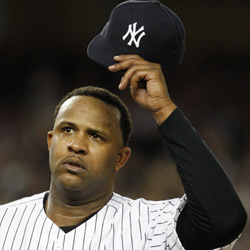 One down and two to go for the Yankees as they strive to escape the first round for the first time since Casey Stengel’s 1953 team made it to the Championship Series. Okay, okay, it was 2004, but who wants to remember that season with its crushing reversal of fortune against the Red Sox? I also don’t want to remember 2003 (ugly World Series loss), 2002 (rampaging Angels), or 2001 (Tony Womack? Come on), the 2000 team was one of the weaker champions you’ll see, and I resent 1999 because Derek Jeter should have won the MVP award that year but didn’t. The way things are going, I think it would be safest to go with 1953.
CC Sabathia did exactly what he was supposed to do, the thing he was paid the big money to do, which is reassuring after so many disappoints, both in terms of past Yankees signings and Sabathia’s own performance in recent postseasons. What most impressed about this start was that when the Twins were able to lay the bat on the ball, they were able to knock it for singles (six of ’em, plus two doubles), but Sabathia didn’t walk anyone and got eight strikeouts, al of them seemingly when they were most needed. It wasn’t Don Larsen ’56, but it was good enough.
With a big lead, Joe Girardi had the luxury to pull Sabathia after 113 pitches, not a high total for him. The on-off schedule of the first three games gave him the additional luxury of being able to get his mostly inexperienced relievers into the postseason in a relatively low-pressure situation. Using four relieves, including Mariano Rivera, in a 7-2 game seemed like a bit of overkill, but with Thursday off, Girardi can make changes like there’s no tomorrow, because, well, there isn’t.
The one disturbing aspect of the game was Jorge Posada’s bad night behind the plate. It was as if Old Man Jorge set out to confirm every paranoia that has been attributed (probably unfairly) to A.J. Burnett. Two passed balls and a wild pitch in one game is an extremely poor showing, regardless of if Sabathia might have crossed up his catcher on one of the three misses. Posada has always missed a lot of balls. He’s the active leader in passed balls, and his first next year will vault him into the top ten all time (fortunately, all-time leader Lance Parrish’s record of 192 seems out of reach). As he becomes older and more immobile, there are going to be ever more balls skipping past him. At the risk of overreacting to what could be one aberrant game, tonight might have been a preview of the moment, coming perhaps in 2010 or 2011, when Posada’s bat still plays but the sheer number of balls sailing by or rolling to the backstop make him an untenable catcher.
Those misses represent just one base given up and amount to nothing most of the time, but you can get into difficult psychological territory when pitchers feel they are not being properly supported. Mackey Sasser’s problem returning the ball to the pitcher with the Mets in the late 1980s didn’t necessarily lead directly to any runs scoring, but it definitely had the pitchers angry and distracted. One hopes that this day is farther off that it appears after tonight, because if it happens sooner then there will be a gap between Posada and Austin Romine or Jesus Montero or whoever the next catcher the Yankees produce who can hit with more authority than Jose Molina.
Twins vs. Yankees: Head to Head
I don’t know that head-to-head comparisons are truly predictive of anything, but they’re fun and I like doing them, so here we are again for the first time since 2007. As we go down this list, the thing my research has revealed is that though the Twins and Tigers supplied baseball’s one exciting, down to (and past) the wire race, they just weren’t very good teams.
FIRST BASE
Michael Cuddyer vs. Mark Teixeira
Cuddyer is coming off of the best year of his career, the second in which he justified being a first round pick back in 1997. He closed hot, hitting 15 home runs in the last two months of the season. Normally a right fielder, he’s playing first because Justin Morneau is out for the year. He won’t amaze with the glove-work, but he’s a better choice than any old Chris Richard type. Cuddyer is a career .245/.303/.396 hitter against the Yankees; Teixeira is a career .371/.415/.670 hitter versus the Twins.
This is an EDGE: YANKEES, but Cuddyer isn’t incapable. Note that he hit .307/.363//651 against left-handers, with 15 home runs in 166 at-bats.
SECOND BASE
Nick Punto vs. Robinson Cano
The best you can say here is that Punto is a nice glove and can play three infield positions with equal aplomb. He’s also willing to take the odd walk, with the result that the gap between his and Cano’s OBP (.337-.352) is much smaller than the gap between their batting averages (.228-.320). Despite that, the overall package isn’t even close to what Cano offers. Just don’t ask who hit better with runners in scoring position. EDGE: YANKEES.
THIRD BASE
Matt Tolbert vs. Alex Rodriguez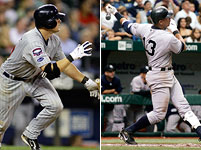 Long is the road from Joe Crede to Matt Tolbert, who sadly will never hit well enough to have any “Tolbert Report” T-Shirts made up. Like Punto, Tolbert is a utility infielder trying to pass as a regular because other Twins’ plans didn’t work out, not that Crede was much of a plan. The amalgam of Tolbert’s two Major League seasons, .251/.310/.338, seems a fair representation of what he’s capable of given his minor league numbers. A switch-hitter, Tolbert has been useless against righties (.221/.290/.286) and hard on lefties (.315/.354/.461) but the samples are small. Against him, the Yankees present A-Rod, who had one of the best seasons ever by a man playing on one leg, Mickey Mantle’s entire career aside.
Another BIG EDGE: YANKEES.
SHORTSTOP
Orlando Cabrera vs. Derek Jeter
Twelve years later, you know what you’re going to get from Orlando Cabrera: a little offense, a little defense, but nothing award-worthy. The Twins infield was bad enough for that to be an upgrade. At .289/.313/.430 and a big home run in the final game, he gave the Twins a little more than they could have expected. Cabrera shared Derek Jeter’s one major negative this year: a propensity to hit into double plays. Jeter, one of the Majors’ most committed ground ball hitters (he ranked eighth in ground ball percentage among batters with 500 or more plate appearances), hit into a double play in 17 percent of his opportunities. Mr. Cabrera was just fractionally off that pace, killing two in 16.4 percent of his chances. The similarities end there — the Captain had one of the best seasons in a career full of them and is somehow better on defense at 35 than he was at 25. Jeter ranked third in the league in OBP, his best finish since his wonderful 1999. One other possible negative: we can only hope his case of postseason bunties doesn’t reappear. In the regular season, Jeter has pulled off a sacrifice once every 126 plate appearances. In the postseason, he’s done it once every 70 plate appearances, which works out to nine in a season of 600 PAs. He doesn’t turn into Jay Bell or anything extreme like that, but it’s still more outs than a hitter of his quality can usefully give away, and it isn’t all that helpful anyway. Regardless, BIG EDGE: YANKEES.
CATCHER
Joe Mauer vs. Jorge Posada
Here we have the probable MVP versus a catcher merely having a very, very good season, which means on any given day the gap between the two isn’t that large. Of course, the gap between Mauer and Jose Molina could span the stars. Not much held Mauer back this year — home, road, lefties, righties, or high-fructose corn syrup. He also hit two home runs in four games in Yankee Stadium II. If you want a down note, Mauer caught only 26 percent of attempted basestealers, which is the lowest figure of his brief career. In this he was about even with Posada.
EDGE: TWINS, but don’t panic about that — panic about the possibility that this fellow has it within him to go George Brett postseason ’78 (or ’76, or ’77, or ’80) on the Yankees.
LEFT FIELD
Delmon Young vs. Johnny Damon
Young had a big finish to the season, winning the final Player of the Week award, but most of the time he’s a Player of the Weak, a player who simply kills his own team. He doesn’t hit for average, doesn’t hit for power, doesn’t walk, doesn’t run, and is an egregious fielder. He also kills his team on the double play, banging into a twin-killing in 21.5 percent of his opportunities, top 10 in baseball in the 400 PA and up division. Young is still young; he turned 24 about three weeks ago. His second half, spiked by that big finish, totals out at .300/.322/.500. You can live with that, in kind of a B- version of Garrett Anderson way, and Anderson at his peak was just okay. Perhaps he has finally gotten in touch with the talent that made him the first overall pick in 2003 and a Major Leaguer at 20, but I remain skeptical that he’ll peak at anything more than Jose Guillen.
Damon had one of the best years of his career at 35, but there were caveats; just about all his power derived from the new ballpark (17 home runs at home, seven on the road), and he disappeared in September. In the same way Young’s finish and his age may interact to say something about his future, so might Damon’s age and his finish. Whatever happens with his bat in the coming years, his best defensive days are definitely behind him, but compared to Young he’s Tris Speaker. EDGE: YANKEES.
CENTER FIELD
Denard Span vs. Melky Cabrera
Minnesota’s first-round pick in 2002 initially looked like a bust, but he’s proved himself to be a strong on-base threat with some pop in his bat and good range afield. Note that he did almost all of his basestealing at home, as if he needed ‘Turf to give him an extra push. Left-handed hitters don’t bother him much. As for Melky, he is what he is, does what he does. He hit .264/.324/.393 in the second half, which is about right. EDGE: TWINS.
RIGHT FIELD
Nick Swisher vs. Jason Kubel
Writing the line above the first time, I typed Joe Kuhel, which isn’t a total miss — they both played for the same franchise, sort of. Kubel broke through in his age-27 season, with a season at-bat far beyond his previous achievements. Note that he was seriously diminished both on the road and against lefties (.243/.299/.345). Conversely, Swisher might be the only player on the Yankees who feels bad about having home field advantage. That said, he did finally figure out how to hit at YS II in September, batting .314/.417/.686 with five home runs in 51 at-bats. That’s something you might expect to continue in the playoffs, given that there was no reason for it to happen in the first place.
Swisher looks erratic on defense but makes most of the plays, while Kubel is a DH pushed into wearing a glove due to Morneau’s injury. Their seasons had different shapes, but the difference in value between the two was
minimal. I’m calling it NO EDGE, but you can make a case for Swisher based on his being the better all-around player.
DESIGNATED HITTER
Jose Morales vs. Hideki Matsui
Morneau’s injury set off a chain reaction which pushed right fielder Cuddyer to first base and DH Kubel to right field. Without an obvious DH candidate (their Triple-A version of Juan Rivera, Garrett Jones, had gone off to do wonderful things for the Pirates), they turned to 26-year-old catcher Jose Morales, an almost pure singles hitter. He gave them a good on-base percentage and zero power, which is something. Matsui had a fantastic year, especially considering that he’s now more machine than man from the knees down. Of special note was his performance against left-handers. Matsui is the rare lefty who isn’t troubled by a left-handed pitcher (you wish he could teach that), and this year he was especially cruel to them, slugging 13 home runs in 131 at-bats. Big EDGE: YANKEES.
 STARTERS
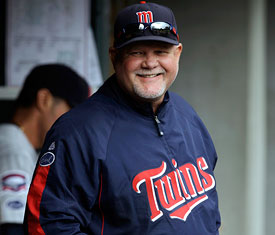
CC Sabathia goes in Game One against the average-at-best Brian Duensing. Lefties slugged only .268 against Duensing, hitting no home runs in 82 at-bats, but small-sample caveats apply. Duensing was actually more of a fly ball pitcher, so that shouldn’t last, especially in the friendly confines of YS II. I haven’t seen how Ron Gardenhire intends to set up the rest of his rotation yet, but Nick Blackburn has been savagely raked by the Yankees in the past, and Carl Pavano is, well, Carl Pavano. Scott Baker is the only starter with swing-and-miss stuff on the staff, and the Yankees won’t get him more than once. You know who the Yankees’ other starters are and what they’re capable of. EDGE: YANKEES.
BULLPENS
Both teams have nigh-unbeatable closers. Otherwise, I see two small advantages for the Twins: first, rookie southpaw Jose Mijares killed left-handers, holding them to .155/.228/.252. The Yankees’ spot relievers, Phil Coke and Damaso Marte, aren’t nearly that effective. Otherwise, the Twins aren’t nearly as deep, but with pitchers like Ron Mahay, Matt Guerrier, and Jon Rauch, they’re more of a veteran group. As good as Phil Hughes, David Robertson, Alfredo Aceves and pals were, they haven’t been here before. I’m calling it EDGE: YANKEES, but with reservations.
MANAGERS
If Joe Girardi doesn’t over-manage the way Gardenhire does, wasting time on bunty one-run strategies, this is a big advantage for the Yankees. Note that Gardenhire doesn’t quite know when to get Joe Nathan into games — Girardi has done a much better job of placing his fireman in the same place as the actual fire. EDGE: YANKEES.
PB PREDICTION: YANKEES IN THREE.
Catching Burnett
POSADA VS. BURNETT
Rob Neyer has it right: if Joe Girardi truly feels that A.J. Burnett is going to pitch better with Jose Molina receiving his pitches, then he has little choice but to bench Jorge Posada despite the huge offensive difference between the two catchers. Burnett is a highly variable pitcher. When he’s on, he’s unhittable. When he’s off, he walks the ballpark and gets pounded. Posada did most of the catching for Burnett at midseason (with some Kevin Cash and Frankie Cervelli throw in). They had the usual mix of good starts and bad, but things seem to have changed in late August after a three-start sequence in which two Posada games bracketed a Molina game. Burnett was savaged in the Posada starts, but struck out 12 Rangers in the Molina start (August 27). That seems to have convinced Burnett or Girardi or someone, because the Burnett’s final six starts were taken by Molina. Burnett’s ERA in those starts was 2.92, so clearly something was working.
The Yankees should survive three Molina at-bats in one playoff game, but this does raise an interesting question for next year. Molina’s contract is up and Cervelli is clearly ready to contribute at roughly the same level as Molina does now. It would be a shame if the Yankees retained Molina just to cater to the whims of one pitcher. And before anyone suggests as an alternative that Posada replace Hideki Matsui as designated hitter while Molina and Cervelli handle the bulk of the catching, keep in mind that the offensive loss would be disastrous.
Pinstriped Bible awards: Part II
WHADDYA KNOW, THERE’S BASEBALL TODAY…
…And unless the game never ends, Iowa Baseball Confederacy-style, the Yankees might even have a playoff opponent before it’s too late.
Meanwhile, the conclusion of the PB awards ballot. Check out Part I here.
 AL CY YOUNG AWARD
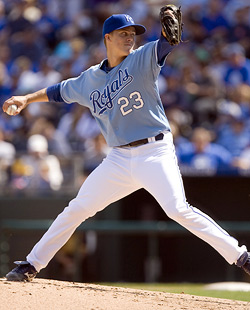
1. Zack Greinke, Kansas City Royals
2. Felix Hernandez, Seattle Mariners
3. Roy Halladay, Toronto Blue Jays
4. CC Sabathia, New York Yankees
5. Justin Verlander, Detroit Tigers
Jon Lester and Mariano Rivera rank just out of my top five. If Greinke wins, that will be three Cy Young awards and five winning seasons for the Royals since 1989. His 16-8 record doesn’t seem like much until you consider that he received only about four runs of support per start and that his .667 winning percentage towers over the team. Adjusted for time and place, his 2.16 ERA against a league average of 4.75 is top 40 all-time.
What’s most impressive to me is the weak contact batters made against him when they weren’t striking out (9.5 times per nine innings); though Greinke is a fly ball pitcher, he allowed just 11 home runs in 229.1 innings, which is a number out of 1909, not 2009. Parenthetically, Andy Pettitte allowed only seven home runs in 240.1 innings in 1997, something I don’t recall hearing a peep about at the time.
Hernandez had a terrific season, the combination of a still-young pitcher maturing and a Mariners defense that was best in the league at turning balls in play into outs. Halladay was his usual excellent self, his only failing being not approaching Greinke’s level of dominance. The Jays have been on a treadmill for his entire career; let’s hope he has something left to give to a real team. Sabathia had a 3.83 ERA after his first 22 starts, a 2.52 ERA in his final 12, even with the embarrassing October 2 blowout by the Rays. The stretch-drive CC is an award winner; the guy who was around before that was just very good. You can say something similar about Verlander, except that he was unhittable at midseason and after that he was still very good, but not quite at the same level (3.90 ERA in August-September).
NL CY YOUNG AWARD
1. Tim Lincecum, San Francisco Giants
2. Chris Carpenter, St. Louis Cardinals
3. Adam Wainwright, St. Louis Cardinals
4. Matt Cain, San Francisco Giants
5. Jair Jurrjens, Atlanta Braves
The differences in quality among Lincecum, Carpenter, and Wainwright are so small as to be insignificant, and you could pick any of the three and the other two would have no kick coming. Carpenter boggles the mind — twice in his career he’s disappeared for more than a year and come back to pitch well. Carpenter was important to a division winner, while Lincecum helped the Giants make an unlikely, pitching-based run at contention. I’m giving the kid the edge, but I’m open to arguments that see it another way.
AL MVP AWARD
1. Joe Mauer, Minnesota Twins
2. Derek Jeter, New York Yankees
3. Ben Zobrist, Tampa Bay Rays
4. Mark Teixeira, New York Yankees
5. Miguel Cabrera, Detroit Tigers
Sentimentally, I’d quite like to see Jeter pick up this award in the way that John Wayne got one for “True Grit,” or Henry Fonda did for “On Golden Pond.” Unfortunately, the magnitude of Mauer’s season dwarfs such considerations. Though he missed 25 games, the season he did have (is having, through tonight) was essentially the best in the American League by a catcher in over 50 years (only Mike Piazza’s 1997 slides past it). Mauer’s impact was not only historical; by tonight, the Twins might be on their way to the postseason, something that would not have come close to happening had Mauer not been so good.
Jeter had one of the top five seasons of his career and was a better defensive player than he was in his offensive prime. Zobrist had what will probably prove to be a forgotten great season of 2009, hitting like a right fielder while also playing the middle infield. Teixeira had a big offensive season, though not a special one by the standards of his position, and his defense was a key to the Yankees’ success this season; the Yankees tied for second in the league in defensive efficiency, and Teixeira’s vanquishing of the Jason Giambi clank was a big part of that. Just as without Mauer there would be no Twins tonight, without Cabrera there would be no Tigers. Extending this list to include a top 10 would see Jason Bartlett, Evan Longoria, and Kevin Youkilis added.
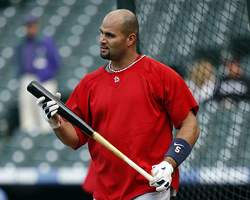 NL MVP
1. Albert Pujols, St. Louis Cardinals
2. Hanley Ramirez, Florida Marlins
3. Troy Tulowitzki, Colorado Rockies
4. Chase Utley, Philadelphia Phillies
5. Prince Fielder, Milwaukee Brewers
Pujols is the easiest No. 1 here, even with some weird power outages during the season. Ramirez’s season wouldn’t look out of place on the back of Honus Wagner’s baseball card. Tuluwitzki rebounded from a slow start to bat .325/.402/.616 from June to the end of the season, helping to propel the Rockies’ unlikely comeback. Utley had his usual fine season in helping the Phillies defend their pennant, and missed little time despite hip surgery. Fielder had bigger slugging seasons than any of the three middle infielders I listed ahead of him, but the middle infielders reap a huge positional bonus from me, one so huge that it’s bigger than Fielder himself. My top 10 would also include Ryan Braun, Pablo Sandoval, Adrian Gonzalez, Ryan Zimmerman, and Derek Lee.
NEXT
Head to head rankings of the Yankees against whoever the heck they’re playing already. If we don’t know soon, I may just substitute the 1949 A’s or 1980 Indians… Johnny Damon ’09 better than Miguel Dilone ’80? The mind reels…
Pinstriped Bible awards: Part I
I don’t get a vote, but as we wait for the quantum states of the Yankees playoff opponents to collapse into a single hostile force, the Pinstriped Bible awards ballot:
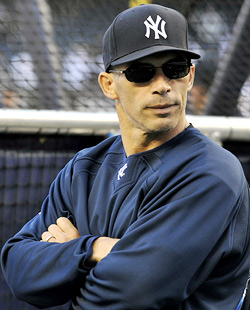 AL MANAGER OF THE YEAR
1. Joe Girardi, New York Yankees
2. Mike Scioscia, Los Angeles Angels
3. Jim Leyland, Detroit Tigers
Sure, Girardi got all the big-ticket Christmas presents last winter, but let’s review: First, last year he was insecure and came off like Captain Queeg. That wasn’t the case this year. Second, he cut down on the one-run strategies (that guys that were bunting were the ones who probably should have been, like Brett Gardner and Francisco Cervelli) and self-defeating intentional walks. Third, he remade the bullpen on the fly for the second year in a row. Finally, he was sensitive to having a veteran team and made a point of resting his regulars.
Against this, we have the Joba Chamberlain rules screw-up, a strange loyalty to Sergio Mitre, the weird survival of non-entities like Angel Berroa on the roster and his favoring of Xavier Nady over Nick Swisher at season’s outset. I’m not sure how many of these issues were solely Girardi’s call or how many current managers would have done better. Let’s also throw in the team’s recovery from a rough start and early abuse at the hands of the Red Sox, and the fact that not all of those expensive toys performed up to expectations from the get-go. Girardi is as good a choice as any manager, despite the Yankees’ bulging payroll.
Scioscia managed a very different kind of Angels team this year, a unit that survived more on its offense, which was the apotheosis of the high-average Scioscia/Mickey Hatcher style, albeit with more power, than its pitching staff that endured many injuries and the murder of Nick Adenhart. They also outplayed their third-order winning percentage by 10 games. Leyland’s team was a mess, but he did restlessly experiment throughout the year with patching its various holes. In the end they outplayed their expected record by eight games.
NL MANAGER OF THE YEAR
1. Jim Tracy, Colorado Rockies
2. Tony LaRussa, St. Louis Cardinals
3. Bud Black, San Diego Padres
In reverse order: Black had nothing to work with and an unstable ownership situation not only meant that the club couldn’t be improved, but that some of his good players, like Jake Peavy, would be sold out from under him. To his credit, the club didn’t quit and actually posted a winning record in the second half. LaRussa started the season with Albert Pujols and pretty much nothing else, and it got worse from there as Khalil Greene imploded, some of the young relievers didn’t take, and Chris Duncan lost his bat. LaRussa improvised a competent lineup while his pitching czar, Dave Duncan, worked miracles with the hurlers. They outplayed their expected record by five games. Finally, Tracy took over a team that was dead in the water, playing at close to a hundred-loss pace through more than a quarter of the season and presided over a .640 finish and a playoff berth. That’s up there with what Bob Lemon did for the Yankees in 1978.
AL ROOKIE OF THE YEAR
1. Andrew Bailey, Oakland A’s
2. Jeff Neimann, Tampa Bay Rays
3. Gordon Beckham, Chicago White Sox
4. Rick Porcello, Detroit Tigers
5. Brett Anderson, Oakland A’s
6. Nolan Reimold, Baltimore Orioles
There were many strong rookie seasons in the AL, but none that really popped, and as such it’s very hard to separate one from the other. Bailey pitched very well, but in a comparatively compressed amount of playing time compared to some of the other candidates. Beckham had a strong year, but his weak August (.223/.313/.393) depressed his numbers just enough that it underscores a future in the middle infield and not the hot corner, while Neimann slipped a bit in the second half. Porcello and Anderson probably have the brightest futures of any of them, and of course if the Tigers does something astounding on Tuesday in saving the division title for his team that could change this ranking.
NL ROOKIE OF THE YEAR
1. Chris Coghlan, Florida Marlins
2. J.A. Happ, Philadelphia Phillies
3. Andrew McCutchen, Pittsburgh Pirates
4. Tommy Hanson, Atlanta Braves
5. Casey McGehee, Milwaukee Brewers
6. Garret Jones, Pittsburgh Pirates
As with the AL, the Senior Circuit enjoyed many solid rookie seasons. Coghlan finished at .321/.390/.460 (128 games) and gave the Marlins the leadoff man they’d desperately needed all season. McCutchen finished at .286/.365/.471 in 108 games. McCutchen may be the better long-term bet, but Coghlan had the more impactful season. On a per-game basis, Garrett Jones was better than either of them on a per-game basis, but didn’t play nearly as much. If Happ took the award it wouldn’t be a crime given the important role he played in stabilizing a pitching staff that was flying apart.
MVP AND CY YOUNG AWARD WINNERS…
…In the next entry.
Walking with Molina
THE THEOLOGY OF JOSE MOLINA
Jose Molina is Friday night’s designated hitter. Did you know that Molina has set his career high in walks this season? His 14th free pass did the trick, shattering his 2005 record of 13. There are all kinds of players — I bet somewhere in his career Barry Bonds got 13 walks in four games. To give Molina all the credit he’s due for his feat, it really does represent a huge uptick in patience. Last year, when Jorge Posada’s injury forced the Yankees to give Molina more playing time than he’d ever received before or ever will again, he walked only 12 times in 297 plate appearances. He’s exceeded that total by two despite coming to the plate 147 times. He’s walking twice as often as he used to. No doubt this is just another example of the cosmic dice finding the sweet spot on Molina’s Strat-O-Matic card again and again, Rosencrantz’s coin coming up heads 92 times in a row. Albert Einstein famously said that God does not play dice with the universe, but this is pretty clear evidence that He does play dice with Jose Molina’s walk rate. Coming soon: The Book of Molina: When Good Things Happen to Inoffensive Reserve Catchers — featuring a new translation of the Book of Job revealing that the whole thing was just a big misunderstanding.
ROSENCRANTZ AND GUILDENSTERN ARE ZACK GREINKE …
… And Jim Leyland is Ophelia. Really. Tonight’s attempt to resolve the never-ending battle of the AL Central features Jake Peavy and the White Sox against Edwin Jackson of the Tigers and Lenny DiNardo of the Royals going against Jeff Manship (whose name always makes me think either of slave-rowed galleys or alien abductions, or both. Methinks the Twins will be but one game out at the end of the night. DiNardo is a journeyman lefty lacking in control or strikeout pitches, and while the Twins have had problems with southpaws this year (they’re under .500 in games started by lefties) DiNardo doesn’t merit any consideration because of his handedness. Manship of Space is a rookie, equally unimpressive in his own way, another Twins pitch-to-contact guy. The thing is, when you’re facing the Royals, pitching to contact isn’t such a big deal.
The Tigers get to try their luck against Peavy, who completely dominated them last week. Familiarity shouldn’t breed success, not with a pitcher of his quality, though it is fair to note that the previous game was at Chicago, and the Tigers have been miserable in road games. As for their own starter, Jackson was impressive early, but note that in the second half his ERA has jumped by two full runs, from 2.52 to 4.53. His strikeout rate has also dropped in that time, going from seven a game to six. In short, his season is a mirror-image of CC Sabathia’s. In his last start against the White Sox, just days ago, he gave up five runs in seven innings. His September includes a solid but unspectacular game against the Rays and seven shutout innings against the Indians. The rest has been mush, the aggregate coming to an ERA of 5.08.
Saturday the odds shift back to the Tigers, as the Twins draw Greinke and they get the sore-armed Freddy Garica. They bombed Garcia last week, but he had actually been pitching very well to that point, with a 3.09 ERA in his previous five starts. Unfortunately, his strikeout rate has been less than intimidating, even in that time, and that means that even if he’s at his best he could give up some runs. The one fly in the ointment for the Tigers is that they’re starting rookie Alfredo Figaro, a sort of functional sinker/change-up guy. One imagines he won’t have too long a leash. The results of Saturday’s play should make Sunday a day of for-all-accounts-and-purposes exhibitions, and the Yankees can get on with the business of figuring out how to beat the Tigers.
If CC gets 20, it will be legitimate
TWENTY, 20, ANDREW JACKSON, CC SABATHIA
Perhaps it’s no big deal for CC Sabathia to win his 20th game now, but there was a time in my life when the Yankees didn’t have 20-game winners. Beginning in 1996 it has happened five times: Andy Pettitte has gotten there twice and David Cone, Roger Clemens and Mike Mussina did it once each. The Yankees had 20-game winners in 1978, 1979, 1980, 1983 and 1985, and then they stopped, seemingly forever. From 1986 through 1995, Yankees starters topped out at 18 wins, and they got there only twice, Dennis Rasmussen and Jimmy Key turning the trick in 1986 and 1993, respectively.
Now, 20-game seasons aren’t all they’re cracked up to be. Sometimes they signify good pitching and sometimes they don’t. Pitchers can have great seasons and not win 20, or even have a losing record — think of Nolan Ryan leading the NL in strikeouts and ERA in 1987 but going 8-16 due to receiving a miserable 3.1 runs per game of offensive support. Conversely, you can name dozens of 20-win seasons that reflected offensive and bullpen support more than they did pitching excellence. Jack Morris won 21 games in 1992 despite an ERA higher than the league average due to nearly six runs of offensive support a game. Former Yankees Rookie of the Year winner Stan Bahnsen won 21 games for the 1972 White Sox despite an ERA a half-run below league average. The next year his ERA was three-quarters of a run better than league average and he lost 21 games. As a statistic, wins can give you some hints as to the proficiency of a pitcher — truly bad ones don’t pile up wins no matter what — but there are a lot of outside factors that go into making a win, and we generally need to look beyond them to discern if we’re seeing real quality or just a fair pitcher who is getting unusually generous help from his team.
 Should Sabathia win 20 games, we need not ask too many of those questions, because these wins have been earned. Sure, he got five runs of support per game, but he also gave the Yankees 21 quality starts in 33 tries and went crazy in the second half, putting up a 2.36 ERA since the All-Star break, upping his strikeout rate from a mediocre six and change per nine innings to an even nine. During the crucial six-week period beginning in early July when the Yankees caught up to the Red Sox and then surged past them, Sabathia made nine starts and won seven of them.
Should Sabathia succeed in winning his 20th, it will have a different feeling than that of Mike Mussina a year ago. That win represented the culmination of a career and a wonderful last hurrah by a great pitcher who had seemed all but washed up the year before. Unfinished business was finished, and a prop was taken away from those who will argue that Mussina doesn’t belong in the Hall of Fame. Crucially, the Yankees were not going to the postseason, so the story was pure feelgood — it had no bearing on the greater history of the franchise.
That is not the case with Sabathia, a big-money ace who actually proved to be worth the money, which is a nice turnaround given 30 years of busts ranging from Eddie Lee Whitson to Carl Pavano. And as with Ron Guidry’s 1978, Ed Figueroa’s 1978 or Tommy John’s 1980, this season meant something toward a pennant. Actually, you can double that, because given the inconsistency of A.J. Burnett, Joba Chamberlain’s lost season, and the constant turnover of the fifth spot in the rotation, Sabathia had only Ol’ Aches and Pains Pettitte to rely on as a wingman — and even he missed time. Now that the Yankees have clinched and the Red Sox are falling away, locked in an autumn malaise, it’s easy to take this pennant for granted, but it was not long ago that the Yankees were gasping for air and the Sox seemed to be on the way to winning 100 or more games. The outcome of this season is the result of a massive reversal of fortunes, and Sabathia was one of the players who engineered that. In short, should he win 20, it will be well worth celebrating a legitimate accomplishment.
A view from the Legends suites
I was given the opportunity to watch a game from the Legends seats at Yankee Stadium, that Goldfinger mini-plane of a section where the elite meet to eat and sometimes watch a ballgame. I came pre-jaundiced, ready to jump on anything that struck me as phony or artificial. Instead, I must report that I had a very good time. It is nice to feel pampered while watching a very exciting ballgame. In fact, if I have any complaint, the pampering was a bit distracting. Had the game been a blowout in either direction, the constant scurrying of waiters and fans fetching food back to the seats would have been a welcome event instead of something that frequently obscured the action.
The high-backed seats were far more comfortable than your typical ballpark torture device. However, they are not positioned perfectly; my seat was a little bit past the infield, and as the seats are not angled, sitting in a natural position would have provided a view only into the short outfield. Combine that with the view being frequently obscured by waiters, fans rising to help themselves to candy and buckets of popcorn (and duck, and sushi, and petit fours), and fans just rising to rise — even these seats play host to the ubiquitous jerk who thinks he can stand in front of you and film the first three innings on his cell phone while you can see nothing but his upholstered backside — and trying to watch the game itself could be a bit of a strain.
Security is also a constant presence, although now that I’ve been in the seats I better understand why. When the Stadium first opened, I was bothered by the concrete moats and Plexiglass barriers between the Legends seats (or “suites” as the Yankees call them) because they offended my sense of egalitarianism. Given that the way the Yankees have elected to set up their Legends benefits, it seems necessary.
Once you’re finally in (after showing my ticket four times and obtaining a wristband), you have free run of the place. Unless you buy alcohol, which is not included in the ticket price, no one asks you for money. This is true not only of the buffet in the main dining room (which is beautifully appointed), but in the subsidiary lounges in which you can, if you choose, fill your arms with food and take it back to your seat. It takes getting used to–I continually expected someone to tap me on the shoulder and say, “Hey! Aren’t you going to pay for that?” They never did. You already paid for it when you bought the ticket.
Some fans I saw were clearly unhinged by the concept. In several places the Yankees have tables piled high with candy for the taking. As I walked past, a couple unfolded plastic bags and were shoveling in piles of M&M’s and Skittles. “Halloween’s come early this year!” the man shouted hysterically. Late in the game, the waiters were making a point of giving the day’s excess away, so I don’t think the team wants to discourage this kind of behavior on the part of the paying customers, but I understand why they wouldn’t want to have those that did not pay able to walk in and start shoving filet of sole and boxes of Rasinets down their pants.
The downside to this policy is that security is a constant and obtrusive presence. They frequently popped into our section to check tickets, attracted, I think, by fans who came late to the section. This contributed to an atmosphere that was in direct contrast to the great friendliness of the waiters and the other staff I encountered.
Several times I heard fans ask for items that were not on the menu, and the waiters promised to make them appear. “Can you guys do a milkshake?” someone asked. “Sure we can,” the waiter said cheerfully (the waiter in our section not only looked like Heath Ledger, but also had an Australian accent — he lives, conspiracy theorists, working anonymously at Yankee Stadium). All of the food and drink orders are sent wirelessly back to the kitchen and brought out by a separate server, so deliveries are nigh-instantaneous.
Those fans that were found to have inappropriate credentials were escorted out of the section. One fellow, apparently slightly inebriated, became belligerent, telling the guard that if he insisted on removing him, he would talk to someone with the Yankees and “have his job.” “You do that,” was the reply, and the guard went about his business. Then the inebriate upped the invective, saying that the guard would be fired and “could go work at McDonald’s for seven dollars an hour.”
“What did you say?” the guard asked. The drunk repeated it. At that, the security guard touched his shoulder radio, called a police officer, and moments later the fan was removed from his seat. Many in the nearby seats applauded — there is no call for saying things like that, especially over a seat at a ballgame and a chance at all the chicken fingers you can eat. Later, I saw the same police officer as we left the ballpark. He was singing along to Frank Sinatra’s “New York, New York,” as if it were an official anthem, and maybe it is.
I wish I could give you a more thorough review of the food beyond it being plentiful. Somehow Heath Ledger gave everyone in my section but me a menu, so I never got a chance to have the duck sent out to my seat, and the buffet options were mostly too meat-centric for my vegetarian self. I stuck with pappardelle pasta in tomato sauce that was a bit on the bland side. The petit fours were delicious though, especially one with coffee-flavored icing. I confess I had two, but then, I could have had ten, or twenty, or taken out a bag and dumped the entire tray.
I was amused to see many adults enjoying ice cream sundaes in upturned plastic Yankees helmets, just as many of us used to get from Carvel when we were kids. I did enjoy sitting in the buffet area, with its dark blue and wood décor and its long bar and countless television sets set to the ballgame. Due to a train mishap (I will spare you my traditional rant on the sorry state of public transit in this country) I got to the ballpark only 15 minutes before game time, but I could see coming early and having a pleasant meal here. I noted as I exited through the same venue that the bar was still serving, and perhaps this is another privilege of being a member, not being chased out of the building the moment the game is over, but instead getting to linger over a beer or cup of coffee and savor the latest win, mourn a loss, or execute a hostile takeover.
I could get used to seeing games this way, though I’m not sure if I would want to, given that morbid obesity would rapidly tip over into simple morbidity were I to avail myself of the all-you-can eat environment too often. Greater self-control than mine is clearly warranted. I also felt oddly guilty, as if the whole exercise was overly decadent and indulgent. The heavy mix of people in suits and ties (including the “go work at McDonald’s” guy) reinforced the feeling that these seats were intended for a class of people who would take this kind of largesse for granted or paradoxically, feel that the premium they paid for the seats would entitle them to act like Hansel and Gretel and gorge themselves on the candy house in the forest, or unfurl sacks and try to cart it home.
That said, there is nothing wrong with the occasional indulgence, and the thought that kept returning is that the Legends seats are a wonderful change of pace, and would make a terrific present for an anniversary, birthday, or graduation. Hey, something special is going on, let’s go see the Yankees in style. And if the other team happens to put Kyle Farnsworth on the mound in a crucial situation while you’re celebrating, so much the better. I don’t think the Yankees can guarantee that, but you may be so busy enjoying the amenities that you won’t notice.
The day after, sans hangover
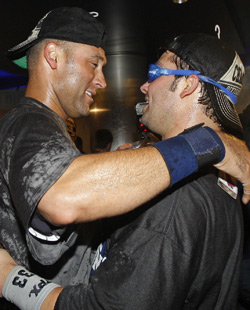 IT’S ABOUT TIME
It seems as if the Yankees have been waiting to clinch for about three months, but seven weeks, ever since the Yankees swept the Red Sox at Yankee Stadium from August 6 to August 9 and went up by 6.5 games. You can shave the Countdown to Coronation to just over a month if you choose August 23 as your starting date. Since August 9, the Yankees have gone 31-14 (.689); since the 23rd, they’ve gone 23-10 (.697). They’ve more than held up their end of the bargain, as even the 1927 Yankees would have had a hard time overtaking them given that level of success. Since August 9, the club has allowed 4.5 runs per game while scoring 5.9. If you discount Sergio Mitre’s starts, the team’s runs allowed in that stretch drops to about 3.2. That’s simply astounding, and given the level of the offense, borderline unfair. Since Mitre won’t come within sniffing distance of the mound in October, that’s the real measure of the offensive/defensive balance that opponents will face. Anything can happen in a short series (stop me if you’ve heard this one before), but the Yankees have to be considered the favorites at this point.
If you’re looking for a key stat, it’s this: the Yankees lead the American League in strikeouts per nine innings, something they haven’t done since 2001 (they finished a close second in 2002 and 2003, those squandered seasons). It’s not a foolproof formula (again, nothing is), but when confronted with a tough offense, as most postseason offenses are, the best thing a team can do to beat them is to get them to swing and miss. When the Royals make contact, the ball doesn’t go too far. When the Angels make contact, it leaps tall buildings. As such, it’s best to keep the bats and the balls from meeting as often as you can.
If the Tigers hold on to their division lead, the Yankees will actually confront a postseason team with a fairly mediocre offense, and that would represent the best of all worlds, regardless of the prowess of their pitching staff — said prowess possibly having been overstated. More on that when and if the Yankees face the Tigers. We’ll be doing the usual head-to-head, position-by-position rankings as soon as the Central race is decided.
HANGOVER
Joe Girardi’s day-after-clinching lineup has no Nick Swisher, no A-Rod, no Jeter, no Teixeira, and the opponent is the Royals. This game should be part of a two-for-one special–buy one ballgame and we’ll give you a pseudo-Yankees game for free. At least Robbie Cano is still in there. It would be something of a shock if he wasn’t. The last time he didn’t start was August 16. The last time he didn’t play was, I believe, on July 3, 1928, when Miller Huggins benched him against Rube Walberg in favor of Mike Gazella. Cano sulked for weeks and ultimately got into a fistfight with Leo Durocher, hastening the latter’s release. Since then, managers have been afraid to bench him, with the result that Cal Ripken, Jr. shattered his record for consecutive games played back in 1995, the record that, paradoxically, Cano is still building.
All of this will be explained in a future installment of “Robinson Crusoe Cano, Time-Tossed Traveler.”
MP3 OF THE MOMENT
Louis Armstrong, “Hobo, You Can’t Ride This Train.” Big hit for Satchmo in 1932.
THE TEACHERS AND ME (YOU NEVER PROMISED ME A SABATHIA SHIRT)
Last week I commented on the child who was forced by his teacher to reverse his Sabathia T-Shirt, and said, among other things, “Longtime readers know that I am no fan of the teaching profession.” This comment reaped the usual mix of responses, and I was prompted to go back and see what I had said here in the past. I first raised the topic in an off-hand remark on Don Mattingly becoming a Yankees coach way back in 2003, and got the predictable firestorm of hostility. Here was my answer then:
The most controversial comment in last week’s PB was this one from the discussion of Don Mattingly as hitting coach: “My own educational experience, which I assume to be typical, is that the ratio of good teachers to mediocrities hacking it out for a paycheck is approximately one out of ten.” Some correspondents thought I had nailed the pedagogical profession while others thought I was being grossly unfair.
The qualifiers offered above were meant to indicate that the statement was entirely subjective. That being said, I feel safe extrapolating from my own experience for this reason: I grew up in a prosperous, middle-class suburban town, one whose school district benefited from an inordinate amount of financial and emotional support from the community. It is considered one of the best in my state and has been cited as one of the best in the nation. And yet, it was terrible.
At six years old I encountered a teacher who was physically abusive (not to me, thank goodness, but to my classmates). Severe verbal abuse was commonplace. Female students were treated by male teachers in a patronizing, insulting manner that would be classified as sexual harassment today. I spent a year with one aged English teacher who was clearly senile–classes sometimes consisted of watching him stare silently at the ceiling–and yet he was allowed to remain. As for Mister Chips, John Keating, Albus Dumbledore–I never saw them. Even the few inspiring teachers I had were flawed. My one favorite, the only one I really admired and to whom I felt sincere gratitude, once, in a rage, attacked me with the blade from a pair of broken shears (long story). I just got away.
This was a good school district, a great school district, so I can barely imagine what an average one must be like, let alone a bad one.
I think back on those shears quite often, as the blade was whipped past my face, knife-thrower style, just missing what is now the eye I can see out of. Then again, it might not have blinded me, it might have just killed me. As I look back over this, I can think of so many details and stories that are left out of that very abbreviated telling, and I may write more about the story in another forum.
The topic came up again a couple of years later. At that time, I received many responses along the lines of those this weekend. Here’s one response along with my answer.
A word about educators. I want you to know that they’re not all bad. My cousin is a teacher in the NYC public school system. She teaches first and second grade. The majority of her students do not speak English at home. The problems she has dealt with include overcrowding, rodents in the classroom, children who are not properly bathed, etc. Many people, include those within my family have encouraged her to seek a position with a private school, where she would be better paid and work under better conditions. She told me something like, “I love these kids, I can’t leave them. Who would take care of them if I didn’t?” To me, she is a great hero! I am a product of a NYC public school education. And as I have moved and traveled extensively throughout the US, I have become more aware of the quality education I received in comparison to many, even private school educated people, in other parts of the country. Just wanted to get that off my chest. — Lis
Lis, I appreciate what you’re saying. I struggle with this all the time. I know generalizations are for dopes and bigotry is for the simpleminded, so for me to paint an entire profession as all good or all bad is weak. I have known good teachers, and I can think of one in particular that had a huge positive impact on my life. Yet, given my own experiences and observations, I do feel that educators like your cousin and the person I’m descri
bing are the exceptions that prove the rule. In fact, the teacher I just mentioned is no longer a teacher, having found, after a long career, that the harassment that came with being good at his job was just too much to take. Perhaps this is true of most professions; one individual excels, all the mediocrities below him try to pull him down. Or perhaps I’m cynical.
The “one in particular” noted above is the same guy that hurled half a scissors at my head. I must have been in a forgiving mood. At the time this response appeared, my oldest child was just starting school, so I had nothing to work with except my own experience. Said child is now well into elementary school, and she has had one or two encounters that have rivaled my own, though no blades were thrown. I don’t want to violate her privacy at this time by writing about what she has gone through in specific terms, since at her age I can’t ask her for her permission in a way that’s really fair. What I can say is that I’m in there fighting for her, because I will not let her be terrorized the way I was.
All I can say is that I’m sorry and I’m not sorry. I’m sorry I hold this particular view, because as I said above I recognize that it is not wholly fair, but I’m not sorry because I am justifiably bitter and will remain bitter for the rest of my life. I love learning. I like being challenged to pick up new things. I’m like that now and I was like that as a child. Then I saw six-year-olds hauled out of chairs and thrown to the floor, or I was repeatedly brought up before a class, harangued, and called stupid because of some perceived offense like poor penmanship. I fondly recall the elementary school gym teacher who called me “[reproductive gerund] useless” in front of my class because I couldn’t do X number of chin-ups one day, or the junior high school English teacher with whom, because of a little classroom disagreement, called my father and told him I was in danger of failing out of school–you can imagine how my father let me have it when I got home–a story she invented out of whole cloth (this incident damaged by relationship with my father for years), or the high school teacher who admitted I knew more about history than he did but was going to fail me anyway. Where I was at first eager, I became afraid, then angry, then resentful, and pretty much turned off until college. I am admittedly biased, and yet I have seen what I have seen. I have seen my education and my daughter’s. I am working against a confirmation bias, but it can’t be helped.
Are there great teachers? Sure. I don’t deny their existence and never have. Do I think they’re anything like in the majority? No. Do our educational statistics bear out that they are anything like in the majority? No (that’s not letting the parents off the hook, of course). I have had friends who have become teachers, but only after failing at some other profession. I had friends in college who became teachers, but only after failing at some other major. Again, these are very narrow slices of information and seen the way I want to see them. I admit that. My anger overcomes that rationality. As a victim of a kind of abuse, what I most want is to run into one of those by-now ancient men or women and be able to say, “Scream at me now! Call me stupid now!” I want to say now what I didn’t have the power to say then. Once I’ve gotten that out of my system, I might be more able to hear arguments about this prejudice, the only one I permit myself.
In closing, to all you great teachers out there, to all of you who are proud relatives of great teachers, I apologize and would very much like to know what it is that makes you different. As for the rest of you, my wish for you is that you find another line of work… But before you do, please join that Yankees-hating teacher on the concourse outside of the Stadium, starting an hour before the first game of the ALCS. Tell everyone who comes by wearing a Sabathia shirt, or better yet a Jeter shirt, to cover it up or else. I promise I’ll send flowers.
MORE OF ME
On Tuesday at 1 PM EST, I’ll be fielding your questions live at Baseball Prospectus. As always, if you can’t tune in and participate at the starting time, you can post your questions in advance here.
This series still matters
 RED SOX REDUX
The alliterative phrase “possible playoff preview” is overused, but here we have one of those series that could be exactly that. If the current seeding holds through the end of the season, the Yankees would face Detroit in the first round and, if they survive that test, see the winner of a Red Sox/Angels match-up in the second round.
Facing either opponent emphasizes the importance of maintaining the division lead and home field advantage, because the Red Sox are a .500 club on the road to date, and despite the recent successful action in Anaheim, the Yankees want to see as little of California as possible. Beating the Tigers only to find out one has to play up to four games in Anaheim might be the only time in sports history that the line, “I’m going to Disneyland!” would signify a negative.
Derek Jeter: I’m going to Disneyland! Aw, [expletive, expletive, expletive]!”
Thus, this series does matter in a real way, beyond the usual Red Sox-Yankees hoopla. There are also three pitchers undergoing key tests: Joba Chamberlain gets yet another chance to lower his post-Rules ERA from 8.50, and against a pitcher, Jon Lester, who has been almost unhittable since getting off to a rough beginning to the season, so there’s not a lot of margin for error. On May 26, Lester was 3-5 with an ERA of 6.07. He’s made 20 starts since then, going 11-2 with an ERA of 2.13. I hope that you readers won’t fault me too much when I say that I root for Lester as a fellow cancer survivor in spite of the uniform he wears. Some things transcend petty rivalry. I don’t mind if the Yankees beat him, of course, but I’d rather it was by a 2-1 score than a 15-1 score. In any case, much as with Joba’s most recent start in Seattle, the Yankees stand a good chance of being lulled to sleep if Joba allows the Sox to score an early touchdown.
On Saturday, CC Sabathia gets a chance to continue his recent dominance against a resurgent Daisuke Matsuzaka, which is really just a game of minimal expectations: You don’t have to win, but don’t pitch so badly that people start to wonder if you’re hurt, or have turned into Joe Cowley or something. On Sunday, Andy Pettitte will get a chance to put his shoulder fatigue further behind him, drawing Paul Byrd as his opponent, Byrd being Boston’s placeholder for a guy named Hypothetical Better Starter that We Don’t Have.
In short, it’s a weekend of confidence testing, of pulling back from a 3-3 road trip. The playoffs are assured and even the shape of the playoffs as far as the Yankees goes seems largely locked into place, so the key thing here is to not fall apart. That doesn’t seem like very much to add.
DARN PLATOONING
Lester on the hill means Melky Cabrera in the lineup. Last year at Triple-A, Brett Gardner batted .324/.407/.495 against southpaws. This year in the Majors he’s hit .302/.393/.415 against them. Cabrera has hit .261/.335/.418 against them, and those rates have slid in the second half — whereas Cabrera hit .267/.345/.480 against lefties through mid-July, since then he’s hit only .256/.326/.359 against them, which is actually a pathetically poor number for a right-handed hitter against left-handed pitching.
This year, all right-handed hitters in the Majors are batting .268/.341/.431 against lefties. All right-handers have a built-in ability to hit left-handers, but not Cabrera. His career averages against southpaws stand at .254/.323/.354, and as with so much about his post-April work, his final numbers are going to be reflective of what he’s done in the rest of his career rather than what he did earlier this year. Joe Girardi really needs to forget about what he thinks he saw this spring and move on with things.
AMERICA, AMERICA
I note Baseball Think Factory:
The blue shirt read “New York No. 52” on the front and “Sabathia” for the New York Yankees’ pitcher CC Sabathia, on the back.
” I thought to myself ‘Is he serious or is he kidding,'” said Nate, 9, a student in Peter Addabbo’s fourth-grade class. “But he had this look like he wasn’t kidding at all.”
Nate complied, and said he was later told to wear it that way until dismissal. At lunch, Nate said the fifth-graders made fun of him because he wearing his shirt inside out.
“It was such a horrible day.” Nate said. “I don’t ever want anything like to happen again.”
Nate said he felt he was treated unfairly.
“Just because my teacher doesn’t like the Yankees I should still have the right to wear a Yankees shirt,” Nate said Thursday after school. The teacher has Boston Red Sox paraphernalia all over the classroom on display, he said.
I have long felt that one of the problems with the educational experience in our country is that school is a place where they teach you about your rights and then fail to honor them. As an aspiring columnist in high school, I simultaneously learned about first amendment rights and was subject to prior restraint and press censorship because the administration didn’t like my choice of topics.
Apparently, now you can also be bullied because the teacher doesn’t like your choice of teams. Had the kid been wearing an Obama T-Shirt, or for that matter a Richard Nixon T-shirt (a friend actually did wear one in high school, albeit as a kind of ironic statement), the violation of his rights would have been much more obvious and probably wouldn’t have been contemplated. Instead, the kid, a fourth-grader, all of nine years old, was singled out in a possibly traumatic way. The petty tyranny of some teachers over children is astounding to behold. They indulge in arbitrary behaviors that they would never, ever have the guts to pull with an adult.
Longtime readers know that I am no fan of the teaching profession. As time goes on and my own children get further into the school system, and I read of matters like this one, I see little to change my mind. This incident was wholly inappropriate and the teacher should be disciplined — and although this is a Yankees-centric feature, I would say that even if the roles were reversed, and an educator who was a Yankees fan told some helpless child to reverse his Kevin Youkilis T.
Since he’s such a brave Red Sox fan, his punishment should be to stand outside of Gate 4 of Yankee Stadium this weekend and ask everyone coming in to reverse their T-shirts. I’d like to see the reaction of people old enough to answer back. Pathetic, pathetic, pathetic.
 Pinstriped Bible