Category: Dailies
Where are the replacements?
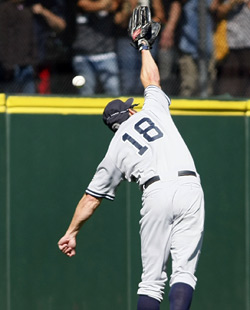 With the amateur draft signing deadline having just passed, I want to spend a couple of entries here looking at the Yankees’ farm system with an eye towards a very specific problem, the absence of solid outfield prospects. The Yankees don’t have them and haven’t developed one in a very long time. While Melky Cabrera and Brett Gardner have their uses, the last outfielder to emerge from the farm system and have anything like a substantial, above-average career with the Yankees was Bernie Williams.
This puts immense pressure on them to retain an aging Johnny Damon this offseason whether giving him another contract is a good idea or not. This is the same pressure that led to the decision to sign Carl Pavano and Jaret Wright a few winters ago when the farm system could not render up quality pitchers. That problem has been treated to a large extent, but the absence of quality position players continues to impel the Yankees towards free agent adventurism.
Since the great center fielder/guitarist, numerous outfielders have passed through the system on their way to the Bronx without making a lasting impression. The parade includes Gerald Williams, Shane Spencer, Ricky Ledee, Ruben Rivera, Kevin Thompson, Justin Christian, Kevin Reese, Shelley Duncan, Donzell McDonald and even Mike Vento. The best of the lot were Marcus Thames, who was dealt away to the Rangers for the mortal remains of Ruben Sierra in 2003, and Juan Rivera, a strong hitter with a tendency towards injuries. He too was traded in 2003, to the Expos as part of the package for Javier Vazquez.
What is meant by a “solid” outfield prospect? It’s a young player who might hit even five percent better than the league average at his position. That’s not asking for the moon or Joe DiMaggio. Five percent better than a Major League average left fielder would be .282/.358/.460; for a center fielder it would be .281/.353/.441; for a right fielder, .284/.362/.465. This is asking for a good player, not a great one. Don’t take those numbers too seriously — they’re just broad guideposts for a hypothetical player who might hit for more power or take fewer walks while arriving at roughly the same place. Whatever your definition of “slightly above-average outfield starter,” that is what is being aimed at.
Prior to the season, Baseball America compiled their list of the top 100 prospects in baseball and placed two Yankees position players on it, Austin Jackson (No. 36) and Jesus Montero (No. 38). Considering Yankees prospects exclusively, they ranked the top 30 players in the organization and found only 10 position players worthy of ranking that high. Among these were four outfielders: Jackson, Kelvin DeLeon, Abraham Almonte and Gardner.
Kevin Goldstein of Baseball Prospectus also compiled a top 100 prospects. As with Baseball America, Jackson (No. 46) was the only Yankees outfielder to rank among the elite prospects in the game. Goldstein also compiles rankings of each organizations top 11 prospects, plus honorable mentions. Using those lists, I compiled the top 86 prospective outfielders coming into the season. Just two of the 86, Jackson and DeLeon, belong to the Yankees.
Although Goldstein’s lists of 11 are more restrictive than BA’s top 30, the shorter list ensures that we are examining players who have a chance to start, as opposed to the likely reserves who often fill out BA’s lists for thinner organizations. Almonte may be the 30th-best prospect in the Yankees organization, but given his current offensive profile (“current” because he is quite young and could evolve) his chances of starting for the Yankees or any team is nil.
Thus, 84 of 86 top outfield prospects coming into the season belong to other organizations. The purpose is not to second guess — as you will see, some of the best of these prospects were early first-round picks, and thus unavailable to the Yankees due to the nature of their consistent high finishes, and it would be unfair to criticize them for that — but to ask what priorities and assumptions the Yankees were working off of in the draft, and to see if other teams are doing a better job of finding outfield prospects in the later rounds or on the international talent market, where good scouting and luck play a greater part.
If the Yankees are stumbling into fewer of those “solid” non-star starters than would be expected, be it because of organizational priorities or simply poor choices, we’ll see why as we explore the top 86 and where they were selected in the draft.
First Round (13): Colby Rasmus (2005/HS), Cameron Maybin (2005/HS), Andrew McCutchen (2005/HS), Brian Bogusevic (2005/C), Trevor Crow (2005/C)Travis Snider (2006/HS), Drew Stubbs (2006/C), Tyler Colvin (2006/C), Jason Heyward (2007/HS), Matt LaPorta (2007/C), Ben Revere (2007/HS), Wendell Fairley (2007/HS), Aaron Hicks (2008/HS).
What the Yankees did: These players were selected in the 2005 through 2008 drafts, so we’ll look at what the Yankees did in those drafts. In 2005, the Yankees picked at No. 17 thanks to the Phillies signing away Jon Lieber. Their own pick at No. 29 went to the Marlins because they signed Carl Pavano. By the time the Yankees picked, Maybin (No. 10), McCutchen (No. 11), and Crowe (No. 14) were off the board, as was Jay Bruce (No. 12). The Yankees spent their pick on the miserable high school shortstop C.J. Henry. Subsequently, John Mayberry (No. 19), Jacoby Ellsbury (No. 23), Bogusevic (No. 24), and Rasmus (No. 28) were selected.
In 2006, the Yankees gave up their first-round pick (No. 28) to the Red Sox to sign Damon, but for the second year in a row the Phillies handed them their own pick to sign a Yankee who wouldn’t help them much, Tom Gordon. By the time they picked at No. 21, Drew Stubbs had gone to the Red at No. 8, as had Colvin (No. 13) and Snider (No. 14). Another strong hitter, Chris Marrero, went to the Nationals at No. 15 (he was later shifted to first base). The Yankees selected Ian Kennedy. Two other outfielders went in the first 30 picks, Cody Johnson to the Braves at No. 24 (he appears to have potential in a Steve Balboni kind of way), and Jason Place to the Red Sox at No. 27.
In 2007, the Yankees picked 30th, last in the first round. Jason Heyward, who might be the best hitting prospect in baseball just now, was selected from the planet Krypton at No. 14. Ichiro-type Ben Revere went at No. 28, and the Giants took Fairley at No. 29, setting up the Yankees to shock the nation by selecting Andrew Brackman, the less said of whom the better. We’ll look at who was still on the board in the ’07 supplemental and second round when we get to the supplemental picks.
In the Year of Our Draft 2008, the Yankees picked at No. 28. Naturally, a lot of the interesting guys were gone. Even the Yankees’ own interesting guy was gone because they didn’t sign their pick, pitcher Gerrit Cole. Hicks was the only outfielder selected in the first round. He went to the Twins at No. 14.
These last four drafts have been borderline disastrous for the Yankees insofar as the first round, where the sure things are supposedly to be found. They completely missed on Henry, and only the recklessness of the Phillies allowed them to redeem the pick by taking him in return for Bobby Abreu, but it’s clear that if the Phillies took Henry they would have taken anybody — the move was the Alex Rios salary dump of 2006.
Brackman also appears to be a complete miss, but it’s too early to write him off despite the 6.56 ERA and seven walks per nine innings in the Sally League. The failure to sign Cole got the Yankees
an extra pick in the 2009 draft, but there’s still an empty spot in the organization where a player with one year of experience would have been.
 Only Kennedy has rewarded the Yankees’ evaluation of him as a prospect, at least until his blood clot surgery this year. That, at least, is an act of God, not scouting. What rankles is the availability of Rasmus, now a rookie center fielder for the Cardinals, in 2005, not to mention Ellsbury, Matt Garza, and Joey Devine, all first-round selections after the Yankees took Henry. Perhaps there were extenuating circumstances, such as Georgia boy Rasmus indicating he would not be happy in the big city, but the same cannot be said of the other players available at that spot.
First Round, Supplemental: Michael Burgess (2007/HS), Kellen Kulbacki (2007/C), Corey Brown (2007/C), Julio Borbon (2007/C), Zach Collier (2008/HS), Jaff Decker (2008/HS).
What the Yankees did: The Yankees didn’t have a supplemental pick in 2007, so they got to watch as Burgess, Kulbacki, Brown, and Borbon (now playing well in the Majors) were selected. In 2008, the Yankees did get a supplemental first-rounder due to the Rockies signing Luis Vizcaino. It was the 14th of the round, two from the bottom, and Collier and Decker had already disappeared by the time they picked. They used the pick on Stanford lefty Jeremy Bleich, now pitching at Double-A Trenton. Note below that a number of quality outfield prospects were available at this point, as several were selected early in the second round.
Second Round: Seth Smith, (2004/C), Nolan Reimold (2005/C), Jon Jay (2006/C), Mike Stanton (2007/HS), Charles Blackmon (2008/C), Cutter Dykstra (2008/HS), Destin Hood (2008/HS), Xavier Avery (2008/HS), Dennis Raben (2008/C), Kenny Wilson (2008/HS), Jay Austin (2008/C).
Now things get interesting, because any of these players were available at the time that the Yankees picked at the end of the first round. In 2005, the Yankees picked at No. 15 in the second round thanks to the White Sox signing Orlando Hernandez (there should probably be an axiom in baseball that says that if the Yankees don’t feel like spending the money to retain their own free agent player, that player is probably not worth having). Their own second round pick (No. 29) went to the Braves due to the ill-considered signing of Jaret Wright. The Orioles took current rookie Reimold two picks ahead of the Yankees, who selected reliever J.B. Cox, now pitching at Trenton.
The Yankees had no second-round pick in 2006 because their pick went to the Braves as compensation for Kyle Farnsworth, which is depressing. Cardinals center field prospect Jay would have been available to them. The Yankees had the last pick of the round in 2007. They made a solid pick in catcher Austin Romine, currently batting .277/.319/.445 for High-A Tampa. The Yankees picked 29th in round two, 2008. They went with Ole Miss righty Scott Bittle, who they elected not to sign. As we will see momentarily, this meant passing on a couple of quality outfield prospects who would be selected in the third round.
We’ll pick up with the third round in our next entry.
No apologies for Yankees Stadium II
YANKEE STADIUM II (III) AND ITS DETRACTORS
In yesterday’s chat, I was asked “What do you think of the new Yankee Stadium? Does the avalanche of home runs to right bother you?” My response: “Not at all. It just is what it is. At worst, it really requires the Yankees to re-embrace their traditional love of left-handed hitters and pitchers, something that had gotten lost with the various shrinkages of the left side of Yankee Stadium over the years.”
As the year has rolled on, I’ve been mystified by the cynical response to the way the new park plays, not least because it has been competitively advantageous for the Yankees. The offense has out-homered the opposition 107-78 in the same number of at-bats, and the pitching staff’s ERA is a third of a run lower at home than on the road. As long as the Yankees keep the park in mind when building the team in the future, it can continue to be so. This year, Yankees opponents have gotten lefties to the plate at Yankee Stadium roughly 850 times, as compared to 1384 tunes for the Yankees. That advantage might be ephemeral — the Yankees won’t always have four switch-hitters and three lefties in the lineup every year — but if they can maintain some semblance of that balance, as well as place renewed emphasis on the drafting a development of left-handed pitchers, and the park should continue to be an asset.
Whatever the Yankees do, I hope that they won’t rush out as soon as the season is over and reconfigure the fences. First, 81 games (plus a few postseason contests) isn’t enough to get an accurate reading on the park. Second, if people talk, let ’em. Whether it’s Coors Field and its altitude or the old Polo Grounds with its shortened foul lines, which resulted in home runs which were criticized as cheap, or even Babe Ruth’s porch at Yankee Stadium I, they’re all legitimate versions of a playing field. The great thing about baseball there are no correct parks or incorrect parks. They just play the way they play. The Yankees have nothing to apologize for.
 MATSUI’S MASHING AND THE FUTURE OF EVERYONE AND EVERYTHING
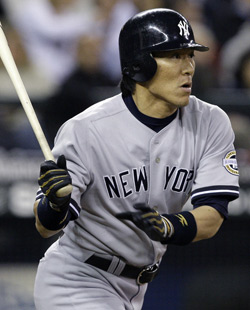
Whenever one of the Yankees’ potentially departing free agents has a big night, usually Johnny Damon but on Thursday night Hideki Matsui, a conversation starts up as to whether the player should be retained. The talk has some validity. The Yankees are not deep in outfield prospects, Austin Jackson’s .301/.362/.413 at Scranton translates to only .266/.330/.385 in the Majors, and he’s been cold for about 10 weeks; because the free agent class is going to be on the weak side, with an emphasis on older players. That limits Brian Cashman’s choices. He can let Damon and Matsui go, figuring that although they’ve done well this year, their negatives — age (Damon will turn 36 in November, Matsui next June) and defensive limitations (Damon has slipped, Matsui’s knees don’t even let him play) — are good enough reason to move on.
In a vacuum, letting the oldsters go would be correct call. However, it also means the menu of alternatives could be a Brett Gardner/Melky Cabrera/Nick Swisher outfield and a rotating DH, which would be offensively light, or the above with Jackson mixed in, or the above with a very young Jesus Montero mixed in at DH, or giving too much money and too many years to Matt Holliday or Jermaine Dye or Magglio Ordonez … or hope to trade the entire farm system to the Braves for Jason Heyward, which won’t happen. It is because of scenarios like these that general managers are paid the big bucks.
As always, much pain could have been avoided if the Yankees had been more adept at drafting and development in recent years. The farm system has clearly improved over the last few seasons, but even having said that, it seems that too often there is cause to observe that the development of position players lags far behind that of pitchers. This has been a glaring problem for so long that it’s hard to believe that the Yankees have not spent time identifying the problem (I am not pointing fingers at anyone, but they need to point fingers at someone or someone(s) or some aspects of what they are doing) and doing something to remedy it, which surely would be cheaper than continuing to pay bonuses to players who end up doing little more than filling out the farm system.
Even if those changes are implemented tomorrow, they will take time to pay off for the big team in the Bronx, so this season’s dilemma remains. I wish I had a brilliant suggestion to solve the problem, other than Montero should be allowed into the mix before long if he heals up well — no use wasting a ready bat waiting for a defensive evolution that might never come — but whereas as season’s outset it seemed like there was no scenario in which it would be worthwhile to bring Damon and Matsui back, now one can at least glimpse situations in which retaining one or both on a short-term contract — most likely Damon given Matsui’s utter loss of speed — isn’t more likely to have a worse outcome than any of the other possibilities.
That’s not exactly a strong endorsement, but it’s more than you could have said in April.
Banged-up Yankees should survive Seattle
THAT WALK-OFF MAGIC
Nothing magical about it. The secret is that the bullpen ranks, somewhat miraculously, as the best in baseball. When you have a reliever corps that can prolong games indefinitely so that the potent offense can get one more at-bat, and then another, and another, you’re going to have a lot of last at-bat wins. Joe Girardi takes some flak for the way he runs a bullpen, and there are certainly some eccentricities in the way he handles things, but his relentless pursuit of a working pen (as opposed to Joe Torre’s relentless pursuit of one reliever he could pair with Mariano Rivera) is commendable.
After the season, we can debate whether the attention devoted to the bullpen came at the expense of the starting rotation, but it doesn’t seem to be the case right now, at least not in non-Sergio Mitre starts. Speaking of which, Chad Gaudin made a nice case for himself on Wednesday, but this weekend’s consecutive Gaudin and Mitre starts will serve as a kind of playoff between the two, or should. Not that the Mariners’ offense is a fair test….
20-GAME WATCH: YANKEES AT MARINERS
| W-L | RS/G | RA/G | AVG | OBP | SLG | AB/HR | SB | CS | HR/9 | BB/9 | K/9 | ||
| Yankees | 14-6 | 5.8 | 4.5 | .295 | .367 | .515 | 21 | 8 | 2 | 0.8 | 3.1 | 8.3 | |
| Mariners | 10-10 | 4.2 | 5.6 | .270 | .320 | .382 | 51 | 6 | 3 | 1.7 | 4. | 6.0 |
The Mariners are a 91-win team at home, the Yankees an 88-win team on the road… It’s hard to believe that the M’s are 10-10 with a hitting and pitching record like that, but there are seven one-run victories hidden there, two over the Tigers, two over the Blue Jays, one over the Royals, one over the Rays, one over the White Sox. That’s a clue that the M’s bullpen has generally been effective, and indeed, Seattle relievers rank fourth in the Majors in wins added. David Aardsma’s transformation from blown No. 1 pick (by the Giants back in ’03) to reliable closer is one of the top 50 stories of the year (he said, without really figuring out what the other 49 are). One suspects it won’t last due to the very low batting average on balls in play against (.258, though the line drive rate is also on the low side) and Aardsma’s high walk rate, but the Mariners get to enjoy it while it lasts.
The Yankees catch a break in this series because Felix Hernandez just pitched, so they get an ex-Pirate salvage operation in Ian Snell, Ryan Rowland-Smith, who is still getting established in the bigs, and two rookies, Luke French and Doug Fister. With Mitre and Gaudin starting in this series, the Yankees aren’t exactly putting forth Whitey Ford, Red Ruffing, Vic Raschi, and Ron Guidry, but they lap the M’s in experience this time around.
As for the Mariners offense, it’s down to Russell Branyan, Ichiro (who is having one of his best years and leads the league in hits despite missing the first two weeks), and a surging Franklin Gutierrez, who is finally displaying the kind of ability he showed in the Dodgers’ Minor League system roughly 50 years ago. Overall, this is the least potent offense in the AL, racing the Royals to the bottom. You never know what might happen, particularly if the various nicks the Yankees suffered in Wednesday’s game lead them to post a sub-optimal lineup for a couple of days, but the Yankees should be able to make a strong showing in this series.
CHAT WITH THE FAT, GOATEED YANKEES GUY
Chatting live at Baseball Prospectus. Come one, come all.
New set of rules hurting Joba
A FEW QUICK NOTES BEFORE THE DAY GAME
Randy Ruiz is a nice story, but are the Blue Jays kidding, calling him up to DH and playing Joe Inglett in right field when they have Travis Snider in the Minors? Sure, Snider failed to hit coming out of Spring Training, but he’s batting .319/.414/.650 at Las Vegas, is crazy hot right now and remains a top prospect. The decision is a nice break for the Yankees, given they get to play an opponent without a right fielder and a DH without plate judgment — Ruiz has power, but what has kept him in the Minors is that he’s a hacker without a position. It’s a dubious call on the part of the Jays, unless they care more about retarding Snider’s service time than fielding a competitive unit for the rest of the year.
On Derek Jeter’s quest for 3,000 hits: If Jeter plays in the Yankees’ remaining 49 games (we know he’ll be forced into a day off shortly, but this is a thought experiment; adjust accordingly) and continues to average 4.3 at-bats per game, that would give him another 211 at-bats. Say he maintains his current .318 average over those at-bats. He would add another 67 hits to his current 145, giving him 212 for the season and 2,747 for his career. Three-thousand would still wait for 2011, but he’d be much closer than could have been expected at the start of the season.
Finally, a quick note about the Joba Rules II: They might not make sense and could hurt Joba. The danger might not be innings pitched, but stressful pitch counts. That Joba might throw a few more innings than the Yankees want is probably not a big deal, and in any case, you can’t know exactly where the injury inflection point is. The only foolproof way of dealing with that is to wrap him in Mylar and stick him in the basement.
No, the bigger danger is more likely to be created by the extra time off than to be prevented by it, and that is high-pitch innings. The less fine control Joba has, and he seems to have less with the extended layoffs and the knowledge that he’s on a short leash, the more he’ll labor in games, have innings in which he walks two batters, allows a hit, and strikes out another. We don’t know for sure, but it’s entirely possible that 110-pitch outings are not created equal, and that a game where a pitcher throws 50 pitches in one inning and 60 in all others is far more damaging to the arm than one in which the pitches are more evenly spread out. It is entirely possible that the Yankees are creating exactly that situation here. There’s nothing more dangerous than good intentions.
Mickey Mitre (M-I-C, K-E-Y…)
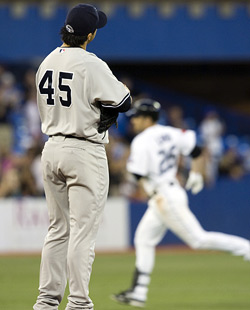 I was immensely frustrated by last night’s game, first because Sergio Mitre started it, second because after the Yankees tied the game in the bottom of the fourth Mitre was allowed to pitch the fifth so he could un-tie it again, third because Joe Girardi spun the game as a good start but for a wayward defensive play, and fourth because of a conversation with Brian Cashman that Michael Kay related during the game.
Let me take the last one first. Kay quoted Cashman as saying (I paraphrase, as I don’t have a transcript handy) in defense of Mitre that if you look around the league, who has a fifth starter that’s better than Mitre anyway? This may very well be true — few teams go four deep in good starters, let alone five — but it should not be an excuse to stop trying to find something better, particularly when, in Chad Gaudin, you have someone who has been demonstrably better in his career.
Even if one is willing to grant that Mitre had a good start — I’m not, but you may, Girardi may, Cashman may — that is but one start in a career in which the pitcher has allowed nearly six runs per nine innings pitched. In 57 games started, he’s made just 20 quality starts, or 35 percent, when the league average is closer to 50. And while it is positive that he’s walking just two batters per nine when he used to walk three or four, there are other aspects to pitching. Further, six strikeouts in five innings is nice, but the Jays weren’t playing John Olerud, Roberto Alomar and Paul Molitor. Getting Rod Barajas and Jose Bautista to swing and miss is not exactly unusual. Further, note that Mitre got three strikeouts in the first, then two more in the second, and one leading off the third. After that, he failed to K his last 14 batters. The Jays weren’t fooled anymore.
Gaudin isn’t a great pitcher, but he’s made 69 starts in his career, and at 26 has more time to work things out than the 28-year-old Mitre. Gaudin has made a quality start 42 percent of the time, below average but better than Mitre by a reasonable amount — given the same number of starts, Mitre would make 24 quality starts to Gaudin’s 29. That little edge is something worth shooting for. As I said yesterday, just because the Yankees’ place in the postseason is assured doesn’t mean that it can be taken for granted.
OTHER STUFF
? Tough blow for the Nationals losing Jordan Zimmerman to TJ surgery. Nothing derails a building program faster (and more predictably) than pitcher injuries.
? Keith Law made a very good point at ESPN.com — that even if the Jays got Kenny Williams to take Alex Rios on a waiver claim, the very fact that they gave him away for nothing underscores the magnitude of the misjudgment by J.P. Ricciardi by issuing the contract in the first place.
? Ryan Franklin of the Cardinals demonstrates why many closers are overvalued, as is the closer’s role itself. The man has allowed six runs all year. Where is it written that he is a closer, or that he should have even been considered? P.S. Mariano Rivera is not overrated. He’s sui generis.
? Geovany Soto hit a home run last night, but he’s still looking like the new Rick Wilkins. And Jacoby Ellsbury is the new Dave Collins, who Bill James called, “A leadoff man who doesn’t score runs.” Good enough for me.
? Kevin Goldstein’s most recent article at BP is about how good middle infield prospects aren’t making their way into the Minors. What this says to me is that Derek Jeter’s replacement will be long in coming. Sadly, Troy Tulowitzki (hit for the cycle last night) and Hanley Ramirez are tied up forever.
MORE FROM ME
I talk about the years of Phil Rizzuto’s MVP, when shortstops out-hit first basemen, at Baseball Prospectus. Also, a reminder that I’ll be chatting live at BP Thursday at 1 p.m. EST. As always, if you can’t make it to the event itself, you can put your questions in the queue at the link above and I’ll look ’em over when we start up.
Some Yankees math
The Yankees are now 69-42, which puts them on a pace for 101 wins. Let’s say the Yankees maintain that pace — they don’t get better and they don’t get worse. The Red Sox would need to win 102 games to take the division title. Given their present record of 62-48, the Red Sox would need to win 40 of their remaining 52 games, or 77 percent. That’s equivalent to winning 125 games over a full season.
While not impossible, it’s also not likely. Consider an alternative scenario, one in which the Yankees somehow have a rough go of it the rest of the way and play a game under .500 for the remainder of the schedule. In that case, the Yankees would finish at 94-68. To reach 95 wins, the Red Sox would need to go 33-19. That’s a .635 winning percentage, in the realm of possibility, but it still requires Boston to spend one third of the season playing as if they were a 103-win team. Obviously, for any team behind the Red Sox, such as the Rays, to displace the Yankees, the road is that much harder.
In short: While you can never take anything for granted, this sweep has put the Yankees in a very, very good place.
Taking the Yankees’ initial 0-8 against the Red Sox out of the equation, New York is 69-34 (.670), and Boston is 54-48 (.529). Those wins by the Red Sox were legitimate, but now seem like a fluke event. The record the rest of the way is simply not comparable. The 2009 Yankees could be a team we will remember. However, much remains to be done. As I pointed out yesterday, the Yankees have had “special” teams in recent years that didn’t bring him any rings. The 2002, 2003, and 2004 Yankees all won over 100 games and were, respectively, bounced out of the first round of the playoffs by the Angels team they can’t seem to beat, mismanaged to a loss in the World Series, and the victims of a historic reversal of fortune against the Red Sox in the ’04 ALCS. The intensity that the Yankees showed in this series, particularly on the pitching side, has to carry over or the events of the past weekend will end up as little more than a footnote.
DECISIONS, DECISIONS
Like all of you, I was initially shocked and appalled at Phil “Home Run” Coke pitching to right-handed batters in the eighth inning, and doubly appalled when premonitions of doom proved to be highly accurate. I’m not going to criticize the manager for that call, not with too much conviction, anyway. For obvious reasons, Joe Girardi had not let the world know that the bullpen was mostly off-limits. I will say that if Girardi really has an ironclad aversion to using pitchers in three consecutive games (a quick look at the record shows that Joe Borowski pitched in four straight games in August 2006 and pitched in three straight games on one other occasion that year; Matt Herges also did so once. Jose Veras appeared in three straight games without an off-day twice last August, and Damaso Marte pitched in four straight games during the same period) then his usage of Hughes for one out in each of the previous two games was shortsighted.
Today will bring more in the way of decisions and bullpen usage because Sergio Mitre is pitching, which is another way of saying that Chad Gaudin will be making his Yankees debut in the fourth or fifth inning. Mitre is 11-23 with a 5.48 ERA in his career, and he’s been lambasted this season. It’s not clear why the Yankees are persevering with him, especially since Brian Cashman has secured the team a better alternative in Gaudin. If the postseason is truly assured, or at least likely, the fifth starter is now auditioning for a role in the bullpen. Try to imagine the circumstances in which Girardi would call Mitre in during a playoff game. No, I can’t think of one either.
The Blue Jays are 12-19 since the end of June. The Yankees will miss Roy Halladay in this series, which means they have a more than fair chance to keep their winning streak alive. That’s if they don’t throw it away on one more Mitre adventure. The only way the club can lose now is to take things for granted, and pitching Mitre is doing just that.
Is fatigue an issue for CC?
 COMPLICATED SHADOWS
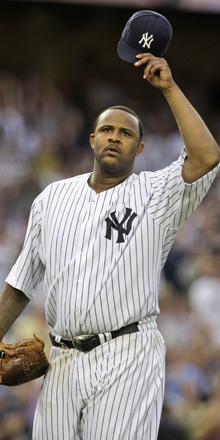
Writing before the start of this series, I asked if CC Sabathia would rise to this challenge, and asked if it was fair to expect him to do so given his performance to date, one that was, by his own standards, weak. I don’t have to tell you how Sabathia answered that question. The next question for Sabathia — there’s always another one — is if he can take the fire he showed against the Red Sox and carry it with him through the rest of the season AND have enough left in the tank for his increasingly likely postseason appearances. Sabathia’s postseason record is the mirror-image of Mariano Rivera’s; he has a 7.92 ERA in five starts. The reason seems to be not nerves, but fatigue. In the past two seasons, Sabathia worked so hard getting his team through September (Milwaukee’s rare postseason appearance last year was his personal work), he was gassed in October. Such an outcome would reduce Saturday’s triumph to the level of a Pyrrhic victory.
And a glorious victory it was. With the Yankees’ second straight shutout, the Red Sox are now batting .144 for the series. The Yankees have discovered Boston’s hidden shame: once you get past Kevin Youkilis, Jason Bay, and (recent acquisition) Victor Martinez, there’s not a whole lot of high-impact hitting going on — and Bay isn’t in this series. While they don’t have any hitters who are total pushovers aside from shortstop (though David Ortiz, hitting .208/.262/.377 in the second half, may soon qualify), they also don’t have anyone aside from the aforementioned three who transcend the level of merely good.
With the win, the Yankees are on a pace to become the club’s first 100-win team since 2004 and the 19th such team in club history. Eighteen of those teams went to the postseason–the 1954 Yankees are the exception, and 12 of them won the World Series. The teams that didn’t make it all the way: 1942, 1963, 1980, and the 2002-2004 teams. Sweeping the series from the Sox would go a way towards avenging humiliations suffered earlier in the season, but it won’t mean much if it doesn’t happen as Boston will decamp trailing by at least 4.5 games. They face 10 games against good teams in the Tigers, Rangers (their immediate rival from the wild card), and Blue Jays, six on the road, before hosting the Yankees from the 21st through the 23rd. The Yankees get three at home against the Jays, followed by an always-difficult western road trip to Seattle and Oakland. The latter, at least, should be less of a challenge than in the past.
WISHING ON THE WILD CARD
In doing such damage to the Red Sox, the Yankees have helped to recast the wild card race. Seven days ago, the Red Sox had a 2.5-game lead on the Rangers and a 5.5-game lead over the Rays. Five straight losses later, the Rangers are a game out and the Rays are 1.5 out. The Rays have six games remaining with the Red Sox and seven with the Yankees (and three with the Rangers next week), so if they just hang in they’re going to have a chance to make noise right until the very end… If you’re thinking about how the Yankees might best avoid seeing the Angels this fall, the Red Sox are 4-2 against the Angels, the Rays 1-2 (they play this week), the Rangers 3-8.
OTHER STUFF
? When Manny Ramirez was suspended, he was hitting .348/.492/.641. Since returning, he’s hit .262/.363/.514. That’s still good, but it’s more like Nick Swisher than Manny Ramirez.
? With Saturday’s seven shutout innings against the Tigers, Carl Pavano is 4-0 with a 1.48 ERA against Detroit, 6-8 with a 6.61 ERA against everyone else.
? When Carlos Lee hit his 300th career home run last night, the Astros became the only team to have three players reach that mark in the same season. This sums up the whole problem with the Astros.
? That Josh Willingham is having a terrific year (.309/.417/.595) shouldn’t be a surprise–his numbers were neutered by the Marlins’ ballpark. He always had it in him to be this kind of hitter.
DISTANT EARLY WARNING
I’ll be hosting a live chat at Baseball Prospectus on Thursday at 1 PM EST. As always, if you can’t make it to the event itself, you can put your questions in the queue at the link above and I’ll look ’em over when we start up. I look forward to exchanging thoughts with y’all.
Thoughts on a classic
 FIRST COMMENT ON LAST NIGHT
Wow, what a game.
SECOND COMMENT ON LAST NIGHT
Junichi Tazawa, welcome to the Major Leagues. Best wishes for the rest of your career.
THIRD COMMENT ON LAST NIGHT
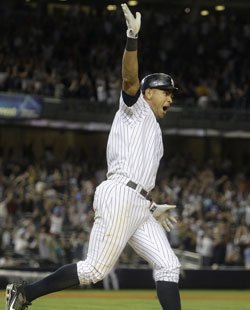
Is Alex Rodriguez now a “true Yankee?” I feel as if I’ve asked that question before.
FOURTH COMMENT ON LAST NIGHT
What a terrific job by the Yankees pitching staff. Given the home run propensities of Yankee Stadium II, stretches of 15 scoreless innings are not going to happen too often. As the stalemate headed into late and extra innings, every left-handed batter carried with him to the plate the potential to loft a fly ball towards right field for a cheap four bases. Given the eight walks the Yankees handed out during the game, that home run, if it had come, very possibly would have been worth more than one run. Yet it didn’t happen, thanks to a combination of good pitching and everything lining up right for one night. Boston’s four hits were singles, and the Yankees outfielders rarely pressed their backs toward the walls.
Joe Girardi got away with a couple of calls in this game. He burned Phil Hughes on a one-batter appearance in the eighth inning, accelerating his path to the less trusted element of the bullpen after Mariano Rivera had thrown his inning. That these pitchers — Alfredo Aceves, who had struggled of late, the seemingly never-quite-right Brian Bruney, and the homer-prone Phil Coke — performed exceptionally well is a bonus from this epic game, a sign that perhaps the whole bullpen is ready to perform at a high level.
Girardi made another odd call when he used Jerry Hairston as a defensive replacement for Nick Swisher in the top of the ninth. While Swisher’s spot would not come up in the bottom of the ninth and almost certainly could not come up before the inning ended or the Yankees delivered a walk-off hit, it had the potential to deprive the team of a useful offensive weapon had the game proceeded to extra innings, as indeed it did. Inevitably, Girardi had to pinch-hit for Hairston with Eric Hinske, a defender who didn’t harm the Yankees but is not normally thought of as being on a par with Roberto Clemente. With a 5-foot-10 outfielder, you also have to worry about certain balls being over his head. Swisher has had some defensive problems this year, but the move was superfluous and potentially harmful. Girardi proved at least the former when he undid it an inning later.
It was also possible to first-guess his decision to take off the bunt when Melky Cabrera was batting with runners on first and second and none out in the third. It was early in the game and one-run strategies are generally to be frowned upon, but it was already clear that Josh Beckett’s current hot streak was unlikely to be broken on this particular evening. Cabrera retains one of the Yankees’ highest double-play rates (13.2 percent), so the bunt was a reasonable percentage ploy in that situation.
In the end, Alex Rodriguez and six pitchers rendered all the chess moves moot. Put this one on a DVD, Yankees, and show it in full to each incoming class of draftees starting next June. They’ll learn a lot about the pleasures and pain, frustration and elation inherent in playing for this team.
Gaudin to the rescue?
Here’s the upside to acquiring Chad Gaudin: He’s been a somewhat reliable starting pitcher in his career. Though as a starter his ERA is just 4.85 in 378.2 innings, he’s kept the ball in the park and pitched well enough, often enough, to post a quality start in 42 percent of his attempts. That’s a below-average figure, but as compared to the work of the other pitchers the Yankees have tried in the fifth starter’s slot it is the work of a Cy Young. This year, Gaudin has made nine quality starts in 19 attempts, or 47 percent, which is actually about average. Add up Phil Hughes, Chien-Ming Wang, Sergio Mitre, and Alfredo Aceves and you get two quality starts in 21 tries. Look at it this way:
| GS | W-L | IP | H | BB | SO | HR | ERA | |
| Wang, Mitre, Hughes | 21 | 5-8 | 90 | 125 | 38 | 64 | 15 | 8.20 |
| Gaudin | 19 | 4-10 | 103 | 104 | 55 | 102 | 7 | 5.23 |
Gaudin has a low 90s fastball and a very good slider, hence the high strikeout rate. The walks have been a career-long problem, which is why he’s ill-suited for the bullpen. Yet, that’s where Brian Cashman said he’s headed for now — Mitre will get another chance.
In the bullpen, though, Gaudin is just another Brett Tomko. He lacks good control, walking 4.3 batters per nine innings in his career and 4.8 per nine this year. Those walks are de-emphasized in an extended appearance, but bring a pitcher with poor control into the seventh inning of a one-run game and the free passes can kill you.
One other worry: Gaudin somehow put up an 8.10 RA in San Diego’s PETCO Park, the friendliest park for pitchers in the biz. That number has all the marks of a fluke occurrence — he had a more reasonable 4.55 RA on the road — but it’s something to be aware of. If a pitcher can get bombed in PETCO, he’s not safe anywhere, especially your friendly neighborhood Yankee Stadium II, where left-handed hitters get to take cheap shots at the right field wall. Lefties have hit .292/.388/.431against Gaudin in his career.
Despite this, the value of players is relative, and on paper Gaudin is an upgrade on what the Yankees have been trying. Why send him to the bullpen when there’s a more urgent an obvious need? One wonders if Mitre gets a break because Joe Girardi is vouching for him based on the good old days with the Marlins — which weren’t that good.
POSADA WEARS NO. 15/THURMAN THROWS
Posada wearing a No. 15 decal on his mask in honor of Thurman Munson was a classy gesture from one great Yankees catcher to another. Posada was not quite eight years old when Munson died, so the act was based as much or more on their mutual standing in that lineage than any real memory of Munson the player. It’s a more profound statement than any based on personal association, as it requires an appreciation and respect for history, and says that Munson remains a powerful enough figure in even death that he was able to touch Posada without Posada having had direct contact with him.
Something about Posada’s tribute reminded me of an aspect of Munson’s career that doesn’t get a lot of comment given the focus on his hitting, his leadership, and his gruff personality: He was great at throwing out runners. Consider:
|
YEAR
|
MUNSON CS%
|
LEAGUE CS%
|
|||||
| 1970 | 52 | 39 | |||||
| 1971 | 61(!) | 39 | |||||
| 1972 | 48 | 39 | |||||
| 1973 | 48 | 38 | |||||
| 1974 | 35 | 38 | |||||
| 1975 | 50 | 38 | |||||
| 1976 | 35 | 34 | |||||
| 1977 | 40 | 39 | |||||
| 1978 | 45 | 38 | |||||
| 1979 | 46 | 36 |
Munson won only three Gold Gloves, those coming in 1973-1975. In his first three seasons the award went to Ray Fosse (1970-1971) and Carlton Fisk (the only one Fisk ever got); from 1976 on the award was dominated by Jim Sundberg, who took six straight awards. Sundberg was also very good at controlling the running game. The Gold Gloves don’t prove much — one of Munson’s awards came in 1974, a year in which a sore arm cut his success rate and led to 22 errors; he made 23 the next season and somehow won again. The errors probably caused the voters to discard Munson for Sundberg so quickly as much as Sundberg’s own defensive excellence; the latter was only in the league for two years when he picked up his first award.
QUICK NOTES ON THURSDAY’S ACTION AND OTHER STUFF
? I’m grieved by John Hughes’ passing. His movies were often skin deep, but at their best there was something touching about them, something wistful about youth and its passing in films like “Ferris Bueller’s Day Off” and “Some Kind of Wonderful” — which is not to forget that these were basically teen comedies and often very funny. Of the films that took place outside of his suburban Illinois universe, there are bits of “Vacation” (the first one, not the countless sequels) that can still make me laugh, and I have a soft spot for “Planes, Trains, and Automobiles,” one of the few films that used John Candy to truly good effect. Hughes’ peak was long ago and far away, the 1980s (and by this I mean to exclude the huge 1990 hit “Home Alone” from the canon), but if you were a teenager then, his work was inescapable, alternatively patronizing and uplifting, and for many people, defining. Seeing him go is a bit like waving goodbye to a piece of the landscape of my youth. It’s saddening, even if the sadness isn’t really about him. I will now spin the Simple Minds’ “Don’t You Forget About Me” from “The Breakfast Club” in his honor.
? I really nailed that analysis of John Smoltz yesterday, didn’t I? Some days you’d be better off staying in bed. As important a win as it was for the Yankees, it was still painful watching a great pitcher brought low. Lefties are now hitting .440 off of Smoltz as he struggles to get his fastball by them on the inside. Righties have had a harder time of it, so perhaps Smoltz might still have some value out of the bullpen if he’s willing to go that route to stay in the game.
? Yesterday did nothing to dissuade me from the idea that the Yankees’ Joba Conservation Plan might cost him his command at a time when he and the team need and most, when he was about to turn the corner and show consistency for the first time all year.
? The Twins acquired Carl Pavano today from a player to be named. Good luck with that, Twinkies.
? Nick Johnson gets traded from the Nats, who can’t win a game, to the Marlins, who then get swept by the Nats. Life can be comically unfair.
? The A’s seem to have done a Soviet-style redaction off Jason Giambi’s place on the team. “No, nothing today,” Geren said. “I haven’t seen him today.”
Turns out the A’s released Giambi on Friday.
MORE TO COME
Since this is the <b>Series of the Year</b> I’ll be posting updates throughout the weekend. Hope you check in.
Once more into the void
 SWISHER, HALF A HERO
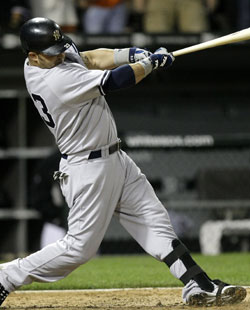
After a long, long cold snap, Nick Swisher seemed to break out on the just-completed roadtrip, going 9-for-27 with four home runs. Such a streak is never a bad thing, but because of Swisher’s oddly divided season it’s entirely possible that he’ll go cold again as soon as he sets foot in Yankee Stadium. Fans attending home games have yet to see the best of Swisher. Fifteen of 18 home runs have come on the road, where he’s batting a terrific .276/.368/.602. At home, he’s hitting just .200/.374/.329. He still has his patience, but everything else disappears.
I sometimes wonder if Swisher, despite his goofy demeanor, is actually quite anxious in certain circumstances. This is the second year in a row he’s had a strange home/road bifurcation. Last year with Chicago he had the reverse problem, hitting .247/.361/.517 at home but only .189/.301/.294 on the road. There is no reason for these splits; Swisher would seem to be the only batter on the planet not taking advantage of new Yankee Stadium’s friendlier dimensions.
It’s not too late for Swisher to stop pressing and enjoy the fruits of the new ballpark. When playing at home, his batting average on balls in play is just .245, which suggests that even when he makes contact at home it’s not good contact, with too many fly balls being sent aloft in the hopes of catching the same jet stream that everyone else has found. If Swisher can resolve whatever ails him in the Bronx, even a small uptick the rest of the way would change his season from one that can be dismissed as just satisfactory and replaceable to something that is an uncontroversial asset.
SIGNS OF THE APOCALYPSE
The Yankees signed Russ Ortiz to a minor league contract. Ol’ Russ hasn’t had an ERA below 5.50 in any length of work since 2004. Since then, he’s gone 10-28 for the Diamondbacks, Orioles, Giants, and Astros, with a 6.56 ERA in 312.2 innings. Pitching at Scranton is awful thin these days, but with any luck they’ll have Sergio Mitre back soon.
20-GAME WATCH: Red Sox vs. Yankees
W-L RS/G RA/G AVG OBP SLG AB/HR SB CS HR/9 BB/9 K/9
Red Sox 10-10 5.5 4.6 .274 .352 .453 30 13 4 1.0 3.1 8.0
Yankees 14-6 5.2 4.4 .281 .361 .473 25 10 4 0.8 2.9 7.9
Here we are again. It’s difficult to know what to expect from this series given how badly the Yankees have struggled with the Red Sox this year. The Sox have struggled a bit of late, as their starting rotation has been reduced to Josh Beckett and Jon Lester plus prayer. The Yankees will get both of them this visit, and given the variability of the Yankees’ own starters, the advantage may well be with the Sox in those games. You’d think that A.J. Burnett would be able to hold his own on Friday against Beckett, but the Sox can be patient and Burnett wild. As for Andy Pettitte against Lester on Sunday, Pettitte has been all over the map this year, and while he’s been good lately with a 3.77 ERA in his last five starts, Lester has been at his best of late with a 2.65 ERA in his last five starts. Then again, it helps when the opponents are the Royals, Blue Jays, Orioles and A’s. The Yankees have also killed lefties this year, batting .293/.377/.490 against them as a team.
The series’ other two conflicts feature John Smoltz against Joba Chamberlain tonight and Clay Buchholz against CC Sabathia on Saturday. Joba has been on a three-start roll but also hasn’t pitched since the 29th, so the Yankees will have to hope that pushing him back didn’t cost him his command. The Red Sox hit him hard in his two starts against him this year (.341/.442/.477), though he struck out 14 and only allowed six runs. Smoltz is an interesting case. He’s 42, and more machine than man at this point. Since coming off of the disabled list, he’s shown decent stuff, a good strikeout rate, and excellent control. He has also, in all but one start, been pounded. This could be just luck–the batting average on balls in play against Smoltz is .370, but the line drive rate against him is actually low. That suggests that grounders and fly balls are falling more often than they should. Luck can change, and it’s possible that the Yankees will have a harder time with the grand old man than the statistics would initially suggest.
Since coming up from the minors, Buchholz has made four starts, alternating good and bad and not making it through the sixth inning in any case. This would seem like advantage Yankees given Sabathia, but the big man has been erratic of late, pushing an average of five runs per nine innings. He’s also been slightly less effective at home than on the road. Yankees fans will expect some motivated over-performance from Sabathia in this series, and no doubt the heart will be willing, but what if the flesh is weak? When a pitcher who is used to striking out eight batters a game is only getting five or six, performance may not be a matter of psychology but physicality.
After 0-8 and a 6.06 ERA against, I’m not making any predictions. My instinct is a split, which would preserve the status quo. That would be an improvement. You’d sure like to see the first win come tonight, though, just so everyone–team, fans, commentators–can feel as if the spell has been broken.
 Pinstriped Bible