Category: Dailies
A little roster shakeup
 SCRATCH THAT PITCHING DIET
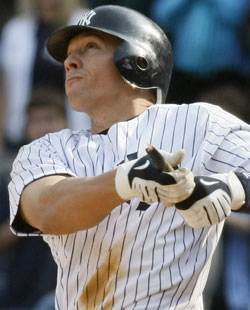
As per George King, the Yankees have called up Anthony Claggett as protection for another blink-and-you-miss-it Sergio Mitre start. So much for my suggestion earlier today that the team experiment with a streamlined, 11-man pitching staff. Instead, Mitre necessitates a baker’s dozen. As Roger Daltey sang in “Who Are You,” “There’s got to be another way.” And then he swore.
Cody Ransom, meanwhile, has finally earned his letters: DFA. Ransom provides one of baseball’s best lessons, one that you can apply to just about anything: “Don’t get excited over small samples.” Ransom’s 2008 performance, .302/.400/.651 with four home runs in 43 at-bats, represents little more than the coin coming up heads over and over again for a small space of time. Some would say Ransom earned himself a chance with that performance, but the truth is that it shouldn’t have been a very long one given his age and track record. There are a few players out there–Mark Reynolds comes to mind-who are skilled enough hitters to survive an unusually high strikeout rate. When they do make contact, they do so solidly enough that good things happen a high percentage of the time. Ransom isn’t good enough to overcome the kind of pressure his strikeout rate puts on him. This year only 15 percent of his balls in play have been line drives, which means his batting average on balls in play is only .278. In short, he didn’t put balls in play very often due to the strikeout rate, and when he did put them in play nothing happened.
In the long term, the Yankees are going to need to get back down to 12 pitchers tops, and that could mean the return of Ramiro Pena. Austin Jackson would make more sense, given that the Yankees require a practiced centerfield reserve more than they need a kid with not very much offense and less experience in the pastures. There are only three weeks left in the Minor League season. If Jackson spends most of that time on the New York bench, it couldn’t possibly set him back in any permanent way, and might possibly help.
Of course, until the Yankees find a way to get more than three innings out of their fifth starter, that last roster spot is probably moot. The sad thing is that in the postseason, the fifth starter won’t matter one bit–you could practically send the guy home. The irony, then, is that they’ll need that guy, whoever he is, to make a contribution if they’re going to get to the postseason. In a word: woof.
The bench and the bullpen, including Mo
 NOT UNUSUAL, EXCEPT IN ONE RESPECT
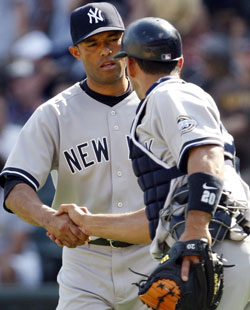
Aside from the victim having been the estimable Doc Halladay, Tuesday night’s win was your standard nail-biting Yankees victory, with Andy Pettitte skating by despite too many walks, a couple of rallies killed by double plays, and some rollercoaster action from the bullpen. That includes the great Mariano, who has shown for all his great accomplishments that he would very much prefer to be used with the bases empty and a lead. Having to pitch in a tie or bail out some other hapless reliever just isn’t part of the deal. Rivera still allows fewer inherited runners to score than the average AL reliever — he’s allowed five of 18 to pass, whereas (hold on) the typical cat will allow about six of 18 to score. It’s a benefit to the Yankees, slim or not, but you might think the greatest closer ever would do better. He’s actually had several seasons where close to 50 percent of inherited runners scored, which is odd given just how dominant he is the rest of the time.
RZEPCZYNSKI (NOUN)
A very high-scoring Scrabble word signifying tonight’s opponent, Marc Rzepczynski. He’s a lefty of the groundballer persuasion with just one home run allowed in his inaugural 27.2 innings. One wonders if this means another outfield start for Jerry Hairston. If Hairston is your main weapon against lefties, you’re really aiming too low. It’s as if we’re back to the days of Clay Bellinger playing center field (20 starts in 2000, Joe Torre, 20 starts!). Hairston is a better player than Bellinger in every way, but that praise is specific to the case and wholly relative.
Given that the 12th man on the staff (Mark Melancon … at least, he didn’t until recently) almost never pitches, it would be a better use of the roster spot to grant Shelley Duncan a berth. In these days of bloated pitching staffs, it would be seen as a brave, daring move to carry only 11 hurlers, but Joe Girardi is proving that the 2009 Yankees, at least, can make it through with less than a dozen pitchers. There is no reason not to acknowledge what is already a reality and use the spot as a weapon rather than a way for a lucky pitcher to get free travel around the country.
REPORTED WITHOUT COMMENT
Courtesy of Baseball Prospectus, pitchers’ wins added above replacement:
|
AL TOP 5
|
|
| 1. Zack Greinke, KC | 6.0 |
| 2. Felix Hernandez, SEA | 5.4 |
| 3. Roy Halladay, TOR | 5.3 |
| 4. Cliff Lee, CLE | 5.2 |
| 5. Edwin Jackson, DET | 5.2 |
|
YANKEES
|
|
| 17. CC Sabathia | 3.3 |
| 23. A.J. Burnett | 3.2 |
| 30. Joba Chamberlain | 2.4 |
| 32. Andy Pettitte | 2.3 |
| 128. Aceves, Hughes, Mitre, Wang | -0.6 |
BOBBY ABREU, PLAYER OF THE MONTH
He batted .380 in July and is having a fine year overall. The Yankees still made the right choice in letting him leave. The Angels got a bargain, one the Yankees weren’t going to get, either in dollars or term of years, and his 2007-2008 numbers (.289/.370/.458) were just adequate for a defensively challenged right fielder. Perhaps Abreu needed the extra motivation supplied by his free-agency letdown. Perhaps this is just a random uptick, and the numbers certainly suggest that. Abreu has always been a prolific line drive hitter, which explains his unusually high success rate on balls in play (career .349). This year he’s hitting .372 on balls in play despite the lowest line drive rate of his career. That’s the favorable luck component of what he’s doing. To put it in plainer words, Abreu hadn’t hit .300 since 2004, and hadn’t hit over .310 since 2000. There was no reason for the Yankees to expect him to post a top-10 batting average in 2009.
HE MIGHT WANT TO TAKE SOME TIME OFF
I’ve undergone this procedure and Bobby Jenks has my sympathies. Let us just say that the surgery itself is not too traumatic but the aftermath is not pretty.
The loss of Montero, the evolution of Melky
 CRUSHED
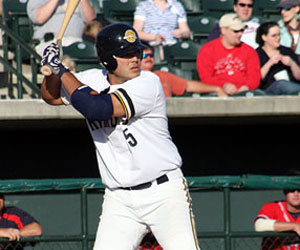
Jesus Montero is out for the rest of the year, having broken the middle finger of his left hand on Saturday. If he’s out even the minimum expected, four weeks, that takes him right through the end of the Minor League season.
Before we mourn, let’s review: 48 games at Tampa, batting .356/.406/.583 with 15 doubles and eight home runs in 180 at-bats. Moving up to Trenton, Montero played in 44 games, batting .317/.370/.539 with 10 doubles and nine home runs in 167 at-bats, this despite being utterly fluxed by the big, cold, riverfront Thunder ballpark (try the crab fries!), where he hit just .232/.376/.354 vs. .400/.457/.718 on the road.
Total: .337/.389/.562. Age: 19. Moreno will turn 20 just after Thanksgiving.
The good news is this: Montero didn’t suffer a knee injury. He didn’t fracture a wrist, which could have affected his swing. He’s not out for six months, just six weeks, tops. The Yankees would have some options at that point, including a quick cup of coffee once rosters expand, and could still send the lad out to the Arizona Fall League or for other winter action with an eye towards prepping him for an extended look in next year’s Spring Training camp. Naturally, this assumes an uncomplicated recovery from the injury.
Montero may not be ready to be a big-league catcher, but if his bat is judged to play the Yankees would be mistaken to send him on an indefinite tour of the upper Minor Leagues waiting for his glove to mature. First, it may never be ready. Second, with Jorge Posada signed through 2011 and still playing well, there isn’t any urgency for him to catch. However, there may be a need for a solid bat of his ability by next spring. There should be room on the club for a young player to take some time at designated hitter while perhaps catching the odd game against less speedy opponents. This could not only get Montero’s bat in the lineup, but serve to lower the team payroll in the short term. Montero’s injury is disappointing, but it need not be a disaster.
MELKY’S CYCLE
I said it last week and I’ll say it again: the lad’s got good timing. If you could just go back and erase that injury at Texas on May 26, he might have had a perfect year. For more than a month after that he struggled to hit .200, and didn’t get hot again until Brett Gardner got hurt. Through July 22 he was hitting just .220/.278/.320 for the month. He hit a double in his sole at-bat on the 23rd and since then he’s been rolling, going 15-for-35 in 11 games overall, with five doubles, a triple, and two home runs. He’s also thrown in six walks and turndown service, including a mint placed just so on top of your pillow.
This is truly a stunning, heartwarming turn of events. Though only 24 (he’ll turn 25 on the 11th of this month), Cabrera had spent 2006 and 2007 playing every day but failing to show much with the bat. He’d hit a few balls in the gap, knock one out of the park every now and again, but not so often that you could say he had real power. He was only moderately patient, so even hitting .280 he didn’t get on base that much. He was a switch-hitter, but he couldn’t touch a lefty. Then it got worse, as he followed a torrid April, 2008 with a 100-game cold streak that got him sent to the Minors.
Coming into the season, there was no reason to view Cabrera as much more than a versatile outfield reserve, and given his 2008 performance, perhaps not even that. Even after another hot April and a solid May, it seemed likely that a cold snap would ensue. When it did, it was impossible to tell if it was due to the Texas injury or just Cabrera returning to form. It now appears that the injury was at least partially to blame, and whatever Cabrera does for the rest of the season, he’s not heading back to the dark depths of post-April 2008. He’s even hitting left-handers, something he’d never done with any consistency or authority before. That, more than anything else, suggests real change.
If Cabrera maintains his current .292/.355/.463 level of production, the Yankees have a very solid center fielder on their hands. The average Major League center fielder is batting .268/.337/.422. For once, the Yankees were patient with a young player (far more patient than your host, for once) and it seems to have paid off — and they had far less reason to be patient with Cabrera than with a host of predecessors who quickly headed out of town, Drabek, Buhner, et al. Let us hope the lesson sinks in — for everyone.
Some more on deadline trades
TRADE-O-RAMA
I enjoyed my BP colleague Christina Kahrl’s take on the Dodgers’ acquisition of George Sherrill from the Orioles for prospective third baseman Josh Bell and righty Steve Johnson:
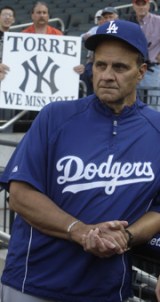 [T]his move seems more about Joe Torre’s desperate need to turn to people he’s heard of in his pen. Sherrill’s been around long enough that Torre can use him with fully-formed preconceived notions without any chance that anyone will blame anyone other than Sherrill if it doesn’t work out in any particular high-leverage ballgame, and that’s the kind of cover the veteran skipper’s grown accustomed to over his long years of service. Bleeding talent for players Torre doesn’t have to sweat developing was one of those intrinsically accepted costs of employing the man in the first place, but that doesn’t necessarily mean that Dodgers fans have to like it.
Torre had his talents, no doubt about it, but he did become spectacularly risk-averse in the bullpen. Most managers are, but Torre reached an extreme. As I’ve remarked before, Joe Girardi has “made” more Major League relievers in less than two years running the Yankees than Torre did in his last five years, perhaps longer.
If you’re the Orioles, you wish you could have done more than this, but the organization isn’t willing to move Brian Roberts, while Melvin Mora and Aubrey Huff haven’t been productive enough to excite anyone. Still, in Bell they added the possible replacement for Mora, and none too soon. There’s some question as to whether Bell can stay at third, and the club still desperately needs help at shortstop, but this is a start.
The Red Sox made an excellent move in picking up Victor Martinez. They received an offensively talented catcher-first baseman who can spell Jason Varitek, Kevin Youkilis, or, by pushing Youkilis to third base, Mike Lowell. Martinez can’t throw, but Varitek can’t either, so no big loss there. Martinez can belong to the Red Sox for another year if they pick up his $7.5 million option, which seems like a no-brainer. The one risk here is that Martinez has been in a severe slump; in his last 30 games he’s hit .161/.268/.279.
The acquisition of Martinez rendered Adam LaRoche redundant, so he was swapped off to the Braves for Casey Kotchman. Kotchman is the New Millennium Doug Mientkiewicz, and he’ll take on that role for the Sox. A greater role in the future will depend on this offseason. If Varitek wants to come back, he has the contractual right to do so, and that could block up the catchers’ position a bit. Mike Lowell has another year to go on his deal, and has no-trade protection. David Ortiz is also signed for another year.
The Braves made an odd deal here, picking up an imminent free agent who isn’t a great hitter for a first baseman. True, Kotchman hadn’t hit like on either, but he’s better at getting on base and is the superior gloveman. The Bravos may do well in the short term given that LaRoche is a second-half hitter, but the gain here is likely small and they may be in possession of neither player by November.
These moves will have an impact on the Yankees as they fight the Red Sox the rest of the way. The Sox have hit well in their own ballpark, averaging 5.7 runs per game in the Fens, but have hit just .252/.336/.402 on the road with an average of 4.6 runs per game. The league-average offense scores 4.7. How the addition of Martinez benefits the Red Sox depends on how they spot him to best advantage in different pitcher match-ups, and if they’re willing to cut into David Ortiz’s playing time now and again or bench Mike Lowell against the odd right-hander in road games. In addition, the deal cost the Sox Justin Masterson the versatile swingman. They might miss having him around.
In terms of the moves the Yankees did not make, it’s a bit surprising to see the long-coveted Jarod Wasburn go to the Tigers for two left-handed pitching prospects, Luke French, who has pitched seven games in the majors this year with strong results, and Mauricio Robles, an A-ball pitcher. Neither is a high-value prospect, just “interesting,” and it seems odd that the Yankees couldn’t have made a competitive offer had they wanted to do so. Now they have the choice of sticking with Sergio Mitre, pulling Phil Hughes out of the bullpen, or trying another minor leaguer, either another retread like (choke) Kei Igawa, or go with an untried pitcher such as Scranton’s George Kontos or Trenton’s Zach McAllister (currently on the disabled list with a “tired arm”). Given Mitre’s track record, they have very little to lose by rolling the dice on anyone this side of Sidney Ponson.
Hairston gives Yanks options
J. HAIRSTON JR.
Say this for the acquisition of the utility man Jerry Hairston: the Yankees have bought into one of the great ball-playing families. Hairston’s brother, Scott, plays for the Athletics. His father, Jerry, was a pinch-hitter for the White Sox for roughly 63 years. His uncle, Johnny, got a cup of coffee with the Reds. His grandfather, Sam, played in the Negro Leagues and briefly made it to the Majors a few years after the color line was broken. There have been more Major League Hairstons than DiMaggios, Niekros, Boones or Bells.
The Hairston under consideration here is 33 years old and, but for a couple of fluke seasons, not much of a hitter. Playing for the Orioles in 2004, he hit .303/.378/.397 in 86 games. Last season he gave the Reds .326/.384/.487 in 80 games. Those numbers stand in stark contrast to his career marks of .259/.328/.372. Even those numbers don’t tell the whole story because Hairston spent 2006-07 hitting .198/.260/.271, then relied on the GAP for his comeback, batting .410/.471/.590 in Cincinnati’s home park. On the road, he hit only .252/.307/.396.
Fortunately, the Yankees didn’t acquire Hairston for his bat, but for his ability to move around the field. This season he’s played everywhere but first base and catcher. Although primarily a second baseman at the outset of his career, Hairston has enough speed that he can move around the field and play competently. Roster flexibility is a virtue, as long as one doesn’t plan on actually making use of it all that much. One assumes that this is curtains for Cody Ransom, which is too bad — as badly as the guy did subbing for A-Rod in April, it was good to see a journeyman get his shot, and he has been passable since coming off of the disabled list, batting .240/.345/.400 in 29 plate appearances. There is no guarantee that Hairston will hit better, but again, the trick is versatility: Ransom was a third baseman-shortstop. Hairston plays everywhere, giving the Yankees more bang for the roster spot.
The Yankees give up a 20-year-old Low-A catcher in Chase Weems in the deal, which isn’t too much given Hairston’s age, ability and one-year contract. Weems hasn’t shown much offensive ability in his 88 pro games, and even were he to blossom, the Yankees are deep enough in catchers that they shouldn’t miss this one.
I’ll be back later today with more trade deadline analysis.
They are what their record says they are
20-GAME WATCH: YANKEES VS. WHITE SOX
W-L RS/G RA/G AVG OBP SLG AB/HR SB CS HR/9 BB/9 K/9
Yankees 14-6 5.6 4.4 .291 .375 .484 25 10 7 1.0 3.1 7.1
White Sox 9-11 4.8 5.0 .261 .328 .423 27 11 3 1.0 3.6 7.1
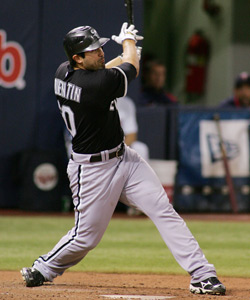 The White Sox are a .500 team. This is entirely appropriate. They have an above-average pitching staff and a below-average offense, and the combination of the two allows them to break even. The Yankees have the misfortune to catch them just as the White Sox have received what should be a boost to their offense thanks to the return of last season’s almost-MVP Carlos Quentin from a long stay on the disabled list. Quentin has all of six hits in ten games since coming back, but he did hit a home run in his most recent game.
The Yankees also get their first look at rookie third baseman Gordon Beckham, the eighth overall pick in last year’s draft. After just holding his own in his first month in the bigs, Beckham has turned it on in July, batting .337/.396/.539 this month. Interestingly, he’s struggled badly at home, hitting only .213 with no home runs in Chicago. His road production, .382/.451/.640, has been monstrous. He’s currently playing third base because that’s where the Sox needed him, but he could play second or even shortstop in the future… On the whole, the White Sox are an impatient club with some power thanks to the usual producers, Jim Thome, Jermaine Dye, and Paul Konerko. That core is rapidly aging, and the Sox are going to find themselves in a difficult transitional (read: losing) phase if they can’t find more youthful company for Beckham.
One possibility is catcher Tyler Flowers, who was picked up from the Braves over the winter for Javier Vazquez. He batted .302/.445/.548 at Double-A Birmingham before being moved up to Triple-A a little over a week ago. He’s not supposed to be a great defender, and A.J. Pierzynski is in his way, but if the White Sox are smart they’ll look at Pierzynski as just another thirtysomething who has to be moved–because he’s impatient, Pierzynski can be at his offensive best and not contribute that much. He’s having one of the best years of his career this season at .304/.330/.454, but that league-average OBP holds him back.
As the Yankees have four games with the White Sox, they not only get to send out their laundry, but also get to see the entire White Sox rotation with the exception of old pal Jose Contreras, who is currently leading the league in losses. Gavin Floyd has been an interesting case this year. His career-making turn last season came in part through crazy good luck on balls in play, and as many predicted, he’s had less fortune in that area, though he’s still getting some above-average returns–instead of .250, he’s around .280, still better than your average cat. He was hit very hard in April and May before suddenly becoming unhittable in June, putting up a 1.28 ERA in six starts. July has been more of a mixed bag.
I have a suspicion the Yankees will do pretty well with 25-year-old Clayton Richard, a lefty who has just average stuff and control and has gotten by mostly by trying to make perfect pitches and being tough on left-handed hitters. If the Yankees bring up a right-handed bat for this game and Mark Buehrle’s start as well it wouldn’t be a bad thing, although if they didn’t it wouldn’t be a disaster either–lefties have hit Buehrle for good power this year. The same goes for Saturday’s starter, John Danks. Still, the Yankees will have their work cut out for them with Buehrle and Danks; the latter has pitched quite well this year except for a few rough starts in May, and in his starts over this month and last has posted a 3.05 ERA. You’ve no doubt heard about Buehrle lately, but it’s worth noting that he’s rarely pitched well against the Yankees. In eight career starts he’s just 1-5 with a 6.11 ERA, Yankees batters having hit .321/.363/.463 against him. We’ll see if those numbers hold up.
Trading day
 As I write this Thursday morning, there are just two shopping days left until the non-waiver trading deadline falls and every deal essentially requires the approval of 29 other teams. Several deals dropped on Wednesday, though none had the participation of the Yankees (their sole transaction line was the release of the ungrateful Brett Tomko).
The Phillies picked up Cliff Lee and outfielder Ben Francisco (I hear Jeannette McDonald sing, “Ben Francisco, open your golden gates” every time I think of that guy, and it never fails to disturb me) from the Indians, the Tribe picking up several players who could be useful contributors in the near future but almost certainly won’t be stars, with the possible exception of New Jersey native Jason Knapp, a teenaged righty whose fastball reaches atmospheric escape velocity.
The Phillies now get another reliable, top of the order type who can not only help them maintain their current lead but can get them through the playoffs — Cole Hamels, J.A. Happ, and Joe Blanton seemed like less than sure bet to get them through Round 1, let alone to the World Series. Lee, Hamels, and Happ seem like a much better bet, and a real threat to an opponent with too left-handed a batting order. The Phillies still have a problem too address, and solving it doesn’t involve blowing their remaining prospects on Roy Halladay, but finding someone who can supplant Brad Lidge at the end of games.
As good as Lidge was last year, the Phillies can’t blow their season on sentimentality. A reliever who is giving up two homers per nine innings pitched isn’t worthy of his job (just ask Edwar Ramirez). I’ve seen some commentary on the deal worrying about how the Phillies are going to accommodate their current rotation plus Rodrigo Lopez and Pedro Martinez. This is much ado about nothing; in the case of the former, the Phillies can thank their various gods that they got some good work out of junk pile pickup, and as for Martinez, his utility is purely theoretical at this point. If he can pitch, perhaps he can add some depth to the bullpen.
The Giants tried to bolster their slim wild card lead by pulling second baseman Freddy Sanchez away from the Pirates. It cost them their No. 2 pitching prospect, righty Tim Alderson. While I am not completely sold on Alderson’s future as an ace (his control is of the finest quality; his stuff isn’t), the Giants might have picked the wrong spot to fix — Sanchez will upgrade their production at second base if he hits at all, but in the grand scheme of things he’s not a big generator of offense (his current .334 on-base percentage is about league average), not even at his batting title best (back in 2006), and he’s just an average glove. The Giants could have tried to live with what Juan Uribe was giving them at second while addressing themselves to left field or even shortstop, where the five-time All-Star Edgar Renteria is having a miserable year. Parenthetically, if Renteria has a couple of decent years left in his bag, he’s going to finish his career with somewhere between 2,500 and 3,000 career hits and make for a really annoying Hall of Fame argument.
The Mariners acquired Ian Snell and Jack Wilson from the Pirates for reasons that are sort of hard to figure. They gave up five, count ’em, five players in the deal. Wilson has a superb glove, but while he should give the M’s more offense than they’ve gotten from their shortstops this year (.222/.249/.320, numbers that deserve a double-take and a whispered prayer), he’s only a career .269/.311/.376 hitter himself and the difference won’t be enough to make a real dent in the Mariners’ major problem, which is that the league-average offense is scoring 4.8 runs a game and they average 3.9.
For their trouble, the Pirates pick up quite a bit of depth. They get a futile shortstop placeholder in Ronny Cedeno, but the real haul is 25-year-old Jeff Clement, a former No. 1 pick who still has a lot of offensive potential (his .288/.366/.505 at Tacoma translates to .255/ .329/.462 in the Majors), especially if the Pirates can live with his defense at catcher. The three pitchers the Buccos got in the deal are lower echelon prospects, but when you’re the Pirates, depth is not a bad thing, as you need a lot of pieces to sort through if you’re ever going to build a competitive roster with the kind of budget that their city requires.
Finally, the Reds picked up outfielder Wladamir Balentien from the Mariners, who had designated him for assignment last week. Balentien looked like he might be a solid prospect a over the last couple of years, hitting for real power in the minors, but his plate judgment is so bad he may never be able to be a regular contributor. Still, he’s only 24 and has a career slugging percentage of .526 in the minors. The Reds, who suffer from the worst outfield production in the bigs, have a much better chance of gaining a lasting asset by playing Balentien than they do by giving more playing time to Laynce Nix — or Willy Taveras, though Balentien can’t play center field. Tavaras’ current .240/.279/.290 would qualify as among the bottom five seasons turned in by a regular outfielder in the history of the game were he to carry those rates through to the end.
GOOD TIMING
In his last 20 games, not counting appearances as a defensive substitute, Melky Cabrera has batted .317/.403/.444, numbers which include five doubles, one home run, nine walks, and only one double play hit into. Much like his running mate Robinson Cano, Cabrera’s hot and cold streaks can make him a frustrating player to watch; he’s seemingly at his best or his worst, with little in between. Last year that divide broke down as best in April, worst the rest of the year. At the very least, Cabrera is mixing it up a bit more this season, and you can’t fault his timing — his first hot streak this year came when Brett Gardner struggled out of the gate, the second after Gardner broke his thumb. Perhaps Cabrera is the kind of player who needs to be in fear of his job to play well. After all, had he continued to slump with Gardner on the shelf, Austin Jackson was just a phone call away.
TERROR IN A TINY TOWN
Yesterday, electrical storms rolled through the obscure village in which I lived and disrupted Internet service for a good chunk of the day; I couldn’t even get on line with my phone. I was quite fearful that the Yankees would acquire Babe Ruth in exchange for $100,000 and the mortgage on Fenway Park and I wouldn’t know about it, but Brian Cashman was good enough to hold off on making any moves. I just want to thank him publicly and let him know that I am back on line and he is free to proceed with any acquisitions he would like to make … as long as they don’t involve dealing Jesus Montero.
Getting the best from everyone
SHOCKER
I don’t think I have single thing to complain about today. Analysis is about finding problems and advocating solutions, but everyone is playing well right now. Even Nick Swisher, who I’ve (reluctantly) become disillusioned with, pulled out of his slump with a two-homer day. To quote a line from John Lennon and the Beatles, “I’ve got nothing to say but it’s OK.” (“Sgt. Pepper’s Lonely Hearts Club Band,” the happiest album about alienation, distraction and disconnectedness.) That’s not quite accurate, now that I think about it — I’ve always got something to say, and it’s not “Billlllly Shears!” Though I wish it was. 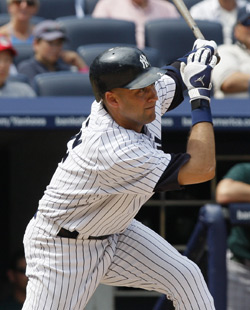 ANOTHER RUN AT AN MVP FOR JETER?
On last night’s broadcast, my fellow YES-man Michael Kay suggested that Derek Jeter is putting together a campaign worthy of the Most Valuable Player award. My first reaction was, “Nah,” first because Jeter’s year seemed to be in the good-not-great category, second because if he didn’t win the award in 1999 or 2006 he’s not going to win it now — voters go wild for RBIs, not runs scored — and third, because there are so many other good candidates. However, on further examination, the idea is not as wild as it at first seemed, though still unlikely.
Thanks to his .402 on-base percentage, fifth in the American League, Jeter is having one of his strongest seasons. He hasn’t reached base 40 percent of the time since 2006, and has gotten there in only two other seasons, 1999 and 2000. He’s also fifth in batting average and second in hits behind Ichiro Suzuki. He ranks ninth in runs scored. He’s not having the best season of any AL shortstop — Jason Bartlett currently ranks him, but that’s going to change over time. Jeter also has had 120 more plate appearances than Bartlett due to the latter’s stint on the disabled list.
Still, the line in front of Jeter is long, and starts with two Twins, Joe Mauer and Justin Morneau. The latter, a past MVP balloting favorite, leads the league in home runs and RBIs, which is usually enough to nab the award. In fairness to Morneau, he’s having a tremendous year, one that is far superior to his 2006, when he last won the award. Mauer has been the best all-around hitter in the league, but he has come back to the pack a bit in July. If the Twins can come back and win the AL Central, still a strong possibility, the M&M Minnesota boys are going to get an extra push, whereas if the Yankees hang on to win the AL East, Jeter will be perceived as one among a cast of talented performers.
Since an April batting line that was indifferent by his own standards, Jeter has hit .337/.418/.459. He’s going to have to top those rates the rest of the way to make a serious dent in the gaudier statistics put up in the Twin Cities. He seems a long-shot to get serious consideration, though it would be only fair if the voters stiffed Morneau to give Jeter an award just as they stiffed Jeter to give Morneau an award in 2006.
BRONSON ARROYO
Rumors surfaced yesterday that Brian Cashman has been burning up cell-phone minutes in calls to Cincinnati, trying to get the richly-salaried Bronson Arroyo for the Yankees’ rotation. The Bronse is under contract next year for $11 million, and there’s also a club option for 2011 at the same price, with a $2 million buyout if Arroyo’s presence is no longer desired. Thus the Yankees would get the right-hander for the remainder of his age-32 season, age 33 and potentially, 34. Arroyo is having a very strange year, in that he’s either unhittable or he has no idea how to pitch. That’s no exaggeration: In his wins he has an ERA of 2.19. In his losses, it’s 11.01. I asked the statistical geniuses at Baseball Prospectus if that differential was particularly dramatic, and indeed it is. Among pitchers with at least 10 decisions, it’s the second-largest spread in baseball this year behind that of Brian Moehler, who has an ERA of 2.62 in his wins and 12.13 in his losses. Felix Hernandez, Jason Marquis and Clayton Kershaw round out the all good/all bad top five. Pitchers with fewer than 10 decisions in this category include Brett Cecil, who has a 1.33 ERA in his wins and a 15.43 ERA in his losses, and Rich Hill, who is at 1.86 in his wins and 15.75 in losses.
If you’re the Yankees, which Arroyo are you going to see most often? There doesn’t seem to be much of a pattern to his periodic lapses into incompetence. This is a deal you might make only if Dave Eiland and the rest of your organizational pitching gurus view hours of tape and say, “We see the problem and we think we can correct it.” If not, the aggregate — a quality start half the time, a sure loss the other half of the time — may not be worth the money and the low-level prospects necessary to spring the pitcher from the Queen City.
MORE OF ME
My take on the Omar Minaya-Tony Bernazard affair can be found in my You Could Look It Up spot.
Yankees could get Washburn-ed in trade
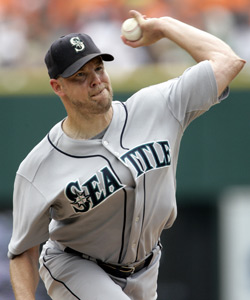 In one of those unrequited love affairs that never seems to end, John Heyman reports that the Yankees have made inquiries about the availability of Seattle starter Jarrod Washburn. The Yankees are naturally impressed by Washburn given that he pitches like a Cy Young winner whenever they see him. Though his record against the Bombers is only 5-6 in 13 career starts, his ERA is just 2.76. If they’ve beaten him, it’s because he likes to give up home runs, and they like to hit them, but since he hasn’t allowed them many walks or hits overall, the overall scoring has been kept to a minimum.
Sergio Mitre doesn’t seem like much of an answer to the fifth spot in the rotation, and they are understandably nervous about pulling Phil Hughes or Alfredo Aceves out of the bullpen, though these worries may ultimately be self-defeating. The Yankees might be able to get through the remainder of the campaign without a reliable fifth starter, and they can certainly make it through the playoffs without ever calling the fifth starter’s name, but it might not be a fifth starter they really need. They might need something more. CC Sabathia has been inconsistent, Andy Pettitte alternates good starts and bad, with the result that his ERA since April is 5.17, and the Yankees also have to worry about Joba Chamberlain hitting a wall in September (whether through an innings limit or fatigue). Say Joba pitches poorly in the fall. That would make the playoff rotation Sabathia, A.J. Burnett, and a lot fingernail-biting (new slogan: Sabathia, Burnett, and pray for a pedicurist). Adding a pitcher of Washburn’s abilities would help ease those fears.
The downside to such an acquisition is that Washburn is having his best year since 2002, and the Yankees would surely have to overpay for that. This is a guy who had a 4.69 ERA a year ago. However, Washburn’s contract status mitigates against a big return, as he’s a free agent after the season. Then, of course, there’s the entire question of if the Mariners want to run up the white flag on their borderline involvement in the pennant race.
Washburn is a fly-ball pitcher, which seems like a bad idea in Yankee Stadium II, although being left-handed he should be at a theoretical advantage in the new park. Indeed, left-handed batters can’t touch him, batting .172/.231/.273 in 137 plate appearances. This is well below his career rates of .239/.295/.389, but let’s take it at face value for the moment. Washburn has good control but is usually very proficient at giving up home runs, leading the AL back in 2003. One of the reasons that he’s having such a good year is that in his average season, over seven percent of the flies he’s allowed have left the building. This year, the percentage is down to five, the lowest rate of his career, and yet there is no corresponding increase in his groundball rate. That screams fluke, something that could change at any time.
Still, if you take his proficiency against lefties as gospel and figure his presence will tilt some opposing lineups to the right side, perhaps his fly ball tendencies are not too troublesome. Whereas left-handed batters are hitting a home run once every 19 at-bats at the new park, right-handed batters have hit them at a more manageable (though still high) rate of one every 25 at-bats.
All of the above still leaves the difficult question of who to deal. The Mariners need batters more than anything else, and the Yankees don’t match up well in that regard. Austin Jackson seems like the kind of overhyped player who would bring more in trade than he will the Yankees in production, but with the outfield in flux both now (with Brett Gardner’s injury) and in the future (with free agent departures), the Yankees probably need to hold on to him, while dealing a Jesus Montero for a Jarrod Washburn seems like the kind of deal that a general manager could spend the rest of his life apologizing for, like Lou Gorman and Jeff Bagwell. Montero hit another home run this weekend, bringing his Double-A line to .309/.366/.537 with nine home runs in 149 at-bats. That line is tempered by Trenton’s wholly impossible home park–Montero is batting .229/.280/.357 in the Garden State capital, but .380/.443/.696 on the road. If he was playing in a fairer home park, there would be a clamor to move this guy to Triple-A or the Majors now. Flags fly forever, but this is the kind of hitting talent that could get his number retired if the Yankees can just find a place for him.
20-GAME WATCH: YANKEES VS. RAYS
W-L RS/G RA/G AVG OBP SLG AB/HR SB CS HR/9 BB/9 K/9
Yankees 15-5 5.6 4.6 .290 .379 .473 25 9 8 1.0 3.0 6.9
Rays 10-10 3.7 4.7 .228 .315 .361 42 19 6 1.0 2.6 7.6
The Yankees have stopped stealing bases with any effectiveness, and that’s not going to change during Brett Gardner’s absence… This is a huge series for the Rays–the Yankees could knock them well back in both the AL East and wild card race. The Rays are lucky to have broken even on their last 20 games given their offensive slump. Other than the indefatigable Ben Zobrist and a rebounding Dioner Navarro, the entire offense has shut down this month. Carl Crawford is hitting .257/.333/.351; Jason Bartlett .238/.342/.349; Evan Longoria .197/.289/.382; Carlos Pena .145/.294/.290. What this means, of course, is that they’re due. Fortunately, the Yankees have Burnett, Sabathia, and Chamberlain going so it won’t be easy for the Rays to break out. They too have their best pitchers going this series, sort of, kind of. The pitching rotation, which lands on James Shields and Matt Garza, plus Scott Kazmir, who is motivated to turn things around after five weeks on the DL. He’s made five starts since coming back and the results have been mixed, with a 5.08 ERA in 28.1 innings.
Thoughts for the weekend
MENTIONED THIS BEFORE, BUT IT’S STILL ON ME MIND
When CC Sabathia goes seven innings and strikes out four batters, I worry. Sabathia has a career rate of 7.5 strikeouts per nine innings pitched. He’s averaging 6.5 strikeouts per nine for the Yankees, which is average for an AL starter this year. Now, none of this matters much if Sabathia can pitch effectively while allowing batters to put more balls in play, and so far he has, in part because (and this is paradoxical given the propensities of Yankee Stadium II) fewer of the fly balls he allows are going over fence walls than they used to. Hand in hand with that is some good breaks on balls in play — coming into this year, batters hit .292 off of Sabathia when they put the ball in play. This year they’re hitting .272.
There are two troublesome aspects to this picture. First, a pitcher’s luck on balls in play can change. Second, when a pitcher’s strikeout range declines, it is sometimes (often) a suggestion that something is wrong — that a crash is coming. Sabathia’s velocity seems to be consistent with previous years, so we’re certainly not seeing any evidence of a physical problem there, but it’s still a difficult thing to accept and with which to be comfortable.
 HOLLIDAY (NOT HALLADAY)
Kudos to the A’s for getting a top prospect in Brett “The Walrus” Wallace from the Cardinals for Matt Holliday. Ever since Eric Chavez’s constitution vanished, the A’s have had a lot of filler at third base. With Chavez signed for one more year (plus an exceedingly painful $3 million buyout), the A’s may feel obligated to keep trotting Chavez out once a year to see if he can remain in an upright position for more than a game at a time, but in the long interim between appearances, they can try Wallace. A first-round pick last year, Wallace has hit .306/.390/.466 in the Minors in about one season’s worth of playing time. He hit .293/.346/.423 at Triple-A Memphis this year, which translates to .272/.321/.397 in the Majors — not great numbers, but then the A’s have gotten only .210/.289/.316 from their third basemen this year.
The problem with Wallace as a third baseman is suggested by the “Walrus” nickname. He’s not fat, he’s just shaped strangely for, well, anyone. He looks like two different people glued together, something like an average-sized person on top and Prince Fielder on the bottom. It’s not a sure thing that someone built like Wallace can play a quality third base in the Majors. So far, though, he’s hanging in, and it would be a huge bonus for the A’s if he can stick at the hot corner.
The A’s also picked up pitcher Clay Mortensen and outfielder Shane Peterson, but neither has the possibilities of the Walrus. Peterson hasn’t much power and unless you’re a plus defensive center fielder, that usually means a life sentence as a fourth outfielder. Mortensen is a starter right now, but given that he’s 24 years old and has had three years of mediocre results, one smells a trip to the bullpen in the near future. He too is a former first-round pick.
WANGERY INFINITY
It seems that Chien-Ming Wang is unlikely to pitch this year. This is sad on one level, and a break for the Yankees on another, because even if he were to pitch again in 2009, it was unlikely that he was going to pitch well, yet the Yankees felt obligated to keep trying. Given the hole in the rotation that Wang’s absence has created when combined with the team’s decision to bolster the bullpen at the expense of the starting rotation (see Phil Hughes and Alfie Aceves), their desperation was understandable, but Wang had reached the point where Sergio Mitre or anyone else would have been a better bet to pitch the team to a win. For the sake of both Wang’s career and the team’s chances in 2009, giving him a pass for the rest of the year is the right thing to do.
 Pinstriped Bible