Tagged: Brett Gardner
Does Melky deserve another shot in center?
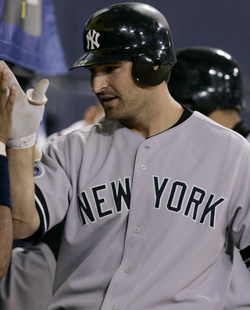 THEY MIGHT BE TRADING
The ice keeping the outfielder/designated hitter free agent market is beginning to break up, and that can only be good news for the Yankees as they look to ease their outfielder logjam. There really isn’t much reason for a team to trade anything of value for an Xavier Nady when better players can be had for mere dollars. However, as those players fall out of the market, the losing bidders will be looking for consolation prizes, and that’s where Nady comes in.
Parenthetically, FOXSports.com’s Ken Rosenthal reports today that it’s not just Nady on the market, but that the Yankees are also floating Nick Swisher. This is so depressing a possibility that I refuse to acknowledge it. Should Swisher rebound, the Yankees will have a right fielder with a .260 average, 25 home runs and 90 walks. Should Nady return, the Yankees will have a right fielder with a .270 average, 20 home runs, and 35 walks. The difference, when you add in Swisher’s superior defensive capabilities, is between four and five wins, which is a huge number. Now, if trading Swisher nets the Yankees Tris Speaker to play center field and trading Nady does not, you could make the argument that Nady + Speaker is greater than Swisher + Brett Gardner/Melky Cabrera. Fortunately, it’s doubtful that a Tris Speaker is available, let alone that one will be made available for either player, so Nady should almost certainly be the man with the one-way airline ticket out of town.
I realize I often drop Tris Speaker’s name when talking about possible center fielders. For those that didn’t take the prerequisite course, Pinstriped Bible Background 101, Speaker, also known as the Grey Eagle, played from 1907 to 1928 and for decades was known as the quality standard for center field defense. He also banged out 3,500 hits, about 800 doubles, and averaged .345/.428/.500. Thus, if the professor says that the Yankees have a chance to get a Tris Speaker, he is referring to the idea of an impact-level, two-way center fielder. He is not referring to Mike Cameron. He is definitely not referring to Melky Cabrera. Sadly, he’s not referring to Brett Gardner either, though Gardner is almost certainly the best of the preceding three names.
Speaking of Gardner, I got a good bit of mail on the subject of he and Melky from reader Jeremy:
In your recent Pinstriped Bible column, you mention that Melky Cabrera doesn’t
deserve to keep his roster spot because: “His Major League batting averages are, in order,.280, .273, and .249. Wake me when the movie’s over.”
With all due respect, I think this deserves more analysis than you give it. Batting
averages aren’t considered to be the defining statistic in baseball anymore. I’m not
pretending to be Bill James or anything, but in 2006 and 2007 Melky posted OPS+s of
95 and 89 respectively. In 2008 he did post an OPS+ of 68, but he had the least ABs
and GP’d since his 20-game stint in 2005. His -4.0 VORP is inexcusable, but for
goodness sake his BABIP was .271! He’s a 24 year old who plays good defense and if
last April showed us anything (.291/.359/.505,6 HR,17 RBI) might have some
potential.
All I’m really saying here is that Melky deserves a much more in-depth look than
batting average can give us. I realize that April is an EXTREMELY small sample size;
but combined with his other statistics, I think that it is worth giving Melky some
growth time. After all, compare the first few seasons of Sammy Sosa with the first few seasons of Melky. I’m not saying that they will even end up being comparable, BUT early career batting averages aren’t the best way to gauge a player’s potential (just ask the Rangers if they would have traded Sosa if they had known he would put up a 201 OPS+ in 2001).
In summation, Melky hasn’t been as great as the Yankees expected him to be so far,
but his early stats show that he has some potential. He’s still only 24 and his
flash of brilliance last year shows that, from time to time, he can mash with the
best of them. Thanks for reading, Jeremy P.
Thank you, Jeremy. Good one. I wasn’t simply evaluating Melky on batting average, though he might prefer it if we stick to that because so far it’s the only offensive skill he’s shown in the Major Leagues. I’ve been through the Melky arguments enough times that I figured it was safe to give you the shorthand version. Let’s run through your points. He had the fewest at-bats of his career for a reason, namely that he was abusing the ones he was given. His batting average on balls in play was indeed low, but so was his line drive rate, and line drives are where batting averages come from. Melky spent much of the season hitting weak fly balls and grounders. It wasn’t bad luck, as we might normally infer from a low BABIP, or defenders making a fluke chain of great plays against him, he just didn’t swing with much authority. That said, even if we grant that his low BABIP could have been caused by bad luck, nothing much changes. Let’s give him the benefit of the doubt and tip him 30 points of batting average, to get him back up to the league average in the BABIP category. At best, you’d have his 2006 production … except you wouldn’t have that either, because his walk rate has also dramatically declined since then, dropping from nearly 11 percent of PAs in 2006 to just 6.5 percent this year.
There’s another problem here, which is that Cabrera is also a fraud as a switch-hitter. He is completely shut down by left-handed pitchers, with career rates of .251/.319/.329. Basically, we’re looking at a batting-average oriented platoon player who has yet to hit for an impressive average over a sustained period of playing time anywhere in his career, who doesn’t and probably will not hit for power and is not particularly selective.
That brings us to your Sosa comparison, which, respectfully, is wildly off base. First, you should recognize that Sosa is an outlier. Most players do not explode the way he did, which is just one reason why observers sometimes look at that explosion with skepticism. I’m not saying they’re correct about that, by the way, merely that the rareness of the development is one reason why. Second, the statistical similarities aren’t really there. Sosa was in the Majors at 21, still clearly learning on the job and swinging at every off-speed pitch he was offered, but still knocking extra-base hits all over the place. This correlated with what scouts were saying at the time: this guy has immense physical tools. When he hits the ball, it travels for whole galaxies. The only problem is that he doesn’t hit it often enough, but if he ever learns how to make better contact, look out. This was something you could see at the time — I have a dim recollection of him simply crushing a ball off of Dave LaPoint into the center field bleachers at Yankee Stadium in 1990.
No one has ever seen those kinds of physical tools in Cabrera. No one is predicting that kind of explosion for him, and I would argue that his approach at the plate largely precludes that kind of development. Now, I’m not prescient, and it’s certainly possible that Cabrera could change that approach, or put on 50 pounds of muscle (in a wholesome way, I mean) and start crushing the ball, or all the bad luck that you think he had in 2008 reverses, he hits .350 on balls in play this year, bats .300 on the season, thereby elevating all of his weak peripherals. Maybe, but I doubt it. I’m not much of a gambling man, but if we’re going to roll the dice that way I’d rather bet on Gardner adding a few singles and a few walks than on Cabrera changing his entire being. One is entirely within the realm of possibility. The oth
er is an almost impossible long shot.
BUNKER BOY RIDES AGAIN
I’ll be back in the Bunker on the YES Hot Stove show again this Thursday evening, so get your comments in and I’ll bug Bob and the newsprint boys about ’em. No doubt we’ll be talking about Mark Teixeira, the center field issue, and the ongoing Andy Pettitte saga. Me, I hope it keeps on going — the Yankees can and should reserve a spot in the rotation for youth.
More questions than answers in the outfield
TO THE MATS WITH READER MAIL
1: GODS AND GODDESES OF DUNGEONS & DRAGONS
I enjoy reading the Pinstriped Blog. An interesting thought came to
mind after the Teixeira signing, which I love. Who do you think is
the most powerful person in baseball — Bud Selig or Scott Boras?
Does Boras have too much influence on the game and should
something be done to limit his control of the game, like a limit on
the number of players he can represent in general or each year?
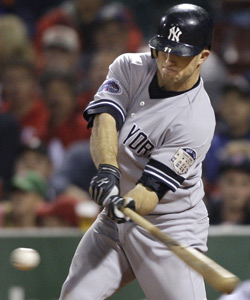 Also, what are the best options for the Yankees in the outfield short
term and long term? If Cabrera and Gardner don’t perform well in center
field, how soon could we see [Austin] Jackson in there? Out of the
current candidates of Swisher, Nady, Cabrera, Gardner who has the
best arm (I leave off Damon and Matsui because I know they can’t
throw)? Thanks, Jeff
Thank you for writing, Jeff. The “power” of Boras is generally overstated. He’s a very smart, very successful agent who does good things for his clients. He doesn’t negotiate media rights contracts or decide who gets to own the Chicago Cubs, though maybe he should. He does his job, which is to drive a hard bargain for his clients. What power he has derives exclusively from teams wanting to hire the people he represents. If they refuse to bargain with him, he’s pretty helpless, although they do pay a penalty for that in not getting hold of some very good players. Power seems to imply the ability to impose your will on others, and Boras needs complicit partners before he can even start talking. As for the outfield, I believe in Gardner’s ability to get on base. The question is if he will do it often enough to overcome his utter lack of power.
As for Jackson, don’t get too excited too soon. His indifferent Arizona Fall League performance and good-not-great performance at Double-A Trenton argues for some Triple-A seasoning before he gets a crack at a full-time job. I expect you’ll see a lot of him in Spring Training just so the Major League staff gets familiar with him, and if he does well at Scranton, an injury call-up during the year is a distinct possibility. The center field job would seem to be something for 2010.
2: SOMETIMES YOU JUST FALL OUT OF LOVE (THERE DOESN’T HAVE TO BE A REASON)
Why is it that lots of Yankee fans don’t like Gardner in center? He’s
very fast, an excellent defender and wasn’t half-bad with the bat in
his second stint last year. Also, what happened to the Yankees’
fondness of Xavier Nady? It seemed like when they got him, the
organization really liked him. But now they’re thinking of trading
him? Trading away a .305 AVG, 25 HR and 97 RBI from an offense that
had trouble scoring runs last year? Does that even make sense? –Tucker
It makes a ton of sense, Tucker, because Nady isn’t really a .305 hitter. In his career, he’s been far closer to the hitter he cooled from his hot pinstriped start, a .268/.320/.474 hitter. As far as corner outfield production goes, it’s subpar. If Nick Swisher gets back on track this year, he’ll get on base much closer to 40 percent of the time and show comparable power. The value in Nady last season was that he was a huge in-season upgrade on Melky Cabrera, who he displaced from the lineup by allowing Johnny Damon to go back to center. That was a very nice move by Brian Cashman to staunch a bleeding wound, but Nady isn’t someone a championship team plans on starting.
The knock on Gardner is that he’s a banjo hitter, but as you point out he did a fine job in his second stint with the Yankees. He’s a fine defender and an excellent baserunner, and if he can get on base with any regularity, he can show that there are more ways to contribute than hitting home runs. His upside is far superior to that of Melky Cabrera, who has but one skill right now, hitting for average, and that skill was absent this season.
3: MORE ON THE THEME OF THE DAY
Steve- in your PB column of today, you indicate the Yankees should
keep Swisher and trade Nady. Certainly, last year’s numbers would
scream for the opposite course of action. You seem to be thinking
that last year was an aberration for both players and that each will
return to their prior form. I would prefer the Yankees use a six-man
rotation of Matsui, Damon, Nady, Swisher, Melky and Gardner to
cover the DH and three outfield spots. Unless the a Nady trade yields
a significant prospect or an upgrade in center field, the only reason I
could see trading Nady and not going with this six man rotation is
financial. Do you agree?–Saul
Happy New Year, Saul. One problem I see right off the bat with the Six-for-One plan is that, assuming a staff of 12 pitchers, the Yankees aren’t going to be able to carry all those outfielders plus a reserve catcher and an extra infielder. Beyond that, it’s not necessarily the best application of resources. First, Cabrera is guilty until proven innocent. He was not a great Minor League hitter, and has yet to be even average in the Majors. His big skill is that he can throw. Last year he killed the Yankees, punished them very badly given what an even subpar center fielder would have done. Many among the readership are ready to forgive and forget, but it’s not clear that there’s a good reason to expect a great deal more. Unless Cabrera develops an unexpected ability to knock balls over the wall or suddenly becomes highly selective, he’s going to have to hit .300 to create any kind of offense. His Major League batting averages are, in order,.280, .273, and .249. Wake me when the movie’s over.
Matsui’s knees may anchor him to DH, and given what we’ve seen of his defense, that’s not a bad thing. Between offensive and defensive deficiencies, there’s no reason to ever play Cabrera, Gardner, or Damon in right field. Although every one of the players you list except for Nady has been a center fielder at some point in his life, only Cabrera and Gardner really have the ability to play the position at this point. Just to sort it all out, Nady would make a fine hedge against injury. Using him to rotate Damon or Swisher out of the lineup against select pitchers or for general rest would be a great thing. There are three problems: first, Nady might not want to spend his season that way. Second, given that he just spent half a season batting .330, his value will never be higher. Third, he’s off to arbitration, so he’s about to get expensive for a bench piece. Oh, and there’s a fourth thing: at the end of the year he leaves and the Yankees have to start all over again. If he brings a more youthful body who will be under team control for several years, the greater utility might be in sending him away.
AND ON THAT NOTE…
…I send myself away for New Year’s revelry. I wish each and every one of you a safe, happy, and loving new year, and I will look forward to seeing you in 2009. May it be a very good year for us all.
Not particularly snappy answers to Melky questions
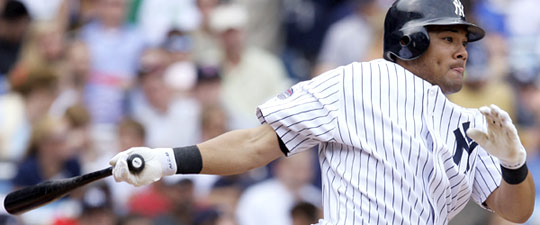 Q: If Melky Cabrera goes 20-for-40 in spring training and Brett Gardner goes 5-for-40, should it change anything about our expectations for either player?
A: No.
Not that anybody asked, but it’s a story we should get out in front of. An even better question is, “If they both go 20-for-40, who do you pick?”
A: Gardner. Even if we assume fielding is a wash, he does other things that Cabrera can’t do.
Q: Could you platoon them?
A: Not in any way that’s going to work. Gardner is a left-handed hitter. Cabrera masquerades as a switch-hitter, but so far he’s been completely ineffective from the right side, hitting .251/319/.329 overall and .213/.279/.299 in 2008. Those rates were fueled by a .227 average on balls in play, which suggests either extraordinary bad luck, extraordinary defense against him when batting right-handed, or the weakest swings in the history of weak swings.
Q: Say Melky does get back on track. What’s his upside?
A: Darned if I know, or anyone else does either. Before this season’s problems, Cabrera seemed headed for a peak of somewhere around .290/.350/.420. That seems crazily optimistic now. To get there, let alone the realm of star quality, he’d have to completely reinvent himself. In his career to date, he’s shown a proclivity for hitting grounders, an approach that makes home runs kind of unlikely. Selectivity seemed to be something that we could project as an asset back in 2006, but that is no longer the case. Then there’s the aforementioned platoon problem. Cabrera hit in some bad luck this year, and if he avoids the lefties his batting average should rebound a bit. That said, batting average isn’t everything. You have to reach base and hit with power too, and the likelihood of Cabrera recovering his patience and learning to elevate his swing seems pretty remote. The chance of even one of them happening seems remote.
Q: So what should the Yankees do?
A: I’m partial to giving Gardner a try. Though he doesn’t profile as a real offensive producer, he should have sufficient patience that if he hits .280 he’ll get on base at an above-average rate. Throw in some stolen bases and good defense and you have a valuable package. If he succeeds, great, and if not, in an ideal world Austin Jackson could challenge for the job before the year is up. Unfortunately, there is a broader problem in that the entire Yankees outfield might not produce next season. Johnny Damon is a near-certainty to regress. If Xavier Nady is the starting right fielder, he represents a 20-run discount on Bobby Abreu while only slightly improving the defense. The Yankees will be asking a great deal of the infield, which makes the center field decision even more important than it seems on the surface. If Cabrera is worth 65 runs of offense to the Yankees next year, and Gardner 75, then they had better go with Gardner because those ten runs are going to count.
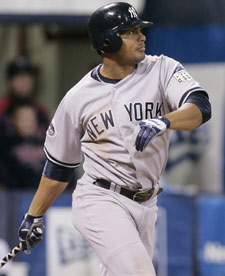 Q: Doesn’t that point up the whole not-offering-arb to Abreu thing?
A: Well, sort of. I can’t speak to the Yankees’ perception of their finances, so let’s stick to this in pure baseball terms. The team is lacking a strong right fielder. It’s not that the Yankees can’t move on from Abreu–there are strong arguments that they should, among them his declining plate judgment and his odd phobia about balls hit to the wall. The problem is that they need to replace that offense. They could theoretically replace it anywhere on the field. If your new right fielder is 20 runs worse (as I suggested above) and your new first baseman is 20 runs better, then at worst you’ve broken even. The problem right now is that Nick Swisher/Xavier Nady isn’t as potent as Jason Giambi/Bobby Abreu, and a country mile off from what Mark Teixeira/Nick Swisher would be.
If all financial matters were equal, then offering Abreu arbitration would have been a win-win scenario for the Yankees. If he declined, the Yankees would pick up some juicy draft picks, picks they can really use. If he accepted, they would have one more year of Abreu, possibly a last good one, without being on the hook for any decline that came later. In that scenario they could also immediately dedicate themselves to trading Nady, whose trade value will never be higher than it is right now (I borrow that last thought from the estimable Cliff Corcoran). There’s a reason that Nady has been with four teams in the last four seasons, and unless the Yankees are careful they’re about to find out what it is.
Q: Hey, Adam Dunn wasn’t offered arbitration. You haven’t mentioned him as a possible acquisition target for the Yankees. Why not?
A: Because my dreams just aren’t that big. A lefty slugger who has popped 40 homers a year for the last five seasons? If the Yankees could clear DH for him they would greatly benefit, but look at the points we’ve just gone over–offense isn’t management’s priority. It’s a shame that economy has brought on an austerity kick now instead of say, 2005, when the Yankees could have banked their money instead of blowing it on Carl Pavano and Jaret Wright. This winter, when the team has legit multiple targets to spend on, they can only afford to have CC Sabathia on the brain. Dunn seems to me to be the kind of player who won’t age well as he hits 33 or so–still five years off–and so does Sabathia, with his hulking frame and heavy workload. Five years from now, Teixeira might be the only one left standing.
A COUPLE OF MORE SITE NOTES
A reminder that as part of our new setting here, there is a handy RSS feed for you to subscribe to. It’s at the bottom of the blue sidebar at the right. We’re also going to be putting a snack bar and a Jacuzzi over there, so keep your trunks handy. Finally, keep those comments coming–I’m paying rapt attention. Finally, tune in to YES on Thursday at 6:30 to see an audio-animatronic version of myself interact in lifelike fashion with the actual Bob Lorenz. A splendid time is guaranteed for all.
 Pinstriped Bible