Tagged: Carl Crawford
The future of Carl Crawford
CRAWFORD’S STRIPES
I’ve seen some suggestions, both here in the comments and elsewhere, that the next Yankees left fielder should be Carl Crawford, MVP of last night’s All-Star Game. There is nothing wrong with dreaming about Crawford, who is a terrific, entertaining player, a burner on the bases and in the field. Yet, his path to the Bronx is far from assured.
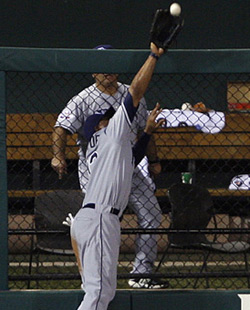 The first problem with projecting Crawford in pinstripes is the assumption that he will be a free agent this winter. That is not necessarily the case. The Rays hold a $10 million club option. If they choose not to exercise it, they would have to pay Crawford a $1.25 million buyout. The marginal cost to the Rays of retaining Crawford, then, is $8.75 million, or just $500,000 more than he’s making his season. That would seem to argue for another year of Crawford in Florida unless the combination of the weak economy and Tampa’s attendance issues — the reigning AL champs’ sales are up, but only by about 2,300 tickets a game — has put the team in a position where it has to cut salary to the bone.
That outcome seems unlikely for two reasons: First, the Rays have a few dollars in useless salaries coming off the books after this season. Troy Percival, Jason Isringhausen and Chad Bradford will combine to make $8 million this year. If the Rays replace them internally, something they’ve already been forced to do with two of the three, then Crawford’s salary is mostly covered. Secondarily, $10 million is high for a left fielder in the present economic environment, but not outlandishly so. It’s less than Raul Ibanez will make next year, or Adam Dunn, and just $1 million more than Milton Bradley. The Rays could absorb the $8.75 million next year, then attempt to re-sign Crawford to a lesser contract based on the new economic realities, or they could pass and take the first-round draft pick. Alternatively, they could pick up Crawford’s option than attempt to trade him a year from now. In short, there is no guarantee that Crawford will even be available to the Yankees.
A more difficult question, but not spectacularly more difficult, is whether the Yankees would really benefit from signing Crawford. Crawford is a very good player who has the potential to be a very bad one. His game is largely based around speed, with only a bit of power and patience thrown in. His batting average is driven by hitting on turf — he’s averaged .302 on the fake stuff versus .285 on grass. Since he doesn’t walk much, his on-base percentage on grass is only .324. His average is also driven by his speed. Nearly 10 percent of Crawford’s hits every year are of the infield variety. At some point, through age or the inevitable knee injury, he’s going to lose half a step, and when he does, close to 20 hits a year will disappear, as will the high stolen base totals, the triples and the stellar outfield defense. That will leave Crawford’s team with a player not too different from the one he was during his injury season last year. Crawford hit .273/.319/.400. That’s not helpful in an offensive era in which the average player can be counted on to do better than that.
You can’t know when Crawford will hit that wall, the one that waits for all players whose productivity is based on speed, but given that the team that signs him as a free agent will have to agree to a multi-year deal that carries the player at least into his early 30s (Crawford turns 28 in August), it’s likely that it will happen on his next employer’s dime. Signing any player, at any stage of his career, is always a gamble, but some gambles are lower percentage risks than others. As much fun as Crawford can be, he seems like one of those, a chance for an acquiring team to get burned. Just Crawford’s career road rates, the non-turf .285/.323/.423 alluded to above, suggests he could retain his speed and still disappoint in the wrong park. In other words, he’s probably more valuable where he is now than he would be almost anywhere else. Before clamoring for Crawford, it would be best to be sure of what one is getting. As the old saying goes, speed kills. In this case, the victims might include those paying a thirty-something Crawford’s salary.
 Pinstriped Bible