Tagged: Jeter
One more chance for Wang
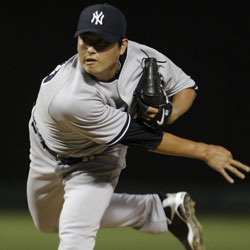 WANG RIDES AGAIN, ONE DAY AT A TIME
Chien-Ming Wang has been sprung from the bullpen. He will start on Thursday against the Rangers. Phil Hughes will take his place in the bullpen. At this writing, the reasoning behind the decision has yet to be reported, but we can safely assume that the Yankees have been sufficiently intrigued by Wang’s work in relief to give him the shot. At the same time, Hughes gets the benefit of a little more experience working in relief and remains on hand to pitch if Wang’s return needs to be aborted.
The upside of the move is clear: at his best, Wang was a consistent starting pitcher who gave the Yankees a fair chance to win about 60 percent of the time. As I have written many times here, the secret of Wang’s success is that his sinker has been so good that not only do batters hit very few home runs off of him, they hit relatively few extra-base hits at any time. If Wang’s control is sharp and he keeps the walks to a minimum, the opposition has to pile up many singles in a row to score more than one run in an inning.
That said, Wang’s very low strikeout rates mean that everything has to be working right for him to win, including the inner defense. As we’ve seen this year, if he’s not at his best, batters don’t swing and miss, they swing and annihilate. Very few pitchers have had any kind of long-term success with Wang’s strikeout rates–a reader in the comments for yesterday’s entry cited Rick Reuschel, Jamie Moyer, Greg Maddux and Paul Splitorff, but all of them except Splitorff had decisively higher strikeout rates in leagues in which batters were harder to strike out (and I’m betting that Spitorff would edge ahead as well given a similar era adjustment), and in any case these are outliers, four pitchers out of, well, everybody.
Hughes has been fascinating so far. He’s averaging eight strikeouts per nine innings, one of the reasons that the Yankees are second in the league in strikeout rate. His walk rate has been a tad high. He has not been consistent, of course, and the Yankees are looking for consistency in a close race. All Yankees tyro pitchers are on an inning-to-inning lease, but given the highly competitive nature of the AL East this change can’t be looked at as a symptom of the team’s typical impatience. Though the Red Sox have had an indifferent record of late, the Blue Jays have been in a tail spin, and the Rays are still struggling to find consistency, you can’t assume that these clubs are just going to fall away and leave the Yankees alone in first place. It makes sense to reach for the arm that you think is going to give you a quality start six out of ten tries instead of four or five times out of ten tries.
Regardless of what Wang does now, the future belongs to Hughes and his strikeouts, to the way that a high-strikeout pitcher can take the weight off of a defense (with an aging Jeter and a crippled A-Rod, this is only going to become more of an issue over time). Eventually the Yankees are going to have to make a commitment to him and let him mature enough to find that consistency, or decide that he’s not going to find it and move on.
They also need to be prepared to abandon this experiment just as quickly as they started it, and for the same reasons. Wang has pitched six times this year. He was creamed the first four times and pitched well the last two. This is not exactly a plethora of evidence that Wang is ready to be a dominating starter. If the AL East is too competitive to let Phil Hughes grow up in public, then it’s also too competitive to let Wang try to reestablish himself as a starter. Forget the two 19-win seasons. They have little relevance to 2009. That was then, this was now, and if Wang isn’t the same guy then there’s no room to let him flounder based on a memory. All luck to him, of course, and all respect for past accomplishments as well, but just like Hughes, Wang should be guilty until proven innocent.
THE CAPTAIN
Having hit in sixteen straight games (.429/.487/.600), Derek Jeter’s overall numbers have risen to the point that, if he simply maintains his current overall level of production, he will have enjoyed a very nice comeback season, his best with the bat in three years. There are, of course, many games yet to go, so you can’t count on that happening, but after last year’s injuries, the concomitant decline in production, and rapidly encroaching old age, it’s good to see that this future Hall of Famer may have another top-quality season in him.
Actually, top-quality is a bit of a misnomer as Jeter’s current level of production doesn’t stand out from any of several other seasons he’s had–he’s always been a consistent player, with a couple of notable exceptions. One of those, of course, was 1999, when Jeter had what was one of the top five or so seasons by a shortstop since the 1950s. There’s Alex Rodriguez’s 1996 and 2000, Nomar’s 1999 and 2000, Robin Yount’s 1982, Alan Trammel’s 1987, and Jeter’s 1999.
Note that with the exception of Yount, the MVP voters missed on every dang one of them.
 Pinstriped Bible