Tagged: Jorge Posada
Ready for your midterms?
THE DREADED MIDTERM GRADES
On Sunday, the Yankees played their 81st game. The season’s official halfway point comes at the All-Star break, but this is it’s actual halfway point. In my ten years as pinstriped armchair detective, I’ve sometimes resorted to the clichéd midterm grades and sometimes not. This year it seemed like a helpful device to review the season. Today we’ll cover the position players, tomorrow the pitching staff.
As you review the report card, remember that the same grade might not mean the same thing for two different players, because each player must be viewed in the context of his position, his career, and his role. Expectations for Mark Teixeira are different than they are for Brett Gardner, so the latter could conceivably get a better grade than the former without implying that he is the better player in a head to head comparison. With that in mind, feel free to offer your own grades in the comments section. 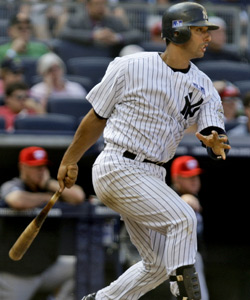 JORGE POSADA-CATCHER
Putting his 25 days on the disabled list aside, you can’t fault Posada’s season. When a 37-year-old catcher is hitting .284/.368/.523, you give thanks for your good fortune and try not to ask too many questions. On defense, he’s thrown out over 30 percent of runners trying to steal, a solid number (the overall Major League success rate on stolen bases this year is 73 percent). The notion that his handling has damaged Joba Chamberlain or anyone else is farfetched bushwah given his career record, as well as those of his many battery-mates. As with several Yankees, Posada has done far more damage at home than on the road. GRADE: 89/100
MARK TEIXEIRA-FIRST BASE
Teixeira has been quite streaky, only reaching a “hot” temperature in May. He’s been vastly more successful at home (.310/.402/.632), but his road production (.243/.373/.472) also gets the job done, albeit at a far more pedestrian level. He’s also been a revelation on defense, even if for some reason the metrics don’t show it. While Teixeira’s season is consistent with his work in previous seasons, he’s not quite at the level of the last two years (.307/.406/.557 in 289 games), and it’s worth noting that he’s having only the fifth-best season among AL first basemen, trailing Justin Morneau, Kevin Youkilis, Russell Branyan, and Miguel Cabrera. Of these, Branyan probably won’t hang on until the end, but the others almost certainly will. Bumped out of the “A” range, but only in comparison to previous performances. The 20-game homerless streak with which he ended the half (.244/.366/.321) didn’t help. GRADE: 86.5/100
ROBINSON CANO-SECOND BASE
Cano has bounced back from his spectacularly miserable 2008, but a league-average on-base percentage is still a bridge too far, as is consistency–in May and June combined, he hit .271/.302/.439, which doesn’t help all that much. He’s on a pace to ground into 24 double plays, and he’s batting .196 with runners in scoring position. There are certainly worse second basemen to have–Howie Kendrick is actually the evil Cano from the Star Trek mirror-verse–but as usual, the whole is less than the sum of the parts. GRADE: 79/100
ALEX RODRIGUEZ-THIRD BASE
With 45 walks and 14 home runs in 51 games, A-Rod has been productive despite his low batting average. Eleven of his 14 homers have been hit at home. Conversely, he’s hitting just .211 in the Bronx, with a truly strange .131 average on balls in play–one wonders if he’s trying to get the ball in the air at the new park, trying to catch up on all the short fence/jet stream-generated fun his teammates had without him. His hip problems seem to have sapped his speed and defense, and he hasn’t been around that much. Docked a few points for days absent and the whole juicing thing, which is spectacularly annoying. GRADE: 83.5/100
DEREK JETER-SHORTSTOP
There are a few nits you can pick with Jeter’s season. He’s only hitting .264/.340/.383 against right-handers, most of his damage coming thanks to .452/.524/.644 rates against lefties. All of his power seems to be a product of Yankee Stadium II; just two of his ten home runs have come on the road. On the plus side, his walk rate is up, he seems more limber this year, both on the bases and in the field, and though he still hits everything on the ground (he ranks 11th among players with 150 or more plate appearances this season), he’s kept his double play rate in hand. Overall, I’m not complaining–after the lethargy of last year, this qualifies as a comeback. GRADE: 91/100
JOHNNY DAMON-LEFT FIELD
Damon hit 17 home runs last year. He’s hit 16 in 76 games this year. The difference is Yankee Stadium II; the former Caveman is hitting .289/.390/.592 with 12 home runs (one every 12.7 at-bats) at home, .278/.340/.465 with four home runs (one every 36 at-bats) on the road. Now, that doesn’t mean that Damon shouldn’t get his due, as being able to take advantage of one’s environment is a skill. It’s much like Jim Rice’s home-road splits in Boston: if everyone who played in Fenway hit like Jim Rice, you’d have an argument about discounting his stats. Damon’s road stats are also sufficient–the average Major League left fielder is hitting .267/.342/.433 overall. At his current pace, Damon is going to obliterate his career high in home runs, his career high in walks is also in reach, and he’s easily going to have his tenth 100-run season. Stolen base frequency is down and his range in left seems down a bit, but as with Jeter I’m not going to complain about a late-career high. GRADE: 90/100
MELKY CABRERA-CENTER FIELD
He’s doing some things he’s never done before, like hitting as a right-hander and taking the occasional walk–he had 29 free passes all of last year, compared to 22 now. That said, he’s mainly helping with his defensive versatility, not his bat. His home runs are a gift of YS II, with seven of eight round-trippers coming in the friendly confines, and coincidental with the injury he suffered in Texas or not, his bat turned off at the end of May and hasn’t come back–even with a semi-hot streak over the last couple of weeks, in 31 games since the end of May he’s hit .221/.303/.379. Given that Cabrera hit only .235/.281/.300 after April last year, the idea that the injury is what’s holding him back should be taken with a huge grain of salt. Cabrera is an asset as a reserve, but he’s not a starter. Alternatively, he’s playing hurt under the misguided belief that he’s helping. At that point, Austin Jackson would be the better choice. GRADE: 72/100
NICK SWISHER-RIGHT FIELD
What a weird player, inconsistent in every phase of his game. At his April level of production, he was a Ruthian terror. In June he hit .253/.379/.506 and was still plenty productive. In between, he took a lot of walks but hit .150. Six games into July he just drew his first walk of the month and was 4-for-22 with one walk in seven games since hitting his last home run going into Tuesday, when he finally broke through with three hits (which doesn’t count towards the midterm). He hasn’t been all that productive with runners on–this seems to be a career-long problem, as if he shortens up his swing and worries about striking out in those situations. The result is quite a few walks but not many hits. His defense is usually solid, but he also has his off days. As he did last season, Swisher has a pronounced home-road split. He’s batting .279/.373/.625 with 11 home runs (one every 12.4 at-bats), but only .181/.347/.302 (again, through Sunday) with three home runs (one every 38.7 at-bats) at home. He’s been helpful on the whole, but the only reason he ranks among the top 15 right fielders in productivity is
that there are only 15 right fielders having good years. In short, I don’t know what to make of him. GRADE: 80/100
BRETT GARDNER-THE OTHER CENTER FIELDER
Gardner is listed among the starters because he’s actually started more games in center than Cabrera, even though Cabrera has played more overall. Given what little was expected of Gardner, not to mention the way he started the season, he probably deserves an A grade just based on performance vs. expectations. He started only 25 games across May and June, but he also appeared in 21 more and hit like crazy, batting .330/.427/.510 with four triples, three home runs, 16 walks, and 12 steals. He has not been handled brilliantly. After Gardner’s 5-for-6 game against the Mets on June 26, he was given just two more starts (he went 0-for-7) before Joe Girardi presumably decided he had gone cold and it was time to try Cabrera again. It’s not clear how a kid is supposed to build up any momentum under those conditions. When he sits, the Yankees aren’t suppressing a great bat, but they do lose some patience (Gardner has drawn a walk every 9.7 plate appearances, whereas Cabrera has taken a pass every 11.6 plate appearances), their best baserunner, and their best center field defender. Despite the hot streak, it’s doubtful that Gardner will ever be a big run producer, but he’s certainly been worth playing. GRADE: 85/100
How well is Robinson Cano playing?
 GIRARDI VS. CANO
Joe Girardi is a polarizing figure for Yankees fans. It was inevitable that the first manager to guide the Yankees to a finish out of the postseason in what seems like a hundred years would become a lightning rod. Some decry his handling of the bullpen, others his love of small-ball tactics — the Yankees bunt often for a present-day American League team.
These criticisms are debatable; the bullpen has risen in effectiveness throughout the season, as weaker sisters have been weeded out (Tuesday’s game notwithstanding), and those Yankees that Girardi has asked to bunt are either those who don’t generate much offense anyway (Francisco Cervelli) or just might beat one out (Brett Gardner). The place where criticisms of Girardi find a more legitimate place are in his construction of the batting order.
Variations in the batting order are not terribly significant. They won’t ruin your season, but they can cost you a few runs on the margins. Since the manager’s job is to maximize his team’s performance, that is, to capture every run that he can, that the batting order is not a top-priority item is no excuse for putting out the best one possible.
For reasons that aren’t obvious, Girardi has fallen in love with Robinson Cano as his fifth place hitter. Cano has started 46 of the team’s 76 games in the No. 5 spot. In putting Cano there, Girardi has delivered Cano some very special plate appearances with runners on base. Mark Teixeira has seen the most baserunners of any Yankees hitter, but Cano is second, having seen just seven fewer runners. The problem is that despite a .300 average on the season, Cano is hitting only .254/.289/.415 with runners on and .213/.248/.340 with runners in scoring position. The offense is setting Cano up, but he isn’t knocking them down.
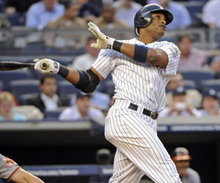 Another way of looking at Cano’s production with runners on is to consider the percentage of baserunners he’s driven in (statistics available at Baseball Prospectus). Cano has scored 30 of the 233 runners he’s seen. That’s 12.8 percent.
The American League average is 14 percent. It’s a small but significant failing. Three more runners driven in would get him to the league average. Were he carrying Jorge Posada’s rate of 17 percent, he would have driven in 10 more runners. Even with all of his struggles, Alex Rodriguez has driven in a greater percentage of his baserunners, 16.4 percent.
Intriguingly, no Yankee is among the league leaders. There are currently 308 hitters who have batted with 75 or more runners on base. The top 10 in percentage of runners driven in:
Posada is the top Yankee, 53rd on the list.
Cano compounds his impatience and failure to hit with runners on base with groundball hitting tendencies that lead to double plays. Cano ranks 11th among Major League hitters who have batted in 30 or more double play situations:
This makes Cano a less than ideal RBI man, but since Girardi chooses to emphasize him in the order, his deficiencies trouble the Yankees far more often than they need to. Of course, it might be hard for Girardi to truly admit the damaging consequences of all those double plays. After all, he holds the team record for hitting into double plays, banging into 17 twin killings in 50 chances in 1999. In the 55 years for which we have records, no one else has come close.
Bombers hitting into double plays too often
BY GEORGE
We open today with a Steinbrennerism. Though many of the Yankee owner’s most acerbic comments have been well publicized over the years, this one is more obscure. Criticizing an umpire’s calls in July, 1979, the Boss said, “He’s with an excellent crew, but he fits like a $3 bill in the cash drawer.” I dedicate this Boss bit of wisdom to Angel Berroa, whose strange reign on the Yankees roster as a non-utile utility player may come to an end later today, when Cody Ransom comes up from Scranton.
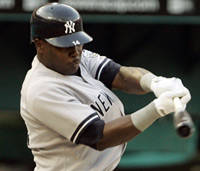 In 14 games in Pennsy, Ransom has done his usual Ransom-y job, batting .250/.346/.477 with two home runs while striking out an unsustainable 12 times in 44 at-bats. Ransom is a fun guy to root for (this seems like a necessary qualifier to issue each time this subject comes up, while also having the benefit of being true), and he’s certainly a more useful player than Berroa, but at 33 years old his problems are ossified, calcified, and calcareous, set in stone and bone. He has power but has problems making contact, with the result that maintaining a functional rate of reaching base becomes an insurmountable problem. With the Yankees anticipating more time off for Alex Rodriguez in the future, and Rodriguez playing like he needs it, the club needs a more viable substitute. That player is not currently in the organization. Whatever trading chips the Yankees are hoarding, they would be better spent on an infielder with some two-way bona fides than on yet another reliever.
DOUBLE PLAYS REVISITED
With Derek Jeter doing some decisive GDP damage the last couple of games, it’s time to check out the double play percentages for Yankees’ batters. The first thing to know is that in the American League, batters are hitting into double plays in about 11 percent (specifically, 10.9 percent) of opportunities. The Yankees as a team are hitting into twin killings a little more often, 11.5 percent of the time. Last year, the average AL team had about 1210 possible double play situations when hitting. This year’s average rate would result in 132 double plays. The Yankees’ rate would result in 137 double plays, which doesn’t seem like much but might matter in a close race — quite recently we’ve seen key double plays by Jeter and Robinson Cano kill the Yankees in close games.
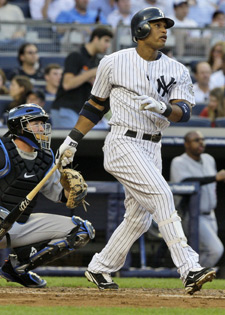 Robinson Cano has been the player causing the Yankees the most trouble so far, knocking into a double play nine times in 42 chances, a rate of over 21 percent. With his double play on Tuesday night, Jeter also brought his rate up to 21 percent. Other Yankees who require Joe Girardi to give their baserunners a flying start include Alex Rodriguez (17 percent), Nick Swisher (14 percent), and Melky Cabrera (13 percent). Surprisingly, the very slow Jorge Posada and Hideki Matsui have above-average performances in this category, hitting into double plays in nine and five percent of their chances, respectively.
One argument for giving Brett Gardner more playing time is that, particularly if he’s batting ninth in front of Jeter, might limit the team’s exposure to the double play in some situations. With Jeter hitting ever more balls on the ground — he’s grounding out three times for every one fly out, a career high — this is going to continue to be a problem where the Captain is concerned.
PARENTHETICALLY, A-ROD
A look at the Yankees ground ball ratios reveals that there’s a reason that A-Rod has such a high double-play rate: he’s hitting more balls on the ground than he has at any time in the last ten years. His offensive problems may or may not be caused by fatigue, but there might also be a mechanical component to the problem.
AN ORPHANED LINE ABOUT PHIL HUGHES
It might be time to give him something more challenging to do.
ANOTHER ENDORSEMENT OF BRETT GARDNER
The average AL center fielder is batting .260/.327/.403. Gardner is now hitting .285/.361/.401. His defense has been impeccable, as has his baserunning. If he can just keep doing what he’s doing, he doesn’t need to improve. Sure, improvement would be good, but the offense would be sufficient to support the other aspects of his game. While Gardner could still stand to be protected from the occasional lefty — one senses with Gardner that at some point more would likely become less — the ratio of playing time in center field should shift dramatically, from 75-25 in favor of Melky Cabrera towards Gardner. Plus — and this is no small thing — he’s the only guy on the team actually performing right now.
The trouble with offense … and A-Rod
SO, WHAT HAVE WE GOT?
During the offseason, I frequently argued that though the Yankees had their attention focused overwhelmingly on pitching, the offense might prove to be a bigger problem. Then they signed Mark Teixeira, and I promptly shut up. It seems odd to talk about a team that has averaged more than five runs a game as having offensive deficits to make up, but the truth is that the particular construction of the Yankees means that it’s still a realistic possibility. The Yankees have to guard against being fooled by the numbers they are seeing, many of them distortions caused by their generous new home park. To this point in the season, certain aging Yankees would seem to have found the Fountain of Youth. What they’ve really discovered is a beautifully appointed new ballpark with wide concourses, laptops in the lockers, and a loving right-field power alley.
The home/road splits are damning: Derek Jeter, .295/.364/.381 with two home runs in 239 at-bats. Melky Cabrera, .278/.329/.354 with one home run in 79 at-bats. Johnny Damon, .260/.317/.449 with four home runs in 127 at-bats. Jorge Posada, .253/.348/.440 with three home runs in 75 at-bats. These numbers aren’t terrible, but they’re more realistic than what the players have done at home, more in line with what the players have done in the recent past and what we might have projected them to do this year.
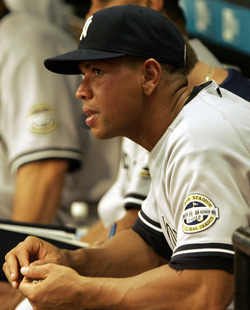 The Yankees are a .500 team on the road so far this season. Their road production has been, overall, quite good, given that Nick Swisher, Robinson Cano and Hideki Matsui have done the bulk of their hitting while traveling. Teixeira has also done his part. Still, this hasn’t been enough to give the team the same explosiveness that it has had in the Bronx, especially when you throw in Alex Rodriguez’s post-surgical problems. (Likely unrelated to his staying up late. Though I’m sure we all want to jump on Rodriguez for his latest transgression, I’m pretty sure that sitting on a barstool next to Kate Hudson doesn’t stress his hip as much as playing does, which was more the point of his “fatigue” problems than his lack of sleep, dig?)
Insofar as winning the division goes, this bifurcation would present less of a problem if the Yankees had won more than 60 percent of their games at home. The 1987 Minnesota Twins showed that in a soft division you could be a hundred-loss team on the road if you were a 100-win team at home. The Yankees are a few games off the latter pace. Say they were just a few games better in their own park, 25-10, instead of 21-14. That’s asking a lot of the Yankees, but we’re in the land of make-believe just now, so stay with me. Were the Yankees to maintain that kind of pace at home while staying around .500 on the road, they would finish the season with a record of somewhere around 99-63, and be in very good shape to win the Wild Card if not the division. They may win the Wild Card anyway, but you can’t take anything for granted.
There is something to be said for players that can take advantage of the features of your home park. Not every Yankee has popped a home run every 13 at-bats at home, as Damon has. The problem is that the park can’t discriminate. The Yankees have outscored their opponents by just 13 runs at home. Over time, that gap may narrow, perhaps because of the park, or maybe because Brett Tomko is pitching. Or Brett Tomko is pitching in the park. The players who have reaped the extra support might also regress, simply through age, fatigue (to use a dangerous word), injury, or changing weather patterns or other effects of the new park we can’t yet foresee.
In June, the Yankees are batting .247/.342/.424, roughly a league mark. The pitchers have been fine. June’s ERA is 3.85, actually the team’s best of the season. June’s starters have an ERA of 4.40, above-average for the league, and the transformed, Veras-free bullpen has an ERA of 2.87. Assuming that CC Sabathia isn’t hurt in any long-term-kind-of way, the pitching staff may well have achieved stability. It is the offense that should now be the source of worry. The lesson for the Yankees is clearly that if opportunities to upgrade the offense present themselves, any chance to replace a middling 35-year-old bat, they have to take it. If finances mitigate against such a move, that’s one thing, but sentimentality or the belief that Melky Cabrera (injured shoulder or not) is going to achieve consistency or Hideki Matsui is going to turn back the clock need to be ignored.
And most of all, perhaps more than anything else, a day-in, day-out A-Rod substitute must be found. Applicant should be able to out-hit Angel Berroa and outfield both he and the less-than-limber Rodriguez. Rodriguez could struggle all season, even if he takes a vow of celibacy. Again, the Yankees don’t want to take anything for granted.
A-Rod needs a rest
STRANGE DAYS INDEED
Good evening, campers. I spent part of my day in a drawer undergoing a PET scan. I must have been a very troubled sweater in a former life because once in my overwhelming instinct is to get out. The good news is that I am out and that this sweater was given a clean bill, freeing what remains of my brain to consider baseball again.
The 1927 Yankees went 21-1 against the St. Louis Browns, one of two doormat teams in the league that season. Given the outcome of the late series with the Nationals, it is apparent that this ain’t 1927. Ironically, given the focus on pitching this year, starting and bullpen, the failure was largely offensive — when you score two runs in two games, you’re not going to beat anyone. There has been something like an obsessive grabbing onto the supposed fact that the Yankees supposedly can’t beat a pitcher they’ve never seen before, but that isn’t the issue so much as the absence of Derek Jeter from the lineup both nights, the absence of Jorge Posada in another, and the cooling bats of certain key players. Nor should we ignore the randomness of fate — if Robbie Cano had put the ball in play in any way other than where he did on Wednesday, the Yankees would have taken two of three games and the series would not have held such a bitter aftertaste.
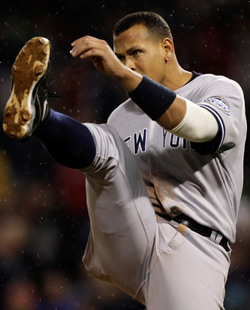 Now comes the news that Alex Rodriguez will be taking two days off, his first since coming off of the disabled list. The way Joe Girardi has handled Rodriguez has been strange — you have a player coming off of a major injury, who was given an incomplete fix for that injury. That would seem to require handling with kid gloves whether the player liked it or not. There is, I think, a mutual enabling going on here, where Rodriguez did not ask out until now, and Girardi, who knows who he would have to list at third base in the alternative, did not ask him to sit out. Girardi’s job, after all, is to win today, and the way Rodriguez hit initially, quickly piling up nine home runs, was helping him do that. Perhaps Girardi needs to think more globally than that, but given that just a few weeks ago there were rumors about his job security, it might be impossible for him to do so.
The fault lies not in the stars but in the front office, which never gave Girardi a viable A-Rod substitute once it was clear that the player required surgery. Cody Ransom bombed and got hurt, Angel Berroa offers nothing in the way of offense or defense, and Ramiro Pena, while a very good glove, is not a hitter. Scranton’s roster is clogged with the likes of Eric Duncan, Justin Leone, Chris Malec, and a rehabbing Ransom, none of whom could be misconstrued as Major League regulars on the darkest of nights. Trenton’s third baseman is Marcos Vechionacci, who shed his prospect status what seems like eons ago.
Given this dearth of viable hot corner men and a clear need for hot corner men, it was incumbent upon the front office to make a deal for a viable Rodriguez substitute. Recently, I have been inveighing against the team making a hasty trade for a reliever, bringing up Jeff Bagwell for Larry Andersen. The reverse of this is that giving up Larry Andersen for Jeff Bagwell is never a bad thing, and if you can’t get a Bagwell, any Tom, Dick, or DeRosa will do. It’s not a move anyone would want to make given a choice, but the Yankees have had a very finely balanced operation so far, and there is every reason to think that such a move will keep paying dividends. Rodriguez’s recovery may be lengthy, and his swing may continue to be affected. His energy level may continue to be low. His range has clearly been affected, suggesting an ongoing need for a late-inning substitute. Plus, there may be other injuries to other players.
The Yankees are now 10-7 in one-run games. They could just as easily be 7-10 — that’s the way one-run games work. They are basically coin flips. As we saw on Wednesday, one-run games can turn on one key double play, one missed opportunity. Either you get the big hit or the big out or you don’t. When the Yankees have to rely on an Angel Berroa, today, tomorrow and in the future, they’re reducing the chances that they will get that big hit or make that diving stop.
If you’re going to go through the season without winning a game over the Red Sox, you’d better win every game that you can. They didn’t do this in the Nationals series. Without some help for A-Rod, they might not do it in the future. This is no time for the usual blithe assumptions that a no-name player will rise to the occasion, Rey Sanchez- or Luis Sojo-style. The time to go hunt down a safety net is now.
A pinstriped win, no matter what
NO MATTER WHAT
HAPPENS, IT’S GOOD FOR THE YANKEES
The next two weeks are going to be a fascinating, possibly
decisive time for the Yankees. First, they should have Jorge Posada back on
Friday, which means they’ll have something like their full offensive complement
for the first time all year–Brett Gardner
substituting for Melky Cabrera for the next several days
notwithstanding, though Brett is actually out-hitting Melky in May,
.357/.449/.619 to .321/.348/.429, so you can’t say the lineup is suffering too badly
for his absence.
The Yankees then take their reconstituted offense into
battle against the Indians, a team that’s no pushover but has real pitching
problems–even during their recent little winning streak, they were pounded more
often than not. Following four games at Cleveland,
where the Indians are 10-11, they go home for three against the Rangers, a
dangerous team but one that is not nearly so dangerous on the road due to their
low on-base percentage. Yes, their power hitters are going to knock a few balls
out of Yankee Stadium II, but so will the Yankees, and they should have more
runners on when they do so.
The Rangers are followed into New York by the Rays, 12-16 on the road and
suffering from a rapidly unraveling pitching staff. After that series, the Yankees go to Boston, where they get another chance to make
some kind of statement against the Red Sox. Before the Red Sox get to that
point on their journey, the Sox have three games at Toronto, which means that no matter what
happens, one team next to the Yankees in the standings will be losing. Then it’s
off to Detroit,
where the Tigers are a tough 15-7 and currently lead the American League in
lowest run average. Finally, they entertain the Rangers at home while the
Yankees are grappling with the Rays. This could be the moment where the Red Sox
see the race slipping away. Their starting pitching is surprisingly poor. Josh
Beckett has now had five straight quality starts, but there are still problems
beyond him, like getting Daisuke Matsuzaka under control, Jon Lester fixed, and
figuring out how to get rid of Brad Penny so one of the kids can come up and
presumably have an ERA under 6.00. They have let David Ortiz kill them all
season long, and replacing him is going to be a painful and divisive thing to
do. This organization is endlessly resourceful, and they won’t just fall apart,
but they have real problems right now.
As for the Jays,
after the Red Sox, they host the Angels for three and the Royals for three,
both winnable series but neither sure things, followed by four games at Texas, which won’t be
easy at all.
THE BULLPEN: A QUICK
WORD
Remember Larry Andersen for Jeff Bagwell. Better by far to
give Mark Melancon a long look before dealing the farm for a Jose Veras
replacement.
MAKE IT STOP!
Are we done with Angel Berroa yet? Has anyone yet explained
his purpose? Does he have incriminating photos of someone?
It’s a small thing, a very small thing, the 25th
man, but then, remember what Joe Torre did with Homer Bush in 1998. Flexibility,
or for that matter a useful hitter off the bench, would allow the Yankees to
win more games. This would seem… obvious.
THE AROUND (AND
ABOUT)
Giants 6, Braves 3:
Randy Johnson threw six strong innings for victory No. 299 (one run, three hits,
no walks, five strikeouts). You’d rather not see him back into 300, and some of
his recent starts have been rough. He’s an amazing physical specimen: in 52
innings, he’s got 54 strikeouts, 9.35 per nine innings. The man is 45 years
old, and there are many, many 25-year-olds who don’t get that many batters to
swing and miss. Only 12 pitchers have thrown as many as 100 innings in a season
at Johnson’s age or older. At 45, Nolan Ryan struck out 8.98 batters per nine
innings. Phil Niekro struck out 6.10 as a 46-year-old Yankee in 1985. There
have been five geriatric seasons in the 5.00s, including Satchel Paige’s 5.93
in 1952. (Paige was a lot further above his league average than Niekro was
above his.) Johnson has the second-largest differential between his rate and
the league strikeout rate after Ryan.
Angels 3, White Sox 1:
Everyone pitched well, even Gavin Floyd and someone with the last name of
“Weaver.” These things happen. In fairness to the last-mentioned, he currently
ranks second in the league in ERA, about a run and a half behind Zack Greinke.
Obligatory former Yankees watch: Bobby Abreu went 2-for-3, as did Juan Rivera,
who is now batting .293/.335/.415, which is kind of like current Brett Gardner,
but without the speed and defense or the promise of improvement.
Padres 8,
Diamondbacks 5: After a miserable, miserable, rehearsals-for-retirement
start, Brian Giles has hit .295/.407/523 over his last 14 games, throwing in
nine walks. It’s something, though 14 games is hardly definitive. Good to see
the Padres bounce back over .500 after their recent winning streak was
terminated; usually a fringe team that starts acting dominant for a couple of
weeks will quickly demonstrate the way gravity works (as in, what goes up must
come down).
Twins 4, Red Sox 2:
Solid work all around by Twins pitching in this one, including three innings of
scoreless relief, 1 1/3 by Jose Mijares, a rookie lefty with a
ninth-inning-worthy fastball-slider combo currently working the middle frames…
Another two-hit day for Ellsbury; if you get your batting average up high
enough, eventually it won’t matter if you don’t walk or hit for power. Said
batting average is higher still than your current .307; see Dernard Span–the
difference is a few more extra-base hits and about 14 more walks in exactly the
same amount of playing time.
Mets 7, Washington 4: A
wild, wild night for Johan Santana, who still seems on pace to win that elusive
third Cy Young award. Three straight wins for the Mets with a lineup that for
the Yankees would be missing Derek Jeter, Johnny Damon, and Jorge Posada. It’s
the Nats, of course, so thank the Lords of Good Timing, but all credit to the
Mets for being able to execute… And Daniel Murphy, who banged a home run off a
rather idiotically placed sign.
Reds 6, Astros 1:
Seventh straight loss for the Astros, who are starting to get to the place
where a 100-loss season becomes a real possibility–something that has never
happened in what has been a generally successful franchise despite never having
had a champion. From 1969 through last year, the club had won 175 more games
than it had lost… It’s not clear who they can trade, as the few exciting
players are signed to outsized contracts, and they have no impact-level
prospects, so the journey of the ‘Stros, not just through the rest of this
year, but into the next, is going to be an interesting one. As C-3PO said,
there’ll be no escape for the princess this time… Remember I was talking about
Phil Hughes and quality start percentage a couple of days ago? Bronson Arroyo
is at 60 percent, but his ERA is over 5.00–in his three losses, his ERA is
13.83.
Indians 12, Rays 7:
The Rays continue to lead the AL
in runs scored per game, but their pitching is like Cerberus’s chew-toy. That
they are hitting so well despite their injuries and a B.J. Upton who ranks as
one of the most futile hitters in the biz is amazing. The regression of the
hurlers is less so, and was widely predicted, though I for one was not so quick
to believe it. I certainly had higher hopes for control artist Andy Sonnanstine,
who has not been so controlling this year. As we saw with Ian Kennedy, a
similar pitcher last year, this model of hurler is either all right or all
wrong–their (lack of) stuff doesn’t allow for a middle ground. The good news
for the Rays is they have some alternatives, such as David Price (now up with
the club) and Wade Davis (not yet).
Marlins 6, Phillies 2:
Sometimes even the champions lose to a pitcher named Burke Badenhop, though not
often. Forty-five thousand watched this one at Philadelphia, and as Casey Stengel liked to
say, the attendance was robbed. If Ryan Howard was hitting better than
.227/.303/.455 (four home runs, 88 at-bats), they’d at least have more to talk
about during these Badenhop bow-downs.
Mariners 6, Athletics
1: Nomar Garciaparra heads back to the disabled list. Just thought I would
point out the biggest non-news of the day. I’d also like to point out that
Mariners infielders are hitting .236/.280/.375 as a group, and that’s counting
Russell Branyan. With his fourth cought stealing, Ichiro equals his total for
all of 2008.
Dodgers 8, Rockies 6:
Andre Ethier had better hurry and find his stroke, because if Juan Pierre is
still hitting .400 when Manny comes back, even I’m going to have a hard time
arguing that he should be benched–that Pierre has allowed the Dodgers to feel
so little pain over Ramirez’s banishment is one of the stories of the year. The
story of the game was that Joe Torre’s pen bent but didn’t break.
Cubs 5, Pirates 2:
Notable mainly for Carlos Zambrano’s ejection-worthy explosion and the
relocation of the Cubs to a game over .500.
Tigers 8, Royals 3:
Another strong start for Rick Porcello, though the low strikeout rate is still
troubling. Kyle Farnsworth threw a scoreless inning in the loss, his usual spot
for scoreless innings.
Orioles 12, Blue Jays
10: Add Nolan Reimold to the list of possibly invigorating youth the
Orioles are now playing with–next year, the AL East could be an even more
difficult place to win a pennant than it is now, though pitching is still going
to be a problem by the Bay. As for the Jays, by the All-Star break we’re not
going to remember they were ever in the race.
Cardinals 3, Brewers
2: In which the Cardinals take control, largely due to their busy bullpen,
though Todd Wellemeyer was solid for five. You wonder if LaRussa’s hardworking
relievers can keep up the pace for the rest of the year, though to be fair he
has spread out the work… Albert Pujols has just one home run in the last two
weeks.
MORE FROM ME
Wholesome
Reading
continues to be wholesomely updated with new entries, and I’m about to start an
argument with a commenter. Warning: politics!
Too many double plays
LET’S KILL TWO!
If the Yankees hitting into three key double plays on Tuesday night bugged you, if you were awake to be bugged, then know that it’s about par for the course for these Yankees, who have gone for the two-outs-on-one-swing sale in about 11.6 percent of their opportunities this year, the seventh-worst rate in the majors this year. The Mariners lead the majors, hitting into a double play in 13.6 percent of their chances. This is kind of amazing, as the Mariners also have the lowest on-base percentage in the majors. They reach base less than anyone else, then kill the few runners they get faster than anyone else.
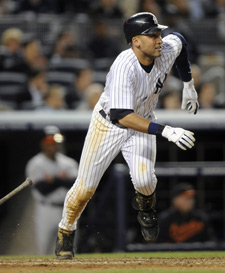 What’s fascinating about the Yankees’ poor performance in double play situations is that for the most part, it’s not the regulars who are doing the damage. This year, the average AL batter is hitting into a twin killing 10.6 percent of the time (the NL rate is almost exactly 10 percent). For example, Derek Jeter has hit into four double plays in 25 opportunities, which is 16 percent. That looks bad, but it’s not, really — one fewer and he’d be right at the league average. The same goes for Melky Cabrera, who has also pounded into four DPs in 25 chances. Brett Gardner, with two in 17 chances, is at the league average, which is surprising given his speed, but less so when one considers that he hits more ground balls than any Yankee except Derek Jeter. The worst Yankees regular is Robby Cano, who has hit into five in 28 chances, or 17.9 percent, but again, that’s not a horror-movie number — Geovany Soto and Mike Lowell are at 30 percent in a significant number of chances (29 and 40, respectively). Several Yankees have actually done a terrific job at staying out of the double play. Nick Swisher, last night’s DP villain, has hit into only two in 33 chances. Johnny Damon has only two. Hideki Matsui and Mark Teixeira are both around six percent.
It’s actually the guys who haven’t played much, or played too much due to injuries, that are driving the Yankees’ into a high number of twin killings at bat. Together, Cody Ransom, Xavier Nady, Kevin Cash, Angel Berroa, Jose Molina, and Francisco Cervelli have hit into 11 double plays in 44 chances, or 45 percent. There’s not much that Joe Girardi can do to address the situation except not play those guys — he already calls as many or more hit-and-run plays as any manager in the game. Unfortunately, he hasn’t always had the choice not to play them, and the existence or continuation of Ransom, Cash, Berroa, and Molina as Yankees was the general manager’s call — but now we’re away from talking about the double play and once more in the realm of depth, so never mind.
In the short term, it’s little consolation that the Yankees blew a chance to take first place in part because of missed offensive opportunities, but at least you can be sure that it was a bit of a poorly timed fluke on the part of two of the three. There’s also an “on the other hand,” which is that when Jorge Posada comes back the team’s double play rate will actually pick up, because Posada runs like the 37-year-old catcher he is. Fortunately, Posada does other things with the bat that more than make up it. You can’t say that about the 11-for-44ers above.
THE AROUND (AND ABOUT)
Orioles 7, Blue Jays 2: Just over 10,000 showed up at Camden Yards to see the Orioles deal the Jays their eighth straight loss. During the streak, Jays batters are hitting .251/.306/.331, which is very bad but isn’t too different from what Padres hitters did during their recent winning streak. Of course, the Padres had great pitching, whereas the Jays have allowed nearly six runs a game. No doubt you’ve heard that Matt Wieters finally comes up on Friday. With Wieters, Adam Jones, and Nick Markakis the Orioles are finally changing, and none too soon… I’ll talk more about Wednesday’s game in our next entry, but it should be noted that the Jays dropped their ninth straight to the Orioles in daytime action, the pen being unable to follow up Roy Halladay’s strong start. The Jays are now just four games over .500 and the division is wide open.
Mets 6, Nationals 1: The Nats DFA’d Daniel Cabrera. As Bill Ladson reported at MLB.com, GM Mike Rizzo said, “I looked at the execution of the performance and it wasn’t up to par. I was tired of watching it.” You have to appreciate a candid GM. Among other things, this should inoculate the Yankees from having to face the spectacularly tedious Mr. Cabrera during interleague play (as Bob Uecker said in “Major League,” “Ball three… Ball four… Ball eight…”). Adam Dunn homered again… Just sayin’. Another home run for Gary Sheffield, and he’s now batting .291/.430/.535. Talk about getting something for nothing, and a needed something now that the Mets are in the position of having to play 20-year-old prospect Fernando Martinez, who hasn’t actually looked very prospect-y in years.
Reds 6, Astros 4: Another three-hit night for Miguel Tejada, but that was most of the fun as Roy Oswalt is no longer the lucky rabbit of yore. Among the most unexpected events in baseball this season: a Laynce Nix renaissance in left field for the Reds, which is kind of like a Rod Stewart renaissance taking over for the late Joe Strummer in a Clash reunion tour. It’s just not something you’d ever think about.
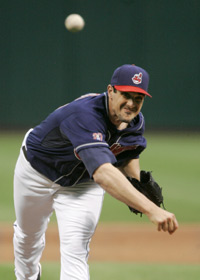 Indians 5, Rays 1: Can’t tell a lie — Carl Pavano killed. Four Indians hit home runs, three of which probably shouldn’t have been in the lineup, but sometimes you win with your worst foot forward. Both of these clubs lost key players yesterday, with Jason Bartlett hitting the DL with a sprained ankle, and Grady Sizemore may take a seat with a left elbow that’s feeling poorly. The Indians shuffled Matt LaPorta off the roster to get another center fielder up to the bigs, so my criticism of them yesterday was in error.
Phillies 5, Marlins 3: The much-denigrated (at least by me) Joe Blanton had one of the best starts of his career, shutting out the Marlins for seven frames, striking out 11. That has far more to do with the Marlins with Blanton, as their defining characteristic as an offense is the strikeout. Make that double if Hanley Ramirez’s groin sidelines him for more than 30 seconds.
Cubs 6, Pirates 1: Cut short by rain, and you can expect that Lou Piniella danced in it, maybe more like Roger Daltrey closing out “Quadrophenia” than Gene Kelly — this win got the team that was going to end the 100-year-old dry spell to the break-even point. Elements of the Cubs that haven’t disappointed this year: Kosuke Fukudome, Ted Lilly, Johnny Evers. Evers in particular has done exactly what was expected of him.
Cardinals 8, Brewers 1: The Cards are pitching at about 20 percent above league average, the mark of not only a good pitching team, but a staff on the verge of having a great season. Whether the Cards can improve that much more I don’t know, but in this division they might not have to. Extra-credit to Adam Wainwright for his solo home run, thereby batting in as many runs as he allowed in seven innings.
Twins 5, Red Sox 2: One of the season’s great flukes — Nick Blackburn striking out seven Red Sox. Blackburn never strikes out seven anybodies. Jacoby Ellsbury has a 21-game hitting streak going, during which he’s batting .333/.366/.417. During the streak, he’s stolen 10 bases, been caught four times, and has driven in four runs.
Royals
6, Tigers 1: How does Jose Guillen have a .412 OBP? Not “how”– that’s like asking where babies come from–I mean, “Why?” …KC shortstops, principally Mike Aviles (now on the DL) are hitting .183/.214/.250 this year. With anything from the position, they might be leading the division right now. It also hurts that David DeJesus is having the worst season of his career. Haven’t mentioned another fine Zack Greinke start, and I won’t, except to say that for some, “potential” is a curse. It’s grand to see someone survive it.
Dodgers 7, Rockies 1: And there was much gnashing of teeth in Denver given the club’s .400 winning percentage, or maybe it was just losing to Eric Milton (and congratulations to the former Yankees’ draftee for making it back). Andre Ethier in May: .190/.298/.266, following up a .306/.423/.553. Shades of Melky ’08! That’s not to suggest that Ethier won’t be back, but that Melky should have been, or maybe that we just don’t know what turns a hitter on or off–the recipe is probably something like one-third mental, one-third physical, and one-third luck (sprinkle lightly with shredded cheese, serve over pasta).
Diamondbacks 6, Padres 5: Thus endeth the Padres’ winning streak, as Max Scherzer strikes out 10 in seven innings… Mark Reynolds is just off of last year’s 204-strikeout pace; he’d finish with 202 in the same number of at-bats. Scherzer is only 2-7 in his brief major league career, but his ERA is 3.21, and he’s K’d 119 in 106.2 innings. Of the current roster, Scherzer and Justin Upton will be part of the next great ‘Backs team, but you can’t be certain of anyone else. At .173/.220/.313, Chris Young has to be one of the biggest failures to launch in recent baseball history, a kid who came up with all the tools but didn’t develop a centimeter from where he started.
White Sox 4, Angels 2: Big day for the Nix family, as Jayson hit two home runs to go with Laynce’s one. What is it with that family and the letter “y?” Big Scrabble fans? Bart Colon’s win pushed his quality start percentage up to 33 percent, still well below average… Bobby Abreu hit his first home run of the season.
Athletics 4, Mariners 3: The A’s did all their scoring in one frame, Jason Giambi driving in two runs on a single as the Seattle pen tossed away six shutout innings from Jarrod Washburn. With Kenji Johjima off for a long stay on the DL, the M’s didn’t call up Jeff Clement, batting .309/.382/.533 at Triple-A Tacoma. The guy has his limitations — he’s an offensive catcher with a big swing — but given that the M’s are by far the worst offensive club on the circuit , you’d think they would go for a little more offense. Oddly, for a team that can’t hit, the Mariners have tried the fewest hitters in the American League. They’re standing pat, even though their lineup looks a lot like that of the ’54 Pirates.
Giants 4, Braves 0: And nothing to say about it except, “Lincecum!” Also, every time I load up the news on the Internet, there’s something about “Jon and Kate.” I have not the foggiest who they are, and don’t think I’m going to try to find out. Jon, Kate, Bread, Circuses — there are bigger fish to fry, like baseball (?).
Jorge to the shelf
…Or so it’s being reported. See the previous entry for more reaction, something akin to outright disgruntlement. The key here is how long Jorge Posada will be out. If it’s going to be more than a month, Mr. Cashman had best start shopping, and not in the superannuated Pudge Rodriguez aisle of Catcher-Mart either.
Actually, I take that back. Even if Posada is out only the minimum 15 days, the Yankees need to find a backstop who can hit at something close to league-average rates. Given Posada’s age, the chance of another injury is high, this year and next year and for however long his career lasts. It’s nice that the Yankees have Yogi Berra, but they need an Elston Howard to get by as well, or at least a Charlie Silvera. They don’t have that, and it was an obvious need — we talked about it in this space all winter.
I just want to repeat something I wrote this morning, because I see in the comments for that entry someone talking about Jose Molina as the awesomest backup of all-time or somesuch thing. Not so much. There’s no arguing he’s a good defender and very tough for opponents to run on, but he just doesn’t reach base enough to play with any regularity. Reaching base is the basis of offense — a team can’t score runs if the hitters don’t reach base. Molina’s career OBP is .277. It is, no matter how you slice it, dice it, adjust it, the 11th-worst OBP of the last 25 years.
Remember Alvaro Espinoza and how little he hit? He reached base more often. Alfredo Griffin once took four walks in a full season of play. He reached base more often. Rey Ordonez’s bat was the joke of the league when he played with the Mets. He reached base more often. You know how my YES colleague John Flaherty likes to make fun of his offensive abilities during many broadcasts? He reached base more often. If you reduce the population solely to catchers, Molina has the sixth-lowest OBP of the last 25 years.
Giving a hitter of this quality anything like regular playing time is extremely damaging regardless of his defense, because the offensive losses outweigh the defensive gains. If the Yankees are going to reap the benefits of having Posada, his bat, they’re going to have to find a better way of dealing with the costs of having Posada, occasional, perhaps lengthy, unavailability.
…The Yankees called up Frankie Cervelli. He seems spectacularly unlikely to hit, but might actually get on base more often than Molina. Yes, this is faint praise.
I’VE SUGGESTED THIS BEFORE…
The Diamondbacks aren’t going anywhere, their bullpen is egregious, and they don’t seem to have much use for 25-year-old backstop Miguel Montero, a career .239/.310/.412 hitter to this point. In 444 career at bats he’s hit 24 doubles and 17 home runs. He’s walked 44 times and has struck out 95 times. In the minors through 2006, he batted .291/.359/.467. He’s not the next Bill Dickey by any means, but he’s overqualified to be a pure reserve and is underappreciated by his current franchise. There might be a match there if the Yankees are willing to part with a pitcher or two. Just sayin’.
Pitchers, Ransom need to step it up
 OPENING DAY U-TURN
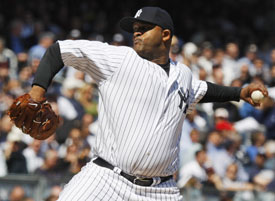
The pomp of the first Opening Day at Yankee Stadium: The Sequel was all well and good, but in the end the club has to execute. The Yankees confronted a 2-7 Indians club led by Cliff Lee, a potential flash in the pan who had been thoroughly mistreated by his every opponent in Spring Training and his first two starts. The Yankees bowed, in part because the offense stranded 27 runners, in part because Jose Veras and Damaso Marte (who hasn’t been the same pitcher with the Yankees he was prior) played arsonist, and if you’re looking for a third culprit, point to CC Sabathia, who negated his ability to throw 120 pitches by burning through them in less than six innings.
Thanks the amazing nine-run seventh inning pitched by Veras and Marte, pitching will receive the bill for this afternoon’s debacle, but the offense could have changed the complexion of the game at any time. Despite getting the first hit at YS: TS, Johnny Damon stranded five runners. Despite hitting the first home run at YS: TS, Jorge Posada stranded six. Special credit must go to Cody Ransom. Ransom’s first at-bat came in the second inning with one out and Robby Cano at second base. The third baseman struck out. In his next at-bat, in the bottom of the fourth, he batted with Hideki Matsui on first base and flew out to right field. He came to the plate again in the fifth with runners on first and third. He grounded to short. Runners were on first and second with two outs in the bottom of the seventh when Ransom struck out again. Finally, with one out and the bases loaded in the bottom of the ninth, the Yankees just looking for some dignity, or maybe a miracle comeback, Ransom grounded into a 4-6-3 double play. He left nine runners on base, and presumably because the Yankees are carrying 13 pitchers and no bench players, Joe Girardi let him.
The Yankees’ 5-5 start is discouraging, but it’s not as depressing as is Ransom’s first 10 games as A-Rod substitute. Ransom is not a kid. He’s a 33-year-old vet. He has had six shots at a big league career since 2001 without ever catching on. We are likely looking at his last chance to have at least a single season in the major leagues, first as Alex Rodriguez’s substitute, then as his caddy. The odds were against Ransom succeeding, because his long experience in the minors showed that he would not hit with enough consistency. Despite this, his small-sample hot streak of last fall gave hope that he could make it. This is the kind of player who is great fun to root for. Unfortunately, Ransom is now 3-for-30 with 10 strikeouts, and it is difficult to see how the Yankees can afford to keep playing him, however quickly A-Rod is expected to come back, or even how they can retain him on the Major League roster once Rodriguez is active. Thursday’s defeat had many fathers, but any kind of contribution from Ransom early on might have meant a different complexion to the game.
 Meanwhile, despite the best efforts of Nick Swisher and Robinson Cano, the rest of the offense has yet to click into gear. The Swisher-free components of the outfield have been a total loss, and there’s a danger that that could be a season-long affliction. Hideki Matsui has looked very sluggish, and Mark Teixeira’s wrist and penchant for slow starts has crippled his numbers. Jorge Posada and Derek Jeter have hung in, but four bats is well short of an offensive load. Take out the 11 runs the Yankees scored against Baltimore in the third game of the season and the club is averaging just 4.2 runs of offense per game. You don’t want to hit the panic button after 10 games, and some of the elements will heat up a bit, even Ransom — but heat is relative. They may not heat up enough to make a truly potent offense. That’s something that Brian Cashman is going to have to watch.
SHAWKEY-SABATHIA
Sailor Bob Shawkey was the first starting pitcher at Yankee Stadium, and CC Sabathia will go down as the first at YS: TS. What was not noted today was that Sailor Bob’s history with the Yankees was contentious. After a very good, just-south-of-Cooperstown career, Shawkey became the manager of the Yankees in 1930, replacing Miller Huggins, who had died during the previous season. The club went 86-68, finishing third, and Shawkey was viewed as a failure because former teammates like Babe Ruth wouldn’t take him all that seriously (one wonders who Ruth did take seriously). In an especially coldhearted move, the Yankees replaced Shawkey with Joe McCarthy but didn’t bother telling him. Shawkey happened to walk into GM Ed Barrow’s office as McCarthy was heading out and put two and two together. “It was a dirty deal,” Shawkey said. In anticipation of Yogi Berra years later, Shawkey cut off all contact with the team. He didn’t return until the threw out the first pitch at the renovated Yankee Stadium — 45 years later. He was 85 years old.
I wonder if the opening day crowd of 2054 will get to see a first pitch from a 73-year-old Sabathia. Try to hang on if you can. I’ll try too, and we’ll talk about it then.
SKINNER
Always interesting to see who gets a hand and who doesn’t when players are announced individually. There wasn’t even polite applause for Indians coach Joel Skinner, who caught for the Yankees for three seasons. I guess fans have forgotten his amazing inability to make contact — in 556 at-bats with the Yankees he struck out 158 times, hitting .214/.299/.253. In comparison to Skinner, Jose Molina is Mickey Cochrane. Maybe they do remember, but are still mad that the Yankees gave up Ron Hassey for him…
…They definitely remembered Carl Pavano. That was clear.
THE AROUND (AND ABOUT)
- Another depressing bit: many fans and pundits held out hope that this would be the year that Royals’ third baseman Alex Gordon really took off. Instead, he’s headed for surgery with a cartilage tear in his right hip. No word on when he’ll be back as of yet.
- I keep forgetting to mention Dewayne Wise separating his shoulder and thus exiting the Chicago White Sox’ lineup. He was another player, like Nady (though a far lesser talent than Nady), whose use I railed against. As with Nady, I’d rather he take a seat than take a surgeon…
- Unless Tony LaRussa gets caught taking betting tips from Pete Rose, he’s going to the Hall of Fame. If he manages to keep his Cardinals winning at anything like their present (8-3) rate with the roster he has, he’ll have gone an extra length towards earning his plaque. Of course, today’s game against the Cubs was their first against a team of any real talent.
Twenty-five men, 25 goals into one
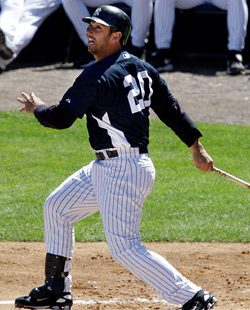 Today we begin our annual look at what each player is looking to accomplish this season — a tradition since whenever I started doing it. I believe it was in 1881, when my friend Clemens yielded this feature to me so he could finish work on Huckleberry Finn.
JORGE POSADA — STARTING CATCHER
2008 GOAL, AS STATED HERE: Repeat his 2007 performance.
DID HE GET THERE? Nope. Injuries intervened.
2009 GOAL: Health, which means not only staying in the lineup and contributing some approximation of his career numbers (.277/.380/.477) but also throwing out 25-35 percent of attempting base stealers.
CHANCE OF MAKING THAT GOAL: He seems to have a fair shot, but it’s asking a lot given his age.
SOMETHING YOU MIGHT NOT BE THINKING ABOUT: Even when struggling last year, Posada was strong with runners in scoring position, batting .250/.392/.425. He’s a career .282/.403/.492 hitter in those situations.
ANOTHER THING YOU MIGHT NOT BE THINKING ABOUT: With 27 home runs this year, Posada can pass YES broadcaster Ken Singleton on the career home run list for switch hitters (Singleton ranks 14th with 246). Kenny is probably safe for another year — Jorge hasn’t hit more than 23 homers in a season since 2003.
JOSE MOLINA — RESERVE CATCHER
2008 GOAL AS STATED HERE: Hit as well as he did after he joined the Yankees in July ’07 (.318/.333/.439 in 29 games).
DID HE GET THERE? Heck no, but he did play terrific defense.
2009 GOAL: Keep up the glove work while rebounding at the plate from a career-worst offensive season.
CHANCE OF MAKING THAT GOAL: You’d think he’d have to if he’s going to stay on the roster.
SOMETHING YOU MIGHT NOT BE THINKING ABOUT: Believe it or not, Molina’s .263 on-base percentage wasn’t the worst of Yankees history (200 PAs and up). Shortstop Jim Mason’s .210 OBP of 1976 takes the prize, while shortstop Pee Wee Wanninger’s .256 of 1925 is even worse than Mason’s mark when contrasted against the league average.
ANOTHER THING YOU MIGHT NOT BE THINKING ABOUT: Elston Howard. There’s nothing wrong with having an old starting catcher, but as that catcher’s durability declines, you need a tandem starter who can give you good production the rest of the time, not just defense. The Yankees had this situation with Yogi Berra and Elston Howard in the early 1960s. Acquiring a reserve catcher with a bat is of paramount importance to the Yankees.
MARK TEIXEIRA — FIRST BASE
2008 GOAL AS STATED HERE: N/A
2009 GOAL: Just consistency would be good. Teixeira is a .290/.378/.541 career hitter and Gold Glove fielder.
CHANCE OF MAKING THAT GOAL: There’s no reason why he shouldn’t.
SOMETHING YOU MIGHT NOT BE THINKING ABOUT: You hear a lot about Teixeira being a slow starter, but the flipside of his slow starts are hot finishes. Teixeira is a career .303/.390/.574 hitter after the All-Star break.
ANOTHER THING YOU MIGHT NOT BE THINKING ABOUT: Teixeira is going to see a lot more of the Red Sox this year than he’s used to, and he hasn’t hit them well in his career. He’s a career. 193/.363/.274 hitter at Fenway Park (80 PA) and has hit only .232/.364/.373 against the Red Sox overall.
ROBINSON CANO — SECOND BASE
2008 GOAL AS STATED HERE: Keep on growing and/or simply hold onto present value.
DID HE GET THERE? Not even close. His season was disastrously poor.
2009 GOAL: Get back to being the guy who hit .322/.358/.504 from 2006 to 2007.
CHANCE OF MAKING THAT GOAL: Reasonably good given his age and a few lucky hits. He might not get all the way back, but he should get close.
SOMETHING YOU MIGHT NOT BE THINKING ABOUT: Five games from now, Cano will pass Jerry Coleman for 10th place on the career list of games played at second base for the Yankees with 573. He still has a long, long way to go to catch the team’s all-time leader, Willie Randolph, who manned the keystone for 1,688 games.
ANOTHER THING YOU MIGHT NOT BE THINKING ABOUT: It might seem like Cano led the Yankees in pop ups last season, but he didn’t. He was fifth, with 33. The leader was Johnny Damon, with 45. Derek Jeter hit 13 pop ups all year.
To be continued…
MAKE IT STOP!
Here’s a literal blast from the past for you: In Tuesday’s Royals-at-White Sox game, the Royals took a 2-1 lead into Chicago’s turn at bat in the bottom of the eighth. The White Sox have the 9-1-2 spots due up: Josh Fields, Dewayne Wise, and Chris Getz. Royals manager Trey Hillman calls on Kyle Farnsworth. The Royals, you see, have decided that Farnsworth is a setup man. We in New York know it ain’t true. They even know it in Detroit and Atlanta, but they’re smarter in Kansas City.
Fields bunts to third base and reaches. Wise flies out to center. Gets singles to right, moving Fields to third. That brings up number three hitter Carlos Quentin. Even Joe Torre would have called for another pitcher by now, but Farnsworth gets Quentin to whiff, so score one for Hillman. Two outs now, future Hall of Famer Jim Thome at the plate. Thome is a left-handed hitter, and he’s getting up there in years, doesn’t hit the portsiders as well as he used to, averaging just .233 against them in 2008 (albeit with a ton of power). The Royals have Ron Mahay in the bullpen, but apparently he’s only hanging around for moral support. You know what happened next. Farnsworth throws, Thome swings, boom — it’s No. 542 for Jim and loss No. one of the 2009 season for Farnsworth.
Nice work if you can get it. Joe Posnanski ruminates on the managerial brilliance of the move.
THE AROUND (AND ABOUT)
In an effort to bond with my cat, I’ve started wearing sisal pajamas… Another year, another pounding for Ian Snell, and the Pirates are off to the races… Khalil Greene so impressed Tony LaRussa with his hot spring that he’s batting fifth; it would be nice to see him complete make that kind of comeback. Of course, any player’s bat is going to perk up after escaping PETCO… The Rays lineup sure looks light with B.J. Upton out. Of course, it’s easy to look light against Josh Beckett when he’s on. They and the Red Sox will go at each other nine times by May 10, a nice quirk of the scheduling for the Yankees; the Yankees have ten total games against both clubs through May 7… As with CC Sabathia, you hope that Tim Lincecum wasn’t burned out by overuse last year… The Marlins drew 11,124 against the Nats in Game 2 of the season, but they did get a terrific start from Josh Johnson, so Joe Girardi, you’re off the hook (so long as he lasts)… The Tigers’ pen tanked their game, but Edwin Jackson’s fine start is the more important omen for them in the long term. Good to see Scott Rolen drag his hot spring into the season… Erik Bedard sort of made it through a start; when does he get dealt? …Dan Haren picked up where he left off for the Diamondbacks (good), but so did Jon Rauch (not so good)…I actually saw Jason Giambi hit a bloop double to the opposite field against the Angels… The Beatles remasters are finally coming!
 Pinstriped Bible