Tagged: New York Yankees
In fairness to Teixeira
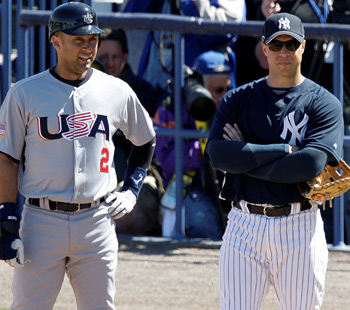 (IF A-ROD CAN’T PLAY LIKE A-ROD)
“Something Shakespeare never said is, ‘You’ve got to be kidding.'” — Robyn Hitchcock
Today the wires are bursting with, “Now the pressure is on you, Mark Teixeira” stories. Those stories couldn’t be more loaded with bull if they mooed. This is a simplistic effort to create a new Yankees scapegoat since Alex Rodriguez’s injury effectively insulates him from criticism. If Rodriguez misses a significant chunk of the season, Teixeira can hit like Lou Gehrig and Don Mattingly put together and still not overcome the basic weakness of the offense.
Let’s go around the diamond:
1B Mark Teixeira: Solid producer, typically scrapes the underside of MVP-level production but could easily rise to that level with a good season.
2B Robinson Cano: Has to hit .300 to contribute. He might do that, he might not.
3B Cody Ransom: Has some pop, but is unlikely to hit for sustainable average (PECOTA: .216/.293/.386).
SS Derek Jeter: Offense has declined in two straight seasons. Average of five projection systems: .300/.368/.419.
LF Johnny Damon: Almost certain to take a giant step back.
CF Brett Gardner and pals: Any production will be a bonus.
RF Nick Swisher: should be productive in a lower echelon kind of way, Xavier Nady less so, either way, not a big plus.
DH Hideki Matsui: should hit decently, but not at an MVP level.
C Jorge Posada: may or may not be ready to open the season, may or may not hit as well as he used to, and will probably have to yield to Jose Molina on a regular basis.
Like the British at Singapore, the Yankees pointed all of their guns in the wrong direction this winter. They went heavy for pitching, but the offense needed an overhaul and the Minor League required needed some of its pitchers converted into position players. That didn’t happen, and as with last season, the Yankees are in the position of having a desperately wounded player (last year it was Posada and Matsui) try to overcome an injury because they just can’t compensate. Without an MVP-level Rodriguez, the offense is very likely to struggle to support the new starting rotation. Unless Cano, Jeter, and the rest rebound in big ways or stave off expected regressions, Teixeira won’t be enough if he hits .180, .280, or .380.
Security behind the plate
 SO, HOW WAS YOUR VALENTINE’S DAY?
My unscientific polling sample of local types was evenly split between couples who believe it’s a cynical holiday manufactured by the greeting-card companies and those who make something of it. I tend to fall into the latter camp, if only because I like an excuse to get my wife a present or two. I don’t buy greeting cards, though. Those are evil, with soul-crushingly banal inscriptions, like:
My Dearest Love
Let me tell you all the ways,
On this special day of days
How you fulfill me in every way
In spite of that disfiguring mark
In the middle of your forehead
That I so easily overlooked when you were 20
But can bug the heck out of me now that we’re older.
Why don’t you get that thing fixed, anyway?
We can finally afford it
Now that we’ve had that bequest from your uncle.
I never thought he would stop kicking
While we held him down
With the fluffy cat pillow
From Wal-Mart.
I guess that’s why I think I love you
Oh, cripes, not “I think,” I mean, “I do.”
Please don’t make a big thing of it.
I wish you wouldn’t cry like that.
You know how I feel better than I do.
You’re always telling me how much I–
Oh, forget it. I can’t talk to you right now.
HAPPY VALENTINES DAY.
On the rare occasions I’m forced to buy a card, I shoot for the blanks and fill in my own inscription. You really don’t want to be going for a lowest common denominator sentiments when expressing yourself to a loved one. That’s lazy, and perhaps, a bit dangerous. No doubt we’ll return to this topic on Mother’s Day and Father’s Day. I was going to crack that on the former the players swing pink bats and on the latter they just hit you with them, but that would make a wider generalization about fathers than would be fair, including to my own, including myself. It’s all comedy folks, it’s just comedy.
RANDOM THOUGHT ON SOUVENIRS AND FEELINGS OF SECURITY
Remember the stuffed Kirby Puckett dolls the Twins used to sell? Think the Yankees might license something similar for CC Sabathia? I know if I were a kid, I wouldn’t be afraid of the dark if I had a stuffed CC in my room. Mr. Scratch comes out of the closet, CC will bean him with a 95-mph fastball. Take that, Ultimate Evil! This tot knows security! You could save thousands in fees to the child psychologist …
PUDGE, AS PLAYERS STRETCH AND PLAY CATCH
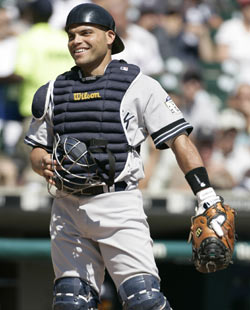
You’ve probably seen the latest from Ivan Rodriguez, who is still out there looking for a job. While I don’t believe Pudge has a lot left (PECOTA says .263/.301/.364), the Yankees would be very foolish not to give him another look. If you believe, as many have suggested, that Jorge Posada, even if ready to start the season, will probably sit for a quarter of the games, then you also have to be praying that the AL East race is not a close one. Simply put: if Jose Molina and Kevin Cash play 40 or more games and the race is at all close, the Yankees will lose it.
The more one considers this possibility, the more stunning it is that the Yankees went through the winter without trying to upgrade at the position — Cash doesn’t qualify; in 557 Major League plate appearances, he’s batted .184/.248/.285, a fair representation of his offensive abilities. I characterized it this way in my most recent chat when I was asked about the possibility of Rodriguez returning:
Eli (Brooklyn): Should the Yankees make a run at Pudge Rodriguez or did him running over Joe Girardi’s dog close that avenue?
Steven Goldman: One of the really disturbing things that Yankees fans will see coming out of Spring Training — well, let me correct that. There are two scenarios, both equally disturbing: (1) Posada is healthy enough to catch, but the Yankees feel nervous enough about this durability that they carry both Jose Molina AND Kevin Cash, or (2) Posada isn’t ready to start the season, so the Yankees start the season with Molina and Cash as their catchers. As such, YES! YES, THEY FREAKING SHOULD BRING IN ANYONE BREATHING! YES!
… I actually raised this point on last night’s Hot Stove show on YES, though somewhat inarticulately: Brian Cashman’s biggest gamble last season was not relying on young pitching, but in going to war with an old catcher and assuming his (to that point) incredible durability would carry them through another year. That he has decided to double up on that bet is really disturbing and will reflect very poorly on him should Posada not be ready to go.
I should have said that it will reflect very poorly on him “should Posada not be ready to go, or if he requires substantial rest to stay healthy — and the latter seems to be inevitable.”
SOME THINGS WORTH READING
? A good MLB.com article on the PECOTA prediction system, which I often site in these here pages and is the backbone of that book I spent the winter editing. How does Bill Pecota feel about inspiring PECOTA? “Hey, any pub is good pub at this point … I definitely didn’t do enough on the field to get people to notice me, so if they’re noticing me now, that’s awesome.” Thank you, Bill. Feel free to come by a book signing. We’ll spot you a copy.
? Sorry for bringing up bad memories, by Joe Posnanski conducts a thoughtful “steroid symphony.”
Let us review
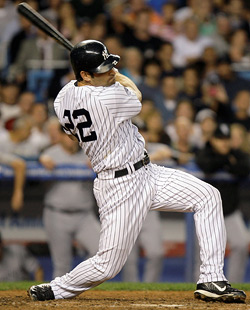 At the risk of boring the more advanced members of the class, I want to revisit Xavier Nady one last time before midterms. Your grade, and that of the Yankees, depends on your ability to answer several true-false, multiple choice, and fill-in-the-blank questions about Nady, so it’s imperative that we come to grips with the subject. Please open your text books/hymnals to page 355 and sing along to Buddy Holly’s classic “Maybe Nady” as we repeat together these key facts:
Nady is 30 years old and is a career .280/.335/.458 hitter. Despite his 89-game surge with the Pirates and brief hot streak with the Yankees, he is at this late stage of his career to be any better than those career rates in the future. He has never rated as a great glove. Per 162 games, he has averaged 30 doubles, one triple, 21 home runs, and 34 walks.
Last season, the average Major League right fielder hit .276/.347/.451. In 2007, the average right fielder hit .281/.351/.453. In 2006, the rates were .277/.347/.460. In the American League East, the standard is a bit higher, given that the competition lists the J.D. Drew/Rocco Baldelli combo, the Matt Joyce/Gabe Kapler combo, Alexis Rios, and Nick Markakis. Only one of the four, the Rays’ Joyce-Kapler mélange, may not exceed the averages. Should Nady play every day in right field and snap back to his 2006-2007 .334 on-base percentage, the Yankees would be operating at a significant deficit relative to the competition.
Now, Nady is not without value, because Johnny Damon is getting old and Nick Swisher has his limitations, and when most teams have to bench a starting corner outfielder due to injury or fatigue, they tend to wind up with Reggie Abercrombie out there, and the road to hell is paved with Reggie Abercrombie. The road to the postseason is paved with having a substitute like Nady. He’s not quite good enough to be a starter on a winning team, but overqualified to be a reserve. The smart teams will hold him to 300 at-bats or so and/or flip him to a team whose starter is even further below average than he is.
In short, Nady is not the kind of player a championship-caliber team plans on starting unless they have no other alternatives. The Yankees have alternatives. It could be Swish Nicker, who has comparable power to Nady and will out-walk him by 50 or 60, so his batting average need not be better than .250 to surpass X-marks-the Sub, or it could be a player we kicked around in yesterday’s installment, like Adam Dunn. They Yankees can flip Nady or not. They can pay the freight on keeping him and have themselves a very positive role player. The one thing they shouldn’t do is mistake his little contribution as something worthy of a starting role.
Review complete. Close your notebooks. You can play silent ball for the rest of the period.
SHOW THREAD: BACK IN THE BUNKER TONIGHT
I’m off to the Death Star-like YES HQ for another stay in the Dot-Com Bunker on the Hot Stove show. If you’ve got any comments, I’ll be checking the comments right up to and even during show time, so get ’em in. Any topic is fair game, including Bob Lorenz’s haircut — but only in a constructive way. Bob is the most tenderhearted regional sports network host you’ll ever come across. Those calloused NESN guys can’t touch Our Bob for generosity. It’s very difficult to see unless you have a top of the line high-def set, but on every Yankees postgame, Bob has a dish of candy out on the desk just in case any of you happen by the studio. He’s that kind of guy. See you at 6:30 p.m. EST.
Another note on Posada
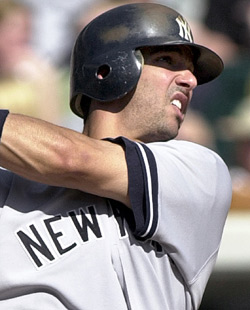 Spurred on by Buster Olney’s mention of this same topic in his blog posting today (I shan’t link; Olney is, shall we say, persnickety about who he links to, so I shall be the same). Olney writes: “If [Jorge Posada] can’t catch, he will have to get the bulk of his at-bats as a designated hitter, compelling the Yankees to press for a trade of one or two veteran hitters, among Xavier Nady, Nick Swisher and Hideki Matsui.”
Seems like they’re working on the latter anyway, as well they should given the declining value of two of the three. As for the designated hitter part of the story, let’s examine that. Last year, the aggregate rates for the DH position were .256/.339/.435, with a home run hit every 24.4 at-bats. The previous season they were .268/.355/.447 with a home run every 25 at-bats.
Parenthetically, the DH numbers always seem to be less than you would expect. The American League as a whole hit .268/.336/.420 in 2008. As a group, the players whose sole job it was to provide offense weren’t a whole lot better. It’s tempting to conclude that AL managers aren’t doing a very good job of designating good hitters, but it that wouldn’t be completely fair; the family of designated hitters had a rough year. Aubrey Huff and Milton Bradley were great, and David Ortiz was good when he wasn’t hurt.
Then there were some rude surprises. Jim Thome struggled early, pulled it together for three months, then slumped again. Matsui was off to a great start when his knees began affecting his production, and his post-injury hitting was even worse. Billy Butler and Jonny Gomes didn’t hit up to their abilities (Butler turned it on in the second half, but it was too late to save his overall numbers). Frank Thomas and Jose Vidro hit the end of the road, and Gary Sheffield hit the Last Rest Stop Before the End of the Road.
The previous year had Ortiz having a monster year, as well as productive seasons from Thome and Jack Cust. There were also some real disasters. I had blocked Shea Hillenbrand out of my memories of the 2007 Angels. He hit .238/.258/.320 as a designated hitter. Whichever team executive thought of Hillenbrand and let him putter on for a quarter of the season should have been cashiered. As planning goes, handing your team a Hillenbrand for its DH is not too dissimilar from those Civil War supply officers who sent their soldiers into battle wearing shoes with soles made out of old cupcake wrappers held together by cat spit.
In the Olney scenario, the Yankees wouldn’t be going with Hillenbrand, or Monty Meigs at DH, but Posada. The question is, if Posada is restricted to DH, can he give the Yankees average or better DH production, something along the lines of the league rates we’ve seen — let’s say a .270 average, .350 on-base percentage, and .440 slugging percentage?
If we go by Posada’s career rates, the answer should be an easy yes. He is, after all, a career .277/.380/.477 hitter. Yet, we’re talking about a Posada that is now 37 years old and is coming off of an injury which affected his swing. As such, Posada’s future is something of a black box. We can look at projections like those at compiled at Fangraphs — Bill James’ system figures .277/.378/.455, CHONE forecasts .266/.363/.434. Posada will hit .285/.374/.466 in Marcel’s prognostication. We should also add PECOTA to that. I can’t tell you exactly what it says just yet, but I will say that it’s a good deal more pessimistic than the rest. It’s also the most conservative on playing time. The projection systems, in the order that I listed them, see something like full-time play, almost full-time play, something like 60 percent play, and, last, PECOTA with something like half a season of playing time.
In Sabermetric circles there is often debate about the relative accuracy of these systems; as a BPer and the co-author and editor of a book which bills itself (tongue in cheek) as the home of the “deadly accurate” PECOTA forecast, I have to dance with the forecaster that brought me. Yet, in this case, I would be prepared to throw it all away, because everything Posada does depends on how he comes back from the surgery. None of these systems know that, although PECOTA has taken last year’s reduction of playing time into account. Posada could do it all, or nothing at all. And suddenly we’re invoking old Frank Sinatra tunes, so it’s probably time to move on.
Does Melky deserve another shot in center?
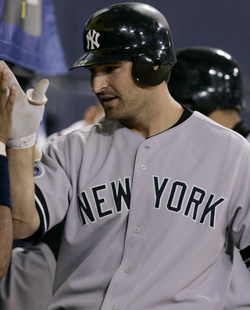 THEY MIGHT BE TRADING
The ice keeping the outfielder/designated hitter free agent market is beginning to break up, and that can only be good news for the Yankees as they look to ease their outfielder logjam. There really isn’t much reason for a team to trade anything of value for an Xavier Nady when better players can be had for mere dollars. However, as those players fall out of the market, the losing bidders will be looking for consolation prizes, and that’s where Nady comes in.
Parenthetically, FOXSports.com’s Ken Rosenthal reports today that it’s not just Nady on the market, but that the Yankees are also floating Nick Swisher. This is so depressing a possibility that I refuse to acknowledge it. Should Swisher rebound, the Yankees will have a right fielder with a .260 average, 25 home runs and 90 walks. Should Nady return, the Yankees will have a right fielder with a .270 average, 20 home runs, and 35 walks. The difference, when you add in Swisher’s superior defensive capabilities, is between four and five wins, which is a huge number. Now, if trading Swisher nets the Yankees Tris Speaker to play center field and trading Nady does not, you could make the argument that Nady + Speaker is greater than Swisher + Brett Gardner/Melky Cabrera. Fortunately, it’s doubtful that a Tris Speaker is available, let alone that one will be made available for either player, so Nady should almost certainly be the man with the one-way airline ticket out of town.
I realize I often drop Tris Speaker’s name when talking about possible center fielders. For those that didn’t take the prerequisite course, Pinstriped Bible Background 101, Speaker, also known as the Grey Eagle, played from 1907 to 1928 and for decades was known as the quality standard for center field defense. He also banged out 3,500 hits, about 800 doubles, and averaged .345/.428/.500. Thus, if the professor says that the Yankees have a chance to get a Tris Speaker, he is referring to the idea of an impact-level, two-way center fielder. He is not referring to Mike Cameron. He is definitely not referring to Melky Cabrera. Sadly, he’s not referring to Brett Gardner either, though Gardner is almost certainly the best of the preceding three names.
Speaking of Gardner, I got a good bit of mail on the subject of he and Melky from reader Jeremy:
In your recent Pinstriped Bible column, you mention that Melky Cabrera doesn’t
deserve to keep his roster spot because: “His Major League batting averages are, in order,.280, .273, and .249. Wake me when the movie’s over.”
With all due respect, I think this deserves more analysis than you give it. Batting
averages aren’t considered to be the defining statistic in baseball anymore. I’m not
pretending to be Bill James or anything, but in 2006 and 2007 Melky posted OPS+s of
95 and 89 respectively. In 2008 he did post an OPS+ of 68, but he had the least ABs
and GP’d since his 20-game stint in 2005. His -4.0 VORP is inexcusable, but for
goodness sake his BABIP was .271! He’s a 24 year old who plays good defense and if
last April showed us anything (.291/.359/.505,6 HR,17 RBI) might have some
potential.
All I’m really saying here is that Melky deserves a much more in-depth look than
batting average can give us. I realize that April is an EXTREMELY small sample size;
but combined with his other statistics, I think that it is worth giving Melky some
growth time. After all, compare the first few seasons of Sammy Sosa with the first few seasons of Melky. I’m not saying that they will even end up being comparable, BUT early career batting averages aren’t the best way to gauge a player’s potential (just ask the Rangers if they would have traded Sosa if they had known he would put up a 201 OPS+ in 2001).
In summation, Melky hasn’t been as great as the Yankees expected him to be so far,
but his early stats show that he has some potential. He’s still only 24 and his
flash of brilliance last year shows that, from time to time, he can mash with the
best of them. Thanks for reading, Jeremy P.
Thank you, Jeremy. Good one. I wasn’t simply evaluating Melky on batting average, though he might prefer it if we stick to that because so far it’s the only offensive skill he’s shown in the Major Leagues. I’ve been through the Melky arguments enough times that I figured it was safe to give you the shorthand version. Let’s run through your points. He had the fewest at-bats of his career for a reason, namely that he was abusing the ones he was given. His batting average on balls in play was indeed low, but so was his line drive rate, and line drives are where batting averages come from. Melky spent much of the season hitting weak fly balls and grounders. It wasn’t bad luck, as we might normally infer from a low BABIP, or defenders making a fluke chain of great plays against him, he just didn’t swing with much authority. That said, even if we grant that his low BABIP could have been caused by bad luck, nothing much changes. Let’s give him the benefit of the doubt and tip him 30 points of batting average, to get him back up to the league average in the BABIP category. At best, you’d have his 2006 production … except you wouldn’t have that either, because his walk rate has also dramatically declined since then, dropping from nearly 11 percent of PAs in 2006 to just 6.5 percent this year.
There’s another problem here, which is that Cabrera is also a fraud as a switch-hitter. He is completely shut down by left-handed pitchers, with career rates of .251/.319/.329. Basically, we’re looking at a batting-average oriented platoon player who has yet to hit for an impressive average over a sustained period of playing time anywhere in his career, who doesn’t and probably will not hit for power and is not particularly selective.
That brings us to your Sosa comparison, which, respectfully, is wildly off base. First, you should recognize that Sosa is an outlier. Most players do not explode the way he did, which is just one reason why observers sometimes look at that explosion with skepticism. I’m not saying they’re correct about that, by the way, merely that the rareness of the development is one reason why. Second, the statistical similarities aren’t really there. Sosa was in the Majors at 21, still clearly learning on the job and swinging at every off-speed pitch he was offered, but still knocking extra-base hits all over the place. This correlated with what scouts were saying at the time: this guy has immense physical tools. When he hits the ball, it travels for whole galaxies. The only problem is that he doesn’t hit it often enough, but if he ever learns how to make better contact, look out. This was something you could see at the time — I have a dim recollection of him simply crushing a ball off of Dave LaPoint into the center field bleachers at Yankee Stadium in 1990.
No one has ever seen those kinds of physical tools in Cabrera. No one is predicting that kind of explosion for him, and I would argue that his approach at the plate largely precludes that kind of development. Now, I’m not prescient, and it’s certainly possible that Cabrera could change that approach, or put on 50 pounds of muscle (in a wholesome way, I mean) and start crushing the ball, or all the bad luck that you think he had in 2008 reverses, he hits .350 on balls in play this year, bats .300 on the season, thereby elevating all of his weak peripherals. Maybe, but I doubt it. I’m not much of a gambling man, but if we’re going to roll the dice that way I’d rather bet on Gardner adding a few singles and a few walks than on Cabrera changing his entire being. One is entirely within the realm of possibility. The oth
er is an almost impossible long shot.
BUNKER BOY RIDES AGAIN
I’ll be back in the Bunker on the YES Hot Stove show again this Thursday evening, so get your comments in and I’ll bug Bob and the newsprint boys about ’em. No doubt we’ll be talking about Mark Teixeira, the center field issue, and the ongoing Andy Pettitte saga. Me, I hope it keeps on going — the Yankees can and should reserve a spot in the rotation for youth.
Teixeira worth the money now, and later
 SPRUNG FROM THE BUNKER WITH A BIG FACE
I couldn’t let Friday end with that face at the top of the screen. It’s like a cellulite eclipse. Let’s tear through a few items before breaking for the weekend. Someone write in and remind me to take a break from editing the Baseball Prospectus annual (Pre-order now! I don’t get anything if you do! Not a dime! But you should.) to spend an hour on the treadmill. They’re going to let me go back in the Dot-com Bunker on the next show, Jan. 8, 2009. This time I might sneak onto the main set when no one is looking, just to see what it feels like to sit in one of those comfy chairs the New York Times guys get. I can dream, and yet the positive to not being in the plush chairs is that they don’t issue rations when you’re in the Bunker, so weight loss is pretty much inevitable. I skipped lunch yesterday, and after about two hours in my cell I was getting pretty low. It’s hard to answer questions about CC Sabathia when you’re thinking, “I wonder if Bob Lorenz would be good with barbecue sauce?” Did you see how they cut to me before my second segment? Next time, instead of working at my computer, you might see me opening up a pizza delivery box.
No, no, no. No pizza. Treadmill, Steve. Treadmill.
In yesterday’s Hot Stove show thread there was something of a debate on the subject of Mark Teixeira vs. Manny Ramirez. To me, the most interesting thing about said debate is not the players involved but the apparently universal sense that the Yankees need to bolster the offense. The sense that they need to improve the defense as well is not universal, or no one would be arguing for Manny. The correct answer, though, is “both,” especially if the Yankees want to fully exploit the Scrooge McDuck money they just put into arms. Think of it this way: Teixeira, as a Gold Glove defender at first base and a top hitter, is all positive. He’s not only adding runs above average on offense, he’s taking them away from the bad guys when in the field. Say Teixeira is worth 50 runs over the average player with the bat, and 10 runs above average with the glove, so you could say that his total contribution to the winning effort is 60 runs.
With Ramirez, the math is different. As Rob Neyer wrote this week, under normal conditions he’s such an egregiously indifferent outfielder that most metrics see him as being worth about 20 runs below average. Those runs have to be held against his offensive totals, such that if Ramirez is worth about 60 runs over the average player with the bat, after fielding is considered, he’s really only a 40-run advantage — or less than Teixeira. Another way of looking at it is to say that Teixeira adds about five wins over the average player with his bat, then gives his team another with the glove. Ramirez gives his team six wins with the bat, but also contributes two losses with the leather.
We haven’t even talked about the elephant in the room with Manny, which is, “If he’s paid, will he give a damn?” but we don’t have to, because there’s another consideration, which is that if he’s signed to a three-year deal, his team is buying his age-37, 38 and 39 season. Hall-of-Fame hitter or not, this is a dangerous thing to do. Ramirez’s fielding is already a problem. If he loses a half a step, he’s not just going to be damaging in the field, he’s going to be a visible joke. Sure, he could DH, but the age is still an issue — at some point age is going to set in, and while we don’t know if it will happen during those three years, there’s a good chance that it will. In contrast, the team that buys eight years of Teixeira will get him from age 29 through 36. His contract will end where Ramirez’s begins. That consideration alone should swing the discussion toward Teixeira.
What we still don’t know is the Yankees’ position on all of this. They’ve signed two starters, supposedly don’t want to go crazy with their budget, and yet are rumored to be looking at still one more free-agent pitcher. This last point would almost certainly be overkill. Few teams go five deep in quality starters in their rotation, and the Yankees have sufficient alternatives in, at the very least, Phil Hughes, winter ball-reborn Ian Kennedy, and Alfredo Aceves, that if one falters they can move to Plan B without too much trouble. Foregoing Andy Pettitte at No. 5 would probably be worth half a Teixeira. Establishing Hughes, Kennedy, or Aceves in the rotation would mean a couple of seasons of pre-arbitration, pre-free-agent salaries at that roster position, along with the possibility of buying that now-established player out of their arbitration/free-agent years, such that their costs are controlled for years. This beats going back to the free-agent market for next year’s A.J. Burnett. Plus, you get to save the offense and the defense. To put it another way, send $22.5 million a year on Teixeira now, save $10 million on Pettitte this year, save $17 million on Burnett II next year, and the year after that, and for however long the team controls the young pitcher it puts into the fifth spot in 2009. At that point, Teixeira starts to look darned cheap — $12.5 million for him, plus the $10 million you would have wasted on an old pitcher anyway.
Stay safe and warm this snowy weekend. The Pinstriped Bible rides again on Monday or with breaking news, whichever comes first.
Talent abound in the AL East
 WHEN LAST WE LEFT OUR HEROES …
… We were in the midst of our subjective position-by-position ranking of the teams in the American League East, with the intention of trying to discern, however unscientifically, how these teams rank in terms of talent. We’re using a simple scoring system: if a team’s player ranks first out of five at a position it receives five points. If it ranks fourth, it receives four points, and on down the line. Having reviewed all the fielding positions (scroll down, pilgrims), the score was Red Sox 31, Yankees 26, Rays 25, Orioles 21, Blue Jays 17 with designated hitter and the pitching staffs yet to go.
Designated Hitter:
1. Red Sox: David Ortiz
2. Yankees: Hideki Matsui
3. Orioles: Aubrey Huff
4. Blue Jays: Travis Snider
5. Rays: Free parking
As with many of these entries, there is a great deal of conjecture here. Will Ortiz be completely healthy? He wasn’t half bad when he was hurting. Will Hideki Matsui’s knee problems be a thing of the past? Will Huff revert to his previously mild levels of production for a DH? How will 21-year-old Snider hit over a full season? Who is the Rays’ DH? The correct signing could jump the Rays up to second place or third place on this list. For now, THE SCORE: Red Sox 36, Yankees 30, Rays 26, Orioles 24, Jays 19.
No. 1 Starter:
1. Yankees: CC Sabathia
2. Blue Jays: Roy Halladay
3. Red Sox: Jon Lester
4. Rays: James Shields
5. Orioles: Jeremy Guthrie
You want to take Halladay over Sabathia, I won’t argue with you. THE SCORE: Red Sox 39, Yankees 35, Rays 28, Orioles 25, Jays 23.
No. 2 Starter:
1. Rays: Scott Kazmir
2. Yankees: Joba Chamberlain
3. Red Sox: Josh Beckett
4. Blue Jays: Dustin McGowan?
5. Orioles: Garrett Olson?
These numbered starter designations are somewhat arbitrary, so if you want to debate who should be sorted where that’s fine. Kazmir rates over Chamberlain on the basis of greater experience; Chamberlain rates over Beckett because of the latter’s health problems this season. Speaking of health problems, it’s not quite clear when McGowan will be back from surgery to repair a frayed labrum. Between injuries (Shaun Marcum is likely out for the season) and the free-agent defection of A.J. Burnett, the Jays have really had a hole blown in their starting rotation. As for the Orioles, their rotation is scary anonymous — and likely scary bad.
THE SCORE: Red Sox 42, Yankees 39, Rays 33, Orioles 26, Blue Jays 25.
No. 3 Starter:
1. Red Sox: Daisuke Matsuzaka
2. Yankees: Burnett
3. Rays: Matt Garza
4. Blue Jays: Jesse Litsch
5. Orioles: Chris Waters
The wild card here is Burnett’s health, Matsuzaka’s ability to dance between walks for another year, and if Garza can take the wonderful things he did to the Red Sox in the ALCS into the regular season.
THE SCORE: Red Sox 47, Yankees 43, Rays 36, Blue Jays 27, Orioles 26.
No. 4 Starter:
1. Yankees: Chien-Ming Wang
2. Rays: Andy Sonnanstine
3. Blue Jays: David Purcey
4. Red Sox: Tim Wakefield
5. Orioles: Radhames Liz
I’m going on feel here. It’s all guesswork at this point, except that Wang should trump the lot if he stays healthy — although David Price could be listed here, and perhaps he blows everyone else away. Liz could turn out to be the best Orioles pitcher, or the worst. He certainly has the potential to be good, but the Orioles aren’t very good at tapping potential. Sending an unrefined pitcher to the O’s is like hiring a porpoise to sniff out truffles.
THE SCORE: Red Sox 49, Yankees 48, Rays 40, Blue Jays 30, Orioles 27.
No. 5 Starter:
1. Yankees: Right now it’s probably Phil Hughes, but they could sign anyone.
2. Rays: Price, barring a Spring Training breakdown.
3. Red Sox: Clay Buchholz likely gets first dibs.
4. Blue Jays: I don’t think they know, either.
5. Orioles: Just what do you want from me, already?
Three pitchers with great potential, two unknowns. I think they call that a full house. The top three could shake out in any order, particularly if Hughes is secretly Derek Lowe or Lefty Grove, Price proves to be Wade Davis or Jeff Niemann or someone like that … Or if Buchholz turns back into Charlie Zink.
THE SCORE: Yankees 53, Red Sox 52, Rays 44, Jays 32, Orioles 28.
Closer:
1. Yankees: Mariano Rivera
2. Red Sox: Jonathan Papelbon
3. Blue Jays: B.J. Ryan
4. Rays: Troy Percival
5. Orioles: George Sherrill
No shame in being third in this group. I’m not going to score middle relief because it’s far too volatile, but if I had to rank them right now, I would pick the Yankees, Blue Jays and Rays in some order ahead of the Red Sox and Orioles. That makes our FINAL SCORE: Yankees 58, Red Sox 56, Rays 46, Jays 35, Orioles 29.
So, there you have it. One version of the talent spread among the teams of the AL East. By switching just a few assumptions, you could easily flip the Red Sox over the Yankees, or bring the Rays a lot closer. There are so many moves yet to happen the whole thing could change … except the Orioles being last. That’s set in stone.
TV TIME AGAIN
I’ll again be chatting from the cyber-closet with Bob and the gang on the YES Hot Stove show, 6:30 p.m. EST on Thursday. Once again, I’ll be looking for your input, so feel free to comment here or in our pre-show thread, which we’ll open up tomorrow. I hope you will tune in.
Is Mike Cameron a good fit for pinstripes?
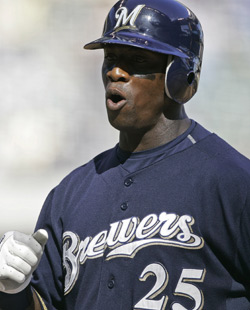 MIKE CAMERON REVISITED
A quick reprise of some words on Mike Cameron from October 23:
Cameron is a low-average hitter with decent selectivity, some power, and a great many strikeouts. He continues to be a good fit in center, if no longer the Gold Glover he used to be. As always, the question with any player of his vintage is, “How long will he be able to stay at his present level?” which in this case would be something like .250/.325/.440. Once again, we must offer this caveat: those numbers are distinctly in the Eh Zone (adjacent to the Twilight Zone, though Rod Serling only went there for later episodes of “Night Gallery”), but the Eh Zone is an upgrade on the Melky Zone, or, as George Harrison once sang, the Sour Melk Sea. “Better” is not the same as “good.”
Cameron’s last two seasons, the most recent of which included a suspension for failing a banned stimulant test, were intriguingly consistent. Here he is against left-handers in 2007 and 2008:
2007: .294/.404/.510
2008: .282/.397/.555
You’re thinking, “Gee whiz, Fonz! That’s pretty good,” right? Let’s move on to the rates against right-handers.
2007: .222/.316/.413
2008: .231/.309/.452
Hrm. Not so good … Everything about Cameron shouts, “Beware! Player in decline!”
A couple of weeks later, I noted:
In a bad luck year, or a year in which age takes hold, Cameron could very easily slide to a below-.300 OBP. And suddenly, having gotten rid of Melky, you’re dealing with his OBP again.
My conclusion in October:
Everything about Cameron shouts, “Beware! Player in decline!” He had a difficult time getting more than a one-year deal last winter. If the Yankees blow him away with two years, they’re going to get burned, if not in year one than definitely in year two, though year one has the distinct odor of possible bust as well.
I would argue that if Brett Gardner hits as he did during his second stint with the Yankees (August 15 on), .294/.333/.412 with eight steals in nine attempts, the Yankees will be in good shape next year given the defensive bonus they should also reap from his range. If Gardner hits only as well as he did in September, .283/.321/.377, they will basically be getting what they got from Melky in his good days, plus speed. It’s not great, but you can live with it given good defense and the thought that Gardner will build with experience and reach greater heights further on, say, .295/.390/.410. Remember, Gardner is a more selective hitter than he showed in the majors this year, and these .320, .330 on-base percentages are a little low.
What the Yankees seem to be missing here is that if they upgrade in right field, they can worry less about bringing in someone expensive to play center. An outfielder-DH in the Adam Dunn mode, combined with reasonable performance from Gardner, would do far more for the team than Cameron plus an Abreu return, or Cameron plus Nady. You can make book right now on a Damon-Cameron-Nady outfield being both defensively bland and offensively subpar. This is a formula for another year of mediocre offense and thousands of words wasted on why the Yankees aren’t “clutch” when they just don’t have the runners on base to be heroic.
The Yankees need to keep thinking outside of the box — their box. The box they’re standing in right now is the 1980s box, the box of indiscriminate application of superior financial resources. It leads to big contracts for the likes of Dave Collins, not to championship rings. They had the right idea last year. They didn’t get good results for a variety of reasons, but that doesn’t mean they were wrong, just that sometimes you have to tinker with a plan before you get it right.
Six weeks later, I stand by that. Another point: Earlier today, Cliff Corcoran pointed out that Jim Edmonds is still available, and he won’t cost the Yankees anything but money. If you take his Cubs numbers (.256/.369/.568) as something he’ll be capable of revisiting at 39, then you have the makings of a pretty good center-field platoon (with someone), one that would almost certainly out-produce Cameron. Edmonds would allow Cabrera to be traded for something else of value, if there’s a market for him beyond Milwaukee, or for that matter, a more valuable Brewer — not an expensive old guy they’re trying to get rid of.
As for Melky, it’s ironic that he might go to the Brewers, because he’s basically Rick Manning, a good defensive outfielder who had a 1500-game Major League career despite doing almost nothing with the bat after his second Major League season. He spent the 4.5 years of his career with the Brewers, coming over just after they went to the 1982 World Series and did his best to impede them from going back. He succeeded. Melky’s timing is uncannily similar.
FAT, BEARDED YANKEES GUY WITH TWO SKINNY GUYS
I dropped by Bronx Banter Breakdown today at the studios of that other local sports network to talk CC Sabathia with Alex Belth and Cliff Corcoran.
Note that I got a self-deprecating “fat guy” joke in there. I think I need to hire a personal trainer to come to my house. Any trainers out there want to shrink me at a discount rate in exchange for frequent endorsements on a well-read baseball blog?
Yanks need to produce for CC to be effective
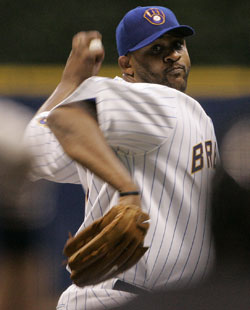 AS WE GO UP WE GO DOWN
Down in the comments, longtime reader/frequent commenter Louis writes:
I have been wanting to make that point about the Blue Jays and their league-leading 3.77 runs per game allowed for awhile, but somehow keep bypassing it, and I thank Louis for reminding me. The Jays scored just 4.41 runs per game The Yankees were almost half a run better, plating 4.87 runners a game. “Better” isn’t “best;” the Yankees ranked only seventh in the league in runs per game.
The question for next year, insofar as any potential Blue Jayism goes, is if the Yankees offense gets better, worse, or stays the same. Brian Cashman is on record as saying “Better.” He bases this on getting a full season out of Jorge Posada; a fixed Robby Cano; a divorced A-Rod; a healthy Matsui. Is he correct? With all respect, probably not:
Posada is a year older and very probably won’t be up to his old 140-game workloads. Whereas almost anything Posada is likely to do will be an improvement on Jose Molina, giving one-fifth or more of the starts behind the plate to Mr. Career .237/.276/.339 is potentially devastating. And if Posada’s shoulder isn’t what it used to be and he can’t catch, look out.
Alex Rodriguez hit at about his career levels last year. Sure, he was well down from 2007, but 2007 was not his typical year. Maybe a more relaxed, Maddona-ified A-Rod will hit better in the clutch, but that adds fewer runs than you might thing.
If Matsui is healthy, he should be reasonably productive at DH, but the Yankees actually did quite well at DH last year thanks to Johnny Damon and Jason Giambi. Overall, Yankees DHs hit .282/.378/.461. Matsui is a career .295/.371/.478 hitter and he’s 35. He’s not likely to give the Yankees a whole lot more than they got last year.
Cashman is probably right about Cano, but we haven’t even gotten to the other aspects of the offense: Johnny Damon will probably lose some production. No one knows what the team will get out of center field. Xavier Nady in right field is a likely step backwards of around 20 runs. Nick Swisher could put first base on a par with what it got last season (.246/.349/.460) or even a little more assuming the return to form we all figure is coming.
So what does that all add up to? Without playing with projected numbers (which I did in a previous entry), it seems like there might be something less than short of a decisive improvement. As for the defense, it’s where it was, and that ain’t good. Figure that if the Yankees want to win 98 games next year, and scoring remains constant or just ticks up a little bit, they would still have to saw nearly 80 runs allowed off of this year’s total. Sabathia replaces Mike Mussina plus (because he pitches further into games) some bullpen innings. Add a healthy Chien-Ming Wang, a full year of Joba Chamberlain, and about 40 starts from pitchers (whoever they are) who should be better than Sidney Ponson, Ian Kennedy, Phil Hughes, and Carl Pavano… It seems doable, but if the offense slips, look out. Things will go backwards as they go forward.
 Pinstriped Bible