Tagged: Nick Swisher
The Pinstriped Bible — LIVE from the Bronx
 MORE FROM THE BALLPARK ( 9:35 p.m.)
As I write, the Yankees are batting in the bottom of the fourth. Andy Sonnanstine, who has not been particularly good this year, have held them to one hit (three hits — in the time it took me to complete this sentence, Teixeira singled and Matsui doubled. Either the Yankees are heating up or my sentences are too long). The Rays have played some excellent defense, as is to be expected given that by at least one measure, defensive efficiency, the Rays are the best leather team in the league — just as they were last year.
With two runners on, the ballpark is plenty loud — I wonder if the acoustics are really as has been said or the fans haven’t had enough to cheer about… And Cano flies out to Carl Crawford in left, and all at once it’s quiet again.
A little earlier, A.J. Burnett skipped a ball through Dioner Navarro’s toes, and that reminded me of a brief encounter I had with sports talk radio earlier today. The caller to Sirius-XM’s midmorning show argued that what the Yankees needed to do to beat the Red Sox was hit them with more pitches. We seem to hear this sentiment every time the Yankees drop a series to the Sox: the Sox intimidate the Yankees but the Yankees don’t intimidate them. It sounds pathetic. I can never remember the old saying correctly — is violence the first refuge of the incompetent of the last? It seems to work either way. Whichever the case, such sentiments are an example of it. The way the Yankees will beat the Red Sox is to win some games. I know it’s a novel idea, but if they hit better than .150 with runners in scoring position against Boston, they’ll score some runs, maybe even more runs than Boston scores. Engaging in a beanball war is not going to achieve much more than getting players suspended at best and hurt at worst. These teams see each other a lot of times this year, and the last thing either of them needs is to see sporting competitiveness spill over into violence.
The thing that really struck me about the call, after its ignorance, was its super-ignorance. The Yankees have hit EIGHT Red Sox this year. The Red Sox have hit TWO Yankees. Don’t you have an obligation to watch the actual games before making so reckless a recommendation? Couldn’t the Yankees try hitting a few home runs before starting a fight? All we are saying is give peace a chance. Or at least common sense.
As I put the pen down on this particular entry, it is the top of the sixth. The Rays have two on and one out after a Jason Bartlett sac bunt (Bartlett had struck out in his two previous at-bats, so the bunt sorta kinda makes sense). Burnett is already over 100 pitches, and I see someone loosening in the bullpen. “Two riders were approaching, and the wind began to howl.” Maybe it’s howling at Jose Veras. Wouldn’t you?
SCENES FROM A BALLPARK ( 7:23 p.m.)
The Pinstriped Bible comes to you from the Bronx, New York this evening, where the Yankees and Rays are about to joust. Let’s see… The Rays thrashed the Red Sox, the Red Sox thrashed the Yankees, so next in the sequence is… Yankees thrash Rays? My boss is in the seat next to me, so I’m sticking with that line. Not good to look too curmudgeonly and pessimistic in front of the guy who signs the checks.
Despite the tough losses of the last few days, there was a lot of animated good spirits on display on the pregame field. Bernie Williams was on hand, joking with Derek Jeter, then chatting with Melky Cabrera behind the cage. I couldn’t make out what they were talking about — the ballpark amps were at 11 — but I hope it was some insight about growing at the major league level or how to hit from the right side, and not the best way to shift to an F#m chord from a D#7 diminished chord without breaking your fingers. Reggie Jackson was also on hand, in uniform (Williams was in civvies), watching over batting practice and chatting eagerly with some reporters (off the record ad strictly personal, natch). A few feet away, John Sterling was interviewing Joe Girardi, but somehow Joe was doing a lot more listening than talking.
I briefly tried to imagine that it was 1927, and the Yankees taking batting practice were Ruth, Gehrig, Meusel, etcetera, but quickly gave up: it was too bloody loud. In 1927 batting practice must have sounded like batting practice: the crack of the bat, a few people shouting on the field and in the stands.
CRACK
Silence.
Silence.
Silence.
CRACK
Silence.
Silence.
Silence.
CRACK
It must have been pure heaven.
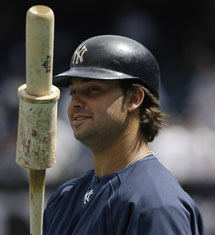 As Nick Swisher came out of the cage, Girardi asked him a question. I assume it was, “How did you feel hitting today?” or something like that. Swisher made a face, shook his head, and must have said something sarcastic, because Girardi bopped him over the helmet with the mitt he was carrying. Swisher isn’t tall, but Girardi had to do a little hop-step-jump in order to pull off the gesture.
Angel Berroa and Brett Gardner took extra batting practice. Berroa caught my eye when he cracked a ball far deeper into the stands than any of the Yankee regulars had–you’ll note that whereas every Yankee starter could put on a show in batting practice, most of them are more applied in their work, drilling line drives in one turn in the cage, pulling balls in another, and so on. Berroa was hitting deep flies, and one traveled deep into the right field bleachers, landing just short of the back row, just in front of the “26 World Champions” sign. This seemed like a wasted drill–Berroa is not going to be cranking balls out of the park under game condition. It’s just not a skill he has. Few hitters achieve any kind of consistency when uppercutting the ball and trying to hit home runs, and Berroa won’t be the first. Why not try to develop a skill that will keep you on a Major League roster instead of one that won’t?
Gardner’s BP seemed, to my weak, rhino-like eyes, to be a mixed bag. On some swings he used the lower half of his body to pull crisp line drives to right, including one which carried out of the park. On a few other swings, he lunged with his upper body as he has been doing in games, and hit something weak the other way. As he finished, he turned to Kevin Long and asked, “How was that?” I didn’t catch Long’s response, as at just that moment, the scoreboard kicked off the Graig Nettles “Yankeeography” at such volume that John Sterling could have been chastising the Hebrews for their dalliance with the Golden Calf, or threatening to turn Sodom into a parking lot. At one point I looked up and saw an image of Tommy Lasorda as big as an aircraft carrier. “Surrender, Dorothy!” he screamed. I dropped to my knees. In doing so, I narrowly avoided being run down by the entire Rays roster, which was engaged in a pregame stretching exercise in which they hopped, skipped, and jumped down the third base line singing, “Three Little Maids from School Are We.” Okay, they didn’t really sing that, but they could have — they were skipping to the proper rhythm.
This should in no way be construed as a comment on the collective masculinity of the Rays. The only point, if there is one, is that grown men rarely looked dignified when hopping and skipping. It’s also a good way to lose your wallet.
Mo, Swish and the around
 OVERTURE
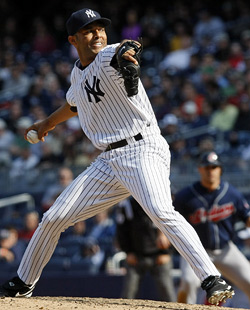
Mariano Rivera has had two one-two-three innings this year, one on April 9, the other on April 15. Since then, he’s allowed 11 hits in 6.2 innings, including two home runs, along with no walks and 10 strikeouts. Not drawing any conclusions here, just sayin’, though one does wonder if the occasional five-day layoffs he’s had are too long to keep him sharp.
A QUESTION I’D REALLY LIKE TO ASK
I’m not going to get up to the Stadium again until next week, but I really want to ask Joe Girardi this: “What are you seeing from Nick Swisher now that you did not see during Spring Training, the absent thing that caused you to call Xavier Nady a starter? Have you considered that if Nady was still healthy you might have left all this production sitting in the freezer?”
That sounds critical, but it’s not meant that way — well, mostly not. I’d really like to know.
THE AROUND (AND ABOUT)
Rays 13, Red Sox 0: About the best thing that’s happened to the Rays all year. Of course, if you listen to the Joba-to-the-pen fetishists, anyone like Matt Garza who throws a near-perfect game as a starter would be more valuable in the bullpen. That way lies madness. Now all they really need is a few players beyond Evan Longoria and Jason Bartlett to feel like hitting. Pat Burrell one home run? B.J. Upton .177/.320/.226? Speaking of the latter, there’s a guy whose career we’re still going to be scratching our heads over 20 years from now.
A’s 4, Rangers 2: Dallas Braden keeps pitching well, but as a scary fly ball guy without great control or a terrifying strikeout rate it’s not clear that he can keep it up. Given how thin the A’s are, they desperately need him to keep it up. For gosh sakes, Landon Powell had to play first base last night. That reminds me to check on Daric Barton’s progress at Triple-A: .149/.274/.209 in 20 games. Farewell, shooting star.
Royals 8, Blue Jays 6: Credit the Jays for this: after a second consecutive thrashing of Brian Burres, they seem to have come to the enlightened point of view that they’re ahead, they may never be ahead again, so they might as well try to win the race with pitchers who have an upside. As such, they demoted three pitchers, including Burres, and called up two of their top prospects, Brett Cecil and Robert Ray, as well as veteran minor league reliever Brian Wolfe. Maybe it was the sight of John Buck pounding balls all over the yard that dropped the scales. All things are possible when the deity is rolling his infinite-sided die, but yeesh, you’d think the outfielders would have had to suffer a spontaneous kidney stone attack for that particular combo to assert itself. Anyway, good move by the Jays going with their best hopes for the future instead of trying some Ponsonian nightmare form the past… Last 11 games for Billy Butler, .333/.458/.564, three doubles, two home runs, nine walks. The nine walks are more than a quarter of the free passes he took all of last year.
Cardinals 9, Nationals 4: I must stop eating these candied cashews I bought yesterday at Target. Other than that, another day, another Nationals loss, though it is good to see Ryan Zimmerman hitting like a star should (.289/.354/.544) — this franchise needs a star or 10. Catcher Jesus Flores hitting .281/.356/.438 is almost as exciting, because if you can’t have stars at least your second-line guys can be good (the key to winning any battle is good interior lines). Meanwhile, Daniel Cabrera throws four wild pitches in six innings but actually gets the quality start as the bullpen gives it up — again. Ask the Joba guys if any of those relievers would be more valuable in a different role, perhaps concessions. “Gentlemen, we concede this game.”
Brewers 4, Diamondbacks 1: One of the best starts of Matt Scherzer’s young career gets tossed aside so that Flash Gordon can “pitch” at 41. Must have seemed like a good idea at the time. I wonder if that girl that loved him still does — she must be in grad school by now, or married with two kids. At some point, we put childish things away. Then again, I still read comic books, so what do I know? On the other side, The Brewers get a rare good start from Jeff Suppan, and Trevor Hoffman resumes his quest to put the saves record out of Rivera’s reach.
Florida 8, Cubs 2: In 10 innings, no less. Groundballer Chris Volstad allowed back to back shots, but otherwise was without blemish in seven innings. The Cubs were fine until they turned things over to Aaron Heilman, who didn’t get an out. It used to be you could see that kind of show here in New York almost any day of the week. Milton Bradley hit one of those two home runs, which was the one good thing the Cubs got out of the game — a sign that Bradley is ready to come to work.
Dodgers 8, Padres 5: All I have to say is, “Four scoreless innings from Jeff Weaver? I just swallowed my gum.” With this loss, the Padres hit .500. Next stop, basement level: luggage, lingerie, Padres.
Pitchers, Ransom need to step it up
 OPENING DAY U-TURN
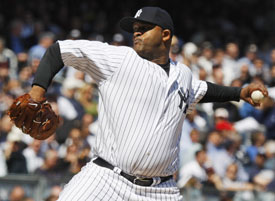
The pomp of the first Opening Day at Yankee Stadium: The Sequel was all well and good, but in the end the club has to execute. The Yankees confronted a 2-7 Indians club led by Cliff Lee, a potential flash in the pan who had been thoroughly mistreated by his every opponent in Spring Training and his first two starts. The Yankees bowed, in part because the offense stranded 27 runners, in part because Jose Veras and Damaso Marte (who hasn’t been the same pitcher with the Yankees he was prior) played arsonist, and if you’re looking for a third culprit, point to CC Sabathia, who negated his ability to throw 120 pitches by burning through them in less than six innings.
Thanks the amazing nine-run seventh inning pitched by Veras and Marte, pitching will receive the bill for this afternoon’s debacle, but the offense could have changed the complexion of the game at any time. Despite getting the first hit at YS: TS, Johnny Damon stranded five runners. Despite hitting the first home run at YS: TS, Jorge Posada stranded six. Special credit must go to Cody Ransom. Ransom’s first at-bat came in the second inning with one out and Robby Cano at second base. The third baseman struck out. In his next at-bat, in the bottom of the fourth, he batted with Hideki Matsui on first base and flew out to right field. He came to the plate again in the fifth with runners on first and third. He grounded to short. Runners were on first and second with two outs in the bottom of the seventh when Ransom struck out again. Finally, with one out and the bases loaded in the bottom of the ninth, the Yankees just looking for some dignity, or maybe a miracle comeback, Ransom grounded into a 4-6-3 double play. He left nine runners on base, and presumably because the Yankees are carrying 13 pitchers and no bench players, Joe Girardi let him.
The Yankees’ 5-5 start is discouraging, but it’s not as depressing as is Ransom’s first 10 games as A-Rod substitute. Ransom is not a kid. He’s a 33-year-old vet. He has had six shots at a big league career since 2001 without ever catching on. We are likely looking at his last chance to have at least a single season in the major leagues, first as Alex Rodriguez’s substitute, then as his caddy. The odds were against Ransom succeeding, because his long experience in the minors showed that he would not hit with enough consistency. Despite this, his small-sample hot streak of last fall gave hope that he could make it. This is the kind of player who is great fun to root for. Unfortunately, Ransom is now 3-for-30 with 10 strikeouts, and it is difficult to see how the Yankees can afford to keep playing him, however quickly A-Rod is expected to come back, or even how they can retain him on the Major League roster once Rodriguez is active. Thursday’s defeat had many fathers, but any kind of contribution from Ransom early on might have meant a different complexion to the game.
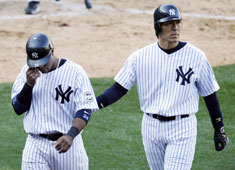 Meanwhile, despite the best efforts of Nick Swisher and Robinson Cano, the rest of the offense has yet to click into gear. The Swisher-free components of the outfield have been a total loss, and there’s a danger that that could be a season-long affliction. Hideki Matsui has looked very sluggish, and Mark Teixeira’s wrist and penchant for slow starts has crippled his numbers. Jorge Posada and Derek Jeter have hung in, but four bats is well short of an offensive load. Take out the 11 runs the Yankees scored against Baltimore in the third game of the season and the club is averaging just 4.2 runs of offense per game. You don’t want to hit the panic button after 10 games, and some of the elements will heat up a bit, even Ransom — but heat is relative. They may not heat up enough to make a truly potent offense. That’s something that Brian Cashman is going to have to watch.
SHAWKEY-SABATHIA
Sailor Bob Shawkey was the first starting pitcher at Yankee Stadium, and CC Sabathia will go down as the first at YS: TS. What was not noted today was that Sailor Bob’s history with the Yankees was contentious. After a very good, just-south-of-Cooperstown career, Shawkey became the manager of the Yankees in 1930, replacing Miller Huggins, who had died during the previous season. The club went 86-68, finishing third, and Shawkey was viewed as a failure because former teammates like Babe Ruth wouldn’t take him all that seriously (one wonders who Ruth did take seriously). In an especially coldhearted move, the Yankees replaced Shawkey with Joe McCarthy but didn’t bother telling him. Shawkey happened to walk into GM Ed Barrow’s office as McCarthy was heading out and put two and two together. “It was a dirty deal,” Shawkey said. In anticipation of Yogi Berra years later, Shawkey cut off all contact with the team. He didn’t return until the threw out the first pitch at the renovated Yankee Stadium — 45 years later. He was 85 years old.
I wonder if the opening day crowd of 2054 will get to see a first pitch from a 73-year-old Sabathia. Try to hang on if you can. I’ll try too, and we’ll talk about it then.
SKINNER
Always interesting to see who gets a hand and who doesn’t when players are announced individually. There wasn’t even polite applause for Indians coach Joel Skinner, who caught for the Yankees for three seasons. I guess fans have forgotten his amazing inability to make contact — in 556 at-bats with the Yankees he struck out 158 times, hitting .214/.299/.253. In comparison to Skinner, Jose Molina is Mickey Cochrane. Maybe they do remember, but are still mad that the Yankees gave up Ron Hassey for him…
…They definitely remembered Carl Pavano. That was clear.
THE AROUND (AND ABOUT)
- Another depressing bit: many fans and pundits held out hope that this would be the year that Royals’ third baseman Alex Gordon really took off. Instead, he’s headed for surgery with a cartilage tear in his right hip. No word on when he’ll be back as of yet.
- I keep forgetting to mention Dewayne Wise separating his shoulder and thus exiting the Chicago White Sox’ lineup. He was another player, like Nady (though a far lesser talent than Nady), whose use I railed against. As with Nady, I’d rather he take a seat than take a surgeon…
- Unless Tony LaRussa gets caught taking betting tips from Pete Rose, he’s going to the Hall of Fame. If he manages to keep his Cardinals winning at anything like their present (8-3) rate with the roster he has, he’ll have gone an extra length towards earning his plaque. Of course, today’s game against the Cubs was their first against a team of any real talent.
The Nady-Swisher situation
 WIN #1
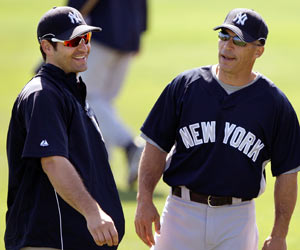
Can Nick Swisher play now? Can Joe Girardi say, as Lincoln did of Grant, “I can’t spare this man — he fights”? A reader recently wrote me to say that I had been quiet about Xavier Nady outperforming Swisher during Spring Training, and it would be more fair to Girardi to admit that Nady had legitimately won the job. My answer here is that it depends on how you define “legitimate.” Making decisions on the basis of 40-60 Spring Training at-bats against highly variable competition is nonsensical, particularly when you have a track record of a couple of thousand at-bats on which to base your evaluation. If those 60 wind-blown at-bats are going to outweigh 2,000 regular-season turns at the plate, there had better be some extenuating circumstances.
Now, in this case I think there were some extenuating circumstances, and I said so: As much as I think Spring Training stats are overblown, given that Swisher came off a .210 season, he had to show the Yankees something to prove that his inconsistency was a fluke. He did not do this, and so he’s going to have to prove himself, start by start.
That said, there is still no reason to believe that Nady is the .328 hitter he was in Spring Training, and only slightly more reason to believe that Swisher is only capable of the .222 he hit. We should also note that Swisher led the spring squad in walks with 13 (Nady took only two), and that he hit the same number of home runs as Nady, one. The difference between them comes down to a few hits.
In short, did Nady really win the job, or were the Yankees guilty of a selective review of the evidence? We’ll see as the rest of the season plays out. Note that Swisher is in the lineup again today, and Nady is not: The competition is not yet over, and with another good showing from Swish Nicker today (a home run off of Kyle Farnsworth? Nah — anyone can do that) it may be that the issue will remain open.
NICK ADENHART
What a senseless loss. Trying to grasp for a silver lining, the one thing I can think of is that if you asked most pitchers how they might like to go, perhaps they would choose to exit right after a strong start. It is small consolation that the police nabbed the perpetrator, a drunken driver, and charged him with “felony drunk driving, felony hit and run, three counts of murder, three counts of vehicular manslaughter and four counts of committing bodily injury during a crime.” There is no circle of hell low enough for drunk drivers, and it is to be hoped that the Orange County District Attorney does not reach for any kind of settlement but prosecutes to the full extent of the law, such that the murderer will never see the light of day again.
Parenthetically, I would be this emphatic were we not talking about a professional ballplayer and his friends but any three victims. There are few more selfish acts than getting behind the wheel of a car when one is inebriated. I don’t think much of drinking to the point of intoxication — I have never done so — but I don’t begrudge others the right to pickle their brains if they so choose. However, if you drive at that point, you are extending an invitation for involuntary audience participation in your potential suicide. The murders committed under the influence are crimes of simple, selfish negligence and deserve not the least bit of sympathy.
As baseball fans, our loss pales beside that of Adenhart’s Angels teammates, his friends and his family, but we do feel it. We did not know Adenhart well, and beyond our basic human sadness at a young life snuffed out is the lost opportunity for Adenhart and for ourselves. When Thurman Munson lost his life, we could, as fans, look back on a long career and a familiar personality. The interruption was sudden, tragic, shocking, but the legacy was there for us to hold on to. Adenhart was just beginning. His legacy is the tragedy of not getting to have a legacy. Baseball is all about history, and we’ve been deprived of one here.
TWENTY-FIVE MEN, TWENTY-FIVE GOALS INTO ONE
Continuing from second base …
ALEX RODRIGUEZ — THIRD BASE
2008 GOAL, AS STATED HERE: Win another MVP award, and try to avoid offending easily irked Yankees fans and media.
DID HE GET THERE? Pretty much whiffed on all counts, though his season wasn’t bad by any means.
2009 GOAL: Quickly return to hip-health despite having foregone, for now, the complete hip reconstruction procedure; hit more like 2007 than 2008, in the process putting questions about steroid-fueled production behind him.
CHANCE OF MAKING THAT GOAL: Seems like a mighty tall order.
SOMETHING YOU MIGHT NOT BE THINKING ABOUT: It won’t last much longer than A-Rod’s DL stay, but with two more home runs, Derek Jeter will pass Rodriguez on the Yankees’ career home run list.
ANOTHER THING YOU MIGHT NOT BE THINKING ABOUT: Rodriguez warps the fabric of space-time with his personality, creating dangerous singularities that will be the subject of a forthcoming series of science fiction films starring Seth Rogen. Sir Anthony Hopkins will portray A-Rod.
DEREK JETER — SHORTSTOP
2008 GOAL, AS STATED HERE: Stay healthy, get some life back in those legs, recover defensive value.
DID HE GET THERE? Not really. He played through a hand injury that ruined his production, hit into a career-high 24 double plays, and his defensive range wasn’t any better than usual.
2009 GOAL: Stay healthy, get some life back in those legs, recover offensive and defensive value.
CHANCE OF MAKING THAT GOAL: Last season’s production was strong in the context of league shortstops, weak in the context of Jeter’s own career, not to mention league-average production. If that was only attributable to the injury, then he has a good chance of hitting well this year. He did bat .344/.406/.434 in August-September of last year. Even then, though, he was lacking some customary pop — there were 65 hits in that period, but the only extra-base hits were two doubles and five home runs.
SOMETHING YOU MIGHT NOT BE THINKING ABOUT: When are we not thinking about Jeter?
ANOTHER THING YOU MIGHT NOT BE THINKING ABOUT: Lou Gehrig. Jeter should pass him to become the Yankees’ all-time hits leader in September.
CODY RANSOM — THIRD BASE/UTILITY INFIELD
2008 GOAL, AS STATED HERE: N/A
2009 GOAL: Fill in for Alex Rodriguez without killing the team, then remain on the roster as a utility infielder.
CHANCE OF MAKING THAT GOAL: Not great, actually. While Ransom’s 1-for-10 showing in the first three games is nothing to get exercised about, there is a reason that he has spent most of his career (going back to 1998) in the Minor Leagues. While his career 162 homers in the sticks attest to some nice pop for a guy who has primarily been a shortstop, his .242 batting average argues that he lacks the hitting consistency to succeed in any sustained way. Last fall’s exciting 13-for-43 with four home runs was a spectacular fluke.
SOMETHING YOU MIGHT NOT BE THINKING ABOUT: Ransom was drafted by the Giants in the ninth round in 1998. Another future Major Leaguer taken in that round was Mark Teixeira, selected by the Red Sox 13 picks in front of Ransom. He didn’t sign. The Yankees picked one in front of the Giants and selected a college outfielder named Claude Greene, who didn’t make it.
ANOTHER THING YOU MIGHT NOT BE THINKING ABOUT: There have been only three players named Cody in Major League history. All of them played in this century, and two of them, Ransom and Cody Ross, are in the Majors now. T
he Marlins’ Ross easily leads the Codies in all statistical categories.
RAMIRO PENA — INFIELD
2008 GOAL, AS STATED HERE: N/A
2009 GOAL: Avoid being overexposed, simultaneously giving the Yankees a reason to retain him on the roster once A-Rod comes back.
CHANCE OF MAKING THAT GOAL: Not good given that he has yet to play at Triple A; the Yankees almost certainly plan on getting him some Scranton time this year. He’s a career .258/.316/.319 hitter in the Minors, so he has plenty of work to do if he wants to have a career greater than quickie injury cameos.
SOMETHING YOU MIGHT NOT BE THINKING ABOUT: When Pena appeared at shortstop on Thursday, he became the 21st player to appear at the position during the Jeter era, not including Jeter. He is now entitled to attend a once a year luncheon with Enrique Wilson, Felix Escalona and Alex Arias.
ANOTHER THING YOU MIGHT NOT BE THINKING ABOUT: Though we’ll hear a great deal about Pena’s speed whenever he’s asked to pinch-run, he was not a basestealer in the Minors, nabbing just 28 bases in 43 tries over 334 games.
THE AROUND (AND ABOUT)
? I was going to comment yesterday that few pitchers can burn though 100 pitches faster than Scott Kazmir, but had I done so it would have been a grave disservice to Oliver Perez of the Mets, who got there in 4.1 innings on Thursday thanks to five hits, five walks and seven strikeouts. When the Deity modeled hard-throwing lefties, he included wildness in the young’uns, which explains Kazmir, still only 25. Perez is 27 and still has some shelf-life, but it doesn’t seem as though he’ll get that walk rate down under four per nine. Just think: Somewhere there’s a parallel universe where the Mets have Perez and Kazmir in the same rotation. Perhaps in that universe they also built their new park with the stairs behind the seats instead of in front of them.
? The Rays held on to beat the Red Sox yesterday, but not before Troy Percival gave up a solo homer to Jason Varitek in the ninth. I imagine a sequence for the Rays in which Percival is replaced by Jason Isringhausen, and then Isringhausen is replaced by a player to be named later at the trade deadline. Percival doesn’t allow many hits, but too many of his mistakes reach escape velocity.
? Who would have suspected that Chris Carpenter had another start in him like Thursday’s against the Pirates (7/1/1/0/2/7)? Heartening to see, given the fellow’s many, many (many) injuries … Ross Ohlendorf had a good start in the game too, though not good enough. Nor were the Pirates helped by their Adam LaRoche-free lineup.
? No doubt you have already seen and perhaps celebrated Carl Pavano’s long Thursday: 1/6/9/9/3/1 with two home runs allowed. He failed to retire a batter in the second. Andruw Jones played and went 3-for-5.
? Staying away from Kyle Farnsworth helped the Royals get to 2-1. If not for the whole Kyle debacle the boys in powder blue would actually be undefeated right now. They got seven innings of three-hit, eight-strikeout shutout baseball from their other Kyle, Kyle Davies. I don’t know if that was really Davies taking a major step forward or simply a White Sox lineup that looks a bit light in the lumber. Center fielder Dewayne Wise is now 0-for-10 on the season with four strikeouts, and Ozzie Guillen dropped him from the leadoff slot yesterday, then pinch-hit for him late in the game. The next step in that sequence is Melky Cabrera.
? The Padres got away with one, walking seven Dodgers but still holding them to three runs. San Diego is an improbable 2-2.
? Horrible moment in the Brewers-Giants game when Giants pitcher Joe Martinez took a Mike Cameron line drive off of his forehead. Martinez popped right up, then fell again, his head bleeding. He walked off under his own power and seems to have gotten away with nothing worse than a concussion (though those are bad enough). Best wishes to the rookie for a speedy recovery … The Giants got great pitching from Matt Cain in that game, as well as fine hitting from Randy Winn, Fred Lewis and Bengie Molina. The Dodgers should win the NL West pretty easily, but the Giants have enough pitching to make it interesting. They probably don’t have the offense or the defense either, but if you’re going to have one out of three, having Tim Lincecum and Matt Cain isn’t a bad option.
AN APOLOGY
I recently missed a media appearance due basically to negligence on my part. I apologize to those involved for what was a purely unintentional oversight.
ONE THAT I DIDN’T SCREW UP …
On Thursday I was on Fox News’ Situation Room with my Baseball Prospectus pal Jay Jaffe. In the linked excerpt, we talk about the “pressure” on Joe Girardi. This was, by the way, a fun format. As the show’s description states, “There is no script, no commercials, just great panelists and conversation on the biggest topics in today’s news. Viewers are a big part of the program, as our hosts read fan emails throughout the show often sparking more conversation.” They’re on eight hours a day online, and do sports each Thursday from 1-2 p.m.
To the mats with reader mail
 1: LET’S START WITH THE GRUMPY ONE FIRST
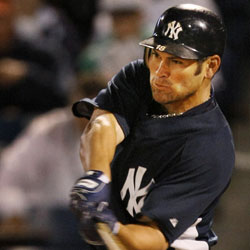
You really are something. You make the biggest deal in the world out of minor differences in Swisher (hero) and Nady (zero) yet totally discount the importance of swapping Jeter and Damon in the order. If I wanted to bore you I could come up with 10 factors — physical, mental and record based — that could change the dynamic of the Yankee lineup — or not. But to be so disdainful of how we earthlings waste our time obsessing over swapping a Hall of Fame No. 2 hitter with one of the better career leadoff men of the past ten or so years… Yes, I understand that none of this matters in the grand scheme of the universe — other than Nick Swisher, of course.– javamanny
Hey, I did allow for the possibility of a placebo effect, which takes care of your “physical, mental, and record-based” factors (what’s a record-based factor, anyway?). The point remains that small lineup changes, and maybe even big lineup changes, are more about psychological than real-world benefits. Many studies have been done of this subject, and the results consistently show that the difference between the least-optimal lineup (leadoff with the pitcher or Jose Molina or someone like that) and the best is only a few wins. The difference between the optimal lineup and the second-most optimal lineup or the third-most optimal lineup is nonexistent. As I said yesterday, it’s always possible that someone muscles up and hits .350, and when that happens, you or someone like you will write in and say, “See? It’s all because of the lineup change!” But you won’t really know. Given all this, swapping Jeter and Damon isn’t a significant move at all.
What is not nonexistent, however, is the impact on the bottom line, wins and losses, created by the manager’s decision to play one player over another. At his 2006-2007 best, Swisher’s offense and defense combined to make him a six-win player. At Nady’s normal rate of production–that is his whole career except for the first 89 games of 2008, he was a one-win player. This is anything but a minor difference.
Let it not be said that we don’t agree on anything, javamanny. I am definitely “something.”
2: I KNOW BECAUSE ROD SERLING TOLD ME SO
Just imagine in the spiral bands of the Milky Way Galaxy we have a speck of dust orbiting a star we call the Sun in which there is a Nick Swisher and a Jeter and Damon flip flop. Makes you wonder what might be going on in the M31 Galaxy — although I am beginning to suspect Arod is an android.–midcoaster
That was kind of my point. Flipping one lineup spot is about as infinitesimal a change as you can make… Also: A-Rod is a cookbook.
3: FAIR ENOUGH, I SUPPOSE
Steve – Love you, man, but you wasted about 250 words on this topic without ever saying anything analytical or insightful about the pros/cons of such a move. I’m leaning toward pro for the following: 1) I agree with others about Jeter’s increased propensity for GIDP; 2) no one has mentioned the lefty/righty thing: with Gardner projected in the 9 hole, that would give you l-r-l in the 9-thru-2 spots (nice!); 3) Damon is more of a pull hitter – with Jeter on first base (and the first sacker holding him on) this increases the likelihood of more ground ball hits by Damon in the 1st-2nd hole; 4) Finally, I also generally agree with the points about Damon’s bigger power/run production potential. O another note, did you just imply that – Swisher was a better option in center than Melky? Nick Swisher? Come on… –budboy
You raise some fair points, budboy (as did the others who raised them), and all of them may mean something to the bottom line this year, but what value in terms of wins and losses do you want to assign to them? I will concede that many small things can add up to a big thing, so perhaps Joe Girardi has made a move that will pay off in some way, but a lot of dominoes would have to fall in precisely the optimum way for it to mean very much at all.
As for Swisher in center field, sure, some of the time, if the Yankees are smart about it. When CC Sabathia is pitching, probably not, when Chien-Ming Wang is pitching, sure, and with the other three guys you check which way the wind is blowing before making a decision.
4: ANOTHER POSSIBLE SOLUTION
Just wondering, how suicidal would it be to platoon Nady and Gardner? Now before you jump down my throat thinking I want X in center, stop and breathe. Against righties, run Gardner in center and Swisher in right. Against lefties, Swisher roams center for six innings giving way to Gardner and Nady starts in right until Swisher slides over (assuming a lead.) The preponderance of right-handers would mean, what, 35 partial games in center for Swisher?? I think this set would be the team’s strongest getting the most PAs for the best on-base guy and Nady shots vs. lefties. –Greg D.
It makes sense to me, but Joe Girardi may not want to think that much. See also the adjustments for the starting pitching made above–Sabathia is more of a fly ball pitcher, so you might want your best ballhawk on the field for his starts, regardless of the opposition’s hander. Of course, that would be Gardner and Swisher regardless, but the world ain’t logical or we wouldn’t be talking about this.
Joba psychology, revisited
 In case you didn’t check out today’s action, Joba Chamberlain pitched three shutout innings. Can we stop panicking now? There’s something truly weird about the Psychology of Joba, by which I mean not what goes on in his head, but what seems to go on in ours when he pitches. It seems like a sizable percentage of the population might feel more at ease if he was simply sealed in plastic and never allowed to pitch again. If you don’t use him, he can’t get hurt. There is a kind of denial at work here. Injury risk can be mitigated, but short of a perfect prescience, they cannot be prevented.
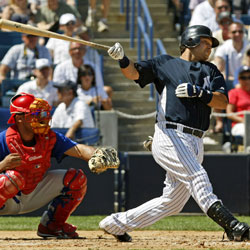
In other news from the game, Nick Swisher went 3-for-4 and Xavier Nady went 2-for-4. Swisher’s spring on-base percentage is now .389, Nady’s .267. I don’t expect anyone around the Yankees to care, because consistency at hitting usually trumps consistency at getting on base, even though better to start with the latter and hope for the former than the other way around. There’s still some time, though, for Swisher to show enough for the Yankees to make the right decision.
Finally, Brett Gardner knocked a triple today, took a walk, and scored two runs. Spring Training statistics are meaningless for the most part, especially this year when camps have been decimated by the WBC, but if consistency of hitting is part of what Gardner had to show, he’s done that so far, and he’s also demonstrated far more thump than before with six extra-base hits–the guy continues to lead the Yankees in home runs this spring. Again, that’s not something to get too excited about, as Angel Berroa is tied for second with two, and also leads the club with a .429 average. Heck, the Ransom of A-Rod is batting .400. It doesn’t promise much of anything, but it’s all good to see.
Another one from the comments
And from a frequent commenter, letsgoyankees, this one on this morning’s entry regarding the dynasty teams:
I agree with almost every point you made except pitching and defense. These (today’s) Yankees have great pitching and a very good defesne! Weren’t we lin the top three last year in errors (correct me if I’m wrong!)? Think about it…A-Rod, Tex, and Jeet all have gold gloves (that’s right, I said I think Jeet is still a good shortstop.I’ve argued it in the past and I’m not changing my stance now.) and Cano is pretty good. Yes, he makes a lot of errors, but only because he has great range. He’ll fix the error porblem. At cathcer we’re suspect with Posada but with Molina we have perhaps the best defensive catcher in the league! Our centerfielder, be it Gardner or Melky, will be an excellent defender. And Damon (minus the chicken arm) and Nady aren’t terrible. And our pitching staff speaks for itself. Our defense is pretty darn good!
Letsgo, you’ve got to let go of errors. Not making errors is part of having a good defense, but a bigger part is simply how many balls in play a team turns into outs. If the pitcher doesn’t strike out the batter or give up a home run, and the batter puts the ball between the lines, what happens next? For most of this century, the Yankees have not been very good at collecting those pesky grounders and flies. Commonly referred to as defensive efficiency (DEF), this is the most basic aspect of defense and also the one that, if improved, can yield the most dramatic results: in 2007, the Rays ranked dead last in the majors in turning balls in play into outs. They shuffled some players around and jumped to first in the majors–you know what happened next. In 2008, the Yankees were 25th in the majors; in 2007 they ranked 13th; in 2006 it was 8th; in 2005 it was 22nd; in 2004 it was 20th; in 2003 they ranked 28th; in 2002, 23rd; in 2001, 25th; in 2000 they ranked 13th.
And that leaves me with these questions: if the Yankees defense has been so good, why are so many balls finding holes? If Derek Jeter is such a great shortstop, why don’t the balls he gets to show up in the numbers? It can’t be all balls over Bobby Abreu’s head–the responsibility has to be shared out, to varying extents, around the diamond.
Yankees were right to pass on Abreu
 WITH A LITTLE HELP FROM MY FRIENDS
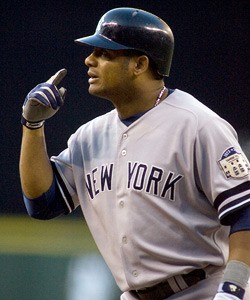
A little while ago, I was complaining to my friend and colleague Jay Jaffe that I wanted to get through today’s entry without writing about Alex Rodriguez and steroids. He immediately came back with this question: “At the price the Angels paid, should the Yankees have brought back Bobby Abreu?”
It’s a heck of a question, though one that may be compromised from the outset, because we don’t know if the Yankees could have gotten Abreu to sign at the same price — one year, $5 million. We don’t even know if Abreu’s agent bothered to come back to the Yankees and say, “Give us $5,000,001 and we’re yours” before making their client a Los Angeles Abreu of Anaheim (or is that a Los Angeles Angel of Abreu?).
I’m going to say no. Here’s why: Abreu had a good year for the Yankees at the plate, but his indicators are all pointing in the wrong direction. His home run rate was nothing special, his walk rate was down, and his baserunning and fielding skills aren’t what they used to be, with the resultant give-back on runs severely denting his offensive value. While a one-year deal at a low salary represents a minimum of risk — the Angels are betting that Abreu at least holds his 2008 value for one more season — the danger here is not financial but to the winning effort. With even a smidge of further attrition, Abreu is going to be no fun at all.
Over the last three years, the typical Major League right fielder has hit .277/.347/.451. The PECOTA projection for Abreu for next season, which does not reflect his move to Anaheim (a good thing in this instance) is .282/.368/.436. Thanks to the high on-base percentage, that would be a better than break-even performance, but not one that’s a huge benefit. Nick Swisher should be able to approximate the on-base and slugging percentages while doing a better job of actually catching the ball. The Yankees are already paying him Abreu’s salary plus a little ($5.3 million this year), and there’s little reason to double up.
Now, Jay’s question would be a lot easier to answer if the Yankees only had Xavier Nady to play right field, because even a diminished Abreu is likely to out-hit him, especially in the key area (really the only area) of on-base percentage. PECOTA’s weighted mean projection for Nady is .270/.323/.444, which falls short of even the average right fielder.
Parenthetically, I know I’ve been like a broken record on the Nick Swisher-Nady stuff, but as we head into a Spring Training season in which the Yankees have few big decisions to make, right field stands out as a position where the Yankees can make a choice that will significantly impact the outcome of the season. Johnny Damon is almost certain to regress. The center fielder, whoever he, she, or it proves to be, will not be a major run producer, and maybe not a minor run producer. It will fall to right field to salvage the outfield production.
Sorting out who starts shouldn’t be difficult at all, and is being complicated by a lot of statistical noise from last season. Swisher had a bad year by his standards, Nady a very good one. However, extrapolating from either season is unwise; Swisher is unlikely to have suffered a complete breakdown at age 27, just as Nady is unlikely to have found new strengths at age 30. Even a bad Swisher drew 82 walks and hit a home run every 21 at-bats; even a good Nady drew 39 walks and hit a home run every 22 at-bats. We’re talking about a difference that comes down to a fistful of singles, and we know those tend to come and go for hitters. Throw in that Swisher is the superior defensive player, and this really shouldn’t be a discussion at all.
In summary, to round back to Jay’s question about Abreu, the differences between Abreu and Swisher, if any, will be small enough that had the Yankees been given the opportunity to top the Angels’ offer to the former by some small number of dollars, they would have been correct to demur. Regardless of the resolution to the battle, the Yankees have already gained one victory in saying “Nyet” to their California-bound alumnus: this year’s right fielder may not hit, but he’s certain to catch a few balls at the wall, something we haven’t seen a Yankee do in years.
Let us review
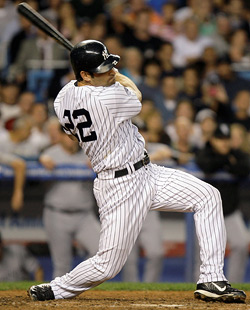 At the risk of boring the more advanced members of the class, I want to revisit Xavier Nady one last time before midterms. Your grade, and that of the Yankees, depends on your ability to answer several true-false, multiple choice, and fill-in-the-blank questions about Nady, so it’s imperative that we come to grips with the subject. Please open your text books/hymnals to page 355 and sing along to Buddy Holly’s classic “Maybe Nady” as we repeat together these key facts:
Nady is 30 years old and is a career .280/.335/.458 hitter. Despite his 89-game surge with the Pirates and brief hot streak with the Yankees, he is at this late stage of his career to be any better than those career rates in the future. He has never rated as a great glove. Per 162 games, he has averaged 30 doubles, one triple, 21 home runs, and 34 walks.
Last season, the average Major League right fielder hit .276/.347/.451. In 2007, the average right fielder hit .281/.351/.453. In 2006, the rates were .277/.347/.460. In the American League East, the standard is a bit higher, given that the competition lists the J.D. Drew/Rocco Baldelli combo, the Matt Joyce/Gabe Kapler combo, Alexis Rios, and Nick Markakis. Only one of the four, the Rays’ Joyce-Kapler mélange, may not exceed the averages. Should Nady play every day in right field and snap back to his 2006-2007 .334 on-base percentage, the Yankees would be operating at a significant deficit relative to the competition.
Now, Nady is not without value, because Johnny Damon is getting old and Nick Swisher has his limitations, and when most teams have to bench a starting corner outfielder due to injury or fatigue, they tend to wind up with Reggie Abercrombie out there, and the road to hell is paved with Reggie Abercrombie. The road to the postseason is paved with having a substitute like Nady. He’s not quite good enough to be a starter on a winning team, but overqualified to be a reserve. The smart teams will hold him to 300 at-bats or so and/or flip him to a team whose starter is even further below average than he is.
In short, Nady is not the kind of player a championship-caliber team plans on starting unless they have no other alternatives. The Yankees have alternatives. It could be Swish Nicker, who has comparable power to Nady and will out-walk him by 50 or 60, so his batting average need not be better than .250 to surpass X-marks-the Sub, or it could be a player we kicked around in yesterday’s installment, like Adam Dunn. They Yankees can flip Nady or not. They can pay the freight on keeping him and have themselves a very positive role player. The one thing they shouldn’t do is mistake his little contribution as something worthy of a starting role.
Review complete. Close your notebooks. You can play silent ball for the rest of the period.
SHOW THREAD: BACK IN THE BUNKER TONIGHT
I’m off to the Death Star-like YES HQ for another stay in the Dot-Com Bunker on the Hot Stove show. If you’ve got any comments, I’ll be checking the comments right up to and even during show time, so get ’em in. Any topic is fair game, including Bob Lorenz’s haircut — but only in a constructive way. Bob is the most tenderhearted regional sports network host you’ll ever come across. Those calloused NESN guys can’t touch Our Bob for generosity. It’s very difficult to see unless you have a top of the line high-def set, but on every Yankees postgame, Bob has a dish of candy out on the desk just in case any of you happen by the studio. He’s that kind of guy. See you at 6:30 p.m. EST.
Another note on Posada
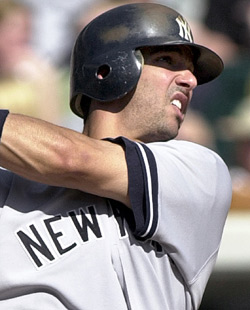 Spurred on by Buster Olney’s mention of this same topic in his blog posting today (I shan’t link; Olney is, shall we say, persnickety about who he links to, so I shall be the same). Olney writes: “If [Jorge Posada] can’t catch, he will have to get the bulk of his at-bats as a designated hitter, compelling the Yankees to press for a trade of one or two veteran hitters, among Xavier Nady, Nick Swisher and Hideki Matsui.”
Seems like they’re working on the latter anyway, as well they should given the declining value of two of the three. As for the designated hitter part of the story, let’s examine that. Last year, the aggregate rates for the DH position were .256/.339/.435, with a home run hit every 24.4 at-bats. The previous season they were .268/.355/.447 with a home run every 25 at-bats.
Parenthetically, the DH numbers always seem to be less than you would expect. The American League as a whole hit .268/.336/.420 in 2008. As a group, the players whose sole job it was to provide offense weren’t a whole lot better. It’s tempting to conclude that AL managers aren’t doing a very good job of designating good hitters, but it that wouldn’t be completely fair; the family of designated hitters had a rough year. Aubrey Huff and Milton Bradley were great, and David Ortiz was good when he wasn’t hurt.
Then there were some rude surprises. Jim Thome struggled early, pulled it together for three months, then slumped again. Matsui was off to a great start when his knees began affecting his production, and his post-injury hitting was even worse. Billy Butler and Jonny Gomes didn’t hit up to their abilities (Butler turned it on in the second half, but it was too late to save his overall numbers). Frank Thomas and Jose Vidro hit the end of the road, and Gary Sheffield hit the Last Rest Stop Before the End of the Road.
The previous year had Ortiz having a monster year, as well as productive seasons from Thome and Jack Cust. There were also some real disasters. I had blocked Shea Hillenbrand out of my memories of the 2007 Angels. He hit .238/.258/.320 as a designated hitter. Whichever team executive thought of Hillenbrand and let him putter on for a quarter of the season should have been cashiered. As planning goes, handing your team a Hillenbrand for its DH is not too dissimilar from those Civil War supply officers who sent their soldiers into battle wearing shoes with soles made out of old cupcake wrappers held together by cat spit.
In the Olney scenario, the Yankees wouldn’t be going with Hillenbrand, or Monty Meigs at DH, but Posada. The question is, if Posada is restricted to DH, can he give the Yankees average or better DH production, something along the lines of the league rates we’ve seen — let’s say a .270 average, .350 on-base percentage, and .440 slugging percentage?
If we go by Posada’s career rates, the answer should be an easy yes. He is, after all, a career .277/.380/.477 hitter. Yet, we’re talking about a Posada that is now 37 years old and is coming off of an injury which affected his swing. As such, Posada’s future is something of a black box. We can look at projections like those at compiled at Fangraphs — Bill James’ system figures .277/.378/.455, CHONE forecasts .266/.363/.434. Posada will hit .285/.374/.466 in Marcel’s prognostication. We should also add PECOTA to that. I can’t tell you exactly what it says just yet, but I will say that it’s a good deal more pessimistic than the rest. It’s also the most conservative on playing time. The projection systems, in the order that I listed them, see something like full-time play, almost full-time play, something like 60 percent play, and, last, PECOTA with something like half a season of playing time.
In Sabermetric circles there is often debate about the relative accuracy of these systems; as a BPer and the co-author and editor of a book which bills itself (tongue in cheek) as the home of the “deadly accurate” PECOTA forecast, I have to dance with the forecaster that brought me. Yet, in this case, I would be prepared to throw it all away, because everything Posada does depends on how he comes back from the surgery. None of these systems know that, although PECOTA has taken last year’s reduction of playing time into account. Posada could do it all, or nothing at all. And suddenly we’re invoking old Frank Sinatra tunes, so it’s probably time to move on.
More on the center field merry-go-round
 Jon Heyman of SI.com had an interesting tidbit in a recent posting about the Yankees shopping Nick Swisher and Xavier Nady:
Johnny Damon isn’t in the trade mix, as the Yankees need him to be their leadoff hitter and part of a center field rotation. The other in-house candidates for center field are Melky Cabrera and Brett Gardner.
That’s interesting, though not in the basic meaning of it — even though Damon is in the last year of his contract and is coming off something like a career season, it seemed unlikely the Yankees would try to move him, given the two roles he plays on the team, leadoff hitter, as Heyman mentions, as well as defensively overqualified left fielder. Many observers tend to focus on Damon’s poor arm, but his speed makes for a corner outfielder who can cover an unusual amount of ground.
Now, if you think about it, the most potent offensive outfield the Yankees could field next year would be Nady in left, Damon in center, and Swisher in right, rather than the presumed alternative, Damon in left, some combination of Gardner and Cabrera in center, and Xavier Nady in right — and Swisher playing the Ghost of Christmas Past, or Hamlet’s Father, or something. The problem with doing that, beyond the misuse of Swisher, is that at Damon’s current stage of the lifecycle, he’s better off not being overtaxed. Further, while his speed still does wonders in left, it’s not quite as spectacular in center — Damon had already slid off his peak the position before the Yankees moved him.
That said, being part of a center field rotation, as per Heyman above, makes all kinds of sense in that it gives the Yankees a great deal more flexibility in being able to waltz other players in and out of the corners. The more positions a star can play without compromising the defense, the better off the team is, because the club begins to close off openings for the replacement-level players that are so damaging to the winning effort. Similarly, Joe Girardi needn’t be married to any one center fielder.
There is yet another hand, which is that the Yankees might want to get married to a center fielder. Damon is in the last year of his contract, and as good as he was at 34 and may be at 35, asking him to keep it up at 36 and 37 will likely be pushing it. Given that the class of free agent center fielders next winter is going to be no fun, the Yankees will be in much better shape going into 2010 if they have the next center fielder lined up now. That could mean getting Gardner established, finding some way to electrify Melky, or even giving Austin Jackson a shot in the second half of the season, should his work at Scranton demand such an audition. Obviously the needs of 2010 have to be balanced against the goal of winning in 2009, with any luck the two goals will be mutually compatible.
One supposes the Yankees will need another leadoff man after 2009 as well. Traditional images would suggest that Gardner is the man, but Gardner may never have enough sock to justify taking up so many plate appearances, regardless of how many bases he steals. The Yankees will need to remember that your leadoff hitter need not match the picture of the singles-hitting speedster. That way lies madness. That way lies Juan Pierre. Remember, Wade Boggs was a great leadoff hitter, and he almost never stole a base. It’s about how often you’re on, not about how fast you can run. In an era of home run hitting, the rest takes care of itself.
SO LET’S TAKE THIS TOPIC ON THE AIR
Later today (6:30 EST) I’ll be appearing from the Bunker on the Yes Network’s Hot Stove show. As usual, I’ll be asked to summarize what we’ve been discussing this week. Let’s try a simple vote, which I’ll relay to the fellers on the air: who should be the starting center fielder in 2009? Damon? Gardner? Cabrera? A rotation split roughly in equal thirds? Or a write-in candidate of your choice? Jim Edmonds is still out there, and he murdered the ball for the Cubs last year. He’d be a heck of a platoon player in center. Argue it out in the comments section below, and I’ll tally up your responses while waiting for smilin’ Bob Lorenz to cast his dancing spell my way.
 Pinstriped Bible