Category: Dailies
Ready for your midterms?
THE DREADED MIDTERM GRADES
On Sunday, the Yankees played their 81st game. The season’s official halfway point comes at the All-Star break, but this is it’s actual halfway point. In my ten years as pinstriped armchair detective, I’ve sometimes resorted to the clichéd midterm grades and sometimes not. This year it seemed like a helpful device to review the season. Today we’ll cover the position players, tomorrow the pitching staff.
As you review the report card, remember that the same grade might not mean the same thing for two different players, because each player must be viewed in the context of his position, his career, and his role. Expectations for Mark Teixeira are different than they are for Brett Gardner, so the latter could conceivably get a better grade than the former without implying that he is the better player in a head to head comparison. With that in mind, feel free to offer your own grades in the comments section. 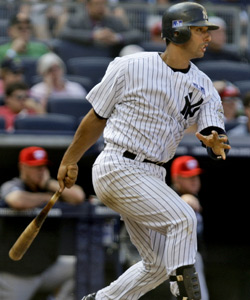 JORGE POSADA-CATCHER
Putting his 25 days on the disabled list aside, you can’t fault Posada’s season. When a 37-year-old catcher is hitting .284/.368/.523, you give thanks for your good fortune and try not to ask too many questions. On defense, he’s thrown out over 30 percent of runners trying to steal, a solid number (the overall Major League success rate on stolen bases this year is 73 percent). The notion that his handling has damaged Joba Chamberlain or anyone else is farfetched bushwah given his career record, as well as those of his many battery-mates. As with several Yankees, Posada has done far more damage at home than on the road. GRADE: 89/100
MARK TEIXEIRA-FIRST BASE
Teixeira has been quite streaky, only reaching a “hot” temperature in May. He’s been vastly more successful at home (.310/.402/.632), but his road production (.243/.373/.472) also gets the job done, albeit at a far more pedestrian level. He’s also been a revelation on defense, even if for some reason the metrics don’t show it. While Teixeira’s season is consistent with his work in previous seasons, he’s not quite at the level of the last two years (.307/.406/.557 in 289 games), and it’s worth noting that he’s having only the fifth-best season among AL first basemen, trailing Justin Morneau, Kevin Youkilis, Russell Branyan, and Miguel Cabrera. Of these, Branyan probably won’t hang on until the end, but the others almost certainly will. Bumped out of the “A” range, but only in comparison to previous performances. The 20-game homerless streak with which he ended the half (.244/.366/.321) didn’t help. GRADE: 86.5/100
ROBINSON CANO-SECOND BASE
Cano has bounced back from his spectacularly miserable 2008, but a league-average on-base percentage is still a bridge too far, as is consistency–in May and June combined, he hit .271/.302/.439, which doesn’t help all that much. He’s on a pace to ground into 24 double plays, and he’s batting .196 with runners in scoring position. There are certainly worse second basemen to have–Howie Kendrick is actually the evil Cano from the Star Trek mirror-verse–but as usual, the whole is less than the sum of the parts. GRADE: 79/100
ALEX RODRIGUEZ-THIRD BASE
With 45 walks and 14 home runs in 51 games, A-Rod has been productive despite his low batting average. Eleven of his 14 homers have been hit at home. Conversely, he’s hitting just .211 in the Bronx, with a truly strange .131 average on balls in play–one wonders if he’s trying to get the ball in the air at the new park, trying to catch up on all the short fence/jet stream-generated fun his teammates had without him. His hip problems seem to have sapped his speed and defense, and he hasn’t been around that much. Docked a few points for days absent and the whole juicing thing, which is spectacularly annoying. GRADE: 83.5/100
DEREK JETER-SHORTSTOP
There are a few nits you can pick with Jeter’s season. He’s only hitting .264/.340/.383 against right-handers, most of his damage coming thanks to .452/.524/.644 rates against lefties. All of his power seems to be a product of Yankee Stadium II; just two of his ten home runs have come on the road. On the plus side, his walk rate is up, he seems more limber this year, both on the bases and in the field, and though he still hits everything on the ground (he ranks 11th among players with 150 or more plate appearances this season), he’s kept his double play rate in hand. Overall, I’m not complaining–after the lethargy of last year, this qualifies as a comeback. GRADE: 91/100
JOHNNY DAMON-LEFT FIELD
Damon hit 17 home runs last year. He’s hit 16 in 76 games this year. The difference is Yankee Stadium II; the former Caveman is hitting .289/.390/.592 with 12 home runs (one every 12.7 at-bats) at home, .278/.340/.465 with four home runs (one every 36 at-bats) on the road. Now, that doesn’t mean that Damon shouldn’t get his due, as being able to take advantage of one’s environment is a skill. It’s much like Jim Rice’s home-road splits in Boston: if everyone who played in Fenway hit like Jim Rice, you’d have an argument about discounting his stats. Damon’s road stats are also sufficient–the average Major League left fielder is hitting .267/.342/.433 overall. At his current pace, Damon is going to obliterate his career high in home runs, his career high in walks is also in reach, and he’s easily going to have his tenth 100-run season. Stolen base frequency is down and his range in left seems down a bit, but as with Jeter I’m not going to complain about a late-career high. GRADE: 90/100
MELKY CABRERA-CENTER FIELD
He’s doing some things he’s never done before, like hitting as a right-hander and taking the occasional walk–he had 29 free passes all of last year, compared to 22 now. That said, he’s mainly helping with his defensive versatility, not his bat. His home runs are a gift of YS II, with seven of eight round-trippers coming in the friendly confines, and coincidental with the injury he suffered in Texas or not, his bat turned off at the end of May and hasn’t come back–even with a semi-hot streak over the last couple of weeks, in 31 games since the end of May he’s hit .221/.303/.379. Given that Cabrera hit only .235/.281/.300 after April last year, the idea that the injury is what’s holding him back should be taken with a huge grain of salt. Cabrera is an asset as a reserve, but he’s not a starter. Alternatively, he’s playing hurt under the misguided belief that he’s helping. At that point, Austin Jackson would be the better choice. GRADE: 72/100
NICK SWISHER-RIGHT FIELD
What a weird player, inconsistent in every phase of his game. At his April level of production, he was a Ruthian terror. In June he hit .253/.379/.506 and was still plenty productive. In between, he took a lot of walks but hit .150. Six games into July he just drew his first walk of the month and was 4-for-22 with one walk in seven games since hitting his last home run going into Tuesday, when he finally broke through with three hits (which doesn’t count towards the midterm). He hasn’t been all that productive with runners on–this seems to be a career-long problem, as if he shortens up his swing and worries about striking out in those situations. The result is quite a few walks but not many hits. His defense is usually solid, but he also has his off days. As he did last season, Swisher has a pronounced home-road split. He’s batting .279/.373/.625 with 11 home runs (one every 12.4 at-bats), but only .181/.347/.302 (again, through Sunday) with three home runs (one every 38.7 at-bats) at home. He’s been helpful on the whole, but the only reason he ranks among the top 15 right fielders in productivity is
that there are only 15 right fielders having good years. In short, I don’t know what to make of him. GRADE: 80/100
BRETT GARDNER-THE OTHER CENTER FIELDER
Gardner is listed among the starters because he’s actually started more games in center than Cabrera, even though Cabrera has played more overall. Given what little was expected of Gardner, not to mention the way he started the season, he probably deserves an A grade just based on performance vs. expectations. He started only 25 games across May and June, but he also appeared in 21 more and hit like crazy, batting .330/.427/.510 with four triples, three home runs, 16 walks, and 12 steals. He has not been handled brilliantly. After Gardner’s 5-for-6 game against the Mets on June 26, he was given just two more starts (he went 0-for-7) before Joe Girardi presumably decided he had gone cold and it was time to try Cabrera again. It’s not clear how a kid is supposed to build up any momentum under those conditions. When he sits, the Yankees aren’t suppressing a great bat, but they do lose some patience (Gardner has drawn a walk every 9.7 plate appearances, whereas Cabrera has taken a pass every 11.6 plate appearances), their best baserunner, and their best center field defender. Despite the hot streak, it’s doubtful that Gardner will ever be a big run producer, but he’s certainly been worth playing. GRADE: 85/100
Despite the Wangery of things, a good weekend
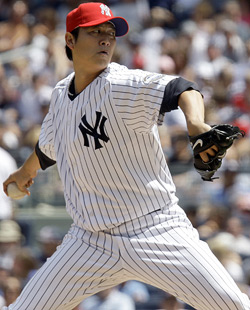 Chien-Ming Wang headed back to the disabled list and Joba-To-the-Bullpen became Joba to Nowhere, but winning trumps everything. Adding to the sweetness of the proceedings was the fact that the victories came at the expense of an AL East opponent, pushing the Yankees to one game under .500 against divisional rivals. They kept the pressure on the Red Sox, who dropped two of three to the Mariners, and put some distance between themselves and the rest of the competition. The Rays, swept by the Rangers, are now six games behind the Yankees in the loss column, the Jays eight behind. The wild card standings remain close, with AL West co-leaders Texas and L.A.-Anaheim just two games back of the Yankees.
How long this happy situation persists will depend in part on how the Yankees choose to compensate for the loss of Wang. This seems a bit odd to say, “compensate for the loss of Wang,” because the Yankees haven’t really had Wang all season long. For all their patience, prodding, and pushing, Wang has yet to record a quality start. Now, quality start is just a made-up statistical category (heck, they’re all made up) denoting a starting pitcher having done certain minimal things in his games — throw six innings, allow three or fewer earned runs. It’s not a crazy high standard, as all it asks a pitcher to do is post a 4.50 ERA. Wang is 0-for-9, and whatever achievements exist in the past, they clearly don’t have much bearing on this season.
Since returning to the starting rotation on June 4, Wang’s ERA is 6.43 in six tries. His rate of home runs allowed per nine innings is a career high, and it didn’t dramatically improve during Wang’s latest sting. He allowed four home runs in 28 innings, which doesn’t sound like much, but it works out to 1.3 per nine. The career rate for the sinkerball artist coming into this season was 0.5. Wang’s latest injury is just the latest clue that anything the Yankees need to cultivate a solid alternative and view anything they get from Wang this year as a bonus.
That alternative is almost certainly not Sergio Mitre. While you can never preclude a team catching journeyman lightning in a bottle (see Aaron Small ’05), Mitre seems a long shot to click. Frequently injured, Mitre is a heavy ground ball type who has never found consistency in the Majors due in large part to control problems — a pitch-to-contact type can’t walk three or four batters per nine innings and expect to succeed. There are simply too many balls in play with runners on base for the pitcher to succeed, even with the enhanced double play rate of the sinker ball pitcher.
One intriguing note here is that Mitre has done great things with his walk rate in the Minors this year, passing just five batters in 39.2 innings. If Mitre can carry that kind of control back to the bigs, it will be almost as if the Yankees were trying a brand-new pitcher, not a 28-year-old retread. Even then, success is not assured. This is a pitcher against whom Major League batters have averaged about .300 — they’re not fooled, and while Mitre might cut down on the number of free passes he gives out, he will still have to keep the batters from simply banging their way on base.
With the All-Star break coming up, the Yankees will have a few days to reorder their rotation and figure out what they want to do with Wang’s spot over the longer term. As much as Alfredo Aceves and Phil Hughes are overqualified to be relievers, they’ve done so well in that role that it’s understandable that the club would be reluctant to pull them from the pen at this juncture, not without some kind of viable alternative to take the spot (the problem of “stretching them out” into a starting role is transient, especially given that Aceves threw 43 pitches on Sunday).
Here is yet another occasion to point out the way the Yankees have hurt themselves by perpetuating Brett Tomko in the Majors at the expense of Mark Melancon, lefty Zach Kroenke, or practically anyone else in the organization. Tomko’s trash-time work could have been developmental time for any number of virginal relievers, relievers who might now be promotable to more important roles, something that clearly isn’t going to happen with the 36-year-old, home run-happy Tomko. That theoretical pitcher might have enabled the Yankees to feel more comfortable about elevating Hughes or Aceves. Instead, they have blocked themselves. Much as with the bench space wasted on Angel Berroa until quite recently, Tomko demonstrates that there are no small roster spots, only small players.
To put the matter in proper perspective, one sentence: The loss of Wang expresses itself as a bullpen problem, not a starting pitcher problem. Corollary to the foregoing: the Yankees need to do more to solve their bullpen problem.
In the long term, one interesting starting option within the organization might be right-hander Zach McAllister, currently of Double-A Trenton. If you take his work from the second half from last season, spent at Tampa of the Florida State League, and add it together with that of this season, from Double-A Trenton, you get a stunningly good line: 28 starts, a 13-9 record, 169.1 innings, 139 hits, 36 walks (1.9 per nine), 128 strikeouts (6.8 per nine), just nine home runs, and an ERA of 1.81. The strikeout rate should be a clue that McAllister is not a 95 mph burner. He’s actually somewhat Wang-like, getting by on a sinking fastball. It seems unlikely that a jump to Triple-A, or over it, would be much of an impediment. McAllister may seem like a long shot, and given the organization’s nervousness about the untested, he probably is, but the Yankees owe it to themselves to investigate these possibilities before they start throwing out good players for the detritus of other organizations.
MORE TO COME…
With the Yankees having reached the 81-game mark, the PB hands out the dreaded midterm report cards.
Burning Burnett
BURNETT: ON
The only complaint you might make about A.J. Burnett’s last four starts is that he started his hot streak five days after he lasted less than three innings against the Red Sox. Other than that little complaint, he’s 3-1 with 28.1 innings pitched, 16 hits, 12 walks, 33 strikeouts, and an ERA of 0.95. With the exception of the aforementioned start at Fenway on June 9, all of his starts going back to May 27 have been of the quality variety, six innings or more, three earned runs or less. The one loss came courtesy of the offense and an ill-timed, game-ending Robinson Cano groundball double play (some themes just keep reinforcing themselves, even if I don’t want to go there). Burnett basically can’t get any better except to conquer the Red Sox, but he won’t get another shot at them until August. For now, he’ll make one more start before the All-Star break, presumably Wednesday night at Minnesota.
I don’t know if a guy who is 7-4 with a 3.83 ERA will merit a look for the All-Star game pitching staff, but Burnett would be nicely set up to pitch that game, as his next start after the Twins’ appearance would fall during the break. For what it’s worth, he’s fifth in the AL in strikeouts, and if he wins on Wednesday he’d be in the top three in wins.
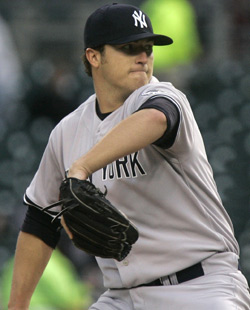 THE KEY TO HUGHES
… And maybe Joba Chamberlain as well. There was a lot of discussion of Jimmy Key on today’s YES broadcast of the Yankees game, a natural given that Key split most of his career between the two teams doing battle. Key, it was acknowledged, had a great career, one that would have been even better had it not been cut short by arm problems. This is inarguably true. Key was a four-time All-Star, had three top-five Cy Young award finishes, led his league in ERA, strikeouts and wins, had terrific control, and generally posted ERAs that were well ahead of the league average. He pitched on six postseason teams, two of which won the World Series. Key won’t be going to the Hall of Fame, but he had a very successful, memorable career.
The one aspect of Key’s career that wasn’t discussed was how he started it. The answer is, “in the bullpen.” A third-round pick in the 1982 draft, Key was a starter all the way through a brief Minor League career that saw him make the Blue Jays out of Spring Training in 1984. Manager Bobby Cox and general manager Pat Gillick never saw fit to give him a start that year. Instead, he made 63 appearances out of the bullpen. He was up and down in terms of results, as rookies often are, but he finished the season strong, putting up a 2.93 ERA in the last two months, and in 1985 he made the move to the starting rotation. Not coincidentally, the Blue Jays improved their record by 10 games and won the AL East.
Key is just one of dozens of successful starting pitchers who broke in this way. For this reason it’s always a little humorous when commentators and fans act nervous about pitching Phil Hughes out of the bullpen, or, for that matter, promoting Chamberlain out of it. Every pitcher is different, so there’s no ironclad rule that says, “Jimmy Key did it, so it must be okay,” but you can point to more stories like Key’s than you can the other kind, the one where a pitcher was somehow destroyed by the diversion into relief work.
MONTERO MANIA
Cue up the hype machine, because the 19-year-old mutant slugger in the making homered in his fourth straight game on Thursday. He’s now batting .325/.395/.571 with five home runs in 21 games at Double-A Trenton. He’s also thrown in nine walks, which is actually a better rate than he had down in the Florida State League. Combine his numbers for the two levels and you get a teenager who is batting .346/.403/.580 in 69 games. Here’s the best thing about the numbers: Trenton is a tough place to hit. Jesus Montero is hitting “only” .314/.368/.457 with one home run there. On the road, the Boy Wonder is batting .333/.417/.667 with four home runs in 42 at-bats. In other words, the numbers are artificially depressed.
This is getting ahead of things, but let’s dream: With a strong conclusion to the season at Trenton, Montero will be in a good position to get a long look from the Major League staff in spring training next year. He would then be a hot streak and an injury away from a call to Scranton. His position is still a problem — Montero threw out just 13 percent of basestealers at Tampa. He’s done a bit better at Trenton, with a 28 percent caught stealing rate, but it’s early days yet. Despite this, if Montero’s bat is ready, the Yankees could use him at the designated hitter spot with occasional spot starts at catcher against those teams that are less inclined to run.
With Hideki Matsui likely to leave town after the season, they’ll have the opening on the roster and a chance to save some money by using a young player in the spot. This is something that teams are generally reluctant to do, as there seems to be the thought that if you let a young guy DH you’re hurting his chances of someday developing into Ozzie Smith. That seems like an unnecessary worry in Montero’s case.
The significance of winning streaks
 LET’S TRY THIS AGAIN, 1947 STYLE
A couple of data bits got dropped in yesterday’s entry on Robinson Cano. I’m going to put them in here a bit differently and hope they make it past my normally reliable interlocutors. First, the top ten batters in percentage of runners driven in:
NAME ROB %
Joey Votto 118 .237
Joe Mauer 124 .234
Todd Helton 190 .232
Hanley Ramirez 197 .218
Albert Pujols 216 .218
Prince Fielder 249 .217
Bobby Abreu 185 .216
Jarrod Saltalamacchia 100 .210
Evan Longoria 225 .209
Brad Hawpe 206 .209
Next, the batters with the highest percentage of double plays per double play situation:
NAME DP SIT DP DP%
Yadier Molina 41 12 26.8
Mike Lowell 58 15 25.9
Jose Guillen 45 11 24.4
Geovany Soto 50 13 24
Fernando Tatis 42 13 23.8
Chase Headley 47 12 23.4
Austin Kearns 48 11 22.9
Delmon Young 44 10 22.7
Magglio Ordonez 53 14 22.6
Bill Hall 45 10 22.2
Robinson Cano 50 11 22
And now you don’t have to look it up. You also don’t have to look up the fact that, after yesterday’s break for a left-handed pitcher, Cano is back batting fifth again today. As I said in yesterday’s entry, this isn’t the end of the world–lineup variations are vastly overrated, and the Yankees are currently seven for their last seven games. That said, the argument about the batting order is worth having, because although these differences may not be writ large, they can still show up in all kinds of small ways. The Yankees have played 19 one-run games and are 10-9 in those contests. There are more close games coming, and if the Yankees are going to put those in the win column they’ll need every extra run they can get.
The current win streak is a good thing, but shouldn’t be overrated–you’re never as good as you look when you’re winning. At exactly this time 62 years ago, the Yankees reeled off the greatest winning streak in team history to that point, and maybe since then. On June 29, 1947, the Yankees lost the first game of a doubleheader to the Washington Senators. At that moment they were 39-26. That’s a pretty good record, good for a 92-win pace then and a 97-win pace now. In either era, it might be good enough to get you postseason spot in a down year for your league or division, but you’re not dominating, not doing an impression of the 1927 or 1998 Yankees.
The Yankees took the second game of that twin bill, and didn’t look back again for almost three weeks. They won 19 straight games. They swept five series and took both ends of six doubleheaders. They outscored their opponents 119-41. They finally lost a game on July 18, when they were shut out by a good Tigers right-hander named Fred Hutchinson. Thanks to the streak, the race was for all intents over. The Yankees were up by 11.5 games. There were 70 games to go, but the Yankees weren’t going to play that lead back. That fall they won a famous, hotly contested World Series against the Brooklyn Dodgers. This was the one famous for Bill Bevens’ wild, not-quite no-hit start in Game 4.
Here’s the relevance to the 2009 Yankees: The 1947 team managed to toss the coin 19 times and have it come up heads over and over again. Before the streak they were a .600 team. During the streak, they were, obviously, a 1.000 team. What kind of team were they after the streak? The answer is that they went 39-31. That’s a .550 pace, the equivalent of 89 wins in a 162-game schedule, 85 wins in a 154-game schedule. It’s the same pace as the current Rays, Tigers, Angels, and Giants are on now–a pace good enough to lead one of the softer divisions, but not good enough, for say, the American League East of 2009. Despite the 19-game streak, overall, the 1947 Yankees were just a pretty good edition of the team. Some underlying weaknesses started causing problems the next season, they lost a close race, and fired the manager–but that’s another story.
The point is that a club can never take anything for granted when it’s trying to win, including interpreting a winning streak as meaning that you’re doing everything correctly. The ’47 Yankees didn’t, dealing for starting pitcher Bobo Newsom in the midst of the streak when an injury sidelined rookie righty Spec Shea. You can choose to look upon the discussion of the batting order as a kind of niggling cavil, but I figure that a team that wants to win a championship, that is behind the Red Sox and has yet to win a game against same, would want to pick up every extra hit, walk, and run that it can. The current winning streak is a great thing, but as the 1947 team shows, perfection isn’t perpetual, and can be followed by play that is merely above average. And above average might not win anything this year. Shuffling the batting order isn’t about disrespecting the present, but trying to optimize the club for the future.
How well is Robinson Cano playing?
 GIRARDI VS. CANO
Joe Girardi is a polarizing figure for Yankees fans. It was inevitable that the first manager to guide the Yankees to a finish out of the postseason in what seems like a hundred years would become a lightning rod. Some decry his handling of the bullpen, others his love of small-ball tactics — the Yankees bunt often for a present-day American League team.
These criticisms are debatable; the bullpen has risen in effectiveness throughout the season, as weaker sisters have been weeded out (Tuesday’s game notwithstanding), and those Yankees that Girardi has asked to bunt are either those who don’t generate much offense anyway (Francisco Cervelli) or just might beat one out (Brett Gardner). The place where criticisms of Girardi find a more legitimate place are in his construction of the batting order.
Variations in the batting order are not terribly significant. They won’t ruin your season, but they can cost you a few runs on the margins. Since the manager’s job is to maximize his team’s performance, that is, to capture every run that he can, that the batting order is not a top-priority item is no excuse for putting out the best one possible.
For reasons that aren’t obvious, Girardi has fallen in love with Robinson Cano as his fifth place hitter. Cano has started 46 of the team’s 76 games in the No. 5 spot. In putting Cano there, Girardi has delivered Cano some very special plate appearances with runners on base. Mark Teixeira has seen the most baserunners of any Yankees hitter, but Cano is second, having seen just seven fewer runners. The problem is that despite a .300 average on the season, Cano is hitting only .254/.289/.415 with runners on and .213/.248/.340 with runners in scoring position. The offense is setting Cano up, but he isn’t knocking them down.
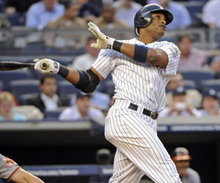 Another way of looking at Cano’s production with runners on is to consider the percentage of baserunners he’s driven in (statistics available at Baseball Prospectus). Cano has scored 30 of the 233 runners he’s seen. That’s 12.8 percent.
The American League average is 14 percent. It’s a small but significant failing. Three more runners driven in would get him to the league average. Were he carrying Jorge Posada’s rate of 17 percent, he would have driven in 10 more runners. Even with all of his struggles, Alex Rodriguez has driven in a greater percentage of his baserunners, 16.4 percent.
Intriguingly, no Yankee is among the league leaders. There are currently 308 hitters who have batted with 75 or more runners on base. The top 10 in percentage of runners driven in:
Posada is the top Yankee, 53rd on the list.
Cano compounds his impatience and failure to hit with runners on base with groundball hitting tendencies that lead to double plays. Cano ranks 11th among Major League hitters who have batted in 30 or more double play situations:
This makes Cano a less than ideal RBI man, but since Girardi chooses to emphasize him in the order, his deficiencies trouble the Yankees far more often than they need to. Of course, it might be hard for Girardi to truly admit the damaging consequences of all those double plays. After all, he holds the team record for hitting into double plays, banging into 17 twin killings in 50 chances in 1999. In the 55 years for which we have records, no one else has come close.
Hinske Ball!
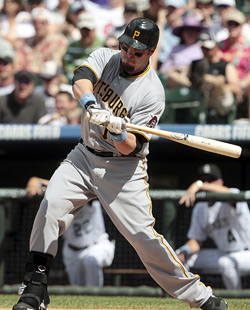 The Yankees made a solid move today in acquiring veteran left-handed hitter Eric Hinske from the Pittsburgh Pirates. Hinske, a former Rookie of the Year (Toronto, 2002) was a solid reserve presence on back-to-back pennant winners with the Boston Red Sox in 2007 and the Tampa Rays last year, and now has the chance to add a third postseason team to his resume.
Able to play all four corners, Hinske has some power and is willing to take more than the occasional walk, so he’ll fit right in with the Yankees. He’s a career .254/.337/.436 hitter, which is not a good figure for a corner starter but you’ll take it for a four-corner reserve. No fun against southpaws at .221/.298/.363, Hinske’s numbers against opposite side pitchers are .264/.347/.456.
The 31-year-old gives the Yankees the kind of valuable bat off the bench they haven’t had in some time. That he can play third base is key. If Alex Rodriguez is going to take days off, this is a better choice than Cody Ransom and about a thousand times better than Angel Berroa. Hinske is not a very good defensive third baseman, but his ability to hit the ball with some authority should ease the pain of those Rodriguez rest periods.
With Rodriguez swinging a hot bat, it seemed as if Rodriguez and Joe Girardi were going to make a point of forgetting their previous agreement about off days. This happened last week — after skipping one game in Florida, Rodriguez played in eight straight games and started seven straight. One wonders if Brian Cashman looked at the trouble that Mike Lowell has been having lately — he had 15 CCs of fluid removed from his hip yesterday, also received a shot of a lubricant, and today was placed on the DL — and wisely concluded that he’d better give Girardi a real alternative to Rodriguez at third base before they killed the presumptive team MVP.
This is not a criticism of Girardi. As I wrote here last week, Girardi has been given conflicting imperatives: win now, win every day, and then, somewhere down the line, don’t kill A-Rod. Given that the alternatives to Rodriguez were spectacularly weak, it’s hard to blame Girardi for prioritizing his first mission at the expense of his second. Breaking Rodriguez might not get him fired, but failing to reach the postseason will. You understand why his instinct, even if on a subliminal level, would be to gamble on the slugger triumphing over pain instead of hoping that Berroa, Ramiro Pena, or Ransom might deliver a big hit, or even a small hit. If the Yankees were 3.5 games ahead instead of behind, the decision to bench Rodriguez would be easier on Girardi, but they’re not.
Ironically, Girardi could end up back in the same head space, only for different reasons. Again, Hinske is not a great defensive third baseman, and it’s possible that he’ll be a bit rusty. He hasn’t played very much third base since 2004, making just 21 appearances at the hot corner (three this year). The Blue Jays bumped him off of third base for Corey Koskie and then Troy Glaus, while in his Boston and Rays stops he was behind Lowell and Evan Longoria, so he had to get into the lineup in other ways. A few well-timed misplays and Girardi’s sense of well-being might get shaken enough that he’ll be reluctant to entrust Hinske with too much hot corner time. Still, if he times the Hinske starts so they don’t coincide with Chien-Ming Wang’s games, the Yankees should be okay. It’s also not as if A-Rod has been excelling on the fielding job; the bad hip would seem to have limited Rodriguez’s range.
In exchange for making Girardi’s life more interesting, the Yankees only had to give up Eric Fryer, the Minor League outfielder acquired for Chase Wright, who does not project to be more than a role player in the Majors, if that, and righty pitcher Casey Erickson, a 23-year-old Sally League reliever.
In his career, Hinske has had the unusual honor of being both a surprise and a disappointment. A 17th-round draft pick of the Cubs in 1998, Hinske raked in the Minor Leagues, batting .285/.380/.511. His defense troubled the Cubs, though, and so even though they were in desperate need of a third baseman at the time, they palmed him off on the A’s for Miguel Cairo. This was a Hall of Fame-level dumb move, as Cairo didn’t last even a full season in Chicago, and in any case he was Miguel Cairo. The A’s held Hinske in the Minors for a season, then sent him to the Blue Jays for Billy Koch. This was a Hall of Fame-level smart move, as the A’s got 44 saves out of Koch in 2002 and then flipped him to the White Sox for Keith Foulke, who was even better. Meanwhile, Hinske played third for the Jays, hit 24 home runs, and won the Rookie of the Year award.
The Jays rushed right out and signed Hinske to a five-year contract, but Hinske was unable to follow up on his production. His walk rate slipped, and his power and batting average went along with it. His 2003 season was subpar and his 2004 was miserable. By 2005 he had been moved to first base, which was an odd decision for the Jays to make given just how bad he had been the year before. He bounced back to some degree in 2006, but by then he was already slipping into utility work.
Kudos to Brian Cashman on this one. Adding a player who slugged .465 a year ago really gives the Yankees the added A-Rod protection they’ve needed all season. The move comes a bit late, but it’s a good one. At this writing, the Yankees haven’t announced the roster move they’re making to get Hinske a spot in the dugout. It should be Brett Tomko who goes down, but it’s hard to imagine the Yankees reducing their staff to 11 pitchers, so one assumes that Pena is headed for the sticks.
ON REFLECTION, IT SEEMS UNLIKELY THAT BIN LADEN THINKS MUCH ABOUT BUCKY DENT, BUT THE POINT STILL STANDS
I’m normally pretty happy when publishers drop a free baseball book on me, but in the case of a new book on, well, something to do with Bucky Dent, they can leave me out. On Saturday, I received an unmarked envelope bearing only my address and a mint condition 1978 Topps Bucky Dent card. There was no return address.
I subsequently have learned that this was done on behalf of a forthcoming book. Now, look: as I said, it’s cool to get free baseball stuff in the mail, but sending mysterious envelopes with no return address to a fellow’s home is no way to go about it. This is, I am told, supposed to be viral marketing. That term is ironic, because that’s what it made me think of — viruses. It occurred to me the second after I unsealed the stupid thing that you’re not supposed to open unidentified mail, that not too long ago there was a freak sending anthrax all over the place, that every once in awhile some fringe reader expresses hostility that goes beyond a mere friendly disagreement about baseball, and that I have a wife and two young children in the house. I was not amused. I was worried, and I kicked myself for unsealing the envelope. The Bucky Dent card was no solace: sometimes bad things come in attractive packages, and anonymity would seem to be something of an antonym for publicity.
So hey, marketing geniuses: if your goal was to trouble me on a perfectly good Saturday and make me associate your book with anonymous anthrax mailings, congratulations. You did your job. Next time, be intelligent enough to include a return address and a flyer so it’s clear what the heck you’re trying to accomplish. I wish the author all the success in the world with his book, and this should not be construed as reflecting upon his efforts. In fact, I hope he does so we
ll that next time he’ll be associated with a better, smarter set of publicists.
MORE FROM ME
Reflections on relief pitchers at Baseball Prospectus.
Appreciating the Mo masterpiece
 MO, MO, MO (497 MORE MOS TO GO)
You can’t follow the Yankees without appreciating Mariano Rivera. He’s superhuman and yet human, approachable and professional. No doubt you’ve read a thousand thoughts along the same lines already today, so instead of heaping on more superlatives, let’s look at the actual record in all of its glorious length. Indeed, length is the key. What makes Rivera great is not only his rare dominance with one special pitch, but for just how long he’s maintained his high level of performance. Many closers rocket up the pop charts, but few have anything like the staying power of Rivera. Generate a list of the top 200 single-season performances of the last 55 years by a reliever (I’m using the context-sensitive wins added, or WXRL) and count everyone who appears on the list more than twice and this is what you get, ordered from lowest to highest:
3 Bruce Sutter
3 Eric Gagne
3 John Smoltz
3 Keith Foulke
3 Lee Smith
3 Lindy McDaniel
3 Randy Myers
3 Rollie Fingers
3 Stu Miller
4 Billy Wagner
4 Dan Quisenberry
4 Francisco Rodriguez
4 Joe Nathan
4 Trevor Hoffman
4 Troy Percival
4 Tug McGraw
5 Armando Benitez
5 Goose Gossage
9 Mariano Rivera
This is a fairer reflection of Rivera’s dominance than something more basic like seasons leading the league in saves-Rivera has done that only three times in 15 seasons. It’s not the number of saves that matters, it’s the quality of the performances, and no one has been as good as often as Rivera has. Twenty-four pitchers appear on the list only twice. There is normally a lot of turnover in the closer department, just as there is for all relievers. There is also much variability depending on how pitchers are used by their managers. Rivera has stuck there like no other pitcher in history. Throw in his extraordinary postseason work, his humanity and professionalism, and this is one inner-circle Hall of Famer that no one will be able to second-guess on induction day.
NADY BE GOOD (EVERYONE’S FAVORITE GERSHWIN TUNE)
The future is now, but in order to win the American League pennant, the Yankees will need to fight the future. No doubt few readers pity Brian Cashman, but he’s in the difficult position of needing to win this year while also thinking about how the Yankees win next year and in the years going forward.
While this page never roots for a player to suffer injury and never will, the removal of Nady for the season (if confirmed) helps to clarify the outfield picture for the rest of the season, or at least until the trading deadline. Nady had some value, but on the whole, 30-walk a year players who don’t also hit .330 or slug .500 are to be avoided. Nady is a stopgap-level player. The Yankees needed that kind of help last year, but don’t this year. The Yankees, particularly Joe Girardi, devoted a lot of air to Nady’s contribution in 2008, but it would seem that the first impression was a lasting one, because .268/.320/.474 isn’t memorable by the standards of corner outfielders. There was a reason that Nady played for four teams in four seasons from 2005 to 2008. The Yankees would have found out why at their own peril. The troubling aspect of the affair was that they seemed willing, if not eager, to do so.
Ironically, they might need Nady-style assistance next season. With Nady’s contract up, that might be the end of him as a Yankee, but one could imagine the team signing him to a low-base, make-good contract, because the outfield shelves could be bare this winter. The contracts of Hideki Matsui and Johnny Damon are up, and the arguments for bring each back are not strong. Matsui’s lack of mobility constricts the Yankees’ roster while his declining bat adds less than the team would should get for paying that price. Given his age, a multi-year contract would also be dangerous even if one expects a bounce-back next year, even if Matsui returns to Godzilla-style smashing in the second half (not that Matsui has been above Rodan-level in the U.S.).
Damon has obviously had a good year, and a couple of big nights in Atlanta and Queens have helped bring up his road numbers. Still, he too is 35, and there’s no guaranteeing that his Yankee Stadium II power boost is more than an ephemeral event. Last year, at 34, Damon was better than he had ever been before. This year he’s been better than that. That’s an unusual progression and one not likely to sustain itself over the course of another three-year contract, and perhaps even not over another two.
Thus, by the end of the World Series, three of the five current outfielders (counting the gimpy Matsui) could be in the wind. The free agent possibilities are not promising: Rick Ankiel, Jason Bay (if the Red Sox don’t extend him, which seems unlikely), Carl Crawford (a team option of $8.25 million seems likely to be picked up), senior citizen Vlad Guerrero, a long-ago Cashman crush vetoed by ownership, Randy Winn… There’s not much. Help won’t be coming from that direction.
Perhaps by the end of the year, Brett Gardner will have cemented himself in center field for a time. Melky Cabrera is not a sufficient bat for a corner, though the Yankees may choose to see him there, and at present levels, he can hit enough to be a rotating jack of all trades, though it should be noted that he’s going to be increasingly expensive in the coming seasons. As far as the farm system goes, you know about Austin Jackson (currently in a mini-slump). With two home runs, he doesn’t seem like a corner outfielder. A Jackson, Gardner, Cabrera outfield would be strong defensively but not very powerful. Swisher, who is signed through 2012, suddenly becomes very important in any conception of next year, not to mention this one.
This leads to an interesting question. If Matsui and Damon are truly to be gone next year, if Jackson is to be among the possible replacements, is it in the Yankees’ best interest to get him at least 100 plate appearances of Major League time this year? The answer is almost certainly “not yet”–while Jackson has had a solid season, his lack of power and moderate selectivity don’t portend production at the big league level. Remember, in the Majors the batting average is likely to slip, which leaves a medium walk rate and, at least this year, little in the way of power. This would change, though, if Jackson surged and/or Matsui or Damon began to slide. Then the needle that swings between present and future would be stuck exactly in the middle of the dial.
Subway Series strips the mystery away
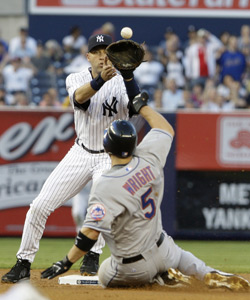 SUBWAY AGAIN (AGAIN)
It’s time for another tired interleague match-up. I realize that I’m acting the wet blanket, but after years of record-distorting play and such scintillating league crossovers as Astros-Royals, it seems to me that a great deal of the attraction of any interleague rivalry, particularly Yankees-Mets, was the impossibility of ever resolving the debate, because Don Mattingly and Keith Hernandez were never going to be in the same game together short of the odd spring training confrontation. The argument could never resolve and everybody could be right–unless, the tantalizing, always just out of reach World Series confrontation materialized. Then it would all be settled at the highest possible level, under the greatest possible tension.
Interleague play stripped the mystery away. Now we know that most meetings between the Yankees and Mets are just like any other game. Maybe the fans feel a bit more jazzed than usual, but in the end, the only thing at stake are some empty bragging rights, now immutably concretized in the drab facts of the box score, and the usual one-game-in-the-standings stakes. In the latter case, the stakes are no different than any midweek game against the Orioles. By the time the two teams finally did meet in a World Series, interleague play had let the air out of the confrontation–it was nothing we hadn’t seen before, as recently as that July.
So here we are again, 12 days after the last time. Admittedly, the last time was exciting, or at the very least strange, with Luis Castillo’s inexplicable dropped pop-up, the unheralded comeback of Fernando Nieve (“comeback” might be a misnomer given that he was never really here), and an unprecedented battering of Johan Santana. Parenthetically, since striking out 11 in six innings against the Nats on May 27, Santana hasn’t struck out more than three batters in any start; in 30.1 innings, his strikeout rate is 4.2 per nine. The Yankees won’t be seeing Santana this series, so that’s just a point of interest.
The Yankees will be seeing Mike Pelfrey (tonight vs. Sabathia), old pal Tim Reddding (Saturday vs. Burnett), and Livan Hernandez (vs. Wang). Pelfrey is a really interesting case. The 2005 first-rounder had a breakthrough season last year, but this season has been choppy to say the least, with his strikeout rate dying a tormented, painful death. Despite this, he was was winning thanks to decent run support. Beginning with his second start of May, he reeled off five very solid appearances, limiting batters to just six walks and one home run in 34.2 innings. His strikeout rate bounced back up into the fours, which isn’t good but was sustainable given the high number of ground balls he was getting. He was, shall we say, Wang-ing it. Just as quickly as they came, the good times ended, June bringing a 7.08 ERA as Pelfrey’s control has wandered, giving hitters more chances to put the ball in play with runners on. Nor has the Mets’ defense done him any favors in this period.
Redding you know from his brief pinstriped experience, a journeyman with a capital “R” for “Replacement level.” He was actually a bit better than that last year, but not by much. This year he’s back in the submarine, sailing below the surface of useful. He’s given the Mets three quality starts in seven tries, but remains a fly ball pitcher without a strikeout pitch, a very bad combination. Hernandez was roughed up by the Yankees in Castillo’s dropped-egg game. What I said then remains true now: his pitching as well as he has was wholly unexpected given just how badly he was treated in both leagues last year. Despite his low-ish ERA, he remains very hittable, averaging 10 safeties per nine innings pitched, and his home run rate is on the high side. He’s pitched well in two starts since the Yankees last saw him.
There is no reason that the Yankees could not sweep this series given the pitching matchups, but that was also true of the Nationals series and we know how that went. However, the Mets are at a further disadvantage, because their many injuries have reduced their list of star-level players to just one — David Wright. He can be enough–he went 5-for-12 against the Yankees the last time around, and has continued to hit well since. However, his power continues to be mystifyingly absent–it has now been 15 games since his last home run. During that stretch he has hit .383 with five doubles, and only four RBIs.
The most remarkable aspect to Wright’s season is that he continues to have a batting average on balls in play of nearly .500 (currently it’s .469). A high percentage of his balls in play, 27 percent, are line drives, which would correlate with a high BABIP, but not this high. In comparison, Scott Rolen has a higher line drive rate and his BABIP is only .354, while Jason Bartlett is leading the majors with an almost 30 percent of his balls in play being liners and his BABIP is “only” .405. It is extremely likely that Bartlett’s BABIP will decline as the year goes on, perhaps by 70 or 100 points, and spectacularly likely that Wright’s will fall off by even more. That leaves the Mets with an interesting problem, because if Wright’s NL-leading average has been due to an overlarge share of luck, and not due to a change in approach by the batter, purposeful or otherwise, then when did his power go, and what happens to his production when some of the singles start to get caught?
As we will likely see tonight when the Yankees put balls in the air and watch what would have been home runs in the Bronx ballpark settle harmlessly into gloves, some of the power outage has been engendered by the Mets zombie tribute to Ebbets Field (ironically, a bandbox–Mickey Mantle used to say, and he meant this, that he would have hit a thousand home runs had he played there), but not all of it, as Wright has hit but one home run on the road this year.
SWISHER/NADY
After a 1-for-6 on Thursday, Nick Swisher apparently gets a mental health break today. It seems as if his place in the lineup is safe, however, as Xavier Nady has had a major setback in his rehab. No confirmation of the damage yet, and I’ll reserve comment until we get the straight dope. I’m waiting for someone to hit my inbox with “Melky should be the everyday right fielder.” It hasn’t come yet, but it will.
Joba, Swisher make their cases
 INSTANT KARMA’S GONNA GET YOU
It was a very strange ballgame last night. It began with the Yankees looking like they were going to lose a perfect game, or at least get shut out, and ended with Mariano Rivera striking out four straight batters for the save, eight runs on the scoreboard. It was the first Rivera appearance in about a year, and it was vintage stuff, one you’ll want to remember if you prize the career of this future Hall of Famer. It didn’t come in a playoff game, but it doesn’t matter–the cutter was really darting in on the lefty hitters, perhaps as much as we’ve seen all year. For one night (and hopefully many more), the Lone Ranger rode again.
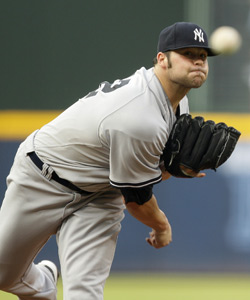
As was pointed out on last night’s broadcast, Joba Chamberlain has now made 14 starts, seven at home and seven on the road. At Yankee Stadium: the Musical, Joba is 0-2 with a 5.18 ERA. Intriguingly, he’s striking out more batters at home, 9.8 per nine innings, than he is on the road (7.0). But he’s also walking six batters per nine innings in the House that Ruth Didn’t Build but Would Have Really Loved to Hit In, and it was speculated by the YES-men that he’s just a bit scared of allowing balls in play at home. This seems like a reasonable explanation given the results on the road–4-0 with a 2.74 ERA (3.59 runs allowed). He’s struck out fewer batters, just seven per nine innings, but perhaps he’s not trying nearly so hard to do so. This more restrained approach has resulted in fewer walks, including none last night, and longer outings.
I’m not certain how the Yankees solve this problem, but I do know this: Chamberlain’s road record is yet another nail in the “Joba-to-the-bullpen” argument. If this is what he can do in a neutral environment, average six innings a start and allow fewer than three runs–that’s more than good enough. Few pitchers can do that, and if Joba can just smooth out his home-park problems, he’s going to contend for a Cy Young Award some day. Sure, the strikeout rate is lower than it was in the pen, but still healthy enough that you don’t have to worry about his health, and beyond that, arguing about the number of strikeouts, seven or nine, is just quibbling. The average AL starter averages 6.4 Ks per start. Joba is fine.
Nick Swisher answered yesterday’s discussion about him here with another home run, and it’s tempting to let that be the final word for now. The guy is second on the Yankees in on-base percentage (to Mark Teixeira), fourth in slugging, but he leads the club in road slugging, road doubles, and road home runs by a wide, wide margin–he and Hideki Matsui are the only hitters on the team that haven’t seen their numbers grossly distorted by the House that Ruth Didn’t etc. He leads the team in walks, and the only reason that hasn’t resulted in a higher number of runs scored by Swisher personally is that he’s been buried in the bottom half of the order. There has been an awful lot of Ransom and Molina up behind Swisher.
Some in the comments for yesterday keep talking about how these are “just” numbers. They’re right. They’re “just” numbers, which means they are “just” a record of WHAT HAPPENED. If you want to deny that Swisher has been on base all those times, fine. You want to deny he’s the team’s leading hitter on the road, that’s fine too. You could go further and deny that getting on base leads to runs, which leads to winning. People deny all kinds of things that seem like settled science. Heck, the Flat Earth Society was active until quite recently.
Unfortunately, there is a payback for stubborn ignorance, and it comes in the form of lost baserunners. That means more outs with fewer runs scoring, and that means more losses– although you can deny that outs without runs leads to losses if you want to. You can deny anything, including the fact that you’re breathing, or thinking.
And once you bench Swisher, you can even deny the slipping place in the standings. You’re mad at the wrong Yankee.
FUTURE YANKEES TO LOVE AND/OR DISTRUST
The rosters for the annual Futures Game prospects showcase were announced today, and the Yankees have two representatives on the World Team, catcher Jesus Montero of the Trenton Thunder and lefty Manny Banuelos of the Charleston RiverDogs. I know you’ve heard plenty about the former, the too-young-to-drink slugger who might be less than a year from a big-league call-up, but Banuelos has yet to get much press (and for good reason–Montero is a special hitter, while Banuelos is a good prospect, but one potential pitcher among many). In 12 starts this year he’s put up a 2.51 ERA, walking just 14 in 61 innings while striking 58. Going into the season, Baseball America ranked his as the team’s 14th-best prospect, right behind Brett Gardner, commending his mechanics and solid fastball while noting his offspeed pitches still have awhile to go. He’s three levels away from the bigs, so this is probably your one chance to see him for awhile if you don’t happen to live nearby. The chance to see Montero speaks for itself.
To the mats with reader comments
TO THE MATS WITH READER COMMENTS
Just a couple of quick ones from this morning’s entry:
Frequent correspondent let’sgoyankees says:
Good article, but I want to make one point…Melky should not be taken out in favor of Gardner. Swisher should. He plays awful defense and is a terrible baserunner. Since both he and Melky are slumping, those other two categories have Swishy beat. Swish is a useful player but he should be platooned. He’s exposed playing every day.
And Charlie F responds:
Swisher does NOT play awful defense. He plays incredibly UGLY defense, but he’s actually quite a good defender. His UZR/150 is above average as is his range factor per game. Don’t confuse ungraceful and lumbering for bad.
To which I, your humble servant, will add that there’s not a lot that’s pretty in Swisher’s game, but he’s a productive player and one the Yankees can’t afford to take out of the lineup. Even when his bat went on vacation in May, he still drew 19 walks, making for a .311 on-base percentage despite a .150 batting average. This month he’s hitting .267/.397/.500. You show me a team that benches a guy with those rates and I’ll show you a team that needs its head examined. Swisher has faults, and when a team is not playing well, those faults — the strikeouts, sub-Speaker agility in the outfield, become exaggerated. This happens to every team in a bad place — the urge to punish someone strong, and it frequently seizes on the wrong player. Swisher has been productive against both lefties and righties, has hit well by any reasonable standard, and has left something to be desired only at Yankee Stadium II, where, despite his struggles, he has posted a .373 on-base percentage. He’s part of the solution, not the problem…
…And yet he’s still going to lose playing time to Xavier Nady. That’s the way of things, and it’s depressing.
…If anyone wants to talk about this or anything else, I’m about to begin a chat (1 PM EST) at
Baseball Prospectus.
 Pinstriped Bible