Category: Dailies
Bombers hitting into double plays too often
BY GEORGE
We open today with a Steinbrennerism. Though many of the Yankee owner’s most acerbic comments have been well publicized over the years, this one is more obscure. Criticizing an umpire’s calls in July, 1979, the Boss said, “He’s with an excellent crew, but he fits like a $3 bill in the cash drawer.” I dedicate this Boss bit of wisdom to Angel Berroa, whose strange reign on the Yankees roster as a non-utile utility player may come to an end later today, when Cody Ransom comes up from Scranton.
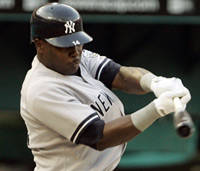 In 14 games in Pennsy, Ransom has done his usual Ransom-y job, batting .250/.346/.477 with two home runs while striking out an unsustainable 12 times in 44 at-bats. Ransom is a fun guy to root for (this seems like a necessary qualifier to issue each time this subject comes up, while also having the benefit of being true), and he’s certainly a more useful player than Berroa, but at 33 years old his problems are ossified, calcified, and calcareous, set in stone and bone. He has power but has problems making contact, with the result that maintaining a functional rate of reaching base becomes an insurmountable problem. With the Yankees anticipating more time off for Alex Rodriguez in the future, and Rodriguez playing like he needs it, the club needs a more viable substitute. That player is not currently in the organization. Whatever trading chips the Yankees are hoarding, they would be better spent on an infielder with some two-way bona fides than on yet another reliever.
DOUBLE PLAYS REVISITED
With Derek Jeter doing some decisive GDP damage the last couple of games, it’s time to check out the double play percentages for Yankees’ batters. The first thing to know is that in the American League, batters are hitting into double plays in about 11 percent (specifically, 10.9 percent) of opportunities. The Yankees as a team are hitting into twin killings a little more often, 11.5 percent of the time. Last year, the average AL team had about 1210 possible double play situations when hitting. This year’s average rate would result in 132 double plays. The Yankees’ rate would result in 137 double plays, which doesn’t seem like much but might matter in a close race — quite recently we’ve seen key double plays by Jeter and Robinson Cano kill the Yankees in close games.
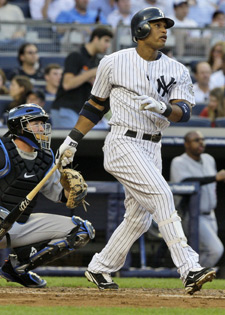 Robinson Cano has been the player causing the Yankees the most trouble so far, knocking into a double play nine times in 42 chances, a rate of over 21 percent. With his double play on Tuesday night, Jeter also brought his rate up to 21 percent. Other Yankees who require Joe Girardi to give their baserunners a flying start include Alex Rodriguez (17 percent), Nick Swisher (14 percent), and Melky Cabrera (13 percent). Surprisingly, the very slow Jorge Posada and Hideki Matsui have above-average performances in this category, hitting into double plays in nine and five percent of their chances, respectively.
One argument for giving Brett Gardner more playing time is that, particularly if he’s batting ninth in front of Jeter, might limit the team’s exposure to the double play in some situations. With Jeter hitting ever more balls on the ground — he’s grounding out three times for every one fly out, a career high — this is going to continue to be a problem where the Captain is concerned.
PARENTHETICALLY, A-ROD
A look at the Yankees ground ball ratios reveals that there’s a reason that A-Rod has such a high double-play rate: he’s hitting more balls on the ground than he has at any time in the last ten years. His offensive problems may or may not be caused by fatigue, but there might also be a mechanical component to the problem.
AN ORPHANED LINE ABOUT PHIL HUGHES
It might be time to give him something more challenging to do.
ANOTHER ENDORSEMENT OF BRETT GARDNER
The average AL center fielder is batting .260/.327/.403. Gardner is now hitting .285/.361/.401. His defense has been impeccable, as has his baserunning. If he can just keep doing what he’s doing, he doesn’t need to improve. Sure, improvement would be good, but the offense would be sufficient to support the other aspects of his game. While Gardner could still stand to be protected from the occasional lefty — one senses with Gardner that at some point more would likely become less — the ratio of playing time in center field should shift dramatically, from 75-25 in favor of Melky Cabrera towards Gardner. Plus — and this is no small thing — he’s the only guy on the team actually performing right now.
The trouble with offense … and A-Rod
SO, WHAT HAVE WE GOT?
During the offseason, I frequently argued that though the Yankees had their attention focused overwhelmingly on pitching, the offense might prove to be a bigger problem. Then they signed Mark Teixeira, and I promptly shut up. It seems odd to talk about a team that has averaged more than five runs a game as having offensive deficits to make up, but the truth is that the particular construction of the Yankees means that it’s still a realistic possibility. The Yankees have to guard against being fooled by the numbers they are seeing, many of them distortions caused by their generous new home park. To this point in the season, certain aging Yankees would seem to have found the Fountain of Youth. What they’ve really discovered is a beautifully appointed new ballpark with wide concourses, laptops in the lockers, and a loving right-field power alley.
The home/road splits are damning: Derek Jeter, .295/.364/.381 with two home runs in 239 at-bats. Melky Cabrera, .278/.329/.354 with one home run in 79 at-bats. Johnny Damon, .260/.317/.449 with four home runs in 127 at-bats. Jorge Posada, .253/.348/.440 with three home runs in 75 at-bats. These numbers aren’t terrible, but they’re more realistic than what the players have done at home, more in line with what the players have done in the recent past and what we might have projected them to do this year.
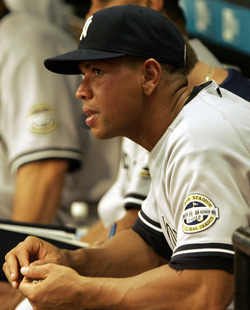 The Yankees are a .500 team on the road so far this season. Their road production has been, overall, quite good, given that Nick Swisher, Robinson Cano and Hideki Matsui have done the bulk of their hitting while traveling. Teixeira has also done his part. Still, this hasn’t been enough to give the team the same explosiveness that it has had in the Bronx, especially when you throw in Alex Rodriguez’s post-surgical problems. (Likely unrelated to his staying up late. Though I’m sure we all want to jump on Rodriguez for his latest transgression, I’m pretty sure that sitting on a barstool next to Kate Hudson doesn’t stress his hip as much as playing does, which was more the point of his “fatigue” problems than his lack of sleep, dig?)
Insofar as winning the division goes, this bifurcation would present less of a problem if the Yankees had won more than 60 percent of their games at home. The 1987 Minnesota Twins showed that in a soft division you could be a hundred-loss team on the road if you were a 100-win team at home. The Yankees are a few games off the latter pace. Say they were just a few games better in their own park, 25-10, instead of 21-14. That’s asking a lot of the Yankees, but we’re in the land of make-believe just now, so stay with me. Were the Yankees to maintain that kind of pace at home while staying around .500 on the road, they would finish the season with a record of somewhere around 99-63, and be in very good shape to win the Wild Card if not the division. They may win the Wild Card anyway, but you can’t take anything for granted.
There is something to be said for players that can take advantage of the features of your home park. Not every Yankee has popped a home run every 13 at-bats at home, as Damon has. The problem is that the park can’t discriminate. The Yankees have outscored their opponents by just 13 runs at home. Over time, that gap may narrow, perhaps because of the park, or maybe because Brett Tomko is pitching. Or Brett Tomko is pitching in the park. The players who have reaped the extra support might also regress, simply through age, fatigue (to use a dangerous word), injury, or changing weather patterns or other effects of the new park we can’t yet foresee.
In June, the Yankees are batting .247/.342/.424, roughly a league mark. The pitchers have been fine. June’s ERA is 3.85, actually the team’s best of the season. June’s starters have an ERA of 4.40, above-average for the league, and the transformed, Veras-free bullpen has an ERA of 2.87. Assuming that CC Sabathia isn’t hurt in any long-term-kind-of way, the pitching staff may well have achieved stability. It is the offense that should now be the source of worry. The lesson for the Yankees is clearly that if opportunities to upgrade the offense present themselves, any chance to replace a middling 35-year-old bat, they have to take it. If finances mitigate against such a move, that’s one thing, but sentimentality or the belief that Melky Cabrera (injured shoulder or not) is going to achieve consistency or Hideki Matsui is going to turn back the clock need to be ignored.
And most of all, perhaps more than anything else, a day-in, day-out A-Rod substitute must be found. Applicant should be able to out-hit Angel Berroa and outfield both he and the less-than-limber Rodriguez. Rodriguez could struggle all season, even if he takes a vow of celibacy. Again, the Yankees don’t want to take anything for granted.
A-Rod needs a rest
STRANGE DAYS INDEED
Good evening, campers. I spent part of my day in a drawer undergoing a PET scan. I must have been a very troubled sweater in a former life because once in my overwhelming instinct is to get out. The good news is that I am out and that this sweater was given a clean bill, freeing what remains of my brain to consider baseball again.
The 1927 Yankees went 21-1 against the St. Louis Browns, one of two doormat teams in the league that season. Given the outcome of the late series with the Nationals, it is apparent that this ain’t 1927. Ironically, given the focus on pitching this year, starting and bullpen, the failure was largely offensive — when you score two runs in two games, you’re not going to beat anyone. There has been something like an obsessive grabbing onto the supposed fact that the Yankees supposedly can’t beat a pitcher they’ve never seen before, but that isn’t the issue so much as the absence of Derek Jeter from the lineup both nights, the absence of Jorge Posada in another, and the cooling bats of certain key players. Nor should we ignore the randomness of fate — if Robbie Cano had put the ball in play in any way other than where he did on Wednesday, the Yankees would have taken two of three games and the series would not have held such a bitter aftertaste.
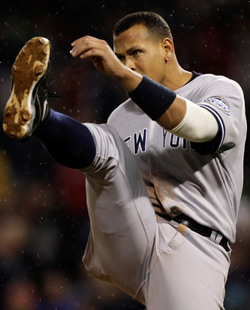 Now comes the news that Alex Rodriguez will be taking two days off, his first since coming off of the disabled list. The way Joe Girardi has handled Rodriguez has been strange — you have a player coming off of a major injury, who was given an incomplete fix for that injury. That would seem to require handling with kid gloves whether the player liked it or not. There is, I think, a mutual enabling going on here, where Rodriguez did not ask out until now, and Girardi, who knows who he would have to list at third base in the alternative, did not ask him to sit out. Girardi’s job, after all, is to win today, and the way Rodriguez hit initially, quickly piling up nine home runs, was helping him do that. Perhaps Girardi needs to think more globally than that, but given that just a few weeks ago there were rumors about his job security, it might be impossible for him to do so.
The fault lies not in the stars but in the front office, which never gave Girardi a viable A-Rod substitute once it was clear that the player required surgery. Cody Ransom bombed and got hurt, Angel Berroa offers nothing in the way of offense or defense, and Ramiro Pena, while a very good glove, is not a hitter. Scranton’s roster is clogged with the likes of Eric Duncan, Justin Leone, Chris Malec, and a rehabbing Ransom, none of whom could be misconstrued as Major League regulars on the darkest of nights. Trenton’s third baseman is Marcos Vechionacci, who shed his prospect status what seems like eons ago.
Given this dearth of viable hot corner men and a clear need for hot corner men, it was incumbent upon the front office to make a deal for a viable Rodriguez substitute. Recently, I have been inveighing against the team making a hasty trade for a reliever, bringing up Jeff Bagwell for Larry Andersen. The reverse of this is that giving up Larry Andersen for Jeff Bagwell is never a bad thing, and if you can’t get a Bagwell, any Tom, Dick, or DeRosa will do. It’s not a move anyone would want to make given a choice, but the Yankees have had a very finely balanced operation so far, and there is every reason to think that such a move will keep paying dividends. Rodriguez’s recovery may be lengthy, and his swing may continue to be affected. His energy level may continue to be low. His range has clearly been affected, suggesting an ongoing need for a late-inning substitute. Plus, there may be other injuries to other players.
The Yankees are now 10-7 in one-run games. They could just as easily be 7-10 — that’s the way one-run games work. They are basically coin flips. As we saw on Wednesday, one-run games can turn on one key double play, one missed opportunity. Either you get the big hit or the big out or you don’t. When the Yankees have to rely on an Angel Berroa, today, tomorrow and in the future, they’re reducing the chances that they will get that big hit or make that diving stop.
If you’re going to go through the season without winning a game over the Red Sox, you’d better win every game that you can. They didn’t do this in the Nationals series. Without some help for A-Rod, they might not do it in the future. This is no time for the usual blithe assumptions that a no-name player will rise to the occasion, Rey Sanchez- or Luis Sojo-style. The time to go hunt down a safety net is now.
PinstripedBible.com on Yankees BPTV
To the mats with reader comments
 1: FROGPEN
Frogs worldwide are dying off at a high rate, which is depressing. Add in the state of Yankees’ middle relief and I am almost unbearably sad. Reader Ben is too:
Honestly Steve, your comment about the Yankees overusing Phil Coke, Alfredo Aceves and Mariano Rivera are not well-thought out. Jose Veras is as inconsistent as can be. His stuff is so great, yet never can stay in the strike zone on the first pitch. I swear, it is a loud exhale every time when he throws ball one and you see 15,000 beads of sweat on his face with that deer-in-the-headlights look and it’s like Kyle Farnsworth all over again. Great talent, no clue how to pitch.
I don’t mean to pick on him, but Jonathan Albaladejo and David Robertson can at least claim they have not had much Major League experience. The Yankees have no one else dependable to go to. Maybe things are different with Brian Bruney and Damaso Marte healthy, if that ever happens. But right now, they don’t have depth, because of health and ineffectiveness.
Ben, I don’t see how my observation and your point are incompatible. I said Joe Girardi was turning to certain relievers with frequency because the others had been unreliable. You seem to agree with that reason. I didn’t say that Girardi was wrong to do this, but merely pointed out that there can be consequences to overusing certain relievers (call this the Proctor Rule). If there was any criticism even implicit in what I was saying it was meant not for Girardi but for the front office for not shuffling the bullpen deck again: “Given that the Yankees have other options in the Minors, it would make far more sense for the Yankees to try something new than to continue to burden Girardi with options he’s already discarded.”
By that I meant (at minimum) giving Mark Melancon another shot rather than persevering with Veras — and the Yankees have just taken a step in that direction by designating Veras for assignment. No doubt that move was prompted by the need to keep Phil Hughes around should Chien-Ming Wang fail to pitch well on Wednesday, but with any luck it means that when the club finally is able to have one starter for that spot (as opposed to the tandem starter Chien-Phil Hughes), the resultant opening in the pen will be filled by a fresh face.
2: PESSIMISM, DEAR LIZA, DEAR LIZA
They say I tend to look at the glass as half full. Reader Kevin here sees a hole in the bucket. Truncated some for length and several ill-considered word-choices:
This is not a special team yet. But it is need of some special help. We are seeing this far too often for a Yankee team: 1. Derek Jeter. The “Captain” of the team. He is hitting ok. Every once in a while he is ok in the clutch. But more than not, when he gets up to the plate you are waiting for him to hit that pop-up or hit into the double play. I don’t get it.
2. Johnny Damon. He is hitting “ok” but not clutch. He looks like a nine-year old boy in a little league game every time the ball is hit towards him in left field. No confidence… Wang. Why he is still with the team and not down in AAA I don’t know… Joba. Needs to be a reliever. Bottom line. Pull Wang, insert Hughes. Joba in the bullpen as a reliever. Girardi is acting too optimistic as a manager right now… We went 13 years in a row making the post season until….2008. Common denominator…Girardi. He is too much like a buddy than a manager. It’s obvious to me due to a lot of the decision making that is going on by him.
Jeter is batting .308 with men on, .316 with runners in scoring position, .476 with two outs and runners in scoring position, .375 late and close… What do you want from the guy? Damon is batting only .254 with men on, but has hit six home runs with runners on base, is hitting .355 late and close, and had a memorable walk-off homer against the Twins exactly a month ago. I can’t defend his defense, but he’s 35. He’s still far from a Pat Burrell out there given his speed… Wang isn’t in Triple-A because he’s out of options. Get over Joba as a reliever. He’s about 1.5 changes of role short of becoming Neil Allen. Just relax and let him settle in, try to suppress your panic every time he doesn’t pitch well. Joba has made 24 career starts and has a 3.29 ERA. I don’t have an exact list on hand, but my guess is that very few starters have begun their career with those kinds of results. True, he has only averaged five innings a start, but that’s partially due to the way the Yankees have chosen to manage him. It might also be better to have a starter who throws five strong innings than a pitcher who throws two, no matter how dominant, though I don’t know that for sure.
3: BATTING ORDERS AND THE INTIMATE LIVES OF YOUR FRIENDS DON’T MATTER MUCH…
…But they sure are fun to talk about, as reader Alightningrodfan shows:
I have been critical on these blogs in the past of Robinson Cano, but only regarding his hitting behind A-Rod. I think Jorge Posada hitting behind A-Rod would lead to better protection for A-rod and that might help A-Rod get better pitches, fewer walks, and a chance to more quickly get his groove back after surgery. However, Cano can sometimes do very well. And it seems as if A-Rod, despite his .234 average, keeps finding ways to help his team win and provides inspiration. Even through a pop-up! In any event, since it seems that Joe is going to keep Cano in fifth, I will cheer Cano on to have a successful season.
One of the better things to come out of the Mets-Yankees series was Cano going 5-for-12 with two doubles and two home runs, as he really hadn’t yet taken advantage of Yankee Stadium II. Even after his hot weekend, he’s still batting just .278/.324/.452 at home, compared to .301/.350/.534 on the road… The average AL No. 5 hitter is batting. .269/.340/.456, with a home run every 24.5 at-bats. Yankees No. 5 hitters are batting .241/.285/.425 with a home run every 26.1 at-bats. On the whole, Joe Girardi’s choices for the fifth spot haven’t worked out, but Cano isn’t the major part of the problem, having hit .301/.316/.484 in the spot. His other choices, primarily Jorge Posada, Hideki Matsui, and Nick Swisher, have bombed there. The sample is small enough for each that it wouldn’t be useful to read anything into that. In the long run, Posada is the better choice. It’s fascinating that Posada has spent most of his career batting fifth or lower — the Yankees have given up a lot of Posada plate appearances over the years by keeping him buried. I’d be very curious as to if Girardi or Joe Torre think they see something emotional in Posada that makes him a bad choice to bat up in the order. In his career he’s been much better when batting sixth (.295/.400/.518) instead of fifth (.277/.378/.460), so maybe there’s something to that.
…A walk is obviously not as valuable as a home run, but as long as Rodriguez keeps taking those walks while mixing in the odd home run, he’s going to be productive at the plate regardless of where his batting average ultimately falls.
4: THE UNSUBTLE PLUG
Charlief writes:
The thing to remember about the Nats is the hitting is actually quite good. You say average, but up until the last two weeks – when Guzman, Dunn and Zimmerman all fell into slumps, they were 3rd in the NL in scoring. I think that will tick back up at some point. Throw in future Met Nick Johnson, plus Josh Willingham’s .891 OPS, they aren’t slouches with the bats… In terms of pit
ching, it’s just not there. All rookie starters other than Lannan means a rough go. Lannan vs. Wang should actually be a great matchup. They are similar in more ways than they’re different, strikeout rates aside. I think from a Nats fan point of view it’s good that Detwiler and Zimmermann don’t start in this series. They will be needed in 2010 along with Strasburg, and the Yankees at home can mess with pitchers heads. Also needed are some people who can field, if you know any. This may be Manny Acta’s last series, and Mets fans, he could be sitting on a bench near you in the near future...
I purposely left Josh Willingham out of my evaluation because he’s currently on the bereavement list due to the sad death of his brother in an auto accident, and I wasn’t sure if he’d be back in time for this series. It is true that the Nats were hitting a bit better just a couple of weeks ago, but I’m reluctant to say that that was their true offensive level. I think it more likely that Zimmerman, Dunn, Nick the Greenstick, et al were playing a little over their heads, and what we’re seeing now is a return to a more realistic level of production.
I wish Manny Acta all the best, and hope he gets another chance with a real ballclub, should the Nats pull the trigger as was rumored. No manager could have overcome a bullpen as poor as that of this year’s Nats club. As always, whenever Acta comes up I feel proud to point out that he has cited the book I edited and co-authored, Mind Game as having been an important influence. Someone should get him a copy of Forging Genius as well, given that it’s about a manager who gets fired a lot before going on to greatness. It could be therapeutic… And he’ll probably be more careful about looking both ways before crossing the street. Four things Winston Churchill and Casey Stengel had in common: (1) late-career success after they had been written off; (2) handy with a turn of phrase; (3) enjoyed alcohol, perhaps a bit too much; (4) hit by cars while attempting to cross a street in a major American city. I’m sure there are more…
5: SCARCITY
…Or is that Scar City? Midcoaster asks:
My big question about Jesus Montero is – if he is not expected to be a catcher in the big leagues why is he still catching? Should’t he be learning how to be, at least, adequate in a position he will be playing? Looks like the Yankees are making a career DH. Please no more DH only types. Get him to learn a position he will be playing while he is still on the farm. Yes a big clunky guy could play the outfield if he gets gets experience and is well coached. The way ball are flying out of the new stadium it might be a good idea to keep him.
Jesus Montero is definitely a keeper. The reason he’s still catching is that the Yankees know how hard it is to find a top bat to stick behind the dish. If they can keep Montero back there, he’ll be infinitely more valuable than if he’s a first baseman, left fielder, or designated hitter. They’ve made a determination that until he proves that he absolutely cannot catch he’s going to stay, and it’s a good call, especially since Mark Teixeira has him blocked at first base for the next hundred years. His Tampa numbers this year are equivalent to his hitting .301/.325/.470 in the Majors as a 19-year-old. He could be Mike Piazza for the Yankees, with all the associated pros and cons. There’s no rush to move him.
MORE OF ME–TV
I’ll be on the YES’ Yankees Batting Practice Today show tomorrow, Wednesday, at 6 p.m.. Hope you see me then.
Bring on the (ugh) Nationals
TWO OF THREE…
As with everyone else under the sun, I figured the Yankees could take two of three games from a poorly planned and injury-depleted Mets team, I just figured they would win Game 1 on their own merits and Game 2 by feasting on a journeyman starter before losing Game 3 to one of the best pitchers in baseball. I didn’t figure on them winning Game 1 because a veteran made a Little League misplay, losing game two by being shut down by the fringe-y guy, and then annihilating the Cy Young winner in Game 3. Let’s not even predict what the Yankees might do against the Nats… Then again, it’s sort of my job, so let’s give ‘er a go.
The Nationals are obviously a miserable ballclub, one with a chance to rank with the worst of all time. Their current .262 winning percentage works out to 42-118 over a full season. Just a few teams have been that bad. Here’s the bottom 10 since 1900:
| YEAR | PCT | W | L | |
| 1 A’s | 1916 | .235 | 36 | 117 |
| 2 Braves | 1935 | .248 | 38 | 115 |
| 3 Mets | 1962 | .250 | 40 | 120 |
| 4 Senators | 1904 | .252 | 38 | 113 |
| 5 A’s | 1919 | .257 | 36 | 104 |
| 6 Tigers | 2003 | .265 | 43 | 119 |
| 7 Pirates | 1952 | .273 | 42 | 112 |
| 8 Senators | 1909 | .276 | 42 | 110 |
| 9 Phillies | 1942 | .278 | 42 | 109 |
| T10 Red Sox | 1932 | .279 | 43 | 111 |
| T10 Phillies | 1941 | .279 | 43 | 111 |
| T10 Browns | 1939 | .279 | 43 | 111 |
If they continue along their present path, the Nats would slot in right next to the 2003 Tigers. However, the Nationals are not like the 2003 Tigers. Those Tigers couldn’t hit, pitch, or field. The Nats are bad at two out of three, but they have average hitting. They don’t catch the ball, their starting pitching is the worst in the league, allowing nearly six runs per game, and their bullpen may yet prove to be the worst in the history of relief pitching.
That doesn’t necessarily mean the Yankees will get off easy. Their best bet for an easy win is Tuesday, when CC Sabathia takes on the Curacao-born 22-year-old Shairon Martis (with a name like Shairon, I keep thinking he must be Israeli). As the Nationals go, he’s pitched very well, with five quality starts in 12 tries, including a complete game, one-run win over the Cardinals. What works in the Yankees’ favor, particularly because this series is being contested in New York, is that Martis gives up a lot of fly balls and has a low strikeout rate. That suggests the Yankees making good contact and hitting balls in the air, and we know what happens when they do that at home. In addition, two of their three best hitters, Nick Johnson and Adam Dunn, are left-handed, which should be helpful to Mr. Sabathia.
Wednesday’s game has to be rated a toss-up. First, Washington lefty John Lannan can actually pitch. He’s not an extreme ground ball pitcher, but he gets enough of them to keep the ball in the park. On the downside, he doesn’t get a lot of strikeouts, meaning (again) those deadly balls in play. Lefties have also hit him well, slugging .493 against him in his career with a home run every 21.2 at-bats. The Yankees, who list seven left-handers or switch-hitters most days, should be able to do some damage. Unfortunately, much will also depend on whether Chien-Ming Wang can overcome his mechanical difficulties and put in a good start. Thursday’s match-up should again favor the Yankees, as the rookie Craig Stammen will face Joba Chamberlain. Of course, much will depend on Chamberlain throwing strikes. Stammen is no pistol (please pardon the bad horticultural pun), but does have good control. Like Lannon, he has an above-average groundball rate and his strikeout rate is on the low side.
The great thing about the Nationals from the point of view of the opposition is that they can blow a lead at any time. Even if the Yankees trail in these games, they have more than a fair chance at coming back against the bullpen. Their relievers have an aggregate ERA of 5.59. Reliever ERA isn’t the most accurate way to look at bullpen performance, but in this case, it makes a fine proxy for better measures, as it fairly depicts how miserable they’ve been. That should take some pressure off of Wang and Chamberlain — though not all of it, particularly for Wang. One question that arises out of Joe Girardi’s “pitch well or else” edict to Wang is, what about the start after?
COMING UP
We finally get to the mats with reader comments, and Wholesome Reading (Warning! Politics!) continues to be updated.
The around (and about)
Quick style:
? Tony Gwynn, Jr. was a mediocre prospect for years. Traded to the Padres, he’s hitting .344. It would be nice if that kind of magic were real.
? Chone Figgins went 3-for-5 on Friday, continuing a nice hot streak in which he’s batted .400 (32-for-80) over his last 20 games. He’s also thrown in a 3-for-7 in stolen bases, which doesn’t help.
? Friday was one of the few occasions all year when the Diamondbacks gave Dan Haren any offensive support. He’s 5-4 with a 2.20 ERA, but in a fair world he would have ten wins. I’m reminded of Nolan Ryan’s 1987.
? Bad news from the Mariners as Erik Bedard skips a start with shoulder soreness. Scratch one prospect from the ultimate trade package, should they choose to go that way–they may yet convince themselves that their league-leading pitching staff is good enough to overcome their league-lagging offense and get them to the top of a weak division. They might be right, too.
? It was shocking to see that Luke Hochevar had a four-pitch first inning against the Reds until the Reds’ batting order was consulted. The combination of injuries and poor planning has left Dusty Baker with a lineup that’s just not Major League quality right now. Still viable in their division, a trade for any kind of bat at almost any position would be decisive.
? This is stating the obvious, but let’s state it: when the Dodgers are being shut out in homer-happy Arlington, when they have just 44 home runs as a team, then what Manny Ramirez did wasn’t just cheating, it was an act of treason.
? With ultra-prospect Gordon Beckham just 2-for-28 in the Majors, you wonder how long the White Sox will continue to be patient.
? Two former Yankees key to the ending of the Nats-Rays game (there’s an interleague rivalry for you), as Nick Johnson dropped Gabe Kapler’s foul pop-up off of Ron Villone with two outs in the eighth, and Kapler came back and knocked Villone’s next pitch into the seats to swing the score in his team’s favor. Villone actually fell to his knees as the ball went out. It’s not always big failures that make a bad team historically bad.
? Roy Halladay leaves with a groin strain, next start in jeopardy. And if he’s compromised at all, the Jays’ chances of hanging around the fringes of the AL East race just went “poof.”
Irony is such a lovely word
 If you dig irony, the conclusion of Friday night’s game had to be an instant favorite. In November 2007, Mets General Manager Omar Minaya handed out one of the more foolish contracts in recent memory, signing Luis Castillo to a four-year, $25 million contract. Moreno thus assured the Mets of having Castillo’s company from age 32 through 35 when the second baseman’s speed, defense, and durability had already declined due to a set of bad knees. His power was always minimal, so even when at his best his offensive contributions have been minor. The most you can say of him at this point is that he’s selective and that when he does run, he picks his spots well. If you add up the 87 games he played last year with the 50 he’s played this year, you get a .258/.362/.318 hitter with 13 doubles, three triples, and three home runs. He’s also walked 77 times and stolen 23 bases in 27 attempts. He’s not completely without value, but what’s there isn’t something that the Mets needed to lock themselves into, especially when Castillo has so little leeway in his skills; if he slips even slightly, he’s rowing the team backwards.
That this player, of all players, dropped a seeming can of corn to give away a game to the Yankees seems highly appropriate. It would be inhuman not to observe that it’s also a little sad. There is no joy in seeing a 14-season veteran of the Major Leagues humiliated. Still, poor decision-making has a way of coming back to haunt you, and Castillo’s Fumble is the most visible example of a GM’s misevaluation of a player biting his team in the buttocks.
THE REMAINS OF JOBA’S DAY
Joba Chamberlain’s start was not pretty and might be better characterized as bizarre, as he left in the fourth having allowed just one hit but walked five and hit two batters. No doubt the Joba-to-the-Pen crowd will again get hyped up, but let’s be realistic: throwing strikes has been a staff-wide problem for the Yankees this year. With nine walks in nine innings last night, the club raised its rate of ball fours to 4.1 per nine innings. In doing so, they passed the Cleveland Indians for the league lead.
I’ve seen a great deal of hostility expressed towards Dave Eiland in reader comments here and elsewhere, but I’m not sure that you can put the blame on him exclusively. When a team has young, hard throwing pitchers, control problems often have to be worked through. A great deal of frustration usually accompanies this. Those of you kicking around long enough might recall that back in the mid-1980s, Bobby Valentine promulgated an ill-considered get-tough program with his wild Rangers pitchers, vowing that if any of his starters walked two consecutive batters he would be instantaneously yanked from the game. All this accomplished was to make his pitchers nervous. Bobby Witt remained Bobby Witt even with a metaphorical gun to his head. The Yankees can change pitching coaches, but the new guy is unlikely to bring a magic bullet to go with that gun.
MEANWHILE, BACK IN THE PEN…
Joe Girardi has not had a sure touch with the bullpen this year. His reluctance to use Mariano Rivera for a long save in Boston, followed by his usage of him in the eighth inning of Friday’s game, is a frustrating inconsistency. The usage of Brett Tomko ahead of David Robertson (more on this below) makes very little sense. When Girardi finally did get around to using Robertson, the horse was out of the barn. He then tried to push Robertson into a second inning, which would have pushed his pitch count up to 40 or so pitches, more than he typically throws. Instead, he allowed a leadoff hit to Gary Sheffield, which led to a panicky call to Phil Coke.
One interesting aspect of Girardi’s bullpen usage is the frequency with which relievers have pitched; Yankees relievers lead the league in appearances in consecutive games. Phil Coke leads the pack with nine such appearances each. This is in large part a reflection of Girardi’s reluctance to turn to anyone in the pen except for Coke, Mariano Rivera, and lately Al Aceves. As we’ve seen before, particularly in the Joe Torre years, this can lead to burnout of select pitchers. Given that the Yankees have other options in the minors, it would make far more sense for the Yankees to try something new than to continue to burden Girardi with options he’s already discarded.
The one positive to come out of last night’s bullpen mishmash was that Phil Coke had a long outing. The former starter’s splits this year have been backwards: .195/.327/.366 with one home run in 41 at-bats against righties, .216/.245/.523 with four home runs in 44 at-bats against lefties, suggesting that Coke is miscast in the LOOGY role.
Finally, it’s great to see a Yankees manager finally using the team’s closer in tight eighth-inning situations instead of already-settled ninth innings, but it is unfortunate that it took until Rivera was 39, when he may no longer be mentally or physically adaptable to the change.
SAVE UP YOUR MONEY FOR A RAINY DAY,
GIVE ALL YOUR CLOTHES TO CHARITY…
THINK!
Nick Swisher is just not having a good week for mental acuity. Neither are the official scorers. That the official scorer called the ball that bounced off his mitt a double is just one more illustration of how badly baseball needs to professionalize official scoring. Millions of dollars in salaries are affected by performance statistics, and too often those statistics are perverted by scorers who display something less than objectivity.
Of course, nothing Swisher did this week compares to Milton Bradley’s actions on Friday, when he forgot the number of outs and tossed a live ball into the stands, allowing the Twins to trot around the bases.
VETERAN TOMKOISM
I’m still not clear on what Brett Tomko is adding to the roster, particularly when the Yankees could be getting Tony Claggett or Mark Melancon established in the Majors. He and Angel Berroa (three at-bats this month, seven total since April) are mysteries worthy of a Leonard Nimoy In Search Of… revival. Tomko has been around a long time, bas rarely been any good, and his 10.2 innings out of the Yankees pen going into Friday night’s debacle were deceptive. Sure, the ERA was only 2.53, but he’d walked four and struck out only five. He was always prone to giving up the home run, had already given up one, and with that low strikeout rate it was inevitable that he’d give up another. I’m all for teams fishing in the discard pile for diamonds in the rough, but the Yankees have viable relievers in the minors who might be good for the next five years, not the next five minutes. David Robertson is one of those, and yet he followed Tomko, coming in three-runs down instead of up by one. Veteran Tomkoism is counterproductive in the extreme.
I’m sure someone will write that the Yankees were looking for “length” with Chamberlain out of the game early, but length remains theoretical when the pitcher you choose can’t actually pitch.
THE FARNSRULES
Linked here, a very perceptive bit on Kyle Farnsworth from Joe Posnanski. He illustrates that the Royals have discovered what the Yankees (and Braves, and everyone else) already knew: Farnsworth is to be used in low leverage situations ONLY. “There’s no crying in baseball, except when Kyle Farnsworth comes in.” The Yankees pretended this wasn’t true for two and a half years.
An average bullpen and an average Cano
GOOD-BYE WOODIE HELD
A brief note marking the passing of one-time Yankee Woody Held. Held was signed by the Yankees and had a couple of brief trials with the big club, but the team looked at his limitations — strikeouts, low batting average, shaky defense at short — and ignored the fact that he had a ton of power for a shortstop of the day. In a move that Casey Stengel later acknowledged was a mistake, Held was spun off to the Kansas City A’s in one of the many trades the Yankees made with that ballclub (they got back Ryne Duren) and not retrieved. He went on to hit 179 Major League home runs in a 14-season career during which he played everywhere on the field except first base and catcher. His versatility made him a Stengel-type player, but Casey never got the chance. Regrets from this page to Mr. Held’s family and friends.
 HOLD THAT BULLPEN
Nothing I haven’t said before, but it’s current: Ken Rosenthal reports that the Yankees will be looking to trade for a setup man. They might give Mark Melancon another try first. It would be far cheaper to have him succeed than to deal off Jesus Montero for Huston Street. Melancon hasn’t pitched all that well lately, but has maintained great control in the Minors, walking just under two batters per nine innings, and of course he’s still striking out more than a man per inning. I’m not exactly sure why the folks at Scranton felt they had to let him pitch three innings on Tuesday, but we’ll assume that was an aberration.
As frustrating as the Yankees’ pen has been at time this year, it has overall been about average in its performance. Deleting Jonathan Albaladejo and Edwar Ramirez was a huge step in the right direction. David Robertson has been quite good the second time around, having allowed no runs in his seven appearances since returning. That said, four of those seven appearances have been in losses, and two others were in games in which the Yankees were leading by a large margin. It might be time for Joe Girardi to try entrusting Robertson with a higher leverage role. Al Aceves has also been quite the discovery, last night’s disappointing outing notwithstanding. If Brian Bruney finally returns and is healthy, a lot of the pressure to seek outside help should lift. At least, that’s the theory.
CANO: THE CAUTION HORSES
Seems to me that Robinson Cano’s latest slump is not getting a lot of play. While a certain segment of fandom wants to see Nick Swisher benched every time he strikes out with runners on, Cano gets a pass, because periods of extreme pointlessness is part of what we’re used to with Robby. Yet, Cano really hasn’t been hitting on all cylinders since April’s .366/.400/.581. While he hit for good power in May, his batting average dropped to .272, and since the six walks he took in April stayed in April, his on-base percentage for the month was under .300. This month he hasn’t hit anything at all. Despite 13 multi-hit games since the end of the season’s first month, Cano has batted only .248/.281/.392 in his last 38 games. The average American League second baseman is hitting .271/.333/.410, so as always with Cano, Hot Robby is a real contributor and Cold Robbie is a real problem.
Unfortunately, you can’t platoon Robbie against himself. Since a manager never knows when he’s going to be hot or cold, he can’t bench him only on the cold nights, plus there’s the traditional school of baseball thought, possibly correct, that claims that a hitter has to hit his way out of a slump (usually, if you listen to broadcasters, by bunting, but never mind). That leaves the team with a player who has some months out of the Rogers Hornsby catalogue and others that even Cody Ransom wouldn’t sniff at. Well, maybe Ransom, but you get the idea.
Cano has valuable, of course, especially in the absence of an obvious replacement. There’s no argument here that he be summarily dispensed with. Yet, his overall production for the season is sliding to the point where he’s closer to last year’s numbers than to the good stuff of the previous two seasons. He is, in essence, a tease. I’ve said this before: At some point, the Yankees may need to confront the reality that a player with lower highs and higher lows might be give them more value. Fortunately for Cano, that player is not yet part of the organization. Unfortunately for the Yankees, Cano’s contract escalates to $9- and then $10 million over the next two seasons, so their options may be very limited.
… And of course Cano is batting fifth tonight. Sometimes I don’t understand what Joe Girardi is thinking. If he’s thinking that Cano has a career batting average of .333 against tonight’s starter Livan Hernandez, he might want to consider that Cano has only had six at-bats against him. We’ve seen these kinds of small samples cited in lineup decisions before.
AND ONE THING ON SWISHER
I realize he made a key baserunning error last night, but the guy does have an OBP just under .400, is slugging .538, and is second in the league in walks drawn. He just misses making the league top 10 in whatever overall hitting metric you chose. He’s been a very potent hitter for the Yankees, and to run the guy out of town over one mental error is … a mental error.
YOU KNOW THOSE READER COMMENTS I PROMISED?
They’re still coming, eventually … I had a few other things on my mind I wanted to get to first. I’ll also be updating Wholesome Reading throughout the weekend, so stay tuned.
Wangery X
 The first thing to note is that before you begin arguing that Chien-Ming Wang can make another start because his opponent would be the historically poor Nationals, take a moment to peruse their lineup.
The Nats’ problem is not hitting, but pitching, particularly bullpen pitching. Washington pitching is allowing almost six runs per game (5.88), which bodes well for Yankees hitters, but they’re also scoring 4.55 runs per game, a hair above average. Nick Johnson, Christian Guzman, Ryan Zimmerman, Adam Dunn, Josh Willingham and Elijah Dukes have hit quite well this year.
Second base has been a season-long problem for Washington, as the team’s keystoners have been miserable, and a potentially season-ending injury to Jesus Flores has left catcher in the hands of ex-Yankee Wil Nieves, which is a problem given that Nieves is not a replacement level player, but whatever comes after that. It’s the floor on the elevator that doesn’t get a number, just a black button. The point being belabored here is that Washington can mash a struggling Wang just as well as any other team.
The second argument that should be dispensed with is “Wang won 19 games twice, three and two years ago.” Two years ago, George W. Bush was president. Three years ago, the economy was, if not cooking, looking a whole lot healthier than it is now. Three years ago GM and Chrysler were not bankrupt. Three years ago has zero relevance to what is happening now. Two years ago has only slightly more relevance. Ron Guidry won over 20 games three times, so surely he must have the right to get a few cracks at the Major League rotation. Obviously that’s not realistic — Guidry could do it back in the 1970s and 80s but he’s 59 now. He can no longer do it. Exactly. There is also a chance that, because of his injury, a loss of mechanics, or a loss of confidence, Wang can no longer do it either. At the very best, he can’t do it right now.
Wang is now 0-4. For all intents and purposes he is the difference in the American League East race. Yes, the Yankees have lost every game they’ve played to the Red Sox, but they’ve outplayed the Sox everywhere except head-to-head — their records independent of each other are 34-18 for the Yankees and 28-24 for the Red Sox. Sure, there have been injuries and some other burps along the way. The point here is not to fix blame, but only to underscore the fact that in a close race, and this race should continue to be close, every decision the team makes can have an outsized impact. The Yankees can continue to gamble with Wang and maybe they’ll win that gamble. Wang maintains velocity, so there’s always a chance.
On the other hand, Phil Hughes waits behind door number two, and it’s possible that, with the very good strikeout rate he’s shown thus far, he can make huge strides. All it would take is a slight uptick in his command and some new pitching patterns against lefties, who are having little trouble thwacking him (righties have barely laid a glove on him). That makes it sound all too easy — there are few more loaded phrases in life than, “All that needs to happen is” — but if you have two pitchers, Wang and Hughes, both needing to make adjustments, you might want prefer the guy with the big-time upside who you have to get established anyway because Andy Pettitte might not pitch forever. Or to put it another way, you might choose the pitcher who has had at least one quality start versus the guy who has yet to survive the fourth inning.
Let us be clear that no one knows what will happen. Dave Eiland has insisted that Wang can come back. We can take his word for that, that Wang CAN. That he will come back is a different matter. Things might click for him or they might not. Hughes too might take a step forward, a step back, or a step into the old Yankee Stadium construction site and vanish into the spot where all the construction animals were killed in a cave-in back in 1922. (Don’t do it, Phil. That’s not the way to become a winner.) Anyone who claims to have a definitive answer is lying. What remains is really a question, and then, perhaps, an argument: Can the Yankees afford to give Wang more chances?
DON’T LET HIM STOP
I have to credit Kyle Farnsworth for having had a nice little stretch of pitching for the Royals. New York’s favorite reliever has seemingly turned a corner. In a run of 17 appearances going back to April 21, Farnsworth has pitched 17.2 scoreless innings. He’s allowed nine hits, two walks, and struck out 17. Obviously those pesky home runs have not been a problem. Don’t know where this version of Farnsworth was in New York. Perhaps KC is more his speed. I figure I’ve been picking on the guy for years, so it’s only fair to acknowledge it when he does well.
MORE OF ME
Wholesome Reading has some new bits, with more to come. Warning, innocents! Politics!
In a baseball vein, those with a pass to Baseball Prospectus can check out some historical notes about the draft.
 Pinstriped Bible