Category: Dailies
Taking a flyer on Fryer
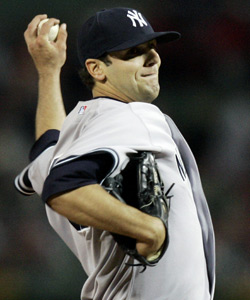
CHASE
CHASED, YANKEES INTO FRYER
Today the Yankees consummated a minor deal, in at least two
senses of the word minor, swapping lefty Chase Wright, who had been designated
in the aftermath of Andy Pettitte’s re-signing, in return for
catcher-outfielder Eric Fryer, formerly of the Brewers.
Initially this might look kind of exciting because Wright
was a low-strikeout type who was unlikely to live down the historic 2007 game
against the Red Sox in which he allowed consecutive home runs to Jim Rice,
Carlton Fisk, Carl Yastrzemski, Ted Williams, Felix Mantilla and Don Buddin,
whereas Fryer batted .355/.407/.506 in the Sally League last season. Steal,
right? Wrong. You don’t get a major prospect for Chase Wright unless the
general manager on the other side of the table has a serious drinking problem
and no oversight. Fryer was 22 last year and had spent three years in college,
so he was a bit experienced for Low-A ball. He had a great year, but we should
expect the pitching to catch up to him in a big way as he moves up. According
to Kevin Goldstein of Baseball Prospectus, Fryer’s swing is also very
complicated, which makes scouts skeptical about his future.
The other problem with Fryer, and it’s odd to call it a
problem, is that when we say catcher-outfielder, we really mean “former
outfielder.” That, at least, is how the Brewers viewed him, increasingly
playing him behind the dish as the season wore on. If the Yankees also view him
as a catcher, it’s difficult to see how he’s going to get any playing time in, as
he’s at the same level as the two best prospects in the Yankees organization,
Austin Romine and Jesus Montero, both of whom happen to be catchers. They can’t
all go up to Tampa
this year, be rotating catchers and sing in three-part harmony. The assumption
here is that Fryer gets pushed back to an outfield corner, which puts pressure
on him to keep hitting — assuming he showed decent defensive abilities
as a catcher, he wouldn’t have to post another 900 OPS to make it. A much
greater level of skepticism greets an outfielder’s bat.
All of that said, given that the Yankees had no plans for
Wright, a fringe part, getting someone for him that at least looks good isn’t a
bad thing, particularly since said someone is a position player. The Yankees’
system needs more bats. Adding prospects through trades is something that Brian
Cashman will need to prioritize to the best of his ability in the near future,
as last year’s draft, which eschewed a number-one or number-two pick, was a
disaster, and this year’s draft, which has been stripped of picks by all the
free agent action, promises to be thin as well. You can’t feed the farm system
scraps for two seasons and not have it hurt you, regardless of how many free
agents you sign.
It should be noted that one of the reasons that Mark
Teixeira is such a great signing for the Yankees is that next year’s free-agent
class is largely devoid of Teixeira types, twentysomethings at the top of their
games. Top position players likely to hit the market include Carlos Delgado,
Aubrey Huff, Mark DeRosa, Brian Roberts, Chipper Jones, Jason Bay
(bet on the Red Sox tying him up before then), Vlad Guerrero, Matt Holliday…
and Johnny Damon and Hideki Matsui. The Yankees offense looks like a light
offensive unit now. With little help coming from the farm (Austin Jackson
doesn’t look like an impact player at this stage), little on the free agent
market beyond declining vets and re-signing Damon and Matsui, probably an
multimillion-dollar act of wishful thinking, the unit could achieve a helium-like
quality by 2010…
…Which is to say that Mr. Cashman should keep trading those
extra pitchers for bodies with bats, as many as he possibly can.
THE PLACE
WHERE MY FEET ARE
I neglected to mention yesterday that I have a new edition
of my history
column up at Baseball Prospectus, this one talking about the current
free-agent crop and the decline in attendance during the Great Depression. At the same site, my colleague Christina
Kahrl revives the
Jeter-to-center debate. If you’re not a BP subscriber but are an ESPN
insider, then the same piece on Jeter can
be read here.
Finally, for those that would like to ask me a question or
ten, I’ll be doing a live chat at BP this Friday, February 6, at 1 p.m., EST. I hope to see you
then, but if you can’t make it, you can still get your questions in ahead of
time at the URL above.
Quick bits and comments from my mind
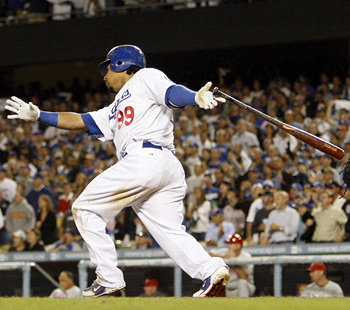 ? The Manny Ramirez situation is one of the most fascinating offseason dramas in years, the latest development being that Ramirez rejected a one-year, $25 million deal from the Dodgers.
One wonders how much money it would take to get Ramirez to sign a one-year deal. I am reminded of a $50 million offer to the Beatles to reunite for a single concert in the mid-1970s. Even John Lennon was up for it at that price. A long-term contract can bring a player security, but if you make enough money in a single season, that IS security. Such an arrangement might be best for Ramirez and for the teams, as he can continue to demand a higher premium for playing a year at a time, while his teams will have some assurance that he will actually come to work.
? The Orlando Hudson in center field idea resurfaced yesterday both in the comments and (by implication) from this interview on the MLB network with Hudson himself, and in this bit from Ken Rosenthal, who says, “[N]either the Mets nor Yankees currently has an opening at second base, but [Hudson] seems to be banking on one of those clubs pursuing a creative solution.” Swell. Let’s hope the Yankees don’t do anything unconventional. First, it’s always novel when you have a center fielder play center field, as opposed to a second baseman, a dancing bear, or a giant eggplant. Actually, if they go with the dancing bear, put me down for season tickets. Second point, one I’ve raised before: Hudson is a career .277/.336/.411 hitter on the road. This is a break-even performance at either second base or center field, but at least if Hudson is at the keystone a team has the benefit of his good defense. In center field you might get good defense or you might not, but my guess, based on a lifetime of seeing this midcareer moves largely blow up (call it the Juan Samuel Observation) would be “no.” Thus: average bat at best, defense questionable… Melky or Gardner is a better bet, and cheaper, too.
? Those that suggested moving Robinson Cano to center field: I again invoke the Juan Samuel Observation. I then also note that Samuel was really fast and Cano is slow enough that around the time he hits 30 I expect us to be discussing how he’s now too sluggish to play second.
? Melky Cabrera’s late and close numbers don’t impress me at all. That he hits a powerless .296 in tight games is nice, but it doesn’t make up for the fact that he’s not been very useful in the other 85 percent of his career plate appearances. Jim Edmonds has a lower batting average in such situations, but has also hit 33 career home runs. Which do you suppose led to more victories? Melky’s odd single or Edmonds’ odd homer? Also, re projections: if a projection system says that Melky is going to reach base 33 percent of the time, and Edmonds is going to reach base 33 percent of the time, but that the former will slug .380 and the latter .420, there isn’t much of an argument as to who that system thinks will be more productive. Now, other Edmonds critics have pointed out his declining range, and I buy that. However, that’s why you keep Gardner or Cabrera on the roster, to caddy for the guy. The only problem with the Edmonds plan is that he also needs a platoon partner, and the Yankees don’t have one on hand.
? Of all the commercials on the Super Bowl, the one that has really stayed with me was one of the first. It basically said, “If you’ve been shafted by the economy, try selling cosmetics.” It frightened me in that I could hear ghosts of 1932 saying, “If you’ve been shafted by the economy, try selling apples.” Brrr.
Gardner, Cabrera might not cut it for Yanks
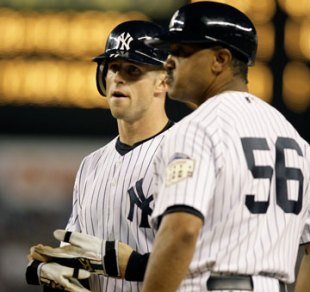 GARDNER-ING AT NIGHT
My associates at Baseball Prospectus have released the weighted-mean PECOTA
projections, which means I can talk a bit about some of the forecasts
therein.
PECOTA sees Brett Gardner batting .253/.339/.351 and sees
something like a full season of playing time coming down the pike. Many
of the other projection systems (Fangraphs does
us the service of gathering those in one place) are of like mind — if
you average their forecasts, you get .262/.343/.361. PECOTA figures
Melky the C at .267/.326/.376, while the other systems compiled at
Fangraphs average out to .274/.334/.390. Last year, the average Major League center fielder batted .268/.334/.420, which means that both of
these fellows would have to exceed their median projection for the
Yankees to break even, putting aside the possibility of crazy-good
defense. It should be noted that the Gardner projections are a good
deal more speculative than the Cabrera projection given that the former
has just filtered up to the bigs. The Cabrera projections are
speculative in their own way, assuming that he’s going to go back to
what he was doing after a year of misery.
My conclusion: Jim Edmonds
would make a nice one-year rental, playing four days a week. Edmonds,
being neither a Type A nor type B free agent, is still available to the
Yankees.
SMALL BITS
The Cubs made two deals today with minor ramifications for the American League, as both of the pitchers they detached are heading to the Junior Circuit. The A’s acquired reliever Michael Wuertz and the Orioles picked up starter Rich Hill.
Wuertz heads to Oakland in return for two Minor Leaguers, outfielder Richie Robnett and infielder Justin Sellers, both of whom are so talented that you are unlikely to ever hear their names again. The former has a .257 career batting average and the latter .256, and neither has the other tools to make up for their general inability to hit with consistency. As such, the A’s get to decorate the back of their bullpen with Wuertz, a slider specialist who tends to be harder on lefties than on righties. Wuertz always seemed like the first guy that the Cubs would bounce back to Triple-A if they experienced a roster crunch, but as he was out of options that source of amusement was closed to them, hence the trade.
Hill is a depressing case, a pitcher who seemed like he’d be a five-year fixture after strong work in 2006 and 2007, but he sailed over the edge of the world in 2008, completely losing his control. He walked 18 in 19.2 innings at the major league level and 44 in 47.2 innings in the minors. The Orioles agreed to give up only a player to be named, the identity of which is no doubt contingent on their ability to bring Hill back to his senses. Here’s hoping they have to give up a good prospect. Yeah, I know they’re division rivals of the Yankees, but come on — it’s the human thing to do.
Foresight proved 20-20 with Torre
 OZYMANDIAS: THE MEMOIR
I’ve been reluctant to offer much conversation on the Joe Torre-Tom Verducci book because I’ve not read the thing (get your act together, Doubleday publicity!) and of all the things the world needs, it’s not another uninformed commentary on that bloody book. Nonetheless, I feel like I can’t let the Greatest Story of Our Time pass without a few words, at least until I get hold of the holy pages. Given what I’ve heard so far of the “controversial” passages, I feel validated.
Longtime readers know I jumped off the Torre bandwagon a few years before he actually left town. I was a convinced fan of Torre’s after the buttoned down and seemingly know-nothing Buck Showalter epoch. However, as I wrote here many times, I became convinced that Torre had outlived his usefulness. He was not a builder and he wasn’t a strategist. His main skill was creating a professional atmosphere, something that the organization had proved incapable of doing over a period of nearly two decades.
However, Torre’s ability to do that ebbed, and now the new book suggests that this ability was largely mythological. Torre seems to blame Brian Cashman for foisting too many irregular-size players on him, but this gets into circular, chicken-and-egg territory: were Cashman’s players unable to blend, or did Torre fail to blend them? For every end-of-the-line gamble Cashman took, like Kevin Brown, where no manager would have been able to save the situation, there have been others who left New York and went on to productive work. Perhaps more importantly, in 2008, Joe Girardi minted more Major League relievers than Torre did in his entire 12-year stay.
Torre’s failing judgment climaxed with Alex Rodriguez. When Torre batted A-Rod eighth in the fourth game of the 2006 ALDS, he publicly demonstrated that his usefulness was at its end. That was actually the second such gesture that year, and the first of his self-immolating collaborations with Verducci, when he conspired in the swift-boating of his own third baseman in the pages of Sports Illustrated. If you will recall, A-Rod had slumped that August, the boos were again raining down and Torre was at a loss. At that point, Torre enabled the Verducci story, which then waited like a time bomb for Rodriguez to emerge from his slump and enter the playoffs. It went off just in time to kneecap A-Rod at the most important moment of the season.
With this helpful stab in the back, Rodriguez was “motivated” right back into his slump.
Not satisfied, Torre then jerked the future Hall of Famer up and down the lineup throughout the short series. Where a player hits over the course of four games isn’t all that important, but the psychological impact of those moves is. Rather than leave Rodriguez alone, and minimize the stress on his player, Torre did everything he could to make him the story.
If Torre wasn’t an Xs and O’s manager, if he couldn’t get young players into the lineup, and he was unable to communicate with the players the GM was giving him, no matter how difficult, then what did he bring to the table besides an increasingly illusory and irrelevant gravitas? Again, not having read the book as of yet, I cannot draw any firm conclusions, but from A-Rod to his bitterness about not getting Bernie Williams back in 2007 (another example of hideously poor judgment, one he apparently tries to excuse by character-assassinating Carlos Beltran, the player who would have displaced the beloved Bernie) this tome seems to be one of the greatest examples one can think of a man doing all he can to destroy his own reputation, the myth of his own greatness. Instead of proving his indispensability to the Yankees, Torre has made a persuasive case for why they had to let him go.
Let us review
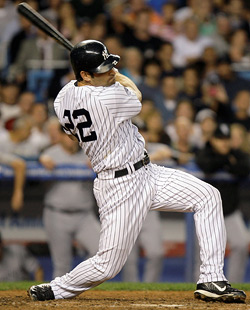 At the risk of boring the more advanced members of the class, I want to revisit Xavier Nady one last time before midterms. Your grade, and that of the Yankees, depends on your ability to answer several true-false, multiple choice, and fill-in-the-blank questions about Nady, so it’s imperative that we come to grips with the subject. Please open your text books/hymnals to page 355 and sing along to Buddy Holly’s classic “Maybe Nady” as we repeat together these key facts:
Nady is 30 years old and is a career .280/.335/.458 hitter. Despite his 89-game surge with the Pirates and brief hot streak with the Yankees, he is at this late stage of his career to be any better than those career rates in the future. He has never rated as a great glove. Per 162 games, he has averaged 30 doubles, one triple, 21 home runs, and 34 walks.
Last season, the average Major League right fielder hit .276/.347/.451. In 2007, the average right fielder hit .281/.351/.453. In 2006, the rates were .277/.347/.460. In the American League East, the standard is a bit higher, given that the competition lists the J.D. Drew/Rocco Baldelli combo, the Matt Joyce/Gabe Kapler combo, Alexis Rios, and Nick Markakis. Only one of the four, the Rays’ Joyce-Kapler mélange, may not exceed the averages. Should Nady play every day in right field and snap back to his 2006-2007 .334 on-base percentage, the Yankees would be operating at a significant deficit relative to the competition.
Now, Nady is not without value, because Johnny Damon is getting old and Nick Swisher has his limitations, and when most teams have to bench a starting corner outfielder due to injury or fatigue, they tend to wind up with Reggie Abercrombie out there, and the road to hell is paved with Reggie Abercrombie. The road to the postseason is paved with having a substitute like Nady. He’s not quite good enough to be a starter on a winning team, but overqualified to be a reserve. The smart teams will hold him to 300 at-bats or so and/or flip him to a team whose starter is even further below average than he is.
In short, Nady is not the kind of player a championship-caliber team plans on starting unless they have no other alternatives. The Yankees have alternatives. It could be Swish Nicker, who has comparable power to Nady and will out-walk him by 50 or 60, so his batting average need not be better than .250 to surpass X-marks-the Sub, or it could be a player we kicked around in yesterday’s installment, like Adam Dunn. They Yankees can flip Nady or not. They can pay the freight on keeping him and have themselves a very positive role player. The one thing they shouldn’t do is mistake his little contribution as something worthy of a starting role.
Review complete. Close your notebooks. You can play silent ball for the rest of the period.
SHOW THREAD: BACK IN THE BUNKER TONIGHT
I’m off to the Death Star-like YES HQ for another stay in the Dot-Com Bunker on the Hot Stove show. If you’ve got any comments, I’ll be checking the comments right up to and even during show time, so get ’em in. Any topic is fair game, including Bob Lorenz’s haircut — but only in a constructive way. Bob is the most tenderhearted regional sports network host you’ll ever come across. Those calloused NESN guys can’t touch Our Bob for generosity. It’s very difficult to see unless you have a top of the line high-def set, but on every Yankees postgame, Bob has a dish of candy out on the desk just in case any of you happen by the studio. He’s that kind of guy. See you at 6:30 p.m. EST.
Pettitte and the perfect team
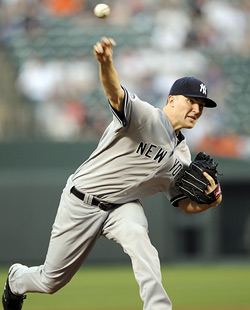 I said a good deal of what I wanted to about the return of Andy Pettitte in yesterday’s installment, and you said what you had to say in the comments. Then, in Brian Cashman’s phoner after the deal was announced, he echoed some of your comments about depth and how at some point the Yankees might still need to call upon one of their younger pitchers.
Still, Phil Hughes (pictured) and pals have clearly been relegated to Plan B, and that’s not necessarily a good thing. The Yankees are well fixed for Minor League pitchers, so depth was unlikely to be an issue. More pressing is the need to give those pitchers Major League experience so that when Chien-Ming Wang gets hurt again, or Pettitte’s always troublesome arm acts up, or A.J. Burnett experiences whatever happens to Burnett, they are ready to step in with more consistency than they showed in 2008. It is not overly optimistic to think that last year was the growing pains year for Hughes and Ian Kennedy, while 2009 could be the year they begin to deliver. Yet, that possibility seems to have been aborted.
Yet, there is no reason to be glum. On paper, the Yankees have put together a team that is going to be very tough to beat. If everyone does what they’re supposed to do, the rotation will be the deepest in the game, the bullpen will be solid, and the lineup… Well, the lineup may still have some problems, even if Jorge Posada is healthy. Robinson Cano needs to snap back, Derek Jeter needs to find the Fountain of Range — I mean Youth, and the outfield could be a complete wipeout.
That leads me to the question of the day, and one which I will probably center my Hot Stove show comments around this Thursday: on the phoner, Mr. Cashman was asked if he was now ready to retire for the winter. “I wouldn’t expect anything further at this stage, or anything significant,” he said.
Here are my questions: Should the Yankees be done? Has Cashman done enough? How would you evaluate the job that he and the Yankees did in preparing the team to contend this year? I’m not sure what the structure of this week’s show will be, but if it all possible I will read selected answers and respond on the air.
A-ROD/A-FRAUD/A-FROG/WHATEVER
I’m holding my comments on the Joe Torre/Tom Verducci book until I’ve actually read it, but it’s worth briefly revisiting Alex Rodriguez’s supposedly un-clutch performances. I can’t defend the guy’s personality or his teammates’ perception of it. That’s a different matter from what he does on the field. The fact is, except perhaps in very limited cases of piling on, all the runs generated by a player count. We make judgments as to a hit’s value using information that we could not possibly know at the time, which is to say the game’s outcome. It is true that if an A-Rod hits a home run with his team down 5-0 in the seventh, it’s likely that the home run won’t have any impact beyond the back of his baseball card.
However, game conditions change, and scores affect player behavior and managerial decision-making. A three-run shot with a 3-0 lead moves a game from in doubt to safe. That single tally in the face of a big deficit may bring a closer into the game who otherwise would have rested, or serve as the foundation block of a rally. You can’t really know until it’s all over. Naturally, it would be preferable if A-Rod chipped in a few more two-run shots when the team was down 1-0, but it is incorrect for anyone to imply that his stage fright in some of the big spots means that the rest of his contribution is without value.
Pettitte-O-Mania
 As I take pen in paw here, reports are circulating that the Yankees are close to an agreement with L’il Orphan Andy Pettitte. This will no doubt make Andy’s many fans very happy, and for good reason, as he should be an asset this season. As I’ve written here several times over the course of the offseason, some of his second-half fade was attributable to very poor defensive support. It will also be fun to watch Pettitte add to a career which, while not of Hall of Fame quality, fits nicely into the wider but still relatively exclusive “Hall of the Very Good.”
That said, I do have some trepidation about the Yankees not reserving a spot for youth in the rotation. If Pettitte pitches the Yankees to a pennant, that’s one thing, but if not, at the end of the year he will (presumably) ride off into the sunset, leaving the team with nothing but memories. If Phil Hughes or Alfredo Aceves or anyone young was capable of giving the team something within ten percent of what Pettitte can, then the greater value would be in that pitcher gaining experience rather than the Yankees having a Cadillac in the Pinto part of the rotation.
ONE MORE MOLINA BIT FROM THE COMMENTS
…Before I close this subject until such time as Jorge Posada shows us the condition of his arm. This one is by “amdream23:”
You make two logical fallacies about Molina who would be fine as a full-time catcher with the Yankees, given their other hitting. You say he saved five runs based on throwing out 13 or so baserunners. But he didn’t play a full season so you should project that out further.
Second, what about the baserunners on first that didn’t try to steal since they knew he has a good arm? Isn’t there a deterrence effect? Rather than Molina, look at A-Rod’s failures. He excels in hitting mediocre pitching and padding his stats but chokes against good (never mind great) pitching. He’s another Winfield. The Yankees will never win in the playoffs with A-Rod anchoring the team.
Thanks for taking the time to comment, “am.” I thought a logical fallacy was something like assuming “after therefore because” or saying that fish can swim and so can Derek Jeter, therefore Derek Jeter must be a fish. No? I’m going to ignore the A-Rod bashing because it’s a non-sequitur in a discussion of catching, seems to suggest that we should somehow think Molina a better player than A-Rod. Maybe I’m misreading that, but it’s just weird. Finally, let us say this of Dave Winfield: yes, he had a miserable 1981 World Series, but not too long after leaving the Yankees he drove in the Series-winning runs for the ’92 Jays. Winfield was a terrific player and a lot of fun. His big sin with the Yankees was that he couldn’t pitch.
One logical fallacy I would like to stomp dead is the one in your first sentence: “Molina would be fine as a full-time catcher with the Yankees given their other hitting.” No. We should never look at it like that. It’s the worst kind of complacency, first because it says that a team can settle for mediocrity at a position provided that it did its job at the other positions, and second because it makes an assumption: “given their other hitting.” Every once in awhile, as with the Yankees in 2008, a team will spawn a couple of unexpected replacement-level hitters and suddenly the guy you could tolerate becomes the straw that broke the lineup’s bat — er, back. No, make that “bat.”
Let’s deal with MAD, Molina’s Alleged Deterrence. A full-season workload for most catchers is about 1200 innings, or about 140 full games. Molina caught 737 innings last season, so he got in about 60 percent of a full season. The Yankees played 1441 innings in total, so he took just a fraction over half of the team’s catching load. Now, here’s a very simple way of looking at things, but this is my take on all the baserunners that might not have run because Molina was in the game: they ran anyway. The average AL team saw 129 stolen base attempts last year — 94 steals, 35 caught stealing. Half of that would be roughly 65 attempts — 47 steals, 17 caught. Molina, though, saw 75 stolen base attempts. Another way of looking at it would be to say that the AL least year had .80 stolen base attempts per nine innings. Molina had .92 attempts per nine in the games he caught. Perhaps a lot of that was the pitchers, and had Molina not been catching even more runners might have gone, but that would be pure supposition.
Your request that we give Molina credit for the half-season he didn’t play won’t make him look any better. As above, he played roughly half a season, starting 81 games behind the plate and relieving in 16 more. If we simply double his playing time, we have a player who saved ten runs in dead baserunners and was roughly 30 runs worse than the average catcher and maybe 40 runs worse than the average hitter. Giving you more of Molina doesn’t make him any better; it just increases the damage.
FIXING A HOLE
I have a “Flight of the Conchords” song stuck in my head. I’m off to clear it out with some Beatles.
Some random bits gleaned from the comments
 Jlevy1112 asks: What about the Yankees two highly rated catching prospects in the Minor Leagues, Jesus Montero and Austin Romine? If Posada can’t make his full complement of starts, could one of these two be called up to join the team? I seem to remember they both have nice offensive numbers in the minors. If the Yankees traded for a Saltalamacchia, Teagarden, or Miguel Montero where would that put the aforementioned catching prospects?
Both Montero and Romine are both very far away. As you probably know, Montero may never arrive as a catcher, as he’s a hulking giant of a kid who doesn’t fit very well behind the plate. He has sufficient talent as a hitter that he should be able to make the transfer to first base — I keep thinking of Carlos Delgado, who actually made it to the majors as a catcher before everyone said, “Whoa, that’s not going to work,” and he went over to first base (after a brief stop in left field) and proceeded to hit (to date) 469 home runs. I’m not saying that Montero is going to be a borderline Hall of Famer — that would be premature — but that his career so far has echoes of the Delgado story.
In contrast to Montero, Romine seems to have the defensive tools to remain behind the dish, and he had a terrific finish to his season, punching out eight of his 10 home runs in the final two months of the season. Now, both of these guys are very young. Neither can legally buy a beer, with Montero having turned 19 around Thanksgiving and Romine reaching 20 less than a week earlier. Both finished the year at Low-A Charleston, which means they’re a big three levels from the majors, including the hard jump to Double-A, which many catchers do not survive.
If the Yankees traded for one of the players you mentioned, it wouldn’t harm these players at all given that they seem to be at least two years away, more likely three. As the younger players started to become expensive, the Yankees would have the option of moving them out and starting over. And, of course, Montero might not be a catcher anyway. We’ll soon see what the presence of Mark Teixeira means for his future.
Now, a lot of writers would ignore or ban the following crank, but you know, I find guys like this “42Yankee” kind of amusing.
THIS PORKY SO CALLED SPORTS WRITER NEEDS TO RETIRE AND GO AWAY, FAR,FAR AWAY. THE YANKS SHOULD HAVE NEVER GIVEN POSADA THE BIG CONTRACT, AS ALL HE HAD WAS A LUCKY YEAR AT BAT IN 2007. HE COULDN’T THROW OUT ANYBODY. AS FAR AS MOLINA IS CONCERNED, TELL US US CHUBBO GOLDMAN:::: HOW MANY GAMES DID MOLINA WIN BY THROWING OUT BASE RUNNERS? MORE THAN A MORON LIKE YOU CAN COUNT!!!!! NOW PLEASE RETIRE AND GO AWAY, FAR, FAR AWAY. MAYBE THEN THE YANKEES WILL FIND A REAL SPORTS REPORTER, OR BETTER YET GO JOIN THE REDUX WRITERS TEAM, AS YOU WOULD FIT RIGHT IN AT FENWAY!!!!!
1. “Retire?” Dude, I’m 38 years old. I have a mortgage to pay, two kids to put through college, and most importantly, I’m having way too much fun.
2. “Porky.” Well, that’s not a charitable description, but it’s not unfair. I’ve been working on it, including hiring a personal trainer to develop a workout program for me. Weight has been a thing I’ve fought my whole life. I can show you pictures where I’m kind of svelte and then others that are like, well, now. There are exculpatory medical factors, but they don’t really change the big picture, pun intentional. Anyway, it’s something that bothers me, but unlike “42Yankee” I’m not seven years old. Taunting my physical appearance as a way of attacking my ideas doesn’t really register as anything more than a pathetic, helpless gesture, an Internet wuss’s version of emotional terrorism. Nice try.
Back about my sophomore year of high school I guess I was having one of my heavier seasons. At this time, some friends and I were in the habit of scraping together teams of for pick-up softball or baseball games. We were in a fairly large school, so it wasn’t too difficult to come up with 18 or 20 kids who could show up at the park on a Saturday or Sunday morning and play six innings or so (the scores were usually too lopsided to go nine). One of my best friends threw very hard for a 15-year-old, and he and I made up the battery.
One day after school, he and I went out to a neighborhood park to practice. I was squatting down, catching his fastball. Parenthetically, I never was very good at catching his offspeed stuff, and one day a year or two later he crossed me up and unexpectedly threw something that broke sharply downward, ticking off my mitt and hitting me on the foot, mildly fracturing it. One of our class idiots wandered by — I would like to call him the class idiot, but as I said it was a large class and we had several — and came over to see what we were doing. After a few minutes of watching, for no particular reason he started aiming a series of very weak fat jokes at me, lines that even a third grader, or “42Yankee” here, might find too childish to use.
This was more irritating than effective. The guy had taken up a position a few yards behind me and was endlessly chattering as I caught the ball and flipped it back to my pal, the pitcher. I wasn’t bothered, but my friend was deeply offended on my behalf. He warned Class Idiot, but the babble continued. I remember what happened next vividly. My pal wound up and fired with something extra on the ball. “Sssss” went the ball as it went over my head. Behind me, the Idiot said something like, “Hey, are you an elephant or — aaagh!” I turned around. There was another “Sssss” sound going past me. I ducked, but not before seeing a fastball come within a hair of hitting the idiot in the head.
I’ve rarely been more moved in my life. Here was my friend about to turn this guy into Ray Chapman because he had attacked me. Simultaneously, I also knew that if I cared at all about my friend, that I couldn’t really just watch it happen, because friends don’t let friends go to jail for murder. I shouted that it wasn’t worth it, that the Idiot should be allowed to live, but before the message could sink in, one more fastball lazered just past the bridge of Idiot’s nose, at which point he fled, threatening to tell his mom. How can I be bothered by weight jokes when I have friends like that?
3. “42Yankee” is correct that in an ideal world the Yankees should not have given Posada a four-year deal after 2007, because his age and position made him even riskier than would be typical when you’re booking a player for seasons 36 through 39. That’s the only argument against it, however, and if the deal had been for only two years there wouldn’t be any grounds for criticism at all. However, even the four-year deal has to be excused because Posada had all the leverage in the situation. The Yankees weren’t about to get Joe Mauer away from the Twins, so if they didn’t want to take a big, giant hit at catcher, they had to cater to Posada’s demands. I wrote at the time that they were paying for four years to get two good ones, and perhaps that will still be the case.
4. “42Yankee” is, however, spectacularly wrong when he implies that the Yankees were solely overreacting to Posada’s 2007 season. Yes, he had an unusually belated peak and an uncharacteristically high batting average that season, but he was also a player who had had three other seasons with an OBP above .400, was a five-time All-Star and Silver Slugger winner as the best hitter at his position. Among catchers with 5000 or more career plate appearances, Posada ranks fifth in OPS, trailing only Mike Piazza, Mickey Cochrane, Bill Dickey, and Gabby Hartnett; fifth in on-base percentage (Cochrane, Wally Schang, Dickey, and Piazza are ahead of him); f
ourth in isolated power (behind Piazza, Johnny Bench, Javy Lopez). He even ranks 17th in batting average. If he can hit at all this year, he’ll break into the top 10 in home runs by a catcher, and if he plays something like two more full seasons he’s going to have drawn more walks than any catcher to play the game. Posada may or may not be a Hall of Famer, but as a hitter his peers are all guys with plaques.
I think the most amazing thing about “42Yankee” having written that the Yankees should not have re-signed Posada is that he did so despite having the evidence of what a Posada-less Yankees team looks like. We call it the 2008 Yankees, and they don’t make the playoffs. There you go, “42” — thanks to Posada’s shoulder, they did it your way. Look how it wound up. Congratulations.
5. How many games did Molina win by throwing out baserunners? The easy answer is, not as many as he lost by making outs. First, The Yankees went 43-38 in Molina’s starts, which is a .531 percentage. They were actually a game better with other catchers in the lineup, which says something given how miserable some of the other guys were. Now, I see that one of our correspondents ran through some very simple math for you in the comments, but let me try taking it from a different angle. Last year, Molina caught 44 percent of attempting basestealers, or 33 in 42 attempts. The average stolen base success rate was 27 percent, so in a similar number of attempts, we should have expected the average catcher to catch 20 or 21 baserunners. Right away we have a problem with your valuation of Molina, because his real defensive worth becomes 13 dead baserunners. On average, four or five of those would have scored. That’s what you’re touting here, a defensive benefit of five runs. Given that a generous estimate of his offense would have him worth something like 20 runs less than the average player and 15 runs less than the average catcher, Molina is still deep in the hole. The Yankees didn’t get back to even on those ex-baserunners. Surely, “42,” you can recognize that games won and lost are a matter of those scored and allowed, and that had the Yankees scored 20 more runs in Molina’s plate appearances, but allowed five more, they still would have been close to two wins better off?
6. “Chubbo,” “Moron.” I don’t mind debating with third-graders, Hall of Fame voters, and members of Congress.
7. Here’s that “retire” stuff again. You know, my boss at YES told me that the current caricature on the site made me look too old. Now I believe him. Fortunately, the great Rich Faber will soon be supplying us with some new art. By the way, I’ve never claimed to be a “sports reporter.” Nowadays people tend to call me a blogger, but having opened the Pinstriped Bible in the days before blogs, I’ve always thought of myself as a columnist, although the content here has always been blog-like. My BP colleague likes to use the term “analyst,” and maybe that works too, but in the final analysis I’m just proud to be a writer and happy that I get to engage the public on a regular basis. For now, Chubbo the Columnist is going to retire to the kitchen for some pasta and then do some sit-ups. Thanks for writing, “42.” I look forward to your next note on how Melky Cabrera is more valuable than Mickey Mantle, or perhaps something on how much the team misses Tony Womack’s baserunning capabilities.
One for Abreu and one more for the road
 I spent most of the winter yelling at the free agent market to hurry up, hurry up! When you’re writing a season preview you want all the moves to happen as quickly as possible so your book is as up-to-date as it possibly can be when it hits shelves. All my goading got Mark Teixeira and CC Sabathia signed, but it hasn’t budged Manny Ramirez, Adam Dunn, or any of the dozens of other free agents still on the market. Indeed, this winter has been one of the slowest to develop since the post-strike season, when any number of homeless players began Spring Training in a separate camp for displaced persons. With so many players still available, there are many teams that could look quite different when Spring Training convenes than they do now.
It has long been argued that teams should not shoot themselves in the wallet by overpaying for middle relievers, spot lefties, and the like, because those players are generally so inconsistent, and their roles frequently so marginal, that it doesn’t make sense to pay a premium for their services. With the exception of the odd Mariano Rivera or Joe Nathan, 75 percent of relievers could be shoved into a paper bag at the end of each season and picked out at random until each team had a full bullpen compliment, and the Majors would probably see the exact same distribution of good and bad bullpens as it does now. With the sour economy, it seems likely that teams have finally acquired the discipline to do this, as well as extend the principle to any other suspect class or individual player. This seems the most likely answer for why, for example, so many reasonably good spot lefties are on the market. It’s not that LOOGYs have gone out of style, but that paying them has. The players in turn must adjust to the new reality and diminish their expectations — which, poor lambs, means they’ll still get millions of dollars.
One player who has almost certainly been harmed by the New Fiscal Realities is Bobby Abreu, a player who is undoubtedly looking for a multi-year contract with which to close out his career. So far it ain’t happening, and it’s probably a safe bet that the one-year offers haven’t been to Abreu’s liking either. Say you get hooked into Abreu for his age-35, -36, and -37 season. If Abreu stays right where he is, you’re in good shape, particularly if you’re asking him to be your designated hitter. Unfortunately, 2008 was the kind of termite season that breeds doubters.
It seems strange to say something so critical of Abreu’s .296/.371/.471 season, but there’s a lot to be concerned about. Abreu hit only 20 home runs, not an awe-inspiring total, and while he still took a solid 73 walks, he was less patient than at any time in his career. These two facts — lower echelon power and ebbing patience — mean Abreu’s production will depend heavily on his batting average, and batting average is the least consistent aspect of any player’s production. Throw in a home-road split favorable to Yankee Stadium and signs of declining ability on the basepaths, and there is real cause to worry about getting stuck.
Abreu has been further damaged because 2008 was the year that his defensive problems changed from something that those eccentric fans in Philly made fun of to something that was visible to all and was quickly perceived as a real problem. When Gary Sheffield played right field for the Yankees, I used to make fun of his lack of range and oddly circuitous routes in the outfield. On fly balls to medium or short right field he sometimes looked like water swirling down the drain. Abreu makes the Sheffield of a few years ago look like a master defender, in that Sheffield played his position badly, but at least he attempted to play all of it. Because Abreu cannot go back, only forward, he gives up a whole section of his zone that a right fielder without this unusual handicap would cover. Even a poor outfielder would catch the odd ball at the wall.
This estimation of Abreu’s defense likely restricts him to the American League, where he may be hurt by the fact that a younger, more versatile (sort of), and more productive player in Dunn is still hanging around the market, not to mention Ramirez. A solid year from Abreu could be a godsend for the Angels after losing Teixeira. He could probably help the A’s, although with Matt Holliday in left, two designated hitters in Jason Giambi and Jack Cust, and a first baseman they’d like to get back on track in Daric Barton, it’s hard to see where everyone is going to play. If the Mariners would let Jeff Clement catch and push Kenji Johjima to the bench, Abreu would be a good fit in the Emerald City. The Rangers have this odd idea about letting Nelson Cruz play in right field, so he probably wouldn’t fit in there, and their DH spot is occupied by Hank Blalock.
These are not great choices. There is no automatic fit. Nor is Abreu a good fit for any of these teams at three years, and maybe not even for two. Abreu never got his due as a great player at his peak, but now his game has eroded to the point that it’s far too late to give him the rewards his resume would suggest that he deserves.
Another note on Posada
 Spurred on by Buster Olney’s mention of this same topic in his blog posting today (I shan’t link; Olney is, shall we say, persnickety about who he links to, so I shall be the same). Olney writes: “If [Jorge Posada] can’t catch, he will have to get the bulk of his at-bats as a designated hitter, compelling the Yankees to press for a trade of one or two veteran hitters, among Xavier Nady, Nick Swisher and Hideki Matsui.”
Seems like they’re working on the latter anyway, as well they should given the declining value of two of the three. As for the designated hitter part of the story, let’s examine that. Last year, the aggregate rates for the DH position were .256/.339/.435, with a home run hit every 24.4 at-bats. The previous season they were .268/.355/.447 with a home run every 25 at-bats.
Parenthetically, the DH numbers always seem to be less than you would expect. The American League as a whole hit .268/.336/.420 in 2008. As a group, the players whose sole job it was to provide offense weren’t a whole lot better. It’s tempting to conclude that AL managers aren’t doing a very good job of designating good hitters, but it that wouldn’t be completely fair; the family of designated hitters had a rough year. Aubrey Huff and Milton Bradley were great, and David Ortiz was good when he wasn’t hurt.
Then there were some rude surprises. Jim Thome struggled early, pulled it together for three months, then slumped again. Matsui was off to a great start when his knees began affecting his production, and his post-injury hitting was even worse. Billy Butler and Jonny Gomes didn’t hit up to their abilities (Butler turned it on in the second half, but it was too late to save his overall numbers). Frank Thomas and Jose Vidro hit the end of the road, and Gary Sheffield hit the Last Rest Stop Before the End of the Road.
The previous year had Ortiz having a monster year, as well as productive seasons from Thome and Jack Cust. There were also some real disasters. I had blocked Shea Hillenbrand out of my memories of the 2007 Angels. He hit .238/.258/.320 as a designated hitter. Whichever team executive thought of Hillenbrand and let him putter on for a quarter of the season should have been cashiered. As planning goes, handing your team a Hillenbrand for its DH is not too dissimilar from those Civil War supply officers who sent their soldiers into battle wearing shoes with soles made out of old cupcake wrappers held together by cat spit.
In the Olney scenario, the Yankees wouldn’t be going with Hillenbrand, or Monty Meigs at DH, but Posada. The question is, if Posada is restricted to DH, can he give the Yankees average or better DH production, something along the lines of the league rates we’ve seen — let’s say a .270 average, .350 on-base percentage, and .440 slugging percentage?
If we go by Posada’s career rates, the answer should be an easy yes. He is, after all, a career .277/.380/.477 hitter. Yet, we’re talking about a Posada that is now 37 years old and is coming off of an injury which affected his swing. As such, Posada’s future is something of a black box. We can look at projections like those at compiled at Fangraphs — Bill James’ system figures .277/.378/.455, CHONE forecasts .266/.363/.434. Posada will hit .285/.374/.466 in Marcel’s prognostication. We should also add PECOTA to that. I can’t tell you exactly what it says just yet, but I will say that it’s a good deal more pessimistic than the rest. It’s also the most conservative on playing time. The projection systems, in the order that I listed them, see something like full-time play, almost full-time play, something like 60 percent play, and, last, PECOTA with something like half a season of playing time.
In Sabermetric circles there is often debate about the relative accuracy of these systems; as a BPer and the co-author and editor of a book which bills itself (tongue in cheek) as the home of the “deadly accurate” PECOTA forecast, I have to dance with the forecaster that brought me. Yet, in this case, I would be prepared to throw it all away, because everything Posada does depends on how he comes back from the surgery. None of these systems know that, although PECOTA has taken last year’s reduction of playing time into account. Posada could do it all, or nothing at all. And suddenly we’re invoking old Frank Sinatra tunes, so it’s probably time to move on.
 Pinstriped Bible