Category: Dailies
The Understudies
 Ever go to a Broadway play to see a famous actor in a part, only to have the guy not show up? You’ve dropped some serious dough on Brad Pitt as Willy Loman in “Death of a Salesman” (work with me here). As you’re sitting in your seat waiting for the lights to go down, a little slip of paper flutters out of your Playbill. It says, “For tonight’s performance, the part of Willy Loman, normally played by Brad Pitt, will be played by Ethel Birnbaum.” You are, at the very least, nonplussed.
Wednesday’s game had the feeling of an Ethel Birnbaum performance. For reasons of necessity, Joe Girardi started only about half of his normal lineup. There was no Jorge Posada, Alex Rodriguez, Johnny Damon and Nick Swisher, and once the game was turned over to the bullpen — perhaps a bit hastily — there was no Phil Hughes. That the Yankees won in spite of these sacrifices is one of those “any given day” hand-outs that sports, and that Flying Dutchman of a pitcher A.J. Burnett, can grant.
I am reminded of an occasion during Casey Stengel’s Minor League managerial career when, desperate for a starter, he called on a pitcher lacking the stuff to break the proverbial pane of glass, and won. “Casey,” said the opposing manager, “I think you’re underestimating this league.” Girardi wasn’t guilty of that; he had his reasons, but the effect was the same. You wouldn’t want to try this again unless you had to, especially not against the Angels.
DEAR JOE GIRARDI
Sir:
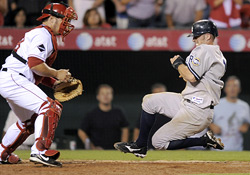 Can we please have more Brett Gardner? By this I am not asking that he make even more appearances as a pinch-runner or defensive substitute, but that he be given more starting assignments now and into the playoffs. He’s not dramatically more productive than Melky Cabrera is, but as we saw on Tuesday in Anaheim, his style of play can be a welcome change of pace from the usual Earl Weaver-style approach employed by the Yankees.
Now, I’m the last one to ever criticize Weaver-style on-base ‘n’ bash baseball, because I believe it is the most effective form of offense there is. You could almost say I’m religious about it, Joe. Yet, even Earl employed his base-stealers, players like Paul Blair, Don Buford, Al Bumbry and Don Baylor, who in his younger, more svelte period swiped 30 bases a year for Team Baltimore. Even Reggie Jackson swiped 28 bags his one year in the Crab Kingdom, a career high. Earl’s 1973 team even led the league, hard as that is to believe.
See, it wasn’t that Earl totally disdained the stolen base. He saw it as a tactical weapon, one to be used sparingly rather than fetishized. And if the base-stealer in question does some other things, like takes the odd walk and plays solid defense, well, Earl had his Mark Belanger, after all. Gardner is no Belanger, Joe. My point is our particular offensive cult does permit this kind of messing around with speed guys; as long as two guys are on when the home run hitters come up, we’re okay. Gardner would seem to provide your best option for getting that out of your center fielder.
As for the power you would be giving up, there’s not a whole lot there on Cabrera’s part, and its loss should be offset by Gardner’s larger contribution on defense, on the bases, and of course from his reaching base more often. Cabrera is a groundball hitter, and his current 12 home runs seems to be around the upper limit of his power. Sure, he gets into stretches where he gets a little more loft on the ball, resulting in his bunching four of his home runs into the month of April, but outside of those hot streaks the power production comes down to one or two home runs a month.
That’s not a lot to sacrifice given what’s being gained. And here’s another bonus: both Gardner and Cabrera hit a ton of ground balls, but the latter’s speed is unexceptional, resulting in a high percentage of double plays. The Major League average hitter (the number is almost the same in both leagues) hits into a double play in about 11 percent of his chances. Cabrera hits into one 14 percent of the time. Gardner, with his speed, hits into one only seven percent of the time. Over the course of a full season this is a gain of many outs. This is why, despite the gap in home runs, Gardner is creating 5.5 runs per 27 outs, while Cabrera trails at 4.7. Over a full season, this would work out to at least one added win, and that’s without considering defense. Speaking of which, most metrics agree that Gardner is the rangier fielder. I would say that most naked eyes agree as well, but I can only speak for myself, and being down one eye, I should probably leave that assessment to others not part of the Greater New Jersey Order of Cyclopians.
I understand why you’ve been reluctant to start Gardner of late; he had just come off the disabled list, and maybe his thumb isn’t up to the daily pounding. Cabrera would also seem to have “won” the job while Gardner was gone, but in truth, his recent production has been nothing special. He’s hit .255/.318/.382 in the second half, .243/.299/.361 in August-September. Cabrera is also getting to the point in his career where he’s going to cost the Yankees some significant dollars (he’s in his arbitration years), and given that the budget has proved to be only semi-infinite it would probably be a good idea to get Gardner established so the front office knows the full extent of its flexibility. Perhaps a Gardner/Austin Jackson combination next year will be just as good as a Gardner/Cabrera combination. In that case: voila, instant trade bait! Instant payroll reduction! This sounds like the best of all worlds to me.
Thank you for giving this matter your full attention.
Very Truly Yours,
Ethel Birnbaum
Gaudin to the rescue?
I WANT TO BANG THIS GONG ONE MORE TIME …
… Because sometimes I just don’t understand the thinking that goes into certain decisions. Today, the (sadly) Boston-bound Pete Abraham reports that not only is Chad Gaudin now in the starting rotation in place of Sergio Mitre, but if he pitches well he has a shot to be in the postseason rotation ahead of Joba Chamberlain:
With Chamberlain not pitching well, Gaudin has emerged as a candidate should the Yankees need a No. 4 starter at some point in the playoffs. Manager Joe Girardi nodded enthusiastically when asked if Gaudin had that chance.
“He sure does,” Girardi said in the dugout Monday night before the Yankees played the Angels. “He’s obviously in the mix or he wouldn’t be starting for us. We went out and got Chad because we felt that he could help us down the stretch and in the postseason, and he has pitched pretty well. He has done a very good job.”
What I can’ t figure out is that if Gaudin was such an important acquisition for the Yankees, why has he done so much sitting around? I’m not trying to pretend that Gaudin is the next Walter Johnson, because we’re talking about a 26-year-old who has a 4.53 ERA in about 600 Major League innings and averages four walks per nine innings. Still, he was a more likely candidate for the fifth starter’s spot, and perhaps even the fourth, than the other fellows the Yankees insisted on using. Let’s review.
Chad Gaudin has pitched only 29.1 innings for the Yankees. He was acquired on August 6 and then didn’t pitch for six days. He didn’t start for almost two weeks, getting his first assignment on August 19 at Oakland. After pitching 4.1 one-hit innings in the game (albeit with five walks), he headed back to the bullpen, not starting again until September 3. He made his third start five days later, but eight days went by before he made his fourth start. Consider what the other Yankees starters have done in that time, and if there was perhaps a place for Gaudin to get a shot at starting:
CC Sabathia has made nine starts with an ERA of 1.79 in 65.1 innings. The team went 9-0 in those games. Hmm. You probably wouldn’t want to pull CC out of the rotation.
A.J. Burnett made nine starts with an ERA of 4.97 in 58 innings. The team went 4-5. This is something of a downer, but opponents have hit only .257/.335/.428 (everyone is Melky Cabrera), which isn’t quite the same as being bombed, plus he’s mixed some good starts in there. Let’s move on.
Andy Pettitte made eight starts, skipping one to rest his shoulder. His ERA was 3.60 in 50 innings, and opponents hit .214. The team went 6-2. No problems here, assuming all the parts are in place.
Joba Chamberlain, kneecapped by his Rules or mechanical problems, or some combination thereof, made eight starts and pitched 31 innings with an ERA of 8.42. Opponents hit .331/.396/.496, which means the average hitter against Joba in this period was Rod Carew. The team went 4-4 since they had turned Joba’s starts into bad relief appearances. This is the only reason you can’t say, “There’s no way the Yankees could have gotten a worse result short of shooting the pitcher themselves.”
Sergio Mitre joined the rotation on July 21 and was started religiously every five days through late August. At the time Gaudin was acquired, Mitre had made four starts and had posted an ERA of 7.50 in 18 innings. He had given up 32 hits and opponents were hitting like Ted Williams, batting .395/.432/.506. Despite the alternative provided by Gaudin, Mitre kept taking his turn in the pulpit. In his next six games before finally being pulled from the rotation, the greatest Yankee named Sergio (also the only Yankee named Sergio) improved his results, the averages against him dropping to a still-miserable .301/.343/.553. His ERA for 28 innings was 7.71. The team record in those games was 3-3. The Yankees actually went 5-4 in Mitre starts, which is (A) a bit lower than a team like the Yankees wants to perform and (B) a reflection of the quality of Mitre’s opponents, teams that let the Yankees back into some games they might have been out of had they been playing a playoff-level opponent.
The Yankees had ample proof that Mitre couldn’t pitch before they got Gaudin, and two appearances since (one starting, one relieving) notwithstanding, he hasn’t given them much argument to the contrary. They could also see Joba, the potential fourth starter in the playoffs, or even third starter if Pettitte’s shoulder continues to trouble him, disintegrating. Yet Gaudin has always been on hold for a rainy day that the Yankees never accepted was here, even though it poured baseballs every time Mitre pitched. Now, with a fraction of the season left and so many games wasted, the guy is supposed to ride to the rescue.
I would tell you what the decision tree that must have led to this point must have been if only I could perceive it myself.
ON YESTERDAY’S MELKY MADNESS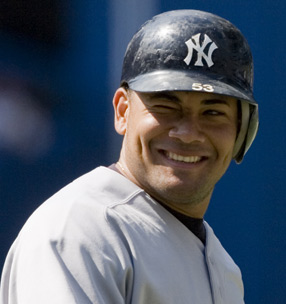 Judging from the reaction to yesterday’s entry, I did a poor job of making myself clear. My intention was to be forward-looking. I was not suggesting that Cabrera’s performance was overly hindering the 2009 Yankees or was a reason they might fall out of the playoffs or fail to save the world when Galactus comes, or anything like that. The 2009 Yankees have their offense pretty much squared away, and while Melky’s 95 OPS+ isn’t a big part of that, it’s good enough under the circumstances. Despite the current rough stretch, I’m not encouraging panic about the team’s chances, though if they punt away home-field advantage, I might change my position on that.
My point was meant to pertain to next season. The Yankees are an old team. Jorge Posada has been great this year, but next year he’ll be 38 and you can’t keep expecting greatness. You can say the same thing about Derek Jeter and A-Rod and Johnny Damon and Hideki Matsui, assuming either or both of them come back. Heck, you could say it if they were in their 20s instead of their 30s, because life is unpredictable, but there would be less reason to worry about it. Because of the unsettled state of things, because it is hard to imagine next year’s offense being of the same quality as this year’s offense, the Yankees may need to get more out of center field. That is, they can’t just assume that other positions will make up for whatever sorta-decent to sub-decent things that Cabrera or Brett Gardner might do. As such, if there’s a “Don’t Look at This Until Spring” pile that Brian Cashman has, which one would assume includes Mark Teixeira and first base, Sabathia as No. 1 starter, etc, center field should not be on it. It is reasonable to suggest that if other positions, within and without the outfield, are going to decline, center field may have to go up. If the Yankees are satisfied, viewing Melky in isolation, that won’t happen.
That was my major point. It had naught to do with 2009. No doubt the current Yankees would do better if Joe DiMaggio was available to play center, but he’s not strictly necessary at the moment.
That Cervelli kid
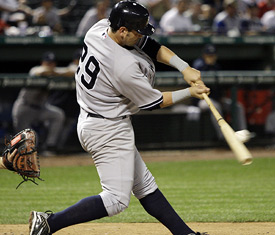 I want to respond to one commenter on yesterday’s entry — I tend to assume that even one opinion fronts for an army of like-thinking fellow travelers, though in this case it’s something we’ve heard before: Let Frankie Cervelli catch next year.
We’ve been over this ground before, but since this thought is still harbored out there like some kind of hidden infestation of bedbugs, I want to go back to it. Cervelli is an athletic, mobile catcher and he’s going to have a decent career just on the quality of his defense. This is not in dispute. Cervelli’s active presence behind the plate catches the eye; there’s nothing subtle about his work, no “inside baseball” aspect that requires you to be told what he’s doing. He’s a lot of fun to watch back there, especially compared to Jorge Posada’s no-frills brand of backstopping, with his trademark “pick it up when it stops rolling” approach to pitches in the dirt. Posada was never the most artful of catchers, and now that his ballplaying life can be numbered in dog-years, he’s starting to be a bit reminiscent of Rodin’s “Thinker”
You already know where we’re going with this: Posada is a crazy good hitter for a catcher. The average MLB receiver is batting .254/.320/.397. There’s a reason the Tigers have tried to shift their catching responsibilities from veteran Gerald Laird to Alex Avila, a rookie out of Double-A while in the midst of a pennant race, which is that Posada-ism is seen as a desirable thing to pursue. There’s always a team or two that goes with a Brad Ausmus-style catcher and sees that as an advantage, but the offensive pace of today’s game is simply too demanding to embrace purely defensive players on more than a limited basis.
Make no mistake that Cervelli is a purely defensive player at this time. While 89 Major League plate appearances is a small sample, Cervelli’s .268/.282/.341 is consistent with his production during his short Minor League career, during which he hit .273/.367/.380 in 828 plate appearances. Although Cervelli showed decent selectivity at the lower levels, his complete lack of power mean pitchers won’t respect him enough to let him utilize that patience — they’re going to come right after him. One key takeaway here is that .273/.367/.380 in the Minors, primarily the low Minors, does not suggest the foundations of a Major League hitter. It suggests an out machine. It might suggest Jose Molina, and Molina, also a very talented catcher, isn’t good enough to play every day.
The Angels, for all of Mike Scioscia’s love of good defense at catcher (he being an excellent defender himself, and a brick wall when blocking the plate), kept him firmly behind Bengie Molina. The team to give Molina the most playing time, last year’s Yankees, was also the first Yankees team to miss the playoffs in 100 years. It was not a coincidence — despite the fact that Molina allowed only two passed balls, despite the fact that he caught 44 percent of basestealers. An offense can’t overcome that many outs, and a bad hitter makes more of them on offense than he can possibly save on defense.
Period. No debate. This is reality. It’s not a stathead thing. It’s not a calculator thing. It’s just very basic truth. A catcher might get 600 chances on offense a year. The number of great, run-saving plays that a strong defensive catcher will make over a mediocre one doesn’t add up to the extra outs. It can’t when we’re talking about plays that save perhaps a base a game, if that.
If Posada’s defense frustrates you, that’s understandable. However, the kind of exchange being proposed suggest that winning is also frustrating. Posada, when he’s not elbowing opposing pitchers in the ribs, is a huge contributor. You want to get mad at the Yankees for being tolerant of players who don’t contribute, you can always remember how many games they lost with Cody Ransom subbing for Alex Rodriguez, or think on how long Angel Berroa stuck on the roster, or rent your garments every time Sergio Mitre pitches — I’m about out of good shirts at this point, although the cats enjoy chasing the flying buttons.
Otherwise, you’re really biting the hand that feeds the Yankees, or one of them. As it says in the New Testament, a prophet is not without honor, save in his own country. It turns out the same thing is true of Jorge Posada. An offensive-minded catcher is not without honor, save to team’s fans.
STILL WAITING ON ACTION JACKSON
Scranton lost their playoff series on Thursday, which frees as many Pennsylvania Yankees as the club would like to come on up to the big city. Juan Miranda was recalled today. Austin Jackson is not on the 40-man roster, so a move would have to be made to get him to the bigs. Perhaps Christian “Out For the Year” Garcia could be shifted over to the 60-day disabled list to create a spot. Or Sergio Mitre could be released…
…Miranda, who is either 16 or 29, had a solid year at Scranton, batting .290/.369/.498 with 19 home runs in 122 games, handling left-handed and right-handed pitchers with equal aplomb. This performance translates to .273/.351/.491, which is not without its uses, though it’s not particularly useful to the Yankees because they’ve gotten fine left-handed production at DH and Mark Teixeira is a full-service first baseman. Thus, the Yankees have another power-hitting pinch-hitter to go with Shelley Duncan, which is okay.
Unfortunately, every team except, apparently, the Rays, has their own Duncan or Miranda, so there’s not much market for these guys. Every once in awhile one will surface in the Majors and do well, like Randy Ruiz with the Blue Jays or Garrett Jones with the Pirates, and everyone will act surprised, but they shouldn’t, because the thing that held them back wasn’t that they couldn’t hit, but that over the long term they weren’t expected to hit well enough to sustain first base or right field given lousy-to-non-existent defense. Kevin Millar is the rare example of this brand of player who actually went on to have a sustained career as a starter.
Whatever his age, Miranda has hit well enough in the minors to deserve at least a small chance from some team looking for a low-cost lefty for a DH or first base rotation. The production likely wouldn’t be great, but say your team is in the position of the Rays, having to play 35-year-old Chris Richard — at that point, you’ll take whatever Miranda can give you.
Unfortunately for him, barring a catastrophic series of injuries, that team will never be the Yankees. Here’s hoping he pops a few home runs during his Big League cameo and ups his trade value. Given his age, which is closer to 30 than not, he’s not going to be getting any better, so he’s not doing much at Scranton other than providing a “Break Glass in Case of” option.
Matsui and Damon are as old as The Beatles
 MATSUI FOREVER?
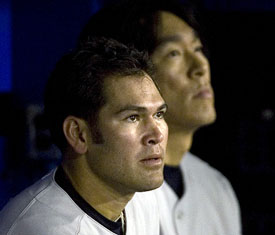
Hideki Matsui is now hitting an excellent .280/.370/.516. There is life in the old boy yet. The average AL DH (it used to be redundant to say “AL DH,” but with the advent of interleague play, there is now such a thing as the NL DH) has hit .253/.336/.446 this season, which is depressing in that a position purely devoted to hitting has produced only slightly above-average offense, the league as a whole averaging .266/335/.429.
Teams with middling to miserable DH production include the Rays, who made a very expensive mistake in signing Pat Burrell; the Tigers (.245/.319/.390), primarily due to the decline of Carlos Guillen, Marcus Thames’ weak season and Aubrey Huff’s inability to hit in their uniform; the Royals, because Dayton Moore and Trey Hillman somehow think Mike Jacobs can hit (.231/.300/.395 as the DH); Seattle (Junior Griffey’s Seattle comeback is like one of those reunion tours in which none of the original band members participates); and Oakland (Jack Cust isn’t the hitter he was last year).
Some of the best DH production belongs to the Twins (primarily Jason Kubel, but also lots of Joe Mauer), Angels (Vlad Guerrero plus great work from almost every regular Mike Scioscia has rotated through) and the White Sox (until recently, Jim Thome). Thanks to Matsui, along with small contributions from Alex Rodriguez, Mark Teixeira and Derek Jeter, the Yankees lead them all in hitting at the hitting position.
Matsui has done this despite bad knees and a stroke which has not made great use of Yankee Stadium — he’s hitting .268/.356/.481 there versus .294/.389/.561 on the road. Joe Girardi has kept him on the bench against some lefties, but Godzilla has never had a platoon problem and has creamed them, hitting .276/.348/.610 against southpaws. The semi-platooning has been primarily directed towards keeping Matsui’s knees functional as well as giving rest to the other Yankees veterans, and it seems to have worked out very well.
Matsui’s contract is up at the end of the season, as is Johnny Damon’s. Next year will be Matsui’s age-36 campaign. Damon will turn 36 this winter. It’s going to be a crowded winter for players whose main job is to hit. Likely free agents include Russell Branyan (if ambulatory), Carlos Delgado (ditto), Nick Johnson (likewise), Adam LaRoche (Mr. Second Half), Hank Blalock (having a miserable year at .237/.278/.466), Troy Glaus (back in the “if ambulatory” category), Bobby Abreu, Jason Bay (who plays the field but maybe shouldn’t), Jermaine Dye (if the White Sox don’t pick up his option), Vlad Guerrero and Andruw Jones.
These players are going to have to tamp down their financial expectations given how few slots are available, how limited their contributions, their generally advanced age, and of course, The Economy. This is true of Damon as well, who has had a strong year at the plate but whose defensive abilities are at ebb tide.
The Yankees have the option of filling both spots internally: Damon’s place with Austin Jackson, Matsui’s with some kind of rotation, but that would be a huge offensive blow. Unless Jackson takes an unexpected leap forward, there just won’t be enough hitting to make up for the loss. The Yankees could also re-sign one player, or both, while attempting to work Jackson into the mix. The International League playoffs could end as soon as tonight (Scranton is down two games to none in a best of five series) and perhaps we’ll see a bit of Jackson in the Majors soon after. They could also re-sign Damon, refuse to pay a high price to keep Matsui in the fold and sign whichever of the many free agent bats fits their budget.
There is no correct answer, except perhaps to observe that retaining two 36-year-olds is courting twice the danger of keeping one — one of them is likely to decline. Actually, there is a correct answer, and that’s two 23-year-olds in those spots, young players who can be Yankees over the next five to ten years, but unless Jesus Montero is going to get an express ticket to the Bronx, the Yankees don’t have even one of those guys in position.
WILL BIG PAPI BE A FORCE IN THE PLAYOFFS?
He’s been up and down since his miserable first two months, but on the whole he’s had a productive half-season’s worth of work since then, hitting .262/.353/.544 in 88 games, 82 of them starts. He’s hit 23 home runs in that span. Left-handed pitchers can neutralize him (.216/.298/.435 overall), but you can’t take him for granted in most situations.
A SIGN OF THE APOCALYPSE
Tim McCarver Sings Selections from the Great American Songbook
I really, really hate to alert McCarver to the fact that “A Nightingale Sang in Berkeley Square” is not part of the American Songbook, though Americans have sung it. It was written by two British fellows and made famous by Vera Lynn, the same chanteuse who is presently keeping the reissued Beatles CDs off the top of the charts in Great Britain.
NUMBER NINE… NUMBER NINE… NUMBER NINE…
Speaking of those Beatles CDs, I’ve been assiduously working my way through the remastered stereo set and enjoying the heck out of it. The music is much clearer, as if you had been listening through some kind of murky haze all of these years. You can make out small touches in the playing and singing that you couldn’t before, perhaps not even on the original vinyl, though I confess it has been years since I listened to those.
Coincidentally, yesterday I came across this quote from the late Kurt Vonnegut in my notes:
The function of the artist is to make people like life better than they did before. When I’ve been asked if I’ve seen that done, I say, ‘Yes, the Beatles did it.’
… I wonder if John Lennon knew he had won the battle of the White Album. The Beatles were writing and basically recording separately by this point, with each composer using the other three as backing musicians (and in Paul McCartney’s case, sometimes leaving them out altogether), so you can attribute each track individually and sort the sprawling mess that is the “The Beatles” (IE “The White Album”). George Harrison and Ringo Starr got a combined total of five tracks; as good as George’s are (“While My Guitar Gently Weeps,” “Long, Long, Long,” “Piggies” and “Savoy Truffle”) you can’t call that more than an EP’s worth of material, whereas John and Paul each contributed a standard album of material. John’s White Album looks like this:
1. Dear Prudence
2. Glass Onion
3. The Continuing Story of Bungalow Bill
4. Happiness is a Warm Gun
5. I’m So Tired
6. Julia
7. Yer Blues
8. Everybody’s Got Something to Hide Except Me and My Monkey
9. Sexy Sadie
10. Revolution I
11. Cry Baby Cry
12. Revolution 9
13. Good Night (sung by Ringo, but written by John)
I haven’t yet listened to the remastered “Revolution 9,” but in a perverse way I’m looking forward to it. If you look at this track listing, it anticipates John’s early solo albums. He wasn’t trying to write pop singles anymore (though “Dear Prudence” could have been one) and instead concentrated on emotional work that tried to express a deeper mood or feeling than good time rock and roll. Given that this is the same man who was primarily responsible for “I Feel Fine” and “Ticket to Ride,” both No. 1 singles, Lennon’s turn towards introspec
tion is, retrospectively, shocking and a harbinger of the group’s dissolution.
Here’s Paul’s White Album:
1. Back in the U.S.S.R.
2. Ob-La-Di, Ob-La-Da
3. Wild Honey Pie
4. Martha My Dear
5. Blackbird
6. Rocky Raccoon
7. Why Don’t We Do It in the Road
8. I Will
9. Birthday
10. Mother Nature’s Son
11. Helter Skelter
12. Honey Pie
Here you have three tracks that could have been singles but weren’t — the Beatles’ 1968 singles releases were non-album tracks like “Lady Madonna” and “Hey Jude” — “Back in the U.S.S.R,” the Beach Boys parody, “Ob-La-Di,” which did get a belated single release in the US eight years later, and perhaps the irritating and ubiquitous “Birthday.” A souped-up version of “Revolution” was the B-Side to “Hey Jude,” but that’s the closest the group came to taking a single off the album. McCartney was still working the pop song-craft part of the street, with one song even inspired by his sheepdog. “Back in the U.S.S.R.” and “Blackbird” were initially attempts at political relevance, though one’s enjoyment of those songs is greatly enhanced by being unaware of the discarded subtext. Or the sheepdog.
John’s would have been the better album. Take this, brother. May it serve you well.
Down with Mitre, brawling, rivers in Thailand
 WHAT CASEY SAID
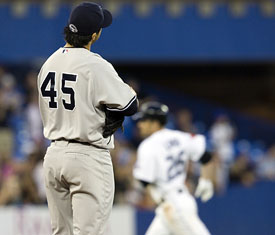
Forgive me if I’ve used this quote before in talking about Sergio Mitre. When the Yankees lost a miserable home game, ten-time pennant-winning Yankees manager Casey Stengel had a saying: “The attendance was robbed,” by which he meant, “We didn’t give the fans fair value tonight.
Each time the Yankees start Mitre, the attendance gets robbed. After Mitre’s last start, Joe Girardi claimed that the defense had undermined what was otherwise a good start. This time, Mitre allowed four home runs in five innings of work. With all respect to Girardi, who has largely done a fine job this season, if he says that Mitre pitched well but the stadium was too small to contain his genius, I’m going to be sick.
The Yankees don’t need these wins, or at least they don’t right now, though if they somehow lose home field advantage in the playoffs, you can start pointing fingers at whoever has authorized Mitre to make start after miserable start. Still, even if they end up with pole position in the postseason, simple professionalism should dictate that Mitre doesn’t get any more games.
Even if these starts rank as throwaways for the 2009 season, surely there is some deserving young hurler — perhaps Trenton’s Zach McAllister? — who deserves a chance to show what he can do so the Yankees are more informed about their options for next year. The more the Yankees know about what they have on hand for 2010, the less they have to sweat subsidizing Chen-Ming Wang’s decline or making any other needlessly expensive moves. At this point, all Mitre is telling them is that he’s currently not a Major League pitcher. What he’s telling the fans, or what the Yankees are telling them by pitching him, is a very different matter.
OVERHEARD
I was drinking coffee in a bookstore recently when I heard a fellow at the table next to me say, “Denial is a river in Thailand.” I’m still not sure what he thought he was saying.
THE BRAWL
It seems like just about every observer of last night’s fracas has come to the same very reasonable conclusion, which is that whatever the offense Jorge Posada thought he had suffered — and having someone throw behind you is worse than having someone throw at you, because you can duck the latter, whereas you’re more likely to duck into the former — the fight was not something the Yankees needed. The risk of serious injury to a key player is too great, and with the team needing to protect both the division title and home-field advantage, even a small suspension can be ruinous.
This is particularly true in the case of Posada, who is sure to be seen as the primary instigator of last night’s action. The drop-off in offense from Hip-Hip Jorge to Hic-Hic Jose Molina or the non-alliterative Francisco Cervelli is so huge that an ICBM couldn’t carry the distance – although let’s give all due credit to Molina for his .320 on-base percentage, which is easily a career high; Molina has never cleared a .300 OBP in any season of more than 81 plate appearances. Sadly, his newfound selectivity does not erase his other offensive deficiencies, so he’s literally about half the hitter that Posada has been this year.
Jesse Carlson is a busher, a 28-year-old sophomore spot reliever on a nowhere team. He was wrong to throw behind Posada, even to deliver a message, and he was out of place on the play at the plate during which Posada (needlessly) elbowed him. We talk about players like this playing spoiler, but usually they do that by beating a contender, not taking a beating so that the contender loses its best players to disciplinary action. Tempers can flare, people will fight — that’s all understandable and human. The Yankees have to be smarter than base instinct if they want to win a pennant and eventually a championship. Girardi was right to tell them so after the game. There’s more at stake than masculine pride.
A couple of notes on player achievements
NICK SWISHER
Swisher hit his 27th home run Monday night and has begun to show more consistency at Yankee Stadium II, which bodes well for the playoffs. Right field is a traditional power spot, especially for the Yankees (that Ruth guy, you know), but the last time the Yankees had a right fielder hit over 30 home runs, Gary Sheffield was still young, or at least younger. He hit 36 home runs in 2004 and 34 in ’05 while spending most of his time in right. If you want a Yankees right fielder who topped 25 home runs before Sheffield, you have to skip past Paul O’Neill (who was a great hitter but averaged 22 round-trippers a season) and Danny Tartabull (who did a lot of his work at designated hitter) and point to Jesse Barfield in 1990. As mention of Sheffield, O’Neill, and also Bobby Abreu should make abundantly clear, the Yankees have largely gotten excellent production from the position — we will skip quietly past the Raul Mondesi Interregnum — but with the exception of Sheffield it has come in the form of high averages and on-base percentages and only average home run power. Nothing wrong with that if you can get it. Swisher lags those players in exactly one regard — fewer singles.
MARK TEIXEIRA
With last night’s 3-for-4, Teixeira upped his numbers to .285/.381/.551. Teixeira has been terrific, both with the bat and with the glove, and if he finishes with roughly this level of production, his season will rank somewhere in the top 10 for production by a Yankees first baseman/post-Gehrig division. Incredibly, though, it won’t rank anywhere near the top. That’s no insult to Teixeira, but a measure of just how good Don Mattingly was in the 1984 to 1986 period. He out-hit Teixeira in each of those seasons, doing so in a vastly different league. The American League of 2009 slugs .429. The AL of Mattingly’s glory days slugged about .400. Power comes more easily now than it did then.
As frustrating as he could be at times, the best-hitting Yankees first baseman of the last half-century not named Mattingly was Jason Giambi in 2002. Giambi hit .314/.435/.598 that year, a devastating combination of power and patience. Of course, he couldn’t field like the other two guys. Heck, he couldn’t field like anybody.
JOE MAUER
Went 3-for-3 to raise his average to .371. At one point it seemed as if .400 was the goal, but now the question is if he can record the highest batting average in history by a catcher. Depending on where you want to place your cutoff, the highest batting average in a full season by a backstop was .362 by the Yankees’ Bill Dickey in 1936 (472 plate appearances) and Mike Piazza in 1997 (633 plate appearances). Smoky Burgess hit .368 in 1954, but had only 392 plate appearances. One wonders what having a minor record like that would do to strengthen Mauer’s MVP candidacy….
People and records, gone but not forgotten
 TRACI AND LOU: A MEDITATION ON LIFE, DEATH, AND RECORDS
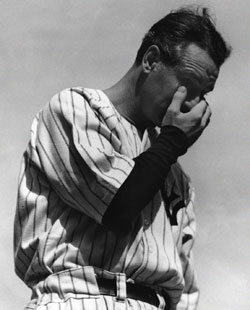
With the relentless focus on Derek Jeter and Lou Gehrig these past few weeks, the Iron Horse has been on my mind quite a bit. As I explained a few entries back, Jeter deserves to have his wonderful career and accomplishments celebrated, but it was difficult to feel complete enthusiasm regarding the passing of one of Gehrig’s records. We can try to be purely unemotional about things and say that baseball careers end for all kinds of reasons, injury being one of them, and a disabling illness or untimely death is just another form of career-ending injury. We can say that, but inside we know that it’s not true. A ballplayer’s record is supposed to end when he proves himself unable to play at the same high levels of his youth, or when he’s ready to go on to other things, or both. He’s supposed to play out the string, not have the string cut as if the three Fates had pulled out their sharpened scissors. As has often been remarked, baseball is one of the few games without a clock. Death is the imposition of time on a game that is supposed to be untimed.
Ty Cobb was a .323 hitter when he retired at the age of 41, but his legs had started to go and so to himself he wasn’t the same Ty Cobb. He also had a hugely successful investment portfolio to manage, and so he moved on. Ted Williams slugged .645 the year he quit, but he was ready to devote more time to fishing. Mike Mussina won 20 games for the first time and went off to watch his kids grow up. Alternatively, Babe Ruth went out fat, lame, and sniffling, but at least he got to give it one more try. All of these players went out on their own terms. So too did every player waived out of the Majors after a .119 season, an 0-for-30, or a 8.11 ERA in 50 innings. They got to take those 30 turns at the plate. They got to pitch the 50 innings. That’s self-determination.
Gehrig never got the chance to end his career because his body quit on him at high speed, not the languorous, creeping way it does for the truly lucky among us. His song didn’t end; the needle was pulled off the record, and if Jeter’s going past him provokes mixed feelings, it is because he gets to impose an alien ending on an unfinished story. No one really passes Gehrig, because Gehrig never finished; he was only interrupted.
None of this is meant to take anything away from Derek Jeter, may all praise his name and sing his deeds. Jeter just happens to be playing through a valley where someone else was struck by lightning, and I can’t help but smell the ozone lingering in the air. I’m not angry at Jeter, I’m sore at an unfair universe, a universe that builds up so many mountains and monuments and then knocks them all over, some suddenly, painfully, without symmetry or justice, and often without apparent meaning. It’s left for us to infer meaning, and life as a course in creative writing can be bewildering and unsatisfying. Gehrig tried his hand at this himself, in his famous Farewell. “Fans, for the past two weeks you have been reading about the bad break I got. Yet today I consider myself the luckiest man on the face of this earth.” I was about to write, “Lou Gehrig was a liar,” but he wasn’t. I think he meant it. I think he meant to reassure us and reassure himself. That doesn’t get at what I’ve always felt when I’ve heard those wonderful words. This is it: He was a great man to say what he said. We were saps to believe him for a second. He had great fans, great friends, a loving family, and shared a storied history with all of them. He was, in all these things, greatly blessed — and none of that changes the fact that he got a raw deal. It was a clever non-sequitur, a changing of the subject, and just about everyone who has ever heard that speech is dumb enough to fall for it. If instead of saying what he had said, Gehrig had just stated, “You’ve been reading about a bad break I got. No, really, everything’s okay. It’s no big deal.” no one would have believed him.
Last November I first told you about my friends Rich Faber and Traci Wagner and Traci’s battle with malignant melanoma, a disease I know from personal experience. I am greatly sorry to report that on the morning of September 10, Traci died of the disease. She leaves behind Rich, devoted husband, who dedicated the last year to caring for her, and a son, Jason, on the verge of turning three, whose youth will, I hope, spare him some of the pain of this moment.
Traci was 42, and she had a lot left to do, from inconsequential things — like seeing how the Yankees make out in this year’s playoffs (she was a dedicated fan, with a particular fondness for Jeter, Mariano Rivera, Andy Pettitte, and Tino Martinez) — to the serious and important, like raising her son and seeing out the years with her husband. As with Lou Gehrig, her record will never be surpassed. Other lives will go on in parallel, but no one will ever do what she did in the way that she did it. Others may live more days, see more than she got to see in her time on Earth, accomplish things that one who is struggling to stay alive day by day is not permitted the time or endurance to attempt, but there will never be another Traci — not a greater Traci, nor a lesser Traci, nor an equivalent Traci. A wife, a mother, a friend can never be surpassed. Everything after is different, even if there is somehow more of it, even if somehow we go on.
That takes nothing away from those who live on, who come after, but let us also not deprive the dead of their due.
Lou Gehrig had no children; it must have made it easier for him to say what he did. In Alan Jay Lerner’s autobiography, he tells of his father’s declining health, and how he was forced to undergo many painful and debilitating medical procedures to stay alive. “How can you go through all this, Dad?” Lerner asked. “Because I want to see what happens to you,” the senior Lerner replied. When I was first diagnosed with cancer, I didn’t cry until I saw my daughter, because just as I would not have her taken from me, I would not have me taken from her, not until I had a better idea of how it all turns out. She was only three at the time. There would be so much more to see. We erect sand castles of families and homes and children and 2,130 games played in a row. We should get to finish building them in the fullness of time. I wanted more. I want Gehrig to have had more. I want Traci to have had more. It’s all of one thing to me, life and death and records.
When I first told you about Rich and Traci — and this is particularly current given the politics of the moment — I talked about how financially debilitating Traci’s battle against cancer had been, in spite of their health insurance, which treated them with typical capriciousness. I asked you to check out his Web site; Rich is a professional, Harvey Award-nominated illustrator, and with his love of baseball, ballplayers have often been his subjects. As noted in his blog, some of these pieces are for sale. Rich also takes commissions. I urge you to drop Rich a line and purchase one; Traci’s battle may be done, but Rich has another ongoing fight to provide for his son’s education as a single parent. I have two of his pieces up in my living room, and they look great; you’ll not only be helping Rich out, you’ll be doing your wall a favor.
If you’re not into bas
eball art or happy walls, there is a Paypal donation button on the sidebar of Rich’s blog; anything you give will go towards Jason’s education.
I struggle to leave you with happier words at the conclusion of this bleak entry. I have watched loved ones come and go. I’ve nearly watched me come and go once or twice. In a song about cancer, Lou Reed sang, “There’s a bit of magic in everything, and some loss to even things out.” I think that’s the best, most uplifting thought I have at the moment. Life is an accumulation of events, not separate threads. It is wonderful to be here and terrible to leave, and yet we are always in the process of leaving. Yet, each time we do, what we leave behind us represents a unique, unalterable tale — in the words we say, the songs and stories we write, in those we loved who remember us, and the children we bring into the world, who carry within them our part of those who have gone in their very genes. Others may write other stories, sing louder songs, or make more hits on the ballfield, but never better, only different. As Albert Einstein said, nothing is created or destroyed. It’s all still here. That’s the magic. So let us not say goodbye to Lou, or even Lou’s record, for Lou is still here, and nor will we say goodbye to Traci, for she too will remain.
A taste of the Secret Sauce
THE SECRET SAUCE
My pals at Baseball Prospectus have a little congeries of stats we call the Secret Sauce. Introduced in the book, Baseball Between the Numbers, to which your humble host contributed a chapter and a little page about the relationship between stats and Stephen King’s “Cujo,” the Secret Sauce ranks teams by how well they do in the three key areas that correlate to winning postseason games. As explained here by sauce-master Nate Silver, they are:
1. A power pitching staff, as measured by strikeout rate.
2. A good closer.
3. A good defense.
I won’t get into how these ranking are derived, because they involve some of those esoteric statistics that I suspect make many of y’all’s eyes glaze over. Still, we can appreciate what the rankings say by looking at some more commonplace measures. Here is how the likely postseason teams fare, in reverse order:
 No. 20 PHILADELPHIA PHILLIES
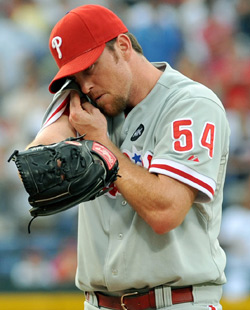
The Phillies have been strong in strikeouts, both in the rotation, where Cole Hamels and Joe Blanton have done their part, and particularly in the bullpen, but the pen has been a disaster overall, accounting for the team’s low ranking here. As of today, Brad Lidge and Charlie Manuel are still trying to figure out what the former’s role will be going forward, which is a problem given that the season is nearly over. You wouldn’t want to say that Lidge has gone Steve Blass on the Phillies, but six walks and two home runs per nine makes a compelling case that he has. The Phillies can at least take justifiable pride in their strong defensive infield of Chase Utley, Jimmy Rollins and Pedro Feliz.
No. 13 TEXAS RANGERS
The Rangers, second in the American League in runs allowed (4.41 per game; the Mariners lead at 4.36), are third from last in strikeouts per nine innings, which suggests a lot of balls in play. The reason that this is a particularly bad thing in the playoffs is pretty basic: In a regular season game against the Baltimore Orioles, your team might fail to get a lot of strikeouts but nothing happens anyway, because when they hit the ball it goes “piff,” not “boom!” In the playoffs, where the best offenses are usually to be found, balls in play tend to do real damage. Note that AL starters are averaging 6.5 strikeouts per nine innings; Rangers starters are whiffing 5.6.
The Rangers have been solid on defense, with the second-best record in the league of turning balls in play into outs (that’s how they survive the weak strikeout rate). Frank Francisco has been effective, if not a lights-out closer. Neftali Perez’s crazy debut doesn’t enter into these calculations, but you can’t forget about him when talking about the Rangers’ end game.
No. 11 THE LOS ANGELES ANGELS OF ANAHEIM, CALIFORNIA, USA
The Angels get knocked down on the power pitching angle, as overall they are a tick below average in strikeouts per nine, and in defense, which has been just average or a little below. Call it the Bobby Abreu Effect. Closer Brien Fuentes leads the AL with 40 saves but has also blown six, and right-handed hitters are slugging .462 against him. None of this is a reason to take the Angels likely, as Jered Weaver and John Lackey, combined with their fine offense, should be able to keep them in at least the first two games of any short series. Still, this is not Mike Scioscia’s usual flavor of team.
No. 10 ST. LOUIS CARDINALS
The Cardinals get strikeouts from starters Adam Wainwright and Chris Carpenter. The rest of the rotation, and even closer Ryan Franklin, allows the opposition to put more balls in play than is typical. Joel Piniero, who would be the third starter in any playoff scenario, gets by on exquisite control (just one per nine innings) and a high groundball rate. Franklin, formerly an unexceptional starter and reliever, leads the NL in saves with 37 and has a 1.67 ERA and it’s deserved — he’s actually done a good job of stranding inherited runners as well as keeping runners off base in the first place. He’s blown three saves all year long. While the bubble could burst at any time, particularly in October, at this point you have to take Franklin seriously. Cards’ defense has been problematic at times, especially at second base, where converted outfielder Skip Schumaker is making a game effort at competence.
No. 6 COLORADO ROCKIES
The Rockies are about average as National League strikeout rates go, in part because Jason Marquis and Aaron Cook drag down the numbers. Ubaldo Jimenez and Jorge de la Rosa do get batters to swing and miss. The bullpen has also been solid in the swing-and-miss department. The real problem right now is overall depth, with Cook and Huston Street injured. Both are supposed to be back ere long. One potential equalizer for the Rockies is former starter Franklin Morales who (shades of Phil Hughes) has moved into the pen and has been throwing bullets from the left side. When their park is taken into account, Rockies fielders have been solid if unexceptional. Street has converted 33 of 34 saves and has even held left-handed batters in check, a problem for him in the past.
No. 5 DETROIT TIGERS
The Tigers have allowed the third-fewest runs in the AL, just 4.5 per game. Their strikeout rate is roughly average, with only starter Justin Verlander, who leads the league with 230 strikeouts, really jumping out in that department. The Tigers have been an average to slightly above average fielding club, with few standout performances (Clete Thomas has been strong in right field, though he can’t hit like a right fielder) but no truly poor ones either, and overall they rank in the top half of the AL in turning balls in play into outs. Desperation closer Fernando Rodney has blown only one save all year, but walks too many batters for comfort against strong postseason lineups.
No. 4 BOSTON RED SOX
We begin with Jonathan Papelbon. We continue to the staff overall, which is tied with the Yankees for the league lead in strikeout rate, propelled by Josh Beckett, Jon Lester, Daniel Bard and Papelbon. We conclude with a defense that has been surprisingly weak. The outfield has been defensively shaky, the infield has lacked a shortstop of any defensive quality until Alex Gonzalez came over, and Kevin Youkilis has had to play too much third base, not to mention a couple of scary games in left field.
No. 2 LOS ANGELES DODGERS
Joe Torre’s guys have perhaps the best defense in the game this year, which is a novel thought for those of us used to watching even Tommy Lasorda’s good teams juggle balls. They lead the NL in turning balls in play into outs, receiving fine defensive performances around the infield (though Orlando Hudson has not been at his best) and from center fielder Matt Kemp. Manny Ramirez is the exception that proves the rule. They are third in the NL in strikeout rate, an advantage that doesn’t wholly disappear when you start adjusting for park effects. Starter Chad Billingsley is whiffing eight per nine innings, lefty Clayton Kershaw 10, and closer Jonathan Broxton 13.6. It should be noted that the rest of the pen is not particularly intent on the strikeout, a possible vulnerability. Broxton has blown five saves in 39 chances, which is shaky by today’s standards.
No. 1 NEW YORK YANKEES
I probably don’t have to give you much detail here. The Yankees are tied for the league lead in strikeout rate, have the most reliable closer in the game, and ra
nk third in the league in turning balls in play into outs. The high rankings in all three categories boosts the Bombers to the top of this list.
None of the foregoing guarantees anything, but it’s a reassuring indicator. Historically, teams with large helpings of these qualities have gone far in October. The Yankees haven’t had all of the elements line up in the same place at the same time in quite a few years. In fact, the last time the Yankees came this close to the top of the Secret Sauce list, the year was 1998.
To praise Jeter, and not bury him
 TO THE MATS WITH READER COMMENTS: DO YOU LOVE DEREK JETER (GLAD ALL OVER)
As long as I’ve been writing this feature, I’ve had to respond to this kind of comment:
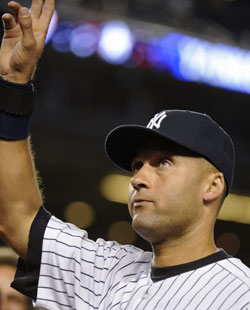
Steve, I always look forward to reading the PB. You are very knowledgeable and have a great sense of humor and write extremely well. That being said, have you ever written anything on Jeter that was totally positive? As, I tell my 10 year old son all the time, we are very blessed to be able to watch him play. Of course he has weaknesses, everyone does, but the total package is to be appreciated. You are able to do this with Posada, why not Jeter? There is no need to put this hits record into perspective. It is what it is. No one is suggesting that he is a better hitter than those he is passing (Mantle, Ruth, Gehrig) anymore than anyone would suggest that Pete Rose was a better hitter than Ted Williams, Hank Aaron or Willie Mays. — RTO
You can’t be much of a baseball fan if you don’t appreciate Derek Jeter. I appreciate Jeter not only for all the things he is, but for all the things he’s not, which is to say that I’ve been following the Yankees long enough to remember in excruciating detail his many predecessors, most of whom were advertisements for how not to build a winning ballclub. Put it this way: I’m just old enough to remember people debating the merits of Chicken Stanley, and I attended games in which Bucky Dent played. Unfortunately, by the time I was old enough to follow the Yankees with anything like an adult comprehension of the game, Dent had stopped hitting even at the low level he had previously; he was essentially done at 30, and the Yankees swapped him for Lee Mazzilli. He gave way to…
ROY SMALLEY (1982-1983)
Smalley was a very good hitter for a shortstop of the day, batting .266/.351/.434 as a Yankee in ’82 and ’83, but injuries had reduced his range to that of a rusty coat rack. Before the 1983 season was over, the Yankees were experimenting with other players. Worse, they traded Greg Gagne to the Twins to acquire Smalley; Gagne was a not a great player, but he played a fair shortstop for two championship teams while the Yankees watched from the sidelines.
ANDRE ROBERTSON (1981-1985)
The Yankees tried hard to pretend that Robertson was a Major League shortstop. His glove got good reviews, but he had struggled to post even a .285 on-base percentage in the minors. In 1983 he got a chance to take over for Smalley and hit .248/.271/.326, which is actually better than would have been projected from his showing in the sticks. Indeed, he was in an extended slump when a serious car accident ended his season in August. The rest of his career was one long attempt at a comeback. At the time, there was a good deal of asking “what could have been,” but the correct answer was, “Not much.”
BOBBY MEACHAM (1983-1986)
Meacham took over shortstop after Robertson got hurt, and then repeated the experience when Robertson’s 1984 comeback was aborted due to his making a disproportionate number of outs. Meacham was a double-threat. He couldn’t hit and was an erratic, error-prone fielder. He was also singled by the owner, which almost certainly did not help. In 1985, Meacham’s .218/.302/.266 rate stats and 24 errors played a decisive role in the loss of a close divisional race to the Blue Jays. In 1984, we also had the pleasure of seeing 33-year-old infielder Tim Foli dramatically under-hit his career .251/.283/.309 rates as a Robertson/Meacham substitute. Meacham began 1986 in the same role, likely because offseason moves were being misguidedly being restricted. When Meacham had batted only .222/.301/.278 through mid-June, the Yankees finally sent him down. This was a terrific move, except there was no substitute on hand. In the short term, the Yankees tried veteran non-hitter Mike Fischlin, who batted .206/.261/.225 on the season. They also tried Dale Berra and veteran National Leaguer Ivan DeJesus. Ken Griffey and Robertson were then dealt to the Braves for Claudell Washington and 27-year-old Paul Zuvella, who was installed as the sorting shortsop. He hit .083. The Yankees then traded for…
WAYNE TOLLESON (1986-1987)
The 30-year-old Tolleson came to the Yankees on July 30, 1986. The 5’9″ infielder had primarily been a light-hitting second baseman in his career, but he was coming off a fluke season in which he had hit .313, albeit with no walks or power. Still, he made the Yankees look good over the remainder of the season, batting .284/.332/.344. This was great production compared to what they had received from shortstop over the previous months and year. In 1987, a year in which everyone hit, Tolleson became an out machine, and by the end of the year, the Yankees were giving Randy Velarde a look and also gave Meacham one more chance. There were also one-game cameos from veteran Jerry Royster and minor league journeyman Jeff Moronko.
RAFAEL SANTANA (1988)
In December of 1987, the Yankees dealt three middling prospects (all they had at the time) to the Mets for Santana, who had a bit of a glow on him from being the starting shortstop on the champion 1986 Mets. The glow seemingly blinded Yankees decision-makers to the painful realities of Santana’s game — he couldn’t hit, had neither good range nor sure hands and was suffering from an arm problem that hampered his throwing. Billy Martin, then managing his final season, was reportedly appalled by him. Unfortunately, the club had few alternatives. Velarde got in a few games, and veteran Luis Aguayo, brought over from the Phillies to platoon at third with Mike Pagliarulo, got in one game.
ALVARO ESPINOZA (1989-1991)
It was assumed that Santana would start again in 1989, but his arm proved to require surgery that would keep him out for the season. In desperation, the Yankees turned to Espinoza, who had joined the team as a Minor League free agent the year before, spending the entire season at Triple-A Columbus. Espinoza was a fairly steady fielder, but had no business holding a bat in his hands. His .224/.258/.274 season of 1990 still qualifies as one of the most pathetic offensive seasons in Yankees history, and it is no coincidence that Espinoza’s reign coincided with some of the worst years the team has ever had. Substitutes during this period included Tolleson, Velarde, Yankees farmhand Carlos Rodriguez, and veteran infielder Tom Brookens.
STAFF (1992)
The Yankees released Espinoza during spring training 1992, having signed free agent utility infielder Mike Gallego away from the Oakland A’s. Gallego got hurt during spring training and didn’t make his Yankees debut until mid-May. Velarde, now 29 but not yet established in the Majors, played in his place, as did Andy Stankiewicz and farmhand Dave Silvestri, whose Minor League numbers suggested he might hit a bit for a middle infielder, but somehow he never did. A broken wrist shelved Gallego for most of the second half, leaving Velarde and Stankiewicz sharing the shortstop’s job. Overall, team shortstops hit .248/.317/.331, which was miserable but better than what they had been getting out of Espinoza.
SPIKE OWEN (1993)
Another free agent signing, this time from the Expos, Owen was no hitter, though he did walk a bit. Defensively, his range was extremely limited. Buck Showalter rapidly soured on him, and by late April was giving him regular time off, then benched him completely not long after the All-Star break. Gallego and Velarde split time at short over the rest of the season. Velarde was starting to find his bat in this period, but never showed great hands at short.
MIKE GALLEGO (1994)
Gallego played 69 games at short in the 113-game season, although there were also many starts by Velarde and an odd
flirtation with Kevin Elster, who was neither a good hitter nor strong fielder and hadn’t played more than a smattering of games in two years while rehabbing an injury. At this point in his career, he had the range of Jason Giambi. Gallego hit .239/.327/.359, which was beginning to look positively Ruthian as far as Yankee shortstops were concerned.
TONY FERNANDEZ (1995)
The Yankees signed the former All-Star and Gold Glover as a free agent after he had spent a year playing third base for the Cincinnati Reds. The Yankees would be the last team to ask Fernandez to play shortstop for any length of time. There was good reason for this; at 33, the Gold Glove days were long gone, as was the pretense of throwing hard to first base on routine grounders. Fernandez could be a very solid hitter for a shortstop, but as the Mets had discovered a couple of years earlier, his bat had a New York aversion, and he hit a weak .245/.322/.346. When Fernandez required time off, the Yankees tried Elster, the unavoidable Velarde, light-hitting Netherlands import Robert Eenhoorn, the unavoidable Velarde, and a then-obscure fellow named Jeter. The next spring, as Joe Torre was grousing about having to play a rookie shortstop, Fernandez went out for the season, and the rest is history.
IN TOTAL (1982-1995)
For the entire period under discussion, Yankees shortstops hit .245/.306/.331. Given that they played in a division with Cal Ripken (Hall of Fame), Robin Yount (ditto), and Alan Trammell (inexplicably isn’t in, but should be), as well as the occasional Julio Franco, this is even worse than it looks. The Red Sox, who were not exactly playing Vern Stephens and Johnny Pesky at this time, got more production out of their shortstops as well. Yankees shortstops also made more errors during this time than all but a handful of teams.
The Yankees won nothing during this time, and at best did little more than tease the possibility of winning. There were days when you could spend half the game on the phone or in the bathroom or just asleep and know you weren’t going to miss anything from the Yankees’ lineup. Just picking a game at random, on July 31, 1987, the bottom four hitters in the Yankees’ lineup were Gary Ward, Mark Salas, Juan Bonilla, and Wayne Tolleson. Incredibly enough, the Yankees won that game on a walk-off home run by Ward, but such days were few and far between — Ward hit .248/.291/.384, which competes with Rondell White’s 2002 as one of the worst seasons by a full-time Yankees outfielder. But I digress — the point here is the years of Waiting for Jeter, of hoping against hope that the Yankees would solve this ongoing, bleeding, suppurating hole in their roster. Jeter not only put an end to that, not only became the greatest shortstop in franchise history, but he ushered in an age of championships and is going to the Hall of Fame. In short:
OF COURSE I APPRECIATE DEREK JETER! OF COURSE I HAVE WRITTEN POSITIVE THINGS ABOUT HIM!
Yeesh.
If I have written critically about Jeter at times, it is only because the whole world sometimes seems directed towards writing a Jeter hagiography, and I am of the firm belief that we cannot properly appreciate even the best among us unless we fully measure the precise dimensions of their strengths and weaknesses. A Jeter who is perfect isn’t real and isn’t much of a hero, because where is the heroism in perfection? A true hero is a hero in spite of his or her flaws. They overcome. I want to know that George Washington had an incredible temper, that Abraham Lincoln suffered from depression, that Babe Ruth had to keep reminding himself that the world had rules once he got out of the orphanage. These things magnify their accomplishments rather than diminish them, and to discuss them does not betray their memory but exalts it, does not show a lack of appreciation or respect but rather enhances appreciation or respect.
Some people want to worship a Jeter that doesn’t exist, a paper god. I want to see him for what he is — and what he is, especially given what came before him, is great but hardly flawless. If you want more than that from me, I’m sorry, but the Pinstriped Bible is not about alternate realities. Major e longinquo reverentia.
Swish!
Remember when Nick Swisher was going to sit so that the thoroughly mediocre Xavier Nady could play? I thought you would. The Yankees’ baseball men make some very smart decisions, but like all of us the are sometimes vulnerable to valuing something incorrectly because it somehow looks better than it is. In my life I call this The Cindy Syndrome, also known as First Girlfriend Disease. I was lucky enough to break the spell, just as the Yankees were fortunate in that the Benevolent Deity deprived them of Nady long enough for them to discover their errors. It didn’t have to be that way — some of us marry our first girlfriend, and some teams play bad players all season long. In both cases all chance for a heroic October is lost.
 Pinstriped Bible