Category: Dailies
Posada improving on the road
THEME SONG FOR TODAY
I’m diggin’ one of the great lost rockabilly classics, “Red Cadillac and a Black Moustache”. Somehow Sam Phillips of Sun Records never got this late ’50s track on a single, even as a B side; he was apparently too busy promoting guys like Elvis Presley, Johnny Cash, Carl Perkins, Roy Orbison and Jerry Lee Lewis. You try to figure out a guy’s priorities, I tell ya.
 JUST A CRUMB ON POSADA
A few days ago, I said that it was good to see Jorge have some big games on the road, because his production largely favored All-Embracing Yankee Stadium the Deuce. This is still the case (.335/.403/.658 in the Bronx — funny how that doesn’t change with the team on the road), but the road production is now respectable, particularly for an elderly catcher, at .244/.327/.435. His overall rates of .288/.363/.543 are verging on the special. Catchers his age who have carried those kinds of numbers through a full season or anything like it number exactly one: In one of the great fluke seasons, the platoon catcher Greg Myers, a career .255/.313/.395 hitter, had a huge year at 37 for the 2003 Blue Jays, batting .307/.374/.502 with 15 home runs in 121 games. That’s the list. At 37, Johnny Bench was on the golf course. Bill Dickey was with the Great Lakes Navy team after a few years as a part timer. Yogi Berra was a reserve who hit .224. Gary Carter was just hanging on. Ted Simmons stopped hitting that way at 31. Ivan Rodriguez stopped hitting five years ago.
Carlton Fisk, Mike Piazza, Gabby Hartnett, they all had some good years on the aged side of things, but not quite at that level (though Fisk’s 1988, .277/.377/.542 is close when you adjust for context; unfortunately, he only played in 76 games). Ernie Lombardi hit .307/.387/.486 at 37, but against diluted wartime competition. Regardless of whether the new ballpark has given him a push, the fact is that he’s having a season that is a rarity in the annals of extreme veteran backstops.
It seems like only yesterday we were watching Jose Molina and Kevin Cash split the catching chores. What a reversal.
JOBA CHAMBERLAIN, TANDEM STARTER
In the recent past, some teams have experimented with keeping the innings of their pitching prospects under control in the low Minors by designating tandem starters — every fifth day, John pitches four innings and Bob pitches four innings. This was scoffed at by many, and it was unthinkable that such a program would be undertaken in the Majors, and yet, here we are.
At this point, it is safe to say that no pitcher in history has been treated in quite the same way Joba has. Credit where credit is due to the Yankees for trying something different, something preventative, but wow — there are famous works of art that have been treated more harshly (I’m thinking Leonardo’s “The Last Supper” vs. Napoleon’s troops — final score Troops 1, Painting 0). I know I’ve been asking this question in different ways since the All-Star break, but the mystery goes on: What if saving Joba means destroying his effectiveness? What if you get what you wanted but lost what you have?
MORE FROM ME
A bit on the dangers of a speed-based offense at Baseball Prospectus, and no subscription required to view.
Four games in the Great White North
W-L RS/G RA/G AVG OBP SLG AB/HR SB CS HR/9 BB/9 K/9
Yankees 15-5 6.7
4.4 .298 .368 .508 21 9
3 1.2 2.8
8.8
Blue Jays 5-15 4.3 6.0 .246 .324 .406 26 4
4 1.5 3.7
8.3
The Blue Jays have been softer in their last 20 games than the Orioles were in their 20 leading into the just-concluded series with the Yankees. If you replace their fluke 18-run game against the Rangers four days ago with the 21st game in the sequence, they are averaging just 3.7 runs a game. What makes this series competitive, at least on paper, is that the Yankees are employing a patchwork rotation for this four-game series, going with Chad Gaudin, Joba Chamberlain, Andy Pettitte, and Sergio Mitre. Joba matches up with Roy Halladay, and you would like to see him show up for this one given that Halladay has been murderized in his last three appearances (two against the Red Sox, one against the Rays), giving up 17 runs in 17 innings.
Travis Snider tore up Triple-A Las Vegas (.337/.431/.663) but has hit three home runs and basically nothing else since his return to the bigs, hitting .167/.310/.354 in 16 games… Rare for the Yankees to play a team that runs even less frequently than they do in the absence of Brett Gardner, but the Jays are a slow team to begin with. Their main basestealer was Alex Rios, now with the White Sox, an act of generosity on Kenny Williams’ part with no parallel in the history of baseball… With Scott Rolen dealt to the Reds and Edwin Encarnacion hurt, the Yankees will see a lot of Jose Bautista and John McDonald at third base, which is a bit like getting to face a National League lineup. That’s a bit unfair to Bautista, not so much to McDonald… First baseman Lyle Overbay is coming off of a .329/.430/.507 month; he, Aaron Hill (31 homers), Marco Scutaro, and Adam Lind are the consistent threats remaining to this lineup. Toronto’s ability to develop pitchers will keep them vaguely relevant, but they are two-thirds of a lineup away from being a real contender. The farm system shows no signs of giving them that kind of help. Yankees should be good for three out of four here, even with the shaky pitching matchups.
The wins keep coming … and coming
THE PACE
 The Yankees are currently on a pace for 103 wins, and given their remaining schedule, they could win more than that. Should they hold up, the 2009 Yankees would become the 18th team in club history to win 100 or more games. Note that this is no proof of destiny–the 2002, 2003, and 2004 Yankees won over 100 games and only one of them got to a World Series. Still, winning 100 games is the traditional mark of a club that is dominant in a historically significant way, so at some point we will have to figure out where this Yankees edition ranks among the great teams, both in comparison to Yankees predecessors and the 75 other 100-game teams from 1901 onwards.
Should this year’s team exceed 103 wins, they would join a most elite list of Yankees teams that have exceeded that mark — 1998 (114 wins), 1927 (110), 1961 (109), 1932 (107), 1939 (106), and 1963 (104). While dispensing with the normal allowances made for modern conditioning, relievers, the slider, night baseball, integration, and other factors that make comparing teams and players across eras an exercise in futility, it’s hard to see this team competing too strongly with the six listed above, except perhaps for 1932, a very similar outfit that was all about the offense (the only consistent pitchers were Red Ruffing and the fiery Johnny Allen), and the overrated 1961 team. The 1961 team had better starting pitching and a couple of Hall of Fame-level offensive seasons from Mantle and Maris, but the rest was unremarkable.
If you want to go by winning percentage, then the bar gets a little higher, with the 2009 team’s current .636 tied with five other clubs for 18th-best in club history, some non-100-game teams like the 1938 and 1953 Yankees sneaking in ahead of them. No one ever talks about the champion 1953 team as one of the best in club history, but it was a very good offensive unit (Mantle, Gene Woodling, and Hank Bauer all had big years in the outfield, and the only starter not to have at least a league-average season was second baseman Billy Martin) with a deep, versatile pitching staff.
We have another month to figure out where the 2009 team fits, or if they fit at all, so this is premature, but it’s more fun talking about this than the stuff we were talking about at this time last year.
POSADA AND THE PARK EFFECTS…
…That would be a swell name for a band, particularly if your name was Posada. It was good to see him swat a couple of home runs on the road, as he has largely confined his hitting to Yankee Stadium II this year, and we wouldn’t want folks to conclude he was merely banging ’em over the Blue Enabler (see, the Red Sox have the Green Monster and the Yankees have, heh, the Blue… oh, forget it). He still has some distance to go to overcome the possibility of being labeled the anti-Swisher, with .227/.314/.399 rates on the road versus a Piazza-like .335/.403/.658 at home. Despite the imbalance, his current 883 OPS ranks 15th among Yankees catchers (single-season, 300 PAs and up), mostly exceeded by Bill Dickey, Mike Stanley, and Yogi Berra, plus about three seasons from Posada himself. It has been a fine year, though slightly subpar by Posada’s own high standards as his walk rate has hit the lowest level of his career. Given that Posada is a 37-year-old catcher having one of the top 20 seasons at his position in team history, it probably would be ungrateful to kick about a detail like that.
September: Only the cruelest month for Baltimore
 MISSED OPPORTUNITIES: PRETTY MUCH NONE (OR ONE)
…Although “Waiting for Melky Cabrera’s Next Hot Streak” would have made for a very good Johnny Cash song, something along the lines of “Big River”:
Now, I taught the weeping willow how to cry
And I showed the clouds how to cover up a clear blue sky
And I’m still waiting for Melky to start hitting again, Big River
Or I’m gonna sit right here until I die
This is hardly worth a complaint or cavil; with the Yankees having just swept the White Sox, there’s little to complain about. Well, we could always spend more time first-guessing the Joba Rules 3.0, or whatever version Joe Girardi is up to now. The experiment is fascinating in the completely blind way it is being conducted; there is no hope of ever knowing if the Yankees are helping or just sort of messing around. If Joba doesn’t get hurt, it isn’t necessarily because of anything the Yankees did or did not do, and the same thing is true if he does get hurt. Being careful to avoid too large a year-over-year increase in innings pitched seems correct both from an intuitive and anecdotal perspective, but in the final analysis, the only foolproof way to avoid pitching injuries is not pitching.
Simultaneously, if the Joba Rules are in conflict with the goal of developing Chamberlain into a consistently successful Major League pitcher, then it isn’t clear what the Yankees are accomplishing. To paraphrase a tragic Vietnam-era concoction, what if the only way to save the pitcher is to destroy him? Yet another thing we don’t know is if Joba’s recent stretch of weak pitching is due to the rules or just coincidental with their implementation. The righty made 11 starts with a 3.31 ERA in June and July. In August, the month all the messing around really took hold, his ERA was 8.22. If he’s miserable in the playoffs, if he’s miserable next year, then it will be difficult to argue that this was a goal worth pursuing, or that it was pursued correctly.
There is another imperative, one which is in conflict with the Joba Rules, and that is winning ballgames and championships. Had the Yankees been in a tighter race in the middle of this month, they would have faced a fascinating choice between holding to their principles and trying to get back to the postseason. Fortunately for them, and perhaps for Joba, we will never know what would have happened in that situation.
20-GAME WATCH: YANKEES VS. ORIOLES
W-L RS/G RA/G AVG OBP SLG AB/HR SB CS HR/9 BB/9 K/9
Yankees 14-6 6.3 4.5 .298 .357 .513 20 9 2 1.2 2.9 8.6
Orioles 8-12 4.9 5.2 .281 .343 .465 31 11 5 1.3 3.3 5.9
Another August comes to a close, another series against an Orioles team that has packed it in for the year. The Orioles franchise goes back to the founding of the American League in 1901, when it came into existence as the St. Louis Browns. The Browns, as you can probably infer from the fact that they now play in Baltimore, were generally not too successful, their two high points being a terrific but losing race with the Yankees in 1922 and a random pennant in 1944. Much of the rest of the time, including the early Baltimore period, the club was hopeless, twice going more than 10 years without even putting up a .500 record. The first stretch, from 1930-1941, lasted 12 seasons. The second, from 1946-1956, lasted 11. When this season ends, the club will have equaled the former futile run, having not posted a winning record since 1997.
The Yankees have good timing in this series, in that they won’t see the two top pitching prospects the Orioles now have up, Chris Tillman and Brian Matusz. Instead, they get the vet Jeremy Guthrie (hot lately, with consecutive seven inning/one run starts), the rookie David Hernandez, who they have handled before — he remains wild and prone to the home run — and another rookie, Jason Berken, who they battered back in July. This is not something to be boasted of, because pretty much everyone else who has seen Berken has basted him. He has pitched a little better of late, going 10.2 innings and allowing five runs in his last two starts.
The hottest hitter the O’s have won’t play against Andy Pettitte. Outfielder Felix Pie has been a bust in both Chicago and Baltimore, but the 24-year-old got a chance to play with Adam Jones nursing injuries and he made the most of it, batting .333/.394/.651 in August. This aside, the sights to see remain the same: veteran keystoner Brian Roberts, the three young outfielders, and rookie catcher Matt Wieters. If it sounds like I’m not too excited by this series, it’s because there isn’t much reason to be. The Orioles hit at about the same level of productivity as the White Sox, but their pitching is far worse. Given how the Yankees just handled the White Sox, there isn’t much suspense here. Or, at least, there shouldn’t be.
WAITING ON SEPTEMBER CALL-UPS
The Yankees still haven’t said who is coming, nor have they designated all of their Arizona Fall League attendees, so the immediate future of Yankees prospect-dom remains murky. One would hope that Austin Jackson is coming. As miserable as he has been lately (.236/.281/.299 since the break and largely pointless since May), the Yankees still need to get a look at him in big league situations to see what they have. There is some interesting slack in his numbers, including a homerless .302/.346/.414 against left-handed pitching, an oddity for a right-handed hitter. This is not something you would expect to continue, unless Jackson has become such a pronounced ground ball hitter this year that his power is going to stagnate from now on. With a big lead, Brett Gardner hurt, and Cabrera endlessly slumping (.212/.225/.333 in August, .239/.308/.380 since May), veterans in need of rest, and all the leverage in the world on Johnny Damon’s side in upcoming free agent negotiations, giving Jackson a cup of coffee in spite of his weak performance would seem the correct thing to do.
Amending the Joba Rules
 ONE GAME DOESN’T PROVE ANYTHING…
It’s more than one game, though. Since we’ve been arguing about Jorge Posada all week, I thought I would point out that his detractors got his wish, with the old man taking a ball off the finger and going out of the lineup for a few days. With Thursday’s loss, the team record in Molina’s starts dropped to 13-14. Having fun yet? Maybe the next time Bob Geren brings the A’s by, he can suit up and spend the series putting up a .280 on-base percentage for the folks who miss the quiet Yankees games of the early 1990s. You know–the pro-Molina guys.
JOBA RULES AMENDED AGAIN
Peter Abraham reports that Joba Chamberlain will now pitch every five games. There is something to be said for not making things up as you go along, especially when dealing with a kid pitcher who probably lacks the perspective that the Yankees have about injuries. He just wants to win some ballgames, get established, make some millions. Maybe he should care more about innings limits, but it’s hard to when you have a strong desire to do something, the way you might linger of a project, a book, or a TV show when you should really quit and go to bed; the way some have trouble turning down a slab of chocolate cake when they know they really shouldn’t eat it (yes, the previous two examples describe me). Consequences or always for another day. If the Yankees have gotten bad results from putting Joba on an innings diet, it is because they failed to make it clear to him at the outset what he’d be doing and when, and by “outset” what is meant is “spring training.” It is clear that the erratic nature of the Rules left Chamberlain confused and under pressure as well as disrupted him mechanically. He appeared to pitch as if he knew this would be his only chance for the next seven to ten days.
As I have pointed out in the past, the worst thing about this second iteration of the Rules is that they were counterproductive. Preventing pitcher injuries is in no way a science. There’s a lot of guesswork, and in the end, it is likely that the only thing that can prevent pitching injuries is not pitching. The best teams can do is avoid the obviously dangerous stuff. That’s what the Yankees are trying to achieve by controlling Chamberlain’s innings. Yet, another danger, and perhaps a more important one than innings, is that of long, high-pitch innings. The more time off Joba had, the wilder he got. The wilder he got, the more pitches he threw. The total for the entire game might be the same, but one or two innings would suffer from a balloon effect. It is those innings, where pitch after pitch after pitch is thrown, that carry the highest risk of injury.
The latest change would seem to carry the best chances of good results for everyone except Yankees relievers. Chamberlain will start in his rotation spot, but will have his pitches limited and his appearances truncated. Given a fairly solid lock on a postseason berth, team goals shouldn’t be compromised too badly, certainly not any more than they have been by putting Sergio Mitre in the rotation.
COKE: THE PAUSE THAT … UM…
The Yankees’ primary bullpen lefty has now allowed six home runs to left-handed hitters this year. Though left-handers are hitting only .209 against him with a .235 OBP, they’re also averaging a home run every 18 at-bats, which is a 33-homer pace over 600 at-bats. Coke might seem too dangerous to use in a key situation, but should we discount some of the home runs by left-handed hitters because they get to take aim at Yankee Stadium’s short right field? It’s hard to say. Three of the six homers have been shots to right field at home. Would they have gone out of the old park? We can’t know for sure. The one thing we can say is that Coke gets very few groundballs. In his brief but effective debut last year, he was much better at keeping the ball down. This year, he’s deep in negative territory when it comes to groundball/flyball ratio. If he’s going to succeed in a late-inning role, be it at Yankee Stadium II or anywhere else (but especially there), a change in style is going to be necessary.
20-GAME WATCH: WHITE SOX VS. YANKEES
W-L RS/G RA/G AVG OBP SLG AB/HR SB CS HR/9 BB/9 K/9
White Sox 8-12 4.6 4.9 .251 .337 .412 28 14 2 1.4 3.0 7.2
Yankees 14-6 6.1 4.6 .296 .362 .506 20 9 3 1.2 3.7 9.0
The Red Sox took three of four, and given that the Yankees lost three of four in Chicago, they owe the Pale House some of the same treatment… The Yankees’ runs/game numbers are distorted by the 20 they put up in Boston. Discount that game, replace it with a 21st game, August 5 at Toronto, and they have averaged 5.5 runs per game, still very good… Since his perfect game, Mark Buehrle has gone 0-4 with a 6.21 ERA in six starts. That includes eight shutout innings against Seattle (a 1-0 loss for the White Sox), so you can see how miserable he’s been in the other five games… That Alex Rios pickup hasn’t really worked out so far, with the outfielder hitting only .200 in 12 games. White Sox center fielders have batted .223/.276/.307 on the season, which is a lot like not having a center fielder at all… Gordon Beckham, a Rookie of the Year candidate, has been ice cold, with only eight hits in his last 12 games (.170)… An overly right-handed ballclub, with over 60% of plate appearances going to northpaws, the Sox shouldn’t be able to take too great an advantage of Yankee Stadium II.
BLESSED
I’m very happy my friend and colleague Jonah Keri is still alive.
The most annoying game of the year
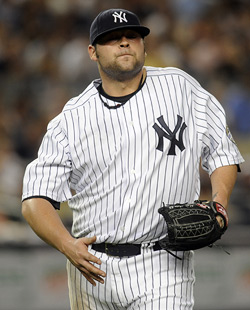 The fact that the game probably won’t mean much to the outcome of the season notwithstanding, Tuesday night’s ballgame had to be one of the most frustrating losses of the year for the Yankees. They got out to a big lead, but Joba Chamberlain was unable to shut down an enemy offense that has had a hard time getting on base at a .300 rate on the road. At this point, it’s impossible to tell if Chamberlain is just lost or the Yankees have lost him, playing so many games with his schedule in the interest of protecting him that they’ve actually played head games with their own pitcher, sabotaging him mentally.
Cut to the bottom of the ninth. Ron Washington decided to finish up with Jason Grilli, never a good idea against a top offense. Predictably, the Yankees started putting runners on base with a Johnny Damon single and a Mark Teixeira walk. Washington then reached for closer Frank Francisco, the Santa Domingo Treat, who couldn’t throw a strike, or at least not a good one. A-Rod walked. Hideki Matsui singled. The much-maligned Jorge Posada singled. Robinson Cano singled. What had been a 10-5 game was unexpectedly 10-9, men on first and second with none out and Nick Swisher at the plate.
Joe Girardi called for a bunt. You can first-guess the play, and I did, but it’s not a clear-cut decision. After last night, Swisher is a .200/.376/.313 hitter at home, and although there isn’t any particular reason that Yankee Stadium II should be such an impediment to him, it isn’t unreasonable at this point for Girardi to assume that Swisher isn’t likely to get a big hit in that spot. That said, Girardi could also have tried to give Swisher a mental boost by showing confidence in him — there’s nothing stopping Swisher from hitting at home except Swisher. Alternatively, Girardi could have also looked at the situation — pitcher falling apart, a batter at the plate who, even if he fails to hit, is still taking a ton of walks, and let Swisher try to walk to reload the bases. The double-play threat was relatively weak — the league double play rate is about 11 percent. Swisher, with all his fly balls and strikeouts, is a little better than average in this regard, hitting into a double play in only 10 percent of his chances.
An additional negative to calling for the bunt derives from goals: are the Yankees trying to tie the game or win it? Conventional wisdom says the former, but with two runners on, none out, and a pitcher in mid-meltdown, they had a good chance to do both. Even if Swisher had succeeded in getting his bunt down, Girardi was falling into the trap that Earl Weaver warned against: if you play for only one run, you’ll only get one run. The Yankees were in a position to win, not tie, the game. There was a very good chance that Swisher would have walked, and although Melky Cabrera and Derek Jeter are double play threats, even a double play has a good chance of scoring the tying run with the bases loaded and none out. In addition, as bad as Swisher has been, the Yankees would have still had to get through Cabrera to survive the inning, and unlike Swisher, Cabrera doesn’t have the redeeming virtue of selectivity.
You know how it worked out. It easily could have gone the other way; if Swisher executed on the bunt, perhaps the game would have gone to extra innings, and the Yankees, with Phil Hughes, Mo Rivera, and the rest, not to mention the last turn at bat, still would have had a very good chance of winning. Still, with Chamberlain’s erratic performance, perhaps provoked by the Yankees’ erratic handling of him, the Rangers trying to give the game away twice, the bunt call by Girardi, and Swisher’s failure to execute, this easily qualifies as the most annoying loss the Yankees have suffered in a long time. As I said above, the good news is that in the long run it shouldn’t mean very much at all.
 LAST-MINUTE TRADES
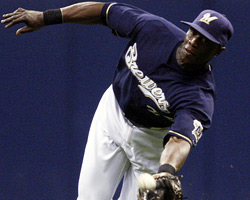
Five shopping days remain until rosters are frozen for the postseason, which means Brian Cashman can still get his trading shoes on and make a deal. I realize I’ve had a Magellanic range of opinions on Cabrera, but given his current slump (.236/.306/.380 from June 1 on, .198/.239/.326 in August) as well as Brett Gardner’s limitations and his uncertain status as he returns from a thumb injury, and the Yankees might benefit from revisiting an offseason trade target, Mike Cameron of the Brewers.
There are four factors which should combine to make Cameron a relatively cheap acquisition should Doug Melvin be willing to deal: the Brewers have next to no chance of getting to the postseason; Cameron is 36; Cameron is making $10 million; Cameron’s contract is up. The old man has had a relatively good season at .259/.362/.456, and his defensive work is still strong. He’s also played on four postseason teams (though his October work has been miserable). Offense isn’t the Yankees’ problem, but every little bit helps when your goal is to win a World Series, and it’s difficult to image the Brewers would hold out for a top prospect…
…Unless they somehow have delusions that getting nothing is better than getting something, which Melvin suggests is the case, saying, “I’ve gotten calls, but they don’t want to give much up at this time of year … They’ll give you cash, but they don’t want to give me a player … I can’t imagine that a team would give up a good player for one month, unless there is a key injury. I don’t anticipate anything.”
Cameron would likely be a Type B free agent, meaning that if the Brewers offered him arbitration (a big if) and he signed elsewhere, they would receive a sandwich pick after the first round. You’d think a functional Minor League arm would be more valuable than the 40-somethingth pick of the draft, but there’s no way of knowing. And, of course, if the Brewers offer arbitration and Cameron takes it, they’re in big trouble — it’s a weak year for center fielders, and Cameron’s numbers are going to look pretty good come negotiation time.
TO THE MATS WITH READER COMMENTS
THE POSADA DISCONTENTS III
Thanks Steven, but you fail to mention besides Jorge’s injury last year that the Yankees did not have CC, A.J., and others on the pitching staff. Furthermore, you also fail to mention that Jorge was not the reason the Yankees were World Champions in the ’90s…it was their pitching staff! Pitching is the name of the game! Yogi Berra, and a host of other top notch catchers will tell you the same thing.
Let’s try this: For all their weaknesses last year, the Yankees finished six games behind the Red Sox for the AL Wild Card. Depending on whose definition of replacement level you use, in 2006-2007, Posada was worth between six and eight wins above replacement. Last year, Jose Molina was worth somewhere between a fraction of a win and two wins above replacement, almost all of the value in defense, as Molina was among the 20 worst hitters in baseball to have any kind of playing time last year.
The Yankees got less than one win out of Posada last year. Pretend Posada had been in the lineup having his typical season. The Yankees pick up four to six wins, which means that anywhere between 75 and 100 percent of their deficit disappears. Once you get down to a gap of one or two games. The Yankees had too many problems to overcome the Rays, but Posada’s inj
ury was the one thing that kept them for qualifying for the postseason in spite of everything else that went wrong.
Ever see the old baseball musical “Damn Yankees”? It has a song about denigrating Posada in it. It’s called, “A Man Doesn’t Know What He Has Until He Loses It.” Then again, the Yankees lost Posada last year and some people still don’t know.
The Posada debate continues
TO THE MATS WITH READER COMMENTS, MORE POSADA DISCONTENTS
If you check out the comments on yesterday’s entry, you will see a lot of frustration with Jorge Posada’s defense. A few lines:
Mr. Goldman, you know as well as I do that we should have let the Mets sign Jorge, instead of the Yanks giving a mediocre catcher the amount of money he received. He grounds into many, many rally-killing DPs and he is a big “K” way too often. Molina is twice the catcher that Jorge is.
Molina knows more about catching than Posada could ever dream about. I believe Cervelli should be brought up to work closely with Jose to refine his game. He’s already proven that he is a better defender than Posada, and hits the ball pretty effectively.
It’s time for the front office to stop turning a blind eye when they see Posada catch. Girardi should know this by now, Posada is not going to learn and doesn’t want to hear it.
 I’m going to agree on one thing. Jose Molina is a much superior defensive catcher to Posada, and Frankie Cervelli looks pretty good, too. I will further agree that Posada hits into a lot of double plays, although show me a catcher who comes up with as many runners on base as Posada does and I’ll show you a double-play machine. I will not agree that he’s “a big K way too often,” as he’s a career .282/.400/.493 hitter with runners in scoring position and a .292/.405/.474 hitter late and close. Finally, I will strongly, violently disagree that the Yankees would be helped in any way by giving more playing time to Molina and Cervelli.
You don’t have to look too far to see what the Yankees would be like without Posada. It happened in a little season called 2008, which was still slowly bleeding to death at this time a year ago. Posada was on the shelf, Molina was playing, and the Yankees were losing games. There were other things wrong with the ballclub, but the Posada-Molina exchange was one of them.
As I tried to indicate in yesterday’s entry, everything in baseball is relative. Posada’s defensive flaws don’t make him a zero as compared to Molina’s 100, it makes him a 70 compared to Molina’s 100. Molina’s pitchers have actually thrown fractionally more wild pitches per nine innings than have Posada’s. Molina has thrown out 41 percent of attempted basestealers in his career, Posada only 29, but that’s a difference of 12 outs per 100 attempts, which sounds like a lot but only works out to a few runs on the season. We could talk about catcher-specific ERA, but that’s a flawed statistic, as it is open to sample size and other distortions, such as who caught who. The point is that you can’t judge players in isolation, but only in comparison. Compared to our idealized vision of a good defense catcher, Posada is terrible. Compared to actual catchers, he’s just a bit below average overall.
Take that knowledge, set it aside, and then consider Posada’s offensive game, which is much easier to evaluate. For most of his career he has not only been an above-average hitter for a catcher, he’s been an above-average hitter period. In 2000, when Posada hit .287/.417/.527, the average AL player hit .276/.349/.443. The average catcher hit only .261/.331/.425. The advantage conferred upon the Yankees was huge. Posada is no longer in his 2000 prime, but he still towers above his catching brethren. Even with Joe Mauer’s huge season in the mix, even counting Posada himself, the average Major League catcher is hitting only .254/.320/.397. To the extent that winning each baseball game is a battle of potential offenses, of being able to say, “My first baseman is better than your first baseman; my catcher is better than your catcher,” the Yankees win still win that battle with almost anyone but the Twins and perhaps the Braves (Brian McCann).
Molina is a career .238/.278/.338 hitter. He’s a below-average hitter compared to the general population. He’s a below-average hitter compared to catchers, shortstops, bat boys, and Snuffleupagus from “Sesame Street.” The offensive loss from such a transaction would outweigh the defensive gains. The Yankees would be net losers, a few runs up on defense, 50 or more runs down on offense. Going by Molina’s performance last year and Posada’s this year, the Yankees would gain a win on defensive runs saved and lose six on offense. As Posada ages, they will eventually have to make a change, but not this one, and hopefully not any time soon.
And before you say, “Yes, Molina, but Cervelli — !” Cervelli is far closer to Molina with the bat than Posada. He’s now 23 and has hit .270/.367/.379 in the Minors, most of that at the lower levels. He hasn’t even had 300 at-bats above A-Ball as yet and it shows in his offensive approach. He needs more time in the bus leagues if he is ever going to improve, and that’s a big if either way. Neither Molina nor Cervelli is going to be the next great Yankees catcher. It could be Jesus Montero, but right now I’d bet on Austin Romine. He’s at least two years away and has some real work to do on his hitting game, as the 20-year-old has power but lacks in selectivity.
In short, keep yelling at the TV if you want to. Perhaps it’s therapeutic. It’s also a bit misguided, because, as I said yesterday, passed balls advance a runner one base. Home runs advance them four. Unless you enjoyed 2008, with its great defensive catching and poor results, root against Posada at your own peril.
|
W-L
|
RS/G
|
RA/G
|
AVG
|
OBP
|
SLG
|
AB/HR
|
SB
|
CS
|
HR/9
|
BB/9
|
K/9
|
|
| Rangers | 10-10 | 4.9 | 4.1 | .281 | .342 | .458 | 28 | 24 | 5 | 1.2 | 3.3 | 7.9 |
| Yankees | 16-4 | 6.2 | 5.8 | .301 | .357 | .519 | 20 | 6 | 1 | 1.1 | 3.4 | 8.8 |
Of the 20 Rangers games surveyed here, 13 were at home, which puts a friendlier tinge on their numbers than is deserved. On the road they have hit .240/.295/.417 as a ballclub. To continue our discussion from above, those are close to Jose Molina numbers. On the whole this is not a great hitting club. They do run the bases a lot, especially rookie Julio Borbon, one of those outfielders that I mentioned in last week’s draft review (which I’ll return to tomorrow). One player to note is Chris Davis, the slugging but strikeout-prone first baseman who returns to the lineup Tuesday night after a long stint in the Minors. A left-handed hitter, he’ll be taking his shots at Yankee Stadium’s right-field porch.
The rookie the Yankees really don’t want to see in this series is Neftali Feliz, a Minor League starter who is doing the Joba Chamberlain ’07 thing for the Rangers’ bullpen. He’s been close to untouchable so far, slinging the ball up to the plate at 100 mph. The Rangers haven’t been great at closing games, but they’ve become very good at the holy eighth inning. In the starting department, the Yankees will face the veteran Kevin Millwood, whose low strikeout rate should work against him in this ballpark — though note that for the last few years he has been much more successful against left-handed hitters than right-handers. Hard-throwing rookie lefty Derek Holland has pitched very well of late, with a 1.85 ERA in his last five starts, and has had a lot of success away from Arlington, so Andy Pettitte has drawn a tough matchup. Journemyman Dustin Nippert takes what would have been Vicente Padilla’s spot, and no doubt everyone involved except Padilla is happier about that. Nippert is a giant at 6’7″, with a good fastball and a power curve but has never pitched with anything approaching consistency. That shouldn’t change in this series.
Responsibility must be with Burnett
ONE AND ONE
Friday was a sort of good Yankees day (great hitting, no pitching) and Saturday was a very bad Yankees day, which sounds like some kind of weird children’s story: “Jorge Posada and the Rumpy Grumpy Starting Pitcher.”
It does seem like Posada has had more than his share of disagreements with his starters this year, but in many ways there is a culture clash at work with the Yankees in a minor key way. The team has a new pitching staff. Few of the current pitchers — CC Sabathia, A.J. Burnett, Joba Chamberlain, Phil Hughes, Alfredo Aceves, Phil Coke, David Robertson, Chad Gaudin, Damaso Marte, and Sergio Mitre (that is, just about everyone except Andy Pettitte and Brian Bruney) — have much experience being Yankees and throwing to Posada. The veterans among them have their own way of doing things. The rookies may be headstrong or timid. Posada, one senses (at least from trying to talk with him in the clubhouse), may not be the most diplomatic guy in the world. You can see how this could lead to conflict on those days when defeat wants to be an orphan. Suddenly it’s not what the pitcher threw, but what the catcher called.
When it comes to an established veteran like Burnett, the final responsibility must be with him. He certainly has the standing on the Yankees to call his own game. It’s not important that he disagrees with Posada, only that he either shake Posada off until they come to an agreement (that is, doing it Burnett’s way) or Burnett throws Posada’s selection with confidence. An in-between approach — resignedly throwing Posada’s pitch — can lead to disaster, apparently what happened yesterday.
Perhaps, though, we need not delve that far to find the source of Saturday’s discord. Burnett has rarely been a consistent pitcher. There are days his control just doesn’t show up for work, one of the reasons he currently leads the American League in walks issued. This has been a career-long problem for Burnett, and blaming his catcher would be unfair given just how many catchers have received his pitches on days like Saturday. Note that Burnett did not blame Posada. We shouldn’t either.
SWISHER’S WEIRD SPLITS
If you average Nick Swisher’s 2008 road stats with his 2009 home stats, you get .198/.343/.309. Miserable. If you put last year’s home stats with this year’s road stats, you get .263/.363/.552. Brilliant. I have no further comment, except to say that if the fellow could just get his concentration down in both places, he could have a 40-homer season. Of course, that he hasn’t is why he was available to the Yankees for Wilson Betamax. As with Burnett’s occasional wild days, Swisher’s oddly bifurcated production represent the invisible hand of human psychology at work on the game.
Musings before the big series in Boston
DAMASO MARTE ACTIVATED — TELL TCHAIKOVSKY THE NEWS
Funny how those extra lefties start showing up right before a team faces David Ortiz in Fenway Park. Ortiz hasn’t hit much this year, but if you’ve seen him do well it was most likely at Fenway, where the Pesky Pole forgives sins of age and PED abuse. The .234/.322/.487 he’s hit at home, including 13 home runs in 278 at-bats, is just dangerous enough that dragging in that extra southpaw is justified, especially when your primary LOOGY is Phil Coke, who has problems with the home run.
I DON’T NEED TO FIGHT TO PROVE I’M RIGHT AND I DON’T NEED TO BE FORGIVEN
One comment on Jim Rice’s Little League rant, and it’s the same one that everyone else is going to have. Rice said:
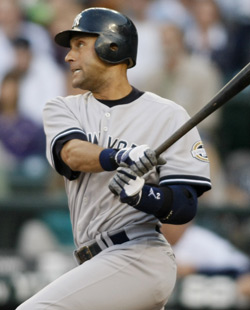 “You see a Manny Ramirez, you see an A-Rod (Alex Rodriguez), you see (Derek) Jeter … Guys that I played against and with, these guys you’re talking about cannot compare … We didn’t have the baggy uniforms. We didn’t have the dreadlocks,” Rice said. “It was a clean game, and now they’re setting a bad example for the young guys”
Rice is a misanthrope, we knew that. Still: A-Rod, Manny … and Jeter? The worst thing Jeter has ever done is shill for cars with low MPG ratings. He does not deserve to be associated with two PED users, nor dreadlocks or baggy pants, though dreads and baggy pants don’t really reflect anything significant except an era in which baseball and all sports have relaxed uniform codes to allow for individual expression.
As for the game of Rice’s era that was so clean, one word: cocaine. I’m not saying Rice used, but so many ballplayers did, prominent ballplayers. Some like Willie Wilson, LaMarr Hoyt and Vida Blue, went to jail. At least a few, like Alan Wiggins, Steve Howe, Rod Scurry and Eric Show, eventually died as a result of their drug habits. More than 20 ballplayers were cited for substance abuse during the 1980s, and that was just the tip of the iceberg — it was speculated by some, among them Keith Hernandez, that close to half of ballplayers were using cocaine at that time. It would also be interesting to ask Hall of Famer Rice if he ever took or had knowledge of players taking amphetamines in his clean game.
In any case, barring some amazing revelation of malfeasance, Jeter is going to be a first-ballot Hall of Famer, whereas Rice is someone that the Baseball Writers are going to spend decades apologizing for passing. There are 50 players who should be in ahead of Rice; when Jeter becomes eligible it will be 51. Years from now, Rice will be as much of a Hall of Famer as is Chick Hafey and Rick Ferrell and Jesse Haines — he’ll have a plaque on the wall, but no one will take it seriously, passing it by on the way to view those of Ruth, Gehrig, Williams, and many more … including Jeter.
20-GAME WATCH: YANKEES VS. RED SOX
|
|
W-L
|
RS/G
|
RA/G
|
AVG
|
OBP
|
SLG AB/HR
|
SB
|
CS
|
HR/9
|
BB/9
|
K/9
|
|
| Yankees | 14-6 | 5.3 | 4.1 | .282 | .342 | .473 23 | 7 | 1 | 0.9 | 3.6 | 8.7 | |
| Red Sox | 11-9 | 5.4 | 5.8 | .265 | .356 | .471 19 | 11 | 4 | 1.5 | 4 | 7.7 |
Since last we left the Red Sox, they’ve gone 7-3 against Detroit, Texas, and Toronto. The principal change the Red Sox have undergone since leaving New York is the addition of shortstop Alex Gonzalez, imported from the Reds. The veteran can’t hit much (career .246/.293/.393) — every few years he has come close to posting a league-average OPS — and this year, having lost all of 2008 to knee surgery, he’s not even halfway there, hitting .214/.258/.298. However, he remains a good glove, certainly better than Nick Green, and Boston hadn’t gotten an ounce of offense from their shortstops anyway, just .220/.291/.327. If the Red Sox slip out of the wild card by a few games, the margin of loss will be exactly the size and shape of the missing shortstop production…
The pitching matchups seem to favor the Yankees this series. Since being abused by the Blue Jays and Angels in consecutive starts at the beginning of July, Andy Pettitte has been very solid, allowing just 10 runs in 39.2 innings, walking 10, and striking out 43. Pettitte has an ERA of 3.63 in 34 career appearances at Fenway Park. In the same period that Pettitte has been pitching well, Friday’s starter Brad Penny has been roughed up, allowing 26 runs in 34 innings and giving up seven home runs. Opponents are hitting .299/.353/.537 against him over that span.
Saturday’s conflict has the occasionally enigmatic A.J. Burnett facing rookie Junichi Tazawa. Tazawa’s Minor League numbers were good, and he pitched well against Detroit in his first start, but the Tigers don’t have a lineup half as deep as that of the Yankees. If the Yankees can lay off of Tazawa’s splitter, or he’s a bit twitchy in locating it, he’ll be out of the game quickly. Finally, Sunday’s 8 p.m. game has CC Sabathia and Josh Beckett dueling, and with Sabathia’s recent run of good starts and Beckett’s great stuff, that should be a game worth tolerating Joe Morgan for. Keep in mind that whatever happens with the starters, the two best bullpens in baseball this year are contained in Fenway Park during this series. The Yankees are No. 1 in wins added, the Red Sox No. 2.
The Yankees are playing with the house’s money here. If they lose the series, even if they get swept, they would retain a significant lead. If they win or sweep, they can probably put the champagne on ice. The Red Sox are tough at Fenway (38-18, .679) but all the pressure is on them. Unlike the last time these two teams met, the only way this series will be historic is if the Yankees execute another sweep for a New Millennium version of 1978’s Boston Massacre. It ain’t over ’til it’s over, but with a 9.5-game lead, it would be pretty darned close.
MORE FROM ME
As always with Yankees-Red Sox series, I’ll be filing updates throughout the weekend. See you then.
Where have all the outfielders gone?
WHERE HAVE ALL THE OUTFIELDERS GONE, LONG TIME PASSING (DRAFTING OUTFIELDERS, PART II)
As we go through the draft, you will note that not only have the Yankees passed on several quality outfielders, they haven’t put much of a priority on drafting outfielders at all. Of course, in the draft you select the best player available, rather than choosing for organizational need. Still, if the Yankees are taking the best available player in each slot, those players should actually prove to be better than players selected subsequently. That hasn’t often proved to be the case.
We’ll look at the third round, then pause to consider the outfielders the Yankees actually did select from 2003 to 2007, players who, had they Yankees hit on an outfielder of value, would have been ready by now. Keep in mind one important fact, one so important that I’m going to repeat it several times below: the lower you go in the draft, the more expectations should be tempered, if not non-existent. Farm systems are vast and not every player can be a prospect; quite often, teams just need a guy to stand in right field so that they can field a functional nine. When you see that the Yankees blew their #31 draft choice on a player who washed out in the Gulf Coast League, keep in mind that 98 percent of the time everyone blows their #31 draft choice on a player who washes out in the Gulf Coast League. Being critical of this would represent a failure to understand the system.
After we dispense with the draft, we’ll consider the international talent market, specifically the recruitment of young talent in Latin America.
Third Round: Jordan Schafer (2005/HS), Daryl Jones (2005/HS), Nick Weglarz (2005/HS), Scout Cousins (2006/C), Cedric Hunter (2006/HS), Angel Morales (2007/HS), Kyle Russell (2008/C), Roger Kieschnick (2008/C).
What the Yankees did: The Yankees picked 29th in the third round of the 2005 draft, and while Weglarz went at #14 and Schafer went at #27, the Yankees drafted Brett Gardner. The Cardinals took Jones with the last pick of the round. In 2006, they picked 28th and selected Zach McAllister, a very promising righty who is now carrying a 2.13 ERA at Trenton. With the last pick in 2007’s third round, they went with another righty, Ryan Pope, also at Trenton, a pitcher who emerged from the unlikely cradle of the Savannah College of Art & Design. He’s shown good control in the minors but has also been knocked around quite a bit.
In 2008, five outfielders were selected after the Yankees wasted their pick on Bittle. Two of them are on the list above. Russell, selected by the Dodgers at #16 in the round, is a left-handed power-hitter with a long swing, now playing in the Midwest League and hitting .271/.365/.544 with 24 home runs. He has also struck out 156 times in 421 at-bats, which is something that might relegate him to a Russ Branyan-style career. That said, Branyan is a more productive hitter than anything the Yankees have on the outfield shelves right now. Kieschnick, taken by the Giants with the fifth pick of the round, is also a lefty power-hitter, batting .298/.344/.535 with 23 home runs in the California League. The Yankees took second baseman David Adams at #29, a pick which has yet to resolve for good or ill — Adams has been a solid but unspectacular performer thus far. In the supplemental phase of the third round, the Padres selected University of Kentucky Sawyer Carroll, one of those “polished college hitters” who have a mature approach at the plate but don’t promise to develop too much. In 114 pro games taking him up to Double-A, the 23-year-old Carroll has batted .314/.412/.485 with seven home runs and a nice 72 walks.
WHO THEY DID GET
We pause here to switch gears, and instead of looking at the outfielders the Yankees passed up or didn’t get a shot at due to draft position, let’s look at the outfielders they did draft in the years 2003 to 2007. If the Yankees took you out of high school as an 18-year-old then in 2003, you’d be 25 now. That should give even the late bloomers enough time to manifest themselves.
2003 Outfielders: Estee Harris (#2), strikeout machine Tim Battle (#3), Jose Perez (#7), and two others who did not sign. Harris stalled at High-A and went off to the Atlantic League. The Yankees nursed the athletic Battle until the end of last season, when they finally conceded that his swing would never be of Major League quality. Perez didn’t make it past Staten Island.
2004 Outfielders: Rod Allen (#12), Robert Vilanova (#15), Jon Tierce (#17), Scott Rich (#21), and four others who did not sign. Allen’s career ended in High-A. Villanova got a cup of coffee–in the Midwest League. Tierce topped out at High-A Tampa. Rich was cut after 42 games at Staten Island.  2005 Outfielders: Brett Gardner (#3), Austin Jackson (#8), James Cooper (#9), Joel Perez (#14), Chris Valencia (#41), and four others who did not sign. Gardner and Jackson you know about. They should be good role players or part timers, but anything beyond that is still in doubt. Cooper, now 25, is playing at Trenton this year. In 391 career games he’s hitting .264/.353/.351, and his chances of being more than organizational filler have long since passed. Perez’s career ended in the Gulf Coast League. Valencia is currently playing for Brockton of the Canadian-American Association.
2006 Outfielders: Colin Curtis (#4), Jeff Fortenberry (#11), Donald Hollingsorth (#14), Brian Aragon (#22), Nick Diyorio (#38), Chase Odenreider (#49), and two other players who did not sign. Curtis, now at Scranton, began promisingly but hasn’t hit in three years. His career averages in 413 games are .265/.336/.378, which won’t get you to the Majors. Fortenberry, 25, showed a little home run power early, but has never hit for any kind of average. The Yankees promoted from Tampa to Trenton this year after he hit .180/.272/.354; he’s hitting .160/.259/.256 at Trenton. Hollingsworth had a good eye but had almost literally zero power and failed to advance past the Sally League. The players taken in the later round care organizational filler/hope to get lucky guys. Suffice it to say that the Yankees got neither.
2007 Outfielders: Taylor Grote (#8), Austin Krum (#9), Isiah Howes (#11), Dave Williams (#15), Taylor Holiday (#19), Matt Morris (#23), Gary Gattis (#26), Steven Strausberg (#27), and three others who did not sign. Grote is currently playing at Low-A Charleston. In 154 career games he’s hit .242/.322/.329. Just 20, it’s in the realm of possibility he could get better, but it seems pretty darned unlikely given how far he has to go. Krum has made it to Double-A Trenton at 23. A center fielder, he is willing to take a walk and will steal the odd base, but the aggregate — this year he’s hitting .263/.371/.351 — doesn’t get you anywhere. Howes washed out at Staten Island. Williams didn’t show anything with the bat and was not promoted out of the Sally League after hitting .249/.321/.367. Holiday hit .215 in the Sally League and that was that. Morris hit .207 up through the Sally League and… Gattis stopped in the Gulf Coast League. Again, good players are rarely found this far down in the draft, so that the Yankees didn’t score here doesn’t necessarily indicate anything. Stausbaugh was apparently cut from Tampa earlier this year.
TO BE CONTINUED
In our next entry, we’ll pause for some present-day stuff, then pick up with the top 86 outfielders and the fourth round of the draft.
 Pinstriped Bible