Ready for your midterms?
THE DREADED MIDTERM GRADES
On Sunday, the Yankees played their 81st game. The season’s official halfway point comes at the All-Star break, but this is it’s actual halfway point. In my ten years as pinstriped armchair detective, I’ve sometimes resorted to the clichéd midterm grades and sometimes not. This year it seemed like a helpful device to review the season. Today we’ll cover the position players, tomorrow the pitching staff.
As you review the report card, remember that the same grade might not mean the same thing for two different players, because each player must be viewed in the context of his position, his career, and his role. Expectations for Mark Teixeira are different than they are for Brett Gardner, so the latter could conceivably get a better grade than the former without implying that he is the better player in a head to head comparison. With that in mind, feel free to offer your own grades in the comments section. 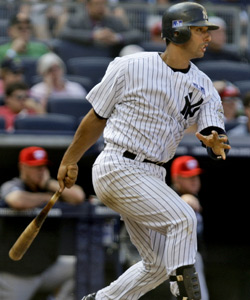 JORGE POSADA-CATCHER
Putting his 25 days on the disabled list aside, you can’t fault Posada’s season. When a 37-year-old catcher is hitting .284/.368/.523, you give thanks for your good fortune and try not to ask too many questions. On defense, he’s thrown out over 30 percent of runners trying to steal, a solid number (the overall Major League success rate on stolen bases this year is 73 percent). The notion that his handling has damaged Joba Chamberlain or anyone else is farfetched bushwah given his career record, as well as those of his many battery-mates. As with several Yankees, Posada has done far more damage at home than on the road. GRADE: 89/100
MARK TEIXEIRA-FIRST BASE
Teixeira has been quite streaky, only reaching a “hot” temperature in May. He’s been vastly more successful at home (.310/.402/.632), but his road production (.243/.373/.472) also gets the job done, albeit at a far more pedestrian level. He’s also been a revelation on defense, even if for some reason the metrics don’t show it. While Teixeira’s season is consistent with his work in previous seasons, he’s not quite at the level of the last two years (.307/.406/.557 in 289 games), and it’s worth noting that he’s having only the fifth-best season among AL first basemen, trailing Justin Morneau, Kevin Youkilis, Russell Branyan, and Miguel Cabrera. Of these, Branyan probably won’t hang on until the end, but the others almost certainly will. Bumped out of the “A” range, but only in comparison to previous performances. The 20-game homerless streak with which he ended the half (.244/.366/.321) didn’t help. GRADE: 86.5/100
ROBINSON CANO-SECOND BASE
Cano has bounced back from his spectacularly miserable 2008, but a league-average on-base percentage is still a bridge too far, as is consistency–in May and June combined, he hit .271/.302/.439, which doesn’t help all that much. He’s on a pace to ground into 24 double plays, and he’s batting .196 with runners in scoring position. There are certainly worse second basemen to have–Howie Kendrick is actually the evil Cano from the Star Trek mirror-verse–but as usual, the whole is less than the sum of the parts. GRADE: 79/100
ALEX RODRIGUEZ-THIRD BASE
With 45 walks and 14 home runs in 51 games, A-Rod has been productive despite his low batting average. Eleven of his 14 homers have been hit at home. Conversely, he’s hitting just .211 in the Bronx, with a truly strange .131 average on balls in play–one wonders if he’s trying to get the ball in the air at the new park, trying to catch up on all the short fence/jet stream-generated fun his teammates had without him. His hip problems seem to have sapped his speed and defense, and he hasn’t been around that much. Docked a few points for days absent and the whole juicing thing, which is spectacularly annoying. GRADE: 83.5/100
DEREK JETER-SHORTSTOP
There are a few nits you can pick with Jeter’s season. He’s only hitting .264/.340/.383 against right-handers, most of his damage coming thanks to .452/.524/.644 rates against lefties. All of his power seems to be a product of Yankee Stadium II; just two of his ten home runs have come on the road. On the plus side, his walk rate is up, he seems more limber this year, both on the bases and in the field, and though he still hits everything on the ground (he ranks 11th among players with 150 or more plate appearances this season), he’s kept his double play rate in hand. Overall, I’m not complaining–after the lethargy of last year, this qualifies as a comeback. GRADE: 91/100
JOHNNY DAMON-LEFT FIELD
Damon hit 17 home runs last year. He’s hit 16 in 76 games this year. The difference is Yankee Stadium II; the former Caveman is hitting .289/.390/.592 with 12 home runs (one every 12.7 at-bats) at home, .278/.340/.465 with four home runs (one every 36 at-bats) on the road. Now, that doesn’t mean that Damon shouldn’t get his due, as being able to take advantage of one’s environment is a skill. It’s much like Jim Rice’s home-road splits in Boston: if everyone who played in Fenway hit like Jim Rice, you’d have an argument about discounting his stats. Damon’s road stats are also sufficient–the average Major League left fielder is hitting .267/.342/.433 overall. At his current pace, Damon is going to obliterate his career high in home runs, his career high in walks is also in reach, and he’s easily going to have his tenth 100-run season. Stolen base frequency is down and his range in left seems down a bit, but as with Jeter I’m not going to complain about a late-career high. GRADE: 90/100
MELKY CABRERA-CENTER FIELD
He’s doing some things he’s never done before, like hitting as a right-hander and taking the occasional walk–he had 29 free passes all of last year, compared to 22 now. That said, he’s mainly helping with his defensive versatility, not his bat. His home runs are a gift of YS II, with seven of eight round-trippers coming in the friendly confines, and coincidental with the injury he suffered in Texas or not, his bat turned off at the end of May and hasn’t come back–even with a semi-hot streak over the last couple of weeks, in 31 games since the end of May he’s hit .221/.303/.379. Given that Cabrera hit only .235/.281/.300 after April last year, the idea that the injury is what’s holding him back should be taken with a huge grain of salt. Cabrera is an asset as a reserve, but he’s not a starter. Alternatively, he’s playing hurt under the misguided belief that he’s helping. At that point, Austin Jackson would be the better choice. GRADE: 72/100
NICK SWISHER-RIGHT FIELD
What a weird player, inconsistent in every phase of his game. At his April level of production, he was a Ruthian terror. In June he hit .253/.379/.506 and was still plenty productive. In between, he took a lot of walks but hit .150. Six games into July he just drew his first walk of the month and was 4-for-22 with one walk in seven games since hitting his last home run going into Tuesday, when he finally broke through with three hits (which doesn’t count towards the midterm). He hasn’t been all that productive with runners on–this seems to be a career-long problem, as if he shortens up his swing and worries about striking out in those situations. The result is quite a few walks but not many hits. His defense is usually solid, but he also has his off days. As he did last season, Swisher has a pronounced home-road split. He’s batting .279/.373/.625 with 11 home runs (one every 12.4 at-bats), but only .181/.347/.302 (again, through Sunday) with three home runs (one every 38.7 at-bats) at home. He’s been helpful on the whole, but the only reason he ranks among the top 15 right fielders in productivity is
that there are only 15 right fielders having good years. In short, I don’t know what to make of him. GRADE: 80/100
BRETT GARDNER-THE OTHER CENTER FIELDER
Gardner is listed among the starters because he’s actually started more games in center than Cabrera, even though Cabrera has played more overall. Given what little was expected of Gardner, not to mention the way he started the season, he probably deserves an A grade just based on performance vs. expectations. He started only 25 games across May and June, but he also appeared in 21 more and hit like crazy, batting .330/.427/.510 with four triples, three home runs, 16 walks, and 12 steals. He has not been handled brilliantly. After Gardner’s 5-for-6 game against the Mets on June 26, he was given just two more starts (he went 0-for-7) before Joe Girardi presumably decided he had gone cold and it was time to try Cabrera again. It’s not clear how a kid is supposed to build up any momentum under those conditions. When he sits, the Yankees aren’t suppressing a great bat, but they do lose some patience (Gardner has drawn a walk every 9.7 plate appearances, whereas Cabrera has taken a pass every 11.6 plate appearances), their best baserunner, and their best center field defender. Despite the hot streak, it’s doubtful that Gardner will ever be a big run producer, but he’s certainly been worth playing. GRADE: 85/100




 Pinstriped Bible