Tagged: Alex Rodriguez
A-Rod and the magic vial
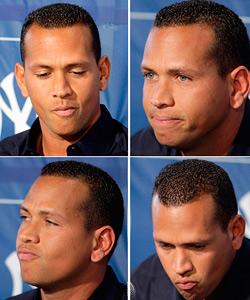 I watched the Alex Rodriguez press conference so you wouldn’t have to, and I have to say that you didn’t miss much. Certainly nothing was said that would convert an A-Rod skeptic or critic into a believer or supporter. Rodriguez hit upon a singularly bad turn of phrase when he said, “I’m here to take my medicine.” However, his answers were basically evasive. He repeatedly fell back on the excuse of youth (he was 25) and naivete, wishing several times that he had gone to college instead of being a Major Leaguer at 18.
That’s fine as far as it goes, but his claims of innocence and ignorance are inconsistent with his other answers. Rodriguez explained that he had little knowledge of the substance he was being injected with, didn’t know how to use it, wasn’t really sure what benefit he received from taking it — he said it was supposed to provide “energy” and did confirm that he felt more energetic — and wasn’t even sure that it was a banned substance. Maybe it was, maybe it wasn’t. At the same time, he felt, he said, that he couldn’t reach out for education, because his use had to be secretive.
These two sentiments seem to conflict. Rodriguez was ambivalent about the illegality of his usage, but felt that he had to conceal that usage. That doesn’t exactly scream “innocent mistake.” Say this for Mark McGwire: he had the stuff out on his locker shelf for all to see, because he didn’t think he was doing anything wrong. One doesn’t take pains to conceal what one does not feel the need to conceal. You ever sneak an extra dessert when no one is looking and carefully throw away the wrapper so there’s no evidence? That’s one Twinkie that just disappeared. Could have been anyone who took it, since there’s no evidence to connect you to the crime, whereas, the legit food that came with dinner, you didn’t sneak under the table to eat it. You had it right out there in front of everyone else.
Now, we all conceal certain things out of fear of embarrassment or ridicule. That is only human — we do not share 100 percent of ourselves, even with our closest loved ones. Maybe you don’t want the wife to know about the time you wound up on the observation deck of the Empire State Building without any pants. More likely, you don’t want the wife to know about the time you thought about being on the observation deck of the Empire State Building without any pants, because that might lead to other, more difficult questions, such as, “So what was it about that scenario that appealed to you?” Her perception of you might change, if only she knew what lurked in the unswept corners of the Id. That’s true of her for you as well, and all of us.
This kind of discretion is distinct from concealing something that you know or strongly suspect is criminal and will open you up to some form of official sanction. If A-Rod was the naïf he claims to be, would he have simply taken a random drug for “energy?” One suspects at least a bit of familiarity with the possibilities of such “aids,” just as one suspects a pretty clear understanding of the consequences of dabbling.
There were other inconsistencies, like this apparent need to rehearse his story with the unnamed “cousin” who suddenly became a major character in the story, one who was not mentioned to Peter Gammons or Katie Couric or Torquemada, the Grand Inquisitor. These things hardly seem worth commenting on, except to say that today’s conference was about Rodriguez regaining his credibility, and it doesn’t seem like that happened.
Of course, none of these concerns go to the bottom line, which, as A-Rod correctly pointed out, is that he had his best season in 2007, and there has been a testing regimen in place for a few years now, one that seems to have been successful in nailing quite a few players. There remains little evidence that steroids do much more for ballplayers than build muscle, or that Rodriguez’s numbers were affected in any significant way. He remains one of the best ballplayers in the business and also one of the hardest to like. From the point of view of winning pennants, one out of two ain’t bad.
Tejada and the terribly blustery day
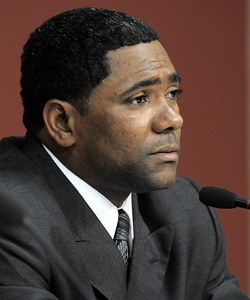 It was painful watching Miguel Tejada weep over his guilty plea for lying to Congress, but a little bit satisfying as well — not in the sense of schadenfreude, of taking pleasure in someone else’s suffering, but in anticipation of the deterrent effect that his tears might have on future ballplayers, arrogant enough, as Tejada was, to dismiss the legal jeopardy that might result from participation in the culture of bodybuilding, that has infected Major League clubhouses. That prosecutors nailed Tejada on something as peripheral as perjury, rather than his own usage, actually makes the potential chill even more visceral — concealing the use of another is enough to get you hooked, booked, and cooked. Potentially all players in a clubhouse can be implicated in the use of PEDs by any one player.
There will always be an incentive for certain players to cheat. These players are not the A-Rods or the Bonds, but the kind of guys that Tejada got in trouble for talking steroids with, Adam Piatt. The vast majority of players caught have been, and will continue to be, those for whom a million-dollar payday is just a few home runs away. Those at the top of the game, those who have the talent and the riches but cheat anyway, we’ll never know why they chose to go that route — there is no good answer. A-Rod suggested that it was insecurity after signing a big contract. For Bonds, the reason seems to have been vanity.
Whatever the reason, it wasn’t intelligence. These athletes seem to be in the thrall of an impulsivity that does not consider consequences. “Field of Dreams” had it all wrong — Shoeless Joe didn’t return from the grave to teach some pseudo-hippie in Iowa the value of forgiveness, but the pain of not being forgiven, of having a shadow hang over you for the rest of your life. Jackson made the dumbest decision of his life at 29 years old and had another 32 years to think of it, 32 years in which he was hanging out in Nowhere, South Carolina, instead of attending reunions in Cooperstown, N.Y. One of the most difficult stories from Jackson’s life to think about is the occasion in which Ty Cobb unknowingly wandered into Jackson’s liquor store, and Jackson was, at first, too ashamed to identify himself.
Cobb had reason for regret as well. He too got caught up in a betting scandal, one that continues to dog his reputation to this day, even though he was officially cleared by the Commissioner. He also lived to regret his reputation for violence and rage. Perhaps Jackson and Cobb are beyond caring now, but both were intelligent enough to know that they were historic figures, and the evil that they did would live after them. “Speak well of me after I am dead,” the old saying goes. They knew that was unlikely to be the case, and it pained their final years — so too for Hal Chase, Eddie Cicotte, Carl Mays, and many of the other players who left the game under a cloud. Again, they are dust now, and beyond pain, but they had to live with the pain, too. Tejada, I think, now has had the smallest taste of that.
Alex Rodriguez could play most of another decade, and his Hall of Fame case will not come before the court of opinion for another five years before that, so he will be living with the legacy of his own stupidity and shortsightedness for a minimum of 15 years, but more likely for the rest of his life. As I said at the outset, there will always be some players who will cheat, who will have the incentive to cheat, but of those for whom cheating is simply a choice born out of greed or ego or just the assumed invulnerability of youth, we can only hope that they will watch Tejada’s tears and say, “That could be me.” We can only hope that they watch Rodriguez, the new Ozymandias, struggle to rebuild his reputation (“Look on my works, ye mighty — I shot myself in the ***”) over and over again in the coming years, and say, “Let the cup pass from my lips — I’m not having any.” The consequences are real, beyond money gained or lost, beyond home runs, beyond temporary suspensions by the namby pamby commissioner. The consequences could be legal, could involve loss of assets or jail, but beyond that, it could result in the permanent suspension of your reputation.
MORE BY ME
For those with an ESPN Insider account, I was charged this week with issuing dire warnings about the Red Sox. In my usual history minute spot at BP, I search for those lineups that are supposedly too left-handed.
I am also proud to note that this year’s BP annual, which I co-edited and to which I contributed much writing, has already begun shipping and currently stands at No. 25 on the Amazon bestsellers list. Select BP colleagues and I will be making appearances around the New York area to sign the book and talk baseball, including (but not limited to) March 1 at the Yogi Berra Museum, March 12 at the Barnes & Noble on East 18th Street in Manhattan, and March 26 at the Rutgers University Bookstore in New Brunswick, NJ. Full details and additional dates to follow shortly. I very much hope you’ll come out and chat. If not, I get kind of lonely.
…I also wanted to note, a bit belatedly, that artist Rich Faber has finally got his signed and numbered Gehrig and Mantle prints in (I have one of each, and they look even better in person). If you scroll down, you should also note his “Drama Queen” T-shirt, which has nothing to do with baseball but was a hit with my daughter when I gave her one — and weirdly predictive, but I don’t blame the T-shirt, as little girls are just like that sometimes.
Too hard on Tejada?
Eleven reactions to the A-Rod/steroids story
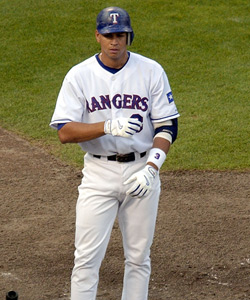 1. Not steroids again. Not A-Rod again. I have seen both of these movies before, and wasn’t clamoring for a re-release or a sequel. This is how I imagine most people feel about Steve Martin’s “Pink Panther” films.
2. I’m still not certain what we’re upset about. We don’t know how performance-enhancing drugs affect a hitter’s performance. We intuitively feel that it should, but actual evidence is nonexistent. I have had acquaintances and fellow writers tell me, “They help you hit the ball farther,” or, “They help you see the ball better.” Unfortunately, none of them could cite a legitimate source for these effects. Indeed, any attempts to tease out the evidence of PED use in baseball statistics tend to come up with few persuasive results (for one effort, see Nate Silver’s chapter on PEDs in Baseball Between the Numbers — in the interest of full disclosure, I contributed a chapter to said book). The key fact is this: steroids help one build muscle. They do not necessarily help one hit a baseball. Indeed, there is no evidence for the latter.
3. Most of the players caught taking steroids have been of the most fringe-y types. These fellows did not turn into Barry Bonds or Alex Rodriguez. It’s hard to see that they received any benefit at all. When we turn to a Bonds or an A-Rod and say that they received a great benefit from using, not only are we automatically in the realm of conjecture about the basic effects, we’re also positing that they received a benefit beyond what other users received. While it is known that certain medications will affect various individuals differently (the impact of side effects varies, for example), it is something of a stretch to say that one guy gets nothing and the next guy gets 50 home runs, or even 10 extra home runs. If you’ve had radiation administered to your eyes, as I have, you will find out that some people have their vision reduced, and some go completely blind (as I have). One guy in a hundred does not turn into Cyclops of the X-Men and go about shooting bad guys with his optic force beams. That kind of result just isn’t on the menu of possibilities.
4. Given the chimerical benefits of PED usage and the fact that Rodriguez lacked the monetary incentives to use that seem to inspire most of the aforementioned fringe-type users, I am forced to fall back on one of the great explanations for everything, vanity. We already knew, or suspected, that Rodriguez was something of a narcissist. This is the confirmation.
5. Rodriguez had the best offensive season of his career in 2007. His 2008 offensive output wasn’t too different, when adjusted for context, than his now-tainted 2003 performance. How do we reconcile these things, assuming Rodriguez was clean after 2003 or 2004? Wouldn’t it be naïve of us to believe that 2003 was the only time A-Rod was using?
6. Clearly, using PEDs does not help you come up with the big hit in a postseason game.
7. Rodriguez could play for another eight or 10 years. He won’t be eligible for the Hall of Fame for another five years after that. Get ready to become intimately familiar with this topic, because we’re going to be kicking it around for something like a decade and a half.
8. The bigger story here is not that A-Rod might have used, but that what should have been a confidential testing record was picked up by the government for no particular reason, and further that the government, as custodian of those records, were sloppy enough in their handling of them that we and Rodriguez have come to this reckoning. Whatever one thinks of what Rodriguez did, whatever one thinks of about Rodriguez, he does not deserve to be a victim of drive-by assassination in a legal proceeding against somebody else, and it seems like the 4th Amendment would give him (and you, and me) the right not to be. Of course, the 4th Amendment ain’t what it used to be.
9. The second-biggest story is the Gene Orza of the Players Union might have been tipping players to upcoming tests. That would throw the whole testing regime into question.
10. The “good” part of the Bonds story was that A-Rod was likely going to erase his home run record anyway, so we would have a “clean” all-time home run leader. Now, not so much — despite the complete and total lack of evidence that what Rodriguez might have done has had any impact on his home run totals anyway. This is yet another aspect of the story that will never, never go away. Thanks, A-Rod. Thanks, Feds.
11. The ‘net is teeming with unqualified advice for A-Rod and how he should handle these disclosures, and I’m not even tempted to join the parade. Despite the points cited above about the lack of evidence for the impact of PEDs on hitting performance, that doesn’t mean that Rodriguez should be perceived as being any less corrupt for having failed a test. The records may be safe but our estimation of this already unpopular player is not, and I imagine it will never be restored.
Foresight proved 20-20 with Torre
 OZYMANDIAS: THE MEMOIR
I’ve been reluctant to offer much conversation on the Joe Torre-Tom Verducci book because I’ve not read the thing (get your act together, Doubleday publicity!) and of all the things the world needs, it’s not another uninformed commentary on that bloody book. Nonetheless, I feel like I can’t let the Greatest Story of Our Time pass without a few words, at least until I get hold of the holy pages. Given what I’ve heard so far of the “controversial” passages, I feel validated.
Longtime readers know I jumped off the Torre bandwagon a few years before he actually left town. I was a convinced fan of Torre’s after the buttoned down and seemingly know-nothing Buck Showalter epoch. However, as I wrote here many times, I became convinced that Torre had outlived his usefulness. He was not a builder and he wasn’t a strategist. His main skill was creating a professional atmosphere, something that the organization had proved incapable of doing over a period of nearly two decades.
However, Torre’s ability to do that ebbed, and now the new book suggests that this ability was largely mythological. Torre seems to blame Brian Cashman for foisting too many irregular-size players on him, but this gets into circular, chicken-and-egg territory: were Cashman’s players unable to blend, or did Torre fail to blend them? For every end-of-the-line gamble Cashman took, like Kevin Brown, where no manager would have been able to save the situation, there have been others who left New York and went on to productive work. Perhaps more importantly, in 2008, Joe Girardi minted more Major League relievers than Torre did in his entire 12-year stay.
Torre’s failing judgment climaxed with Alex Rodriguez. When Torre batted A-Rod eighth in the fourth game of the 2006 ALDS, he publicly demonstrated that his usefulness was at its end. That was actually the second such gesture that year, and the first of his self-immolating collaborations with Verducci, when he conspired in the swift-boating of his own third baseman in the pages of Sports Illustrated. If you will recall, A-Rod had slumped that August, the boos were again raining down and Torre was at a loss. At that point, Torre enabled the Verducci story, which then waited like a time bomb for Rodriguez to emerge from his slump and enter the playoffs. It went off just in time to kneecap A-Rod at the most important moment of the season.
With this helpful stab in the back, Rodriguez was “motivated” right back into his slump.
Not satisfied, Torre then jerked the future Hall of Famer up and down the lineup throughout the short series. Where a player hits over the course of four games isn’t all that important, but the psychological impact of those moves is. Rather than leave Rodriguez alone, and minimize the stress on his player, Torre did everything he could to make him the story.
If Torre wasn’t an Xs and O’s manager, if he couldn’t get young players into the lineup, and he was unable to communicate with the players the GM was giving him, no matter how difficult, then what did he bring to the table besides an increasingly illusory and irrelevant gravitas? Again, not having read the book as of yet, I cannot draw any firm conclusions, but from A-Rod to his bitterness about not getting Bernie Williams back in 2007 (another example of hideously poor judgment, one he apparently tries to excuse by character-assassinating Carlos Beltran, the player who would have displaced the beloved Bernie) this tome seems to be one of the greatest examples one can think of a man doing all he can to destroy his own reputation, the myth of his own greatness. Instead of proving his indispensability to the Yankees, Torre has made a persuasive case for why they had to let him go.
Pettitte and the perfect team
 I said a good deal of what I wanted to about the return of Andy Pettitte in yesterday’s installment, and you said what you had to say in the comments. Then, in Brian Cashman’s phoner after the deal was announced, he echoed some of your comments about depth and how at some point the Yankees might still need to call upon one of their younger pitchers.
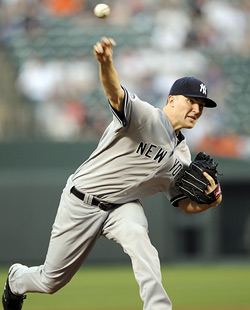
Still, Phil Hughes (pictured) and pals have clearly been relegated to Plan B, and that’s not necessarily a good thing. The Yankees are well fixed for Minor League pitchers, so depth was unlikely to be an issue. More pressing is the need to give those pitchers Major League experience so that when Chien-Ming Wang gets hurt again, or Pettitte’s always troublesome arm acts up, or A.J. Burnett experiences whatever happens to Burnett, they are ready to step in with more consistency than they showed in 2008. It is not overly optimistic to think that last year was the growing pains year for Hughes and Ian Kennedy, while 2009 could be the year they begin to deliver. Yet, that possibility seems to have been aborted.
Yet, there is no reason to be glum. On paper, the Yankees have put together a team that is going to be very tough to beat. If everyone does what they’re supposed to do, the rotation will be the deepest in the game, the bullpen will be solid, and the lineup… Well, the lineup may still have some problems, even if Jorge Posada is healthy. Robinson Cano needs to snap back, Derek Jeter needs to find the Fountain of Range — I mean Youth, and the outfield could be a complete wipeout.
That leads me to the question of the day, and one which I will probably center my Hot Stove show comments around this Thursday: on the phoner, Mr. Cashman was asked if he was now ready to retire for the winter. “I wouldn’t expect anything further at this stage, or anything significant,” he said.
Here are my questions: Should the Yankees be done? Has Cashman done enough? How would you evaluate the job that he and the Yankees did in preparing the team to contend this year? I’m not sure what the structure of this week’s show will be, but if it all possible I will read selected answers and respond on the air.
A-ROD/A-FRAUD/A-FROG/WHATEVER
I’m holding my comments on the Joe Torre/Tom Verducci book until I’ve actually read it, but it’s worth briefly revisiting Alex Rodriguez’s supposedly un-clutch performances. I can’t defend the guy’s personality or his teammates’ perception of it. That’s a different matter from what he does on the field. The fact is, except perhaps in very limited cases of piling on, all the runs generated by a player count. We make judgments as to a hit’s value using information that we could not possibly know at the time, which is to say the game’s outcome. It is true that if an A-Rod hits a home run with his team down 5-0 in the seventh, it’s likely that the home run won’t have any impact beyond the back of his baseball card.
However, game conditions change, and scores affect player behavior and managerial decision-making. A three-run shot with a 3-0 lead moves a game from in doubt to safe. That single tally in the face of a big deficit may bring a closer into the game who otherwise would have rested, or serve as the foundation block of a rally. You can’t really know until it’s all over. Naturally, it would be preferable if A-Rod chipped in a few more two-run shots when the team was down 1-0, but it is incorrect for anyone to imply that his stage fright in some of the big spots means that the rest of his contribution is without value.
Yanks need to produce for CC to be effective
 AS WE GO UP WE GO DOWN
Down in the comments, longtime reader/frequent commenter Louis writes:
I have been wanting to make that point about the Blue Jays and their league-leading 3.77 runs per game allowed for awhile, but somehow keep bypassing it, and I thank Louis for reminding me. The Jays scored just 4.41 runs per game The Yankees were almost half a run better, plating 4.87 runners a game. “Better” isn’t “best;” the Yankees ranked only seventh in the league in runs per game.
The question for next year, insofar as any potential Blue Jayism goes, is if the Yankees offense gets better, worse, or stays the same. Brian Cashman is on record as saying “Better.” He bases this on getting a full season out of Jorge Posada; a fixed Robby Cano; a divorced A-Rod; a healthy Matsui. Is he correct? With all respect, probably not:
Posada is a year older and very probably won’t be up to his old 140-game workloads. Whereas almost anything Posada is likely to do will be an improvement on Jose Molina, giving one-fifth or more of the starts behind the plate to Mr. Career .237/.276/.339 is potentially devastating. And if Posada’s shoulder isn’t what it used to be and he can’t catch, look out.
Alex Rodriguez hit at about his career levels last year. Sure, he was well down from 2007, but 2007 was not his typical year. Maybe a more relaxed, Maddona-ified A-Rod will hit better in the clutch, but that adds fewer runs than you might thing.
If Matsui is healthy, he should be reasonably productive at DH, but the Yankees actually did quite well at DH last year thanks to Johnny Damon and Jason Giambi. Overall, Yankees DHs hit .282/.378/.461. Matsui is a career .295/.371/.478 hitter and he’s 35. He’s not likely to give the Yankees a whole lot more than they got last year.
Cashman is probably right about Cano, but we haven’t even gotten to the other aspects of the offense: Johnny Damon will probably lose some production. No one knows what the team will get out of center field. Xavier Nady in right field is a likely step backwards of around 20 runs. Nick Swisher could put first base on a par with what it got last season (.246/.349/.460) or even a little more assuming the return to form we all figure is coming.
So what does that all add up to? Without playing with projected numbers (which I did in a previous entry), it seems like there might be something less than short of a decisive improvement. As for the defense, it’s where it was, and that ain’t good. Figure that if the Yankees want to win 98 games next year, and scoring remains constant or just ticks up a little bit, they would still have to saw nearly 80 runs allowed off of this year’s total. Sabathia replaces Mike Mussina plus (because he pitches further into games) some bullpen innings. Add a healthy Chien-Ming Wang, a full year of Joba Chamberlain, and about 40 starts from pitchers (whoever they are) who should be better than Sidney Ponson, Ian Kennedy, Phil Hughes, and Carl Pavano… It seems doable, but if the offense slips, look out. Things will go backwards as they go forward.
 Pinstriped Bible