Tagged: Brett Gardner
One mystery remains before Yankees start season
 NOW OUR REVELS ARE ENDED, KIRK
With the demotions of Alfredo Aceves, Dan Giese, and Brett Tomko, all but one of the spring’s competitions and mysteries have been resolved. Brett Gardner (3-for-4 today) is your center fielder. Xavier Nady is your right fielder. Jon Albaladejo is in the bullpen. Jorge Posada and Hideki Matsui are more or less ready to go. Mariano Rivera seems more than ready to go. Southpaw Phil Coke should make the team, and he looks like he’ll be a weapon. Joba Chamberlain started the spring in the rotation and will finish the spring in the rotation. Any time a setup man blows a lead all season long someone will second-guess his being there, even if he’s 16-1 at the time, but he’s in the rotation. All that remains to be determined is the identity of the reserve infielder, a player who may only cling to the roster until Alex Rodriguez returns. Assuming no major injuries and a timely and effective return for Rodriguez (which is assuming a lot, but let’s go with it), that player should only have minimal playing opportunities… Unless, as I hopefully speculated yesterday, Joe Girardi is brave enough to use a late-inning defensive replacement for Derek Jeter.
KEPPINGER (A BRIEF NOTE)
Earlier this spring I touted Jeff Keppinger as a player who would make a useful A-Rod substitute and post-Rod utility player. While not a defensive standout at any position, he’s adequate around the infield and has a far better bat than either Angel Berroa or Ramiro Pena. Today, the Reds dealt him to the Astros for a player to be named later. As the Astros’ farm system is drier than my aunt’s Thanksgiving turkey, the PTBNL isn’t likely to be anything special, which is to say that the Yankees, had they been in on Keppinger, likely could have topped the offer without giving away anyone of real significance. As the Yankees found out last year, the better your bench players, the better the club’s insurance against injuries to star players. I wrote yesterday that Ramiro Pena could be a fine late-inning defensive substitute, but if he has to start for two weeks the Yankees will suffer greatly. You can’t just look at these reserves as guys who are only going to pinch-run and start once a month when someone needs a day off, and you certainly can’t take the health of your players for granted. Jose Molina should have taught the Yankees that. He’s the true example of what happens when a star player gets hurt, not Erick Almonte.
THE AROUND (AND ABOUT)
It was a bad couple of days for ex-Yankees as Gary Sheffield (499 home runs) and Mike Stanton (1,178 games, second all time) hit the release pile. The Tigers are now free to rotate some useful players, like Marcus Thames and Jeff Larish, through the DH spot. In a spot of good news for a former Yankee, it looks like utility infielder Nick Green has made the Red Sox, Julio Lugo being out and Alex Cora being a Met… Amazing that Alfredo Simon, a pitcher with a career 5.04 ERA in the minors (and a 23-40 career record) will be in the Orioles’ rotation… Chan Ho Park is the Phillies’ fifth starter; in other news, the Phillies will not be defending their championship. They also released Geoff Jenkins, who was made redundant last season after Jayson Werth emerged as an everyday player… The Marlins are going to start Emilio Bonifacio at third base; here’s hoping they enjoy their .350 slugging percentage at the hot corner… Dear Royals: Why Sidney Ponson?
Pitch-perfect spring bodes well
 PROMISING PORTENTS
This winter, the Yankees redesigned their pitching staff. While Spring Training statistics and results are generally unreliable and not worth becoming overly excited about, it is at the least a good omen that, through 30 contests, Yankees pitchers have the lowest ERA in the business at 3.41.
Again, exhibitions, with their half-games for regulars and weird weather conditions (the wet and wind in Florida, the dry, heated environment in Arizona) don’t give us a very reliable picture, particularly in a year in which the WBC diluted Spring Training games by sucking off scores of Major League regulars. Further, some of these very effective innings have been pitched by the likes of Brett Tomko and Kei Igawa, who are unlikely to persist in their excellence were they even to make the team, while others were hurled by Phil Hughes and fellow prospects ticketed to the Minors. Even with these caveats, the bulk of the Major League staff has performed well.
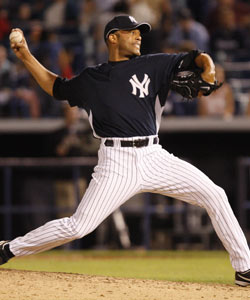
There remains much that we do not know and cannot know, such as the long-term viability of pitchers who are traditional health cases, such as A.J. Burnett and Andy Pettitte, or those that are recovering from injury, like Mariano Rivera (although if all healing pitchers looked as good as Rivera has this spring, most of them would be lining up to go under the knife). Still, so far so good. The offense has been good too, though the numbers aren’t as impressive as those of some Cactus League teams that basically play on the surface of the moon.
NOW THAT BRETT GARDNER HAS WON THE CENTER FIELD JOB…
…I’m wondering if he will ever hit another home run. There is something to the idea that he got a running start on the center field competition by lashing out at cold pitchers early in the spring campaign. Even if true, nothing is taken away from the consistency he’s shown, if consistency can be said to apply to 23 games and 55 at-bats. What is most striking, though, about the now-finished center-field competition is what decided it. In the end, Melky Cabrera played almost as well as Gardner did. To date, each has had 55 at-bats. Gardner has hit .364/.426/.636. Cabrera had hit .345/.419/.491. Each has drawn six walks. Gardner’s offensive edge comes down to one more hit, one more triple, and two more home runs. The differences aren’t significant, especially if Gardner’s power surge was truly an artifact of early spring. What’s left are a few things you can see in the statistics, such as Gardner’s speed, showing up in that extra triple and three more stolen bases, and his superior defensive capabilities. Once you throw in Cabrera’s poor 2008 and Gardner’s strong finish to the same, which disposed Joe Girardi towards him, it becomes clear that Cabrera would have had to out-hit Gardner by a significant margin to make this a real competition.
Gardner’s hold on the job is about as secure as Priam’s hold on Troy; there are enemies at the gate as long as Cabrera remains on the team. In the pressurized world of the Yankees, all it would probably take to throw the doors open to Cabrera is a 2-for-20 in the first games. It’s doubtful that Gardner will be shown the same tolerant patience that the Yankees lavished on, say, Kyle Farnsworth, or Cabrera himself.
Unless Cabrera’s nice spring represents some unexpected development in his abilities, I don’t expect him to get too many chances as a Major League regular from here on in, barring injuries. Every team has players like Cabrera, not particularly special talents who become regulars for a year or two out of need or inertia. Sometimes they play well for a time and fool you into thinking they could be more than the sum of their abilities suggests, but ultimately something better comes along and they are replaced. If they move on to other organizations, where that same need does not exist, they have a difficult time breaking into the lineup. Ultimately they become bench players or journeymen Minor Leaguers.
This is, on the whole, the fate of players whose offensive contributions are built around batting average, and when I say batting average I mean .290 and not .330. To be productive, the .290 guy has to hit .290 or better. The problem is, there are always years in which, due to luck, he will hit .260, and then the fellow is below average. That’s Melky, except that in 2007, when he hit .273, he was below average. Last year he hit .249, and he was a weeping wound. He’s still young enough to rebound and even find some consistency, but the odds are against it. Such a development would require him to find both the physical tools and the internal drive to exploit them. That’s asking a lot of a player, to grow his body and his mind.
THE UTILITY JOB (A BRIEF NOTE)
This corner is all for anyone but Angel Berroa, who is the anti-hitter, and if it’s a young guy so much the better. In case you haven’t checked out the 23-year-old Ramiro Pena, he’s a career .258/.316/.319 hitter in 334 Minor League games through the Double-A level. If Girardi is prepared to use Pena as the purest of defensive replacements, putting a bat in his hands only in blowouts, that’s not a problem. However, if injuries force Girardi to turn to the bench for any length of time, the Yankees will have to look elsewhere–Jose Molina is a better hitter at this moment. That said, Pena is a strong defensive player, reputed to have great range. It would be fascinating if Girardi had the guts–the sheer, General Patton chutzpah–to shake a NY institution to its foundations and utilize a late-inning defensive replacement for Derek Jeter.
THE AROUND (AND ABOUT)
The White Sox waived Jerry Owens, which apparently makes Dewayne Wise their starting center fielder and leadoff hitter. Tough to score too many runs when your leadoff man has a .290 OBP, which is what the Sox just signed on for… The Tigers picked up the speedy Josh Anderson from the Braves, which takes Anderson from shooting for Braves starting center fielder, a position for which he was under-qualified, to reserve outfielder on the Tigers and probable regular defensive replacement for Carlos Guillen in left. That’s something he can do… Really curious to see how Jason Motte does as Cardinals closer. He’s a converted catcher who can dial up his fastball, and his Minor L eague strikeout numbers were amazing, with 110 Ks last year in just 67 innings… Rays owner Stuart Sternberg talked about holding the line on payroll in an <A HREF=”http://www.tampabay.com/sports/baseball/rays/article987949.ece”>article</A> this weekend. If the Rays’ budget isn’t going to rise along with its players’ salaries, than this particular threat to the Yankees is going to be short-lived, like Connie Mack’s 1929-1931 A’s.
What, this movie again?
 In today’s New York Daily News, Mark Feinsand writes:
[Melky] Cabrera, who looked to be fighting for a roster spot more than a starting job, stayed the course and tried to let his play speak for itself. Apparently, his strategy worked.
“In this game, things aren’t always going to go the way you want that day or the next day — or maybe for a week — but Melky didn’t panic,” Joe Girardi said. “He just kept doing his thing, which is a sign of maturity.”
[snip]
“I’m happy with the way Melky is playing; he’s really started to swing the bat,” Girardi said. “They’ve both played at a very high level. Gardy started a little quicker, but to me, they’re both playing at a very high level right now. It’s been a fun competition to watch.”
As Einstein said, and every man of woman born has since repeated, the definition of insanity is doing the same thing over and over again and expecting a different result. Cabrera has been a regular player for three years now, and the Yankees have received three years of below average, declining results. He does not hit for a high average, and since he has little power and no particular love of taking ball four, he produces almost nothing at the plate.
The counter argument here is that Cabrera, now 24, was a young big leaguer and still has room to develop. Perhaps, but (1) at 24 he likely has sailed past the point that a breakout can reasonably be expected and (2) if there is a breakout, where is it to come? Should we expect a player who has never hit more than eight home runs in a season to whack 25 of them this year? Should we expect a fake switch-hitter who cannot bat right-handed (.251/.319/.329 career) to become a reliable .310 hitter? Should the Yankees project that a player who has averaged 50 walks per 162 games played to add another 25 of them to the back of his baseball card?
Now, these things could happen. Cabrera hit for power last April before quitting completely, and maybe whatever alchemy allowed him to be a slugger for one month could reconstitute itself over six months. Not likely, but it could happen. He could hit .300 just on luck. That happens too — every year some player sees an abnormally high (or, in the case of Nick Swisher last season, low) percentage of the balls he hits fall in. He could take more walks based on the understanding that if he doesn’t make every effort not to throw away his at-bats, he will forfeit millions in future salary.
If these things happen, swell — the universe is a capricious place. It giveth and taketh away and sometimes gives us cash bonuses we don’t deserve after we’ve helped cause a global financial meltdown. Such unpredictability is what makes life here so exciting. Betting on such events, however, is never a wise policy, especially when one requires offense to win a pennant, and particularly when one’s MVP just had his hip operated on and your team will require every iota of additional offense to support its gold-plated pitching staff.
It is hoped, and perhaps it is even probable, that Joe Girardi is not entirely serious in what he is saying, and he is merely trying to keep both players pumped or to stoke Cabrera’s trade value by exaggerating his performance this spring. We know that Girardi isn’t stupid and that he can be disingenuous. In this case, he may be letting the latter quality do some of Brian Cashman’s work for him. If that is true, then he’d better hope that potential partners don’t look too closely, as this spring Cabrera has batted .250/.341/.361. It’s more of the same-old, same-old, a movie we’ve seen before.
Post-script: today’s game in Fort Myers, Fla., wrapped up as I tossed these words onto the page. Brett Gardner went 1-for-3 with a stolen base. Cabrera did not play.
ONE FELLOW WHO DID PLAY
Austin Jackson. He hit his second home run of the spring and is now batting .303. Jackson has played consistently well this exhibition season, but I’ve been reluctant to say anything about it because generally he’s been coming into games late and doing his damage against roster fodder. That said, something is better than nothing, and you would have to think that he’s positioned himself to get an early jump on a Major League career should any injuries befall the Major League outfield cadre. That’s a fantastic development for the Yankees as — here’s one cliché that is completely true — you can never have too much depth.
NO ONE EVER LEARNS ANYTHING
I don’t like to single out other writers in this space so I’m going to be oblique here, but there was a piece published today that praised Hanley Ramirez of the Marlins for accepting a change in batting order position from leadoff to third, while castigating Jose Reyes of the Mets for reacting with less enthusiasm to a similar proposal from his manager. There’s a very simple problem with this line of thinking: Ramirez isn’t necessarily right and Reyes is definitely not wrong. The difference between the most optimal, second-most optimal, and eight-most optimal batting order in terms of generating offense is very, very small. To conceive of batting orders in this way is an act of ignorance and naivety. The batting order is more accurately viewed as a mechanism through which the manager distributes playing time. The leadoff hitter will play (come to bat) more than any other player on the team. The No. 2 hitter will have approximately 20 fewer turns than the leadoff hitter. The No. 3 hitter will have 20 fewer turns than the No. 2 hitter, and so on down the order.
Take last year’s Yankees team as an example. The leadoff spot came to the plate 762 times. The second place in the order batted 14 fewer times. The third spot batted 32 fewer times. If we drop down to number nine, we see a gap of 140 plate appearances from first in the order to last. Jerry Manuel of the Mets was proposing that one of his worst hitters, Luis Castillo, bat 40 or so more times this year than Reyes, one of his best hitters. Fredi Gonzalez is proposing a similar reduction in Ramirez’s playing time. Whatever the small effect of batting order changes, there is no way to justify voluntarily giving up the equivalent of eight to ten games worth of times at bat for one of your best hitters.
These days it is rare that a piece by a fellow toiler in these fields seems so wrongheaded that I am obliged to write about it, but this one got to me, being an excuse to take a cheap shot at Jose Reyes over an idiotic suggestion by his manager.
THE PLACE WHERE MY FEET ARE
None too soon for my somewhat fragile constitution, the book tour comes to a close next week with two appearances. First, Jay Jaffe and I will be in Philadelphia on Tuesday the 24th at 5 p.m., at the Penn Bookstore at the University of Pennsylvania (3601 Walnut Street, Philadelphia). Second, Jay, Cliff Corcoran, and I will be at the Rutgers University bookstore (Ferren Mall, One Penn Plaza, New Brunswick, N.J.) on Thursday the 26th beginning at 6 p.m. On both occasions we’ll be talking baseball in any of its multifarious forms. I am very much looking forward to seeing you.
Joba psychology, revisited
 In case you didn’t check out today’s action, Joba Chamberlain pitched three shutout innings. Can we stop panicking now? There’s something truly weird about the Psychology of Joba, by which I mean not what goes on in his head, but what seems to go on in ours when he pitches. It seems like a sizable percentage of the population might feel more at ease if he was simply sealed in plastic and never allowed to pitch again. If you don’t use him, he can’t get hurt. There is a kind of denial at work here. Injury risk can be mitigated, but short of a perfect prescience, they cannot be prevented.
In other news from the game, Nick Swisher went 3-for-4 and Xavier Nady went 2-for-4. Swisher’s spring on-base percentage is now .389, Nady’s .267. I don’t expect anyone around the Yankees to care, because consistency at hitting usually trumps consistency at getting on base, even though better to start with the latter and hope for the former than the other way around. There’s still some time, though, for Swisher to show enough for the Yankees to make the right decision.
Finally, Brett Gardner knocked a triple today, took a walk, and scored two runs. Spring Training statistics are meaningless for the most part, especially this year when camps have been decimated by the WBC, but if consistency of hitting is part of what Gardner had to show, he’s done that so far, and he’s also demonstrated far more thump than before with six extra-base hits–the guy continues to lead the Yankees in home runs this spring. Again, that’s not something to get too excited about, as Angel Berroa is tied for second with two, and also leads the club with a .429 average. Heck, the Ransom of A-Rod is batting .400. It doesn’t promise much of anything, but it’s all good to see.
Another one from the comments
And from a frequent commenter, letsgoyankees, this one on this morning’s entry regarding the dynasty teams:
I agree with almost every point you made except pitching and defense. These (today’s) Yankees have great pitching and a very good defesne! Weren’t we lin the top three last year in errors (correct me if I’m wrong!)? Think about it…A-Rod, Tex, and Jeet all have gold gloves (that’s right, I said I think Jeet is still a good shortstop.I’ve argued it in the past and I’m not changing my stance now.) and Cano is pretty good. Yes, he makes a lot of errors, but only because he has great range. He’ll fix the error porblem. At cathcer we’re suspect with Posada but with Molina we have perhaps the best defensive catcher in the league! Our centerfielder, be it Gardner or Melky, will be an excellent defender. And Damon (minus the chicken arm) and Nady aren’t terrible. And our pitching staff speaks for itself. Our defense is pretty darn good!
Letsgo, you’ve got to let go of errors. Not making errors is part of having a good defense, but a bigger part is simply how many balls in play a team turns into outs. If the pitcher doesn’t strike out the batter or give up a home run, and the batter puts the ball between the lines, what happens next? For most of this century, the Yankees have not been very good at collecting those pesky grounders and flies. Commonly referred to as defensive efficiency (DEF), this is the most basic aspect of defense and also the one that, if improved, can yield the most dramatic results: in 2007, the Rays ranked dead last in the majors in turning balls in play into outs. They shuffled some players around and jumped to first in the majors–you know what happened next. In 2008, the Yankees were 25th in the majors; in 2007 they ranked 13th; in 2006 it was 8th; in 2005 it was 22nd; in 2004 it was 20th; in 2003 they ranked 28th; in 2002, 23rd; in 2001, 25th; in 2000 they ranked 13th.
And that leaves me with these questions: if the Yankees defense has been so good, why are so many balls finding holes? If Derek Jeter is such a great shortstop, why don’t the balls he gets to show up in the numbers? It can’t be all balls over Bobby Abreu’s head–the responsibility has to be shared out, to varying extents, around the diamond.
The banter from Beantown
AL
EAST ON THE EDGE OF FOREVER
As you know, I’m up in Boston
on book-tour duty. I’ve had enough train action in recent weeks that I’m
starting to feel like the Joe Biden of the Internet baseball set. Then again, I
shouldn’t complain, as some of my brethren down in Florida are having to scoot to all corners
of the globe to follow both their normal team assignments as well as peek in on
WBC action.
In this part of the woods, the worries are, as you would
expect, oriented around the Red Sox and if their offense will hold up in the
coming season, and if the Yankees have trumped them by adding CC and A.J. There
are few good answers at this point except to flip the switch on the season and
see what happens, but that moment is a month away yet, so we all get to nibble
our fingernails a bit more — Boston fans on their offense (and maybe their
starting pitching, too), Yankees fans on their offense and defense (and defense
is pitching is defense, so this is a bigger issue than is usually acknowledged)
and Rays fans wondering if it was all a dream (it wasn’t, but that doesn’t mean
the sequel will be easy). The WBC gives us an extra week to think about these
things, which now that I think about it, might be good for the collective
mental health. In the same way that Joe DiMaggio’s hitting streak kept a nation
on the edge of war distracted for one last summer, if this year’s baseball
season starts late and drags into November, well, that’s one more week when the
specter of financial ruination can be put off. I hope.
Meanwhile, today’s exhibition action was more exhibition-y
than usual, with the Yankees taking on a team of Major League All-Stars in a
WBC tune-up — not a good day to be Phil Hughes or any of the other young
pitchers required to face Dustin Pedroia, Adam Dunn, Ryan Braun, etcetera, not
to mention Derek Jeter. As such, the story wasn’t really in the pitchers today
but in the hitters — the Yankees hitters. Brett Gardner put together another
strong day, and against real Major League pitchers like Roy Oswalt. If he keeps
up his current pace, it’s going to be very difficult for the Yankees to deny
him the starting center field job. And then, of course, he’ll have to keep it
up, because with his first 0-for-4, someone will be arguing that it’s time to
see if Melky has learned to hit by sitting on the bench.
The Gardner vs. Melky competition may seem like small beer
given that we’re talking about the team’s ninth-place hitter, but given the
probable offensive shortfall the Yankees will see in left and right field, and
potentially other spots on the diamond, getting something rather than nothing
out of that position could make a small but significant difference in what
should be a tough division race, perhaps a swing of two or more wins. That
could be the difference.
More from me when I’m not comatose from doing two AM TV
spots. It’s always shocking to me to see so many people awake and producing
television programs when they should be sleeping. Those of you in the
Boston-New Hampshire-Rhode Island-Vermont-Canada-Atlantis region, I look
forward to seeing you this evening.
Defending my stance on Jeter
 A COUPLE OF QUICK NOTES AS WE HEAD INTO THE WEEKEND…
First, a few reactions to the comments on retaining Derek Jeter after 2010: as I tried to explain this morning, I’m appreciative of Jeter for all he’s done, but I appreciate winning baseball teams more, and I very much doubt that the Yankees will be able to do so with a 37-year-old shortstop, particularly one who doesn’t play great defense now and has visibly slowed the last couple of years.
Baseball puts fans in a very difficult bind: do you love the team or the player? When the player is 25 and at the peak of his powers, it is very easy to love both. When they’re 35 and gimpy, you have to make a decision. The Yankees, and Yankees fans, have gone through this repeatedly: with Babe Ruth, Joe DiMaggio, Mickey Mantle and many others. At some point, it was time for them to move on so the team could make room for fresh faces that could do more to help them win. The alternative is that the team ceases to try to win and becomes a nostalgia show, perpetuating these players far beyond their usefulness just because it’s hard to let go. If that’s what you want, that’s one thing, but you’re going to see a whole lot of losing, not to mention experience a whole lot of embarrassing discomfort along the lines of what old time Willie Mays fans saw when he joined the Mets in 1972 — not the fleet ballplayer of 1954 who could do anything, but a 42-year-old who looked like a tired old guy. If you want to see Derek Jeter look like that, fine — just keep holding on too tight — and don’t
Specific comments: vrod44, the “you didn’t play the game” insult is as old as dirt and about as logical. Whether I played or not, even if I was Lou Gehrig in a previous life, Jeter is aging. That’s an unavoidable fact, but blame the messenger if you want. Yankee7777, it’s odd that you cite Lou Boudreau given that he stopped hitting after age 30, was a part-time player by 32, and retired at 34. No, he wasn’t fast — he was, in fact, legendarily slow, and as you say he was a great defender nonetheless. Unfortunately, none of that serves your point because by the time he was Jeter’s age, he wasn’t playing anymore. I don’t have time to do it now, but over the weekend I’ll try to figure out which teams won with old shortstops. My guess is it’s a short list. I also disagree with your statement, “Anyone who watches Jeter knows he makes all the plays.” He demonstrably does not. I wrote this in the Baseball Prospectus annual four years ago:
For those of us in the performance analysis biz, Jeter is a difficult problem because any realistic evaluation of his skills, no matter how flattering, seems like a slight when compared to his reputation. In the eyes of true believers, Honus Wagner and Superman combined couldn’t do half the things Jeter does. In truth, he’s terrific at going back on shallow pop-ups and executing the jump throw in the hole. Other aspects of the job — fielding grounders to his left for instance — elude him, and it doesn’t take an MS in scouting or statistics to see it. When watching a Yankees game, simply pay attention to the opposing shortstop. He will routinely get to balls that Jeter cannot. As for the Gold Glove, peel back the foil on the award and you’ll find there’s some tasty chocolate underneath. That’s about what it’s worth, though at least Jeter was better this year. On offense, Jeter walked less than ever before and doubled his previous high in sac bunts, perhaps because he lost confidence after a shockingly poor April. Jeter is a Hall of Famer to be, a key player on a great team, an inspirational leader, a fine hitter…and he gives up a lot of singles with his glove. In light of the rest, why is that last part so difficult to accept?
I stand by what I wrote back in the winter of 2004. Every day you can see balls go past Jeter on the left that most other shortstops easily field, and if he’s ever made a play behind second base it must have been back in the Clinton administration. To this point, for the reasons stated above, that deficiency hasn’t been all that important, because on balance, the combination of offense and defense worked out in the Yankees’ favor. That will be less and less the case over time, and if 2008’s reduced offensive output was not an injury-induced fluke but the beginning of an age-inspired trend (and it was the second season in a row that Jeter’s offense dropped, so arguing about said trend may be a moot point), the day of reckoning is here now.
AND FROM TODAY’S GAME…
The Yankees dropped the decision to the Twins, who came back late against some youngsters who aren’t going to be within hailing distance of this year’s staff. There was still plenty of good stuff: a solid two innings for Ian Kennedy; a 2-for-2 with a double and a stolen base for Brett Gardner (and an 0-for-3 for Melky), a 2-for-3 for Jorge Posada and an identical day for Nick Swisher. Xavier Nady went 0-for-3 with an RBI.
Also of interest was an appearance in left field by Kevin Russo. I get a lot of mail about Russo, who hit .316/.363/.416 in half a season at Double-A Trenton last year. Some out there want to see him as a prospect, but I don’t buy it — as a second baseman, he’s going to have to hit more than that to make it — those numbers don’t really translate to anything impressive — and since he doesn’t play shortstop, his chances to be a utility infielder are not good. Last year he got in an odd bit of utility work at third base and the outfield, and it’s interesting to see the Yankees carrying that forward this spring. If Russo starts the season at Scranton, he could be an injury away from a bench job… It’s not like Cody Ransom has an ironclad lock on a job.
THAT’S A WEEK
I hope to see many of you at the Yogi Berra Museum on Sunday (see below for details). I’ll catch the rest of you here on Monday, unless Brian Cashman goes insane and signs Manny Ramirez tomorrow afternoon. In that case, I’ll be posting — a lot.
Another day, more stuff happens
 THAT’S JUST THE WAY IT WORKS
Can’t complain about the Yankees’ exhibition showing against the Rays on Thursday, and can’t get overexcited about it given that the Rays brought not their B or C squad but maybe Squad Q, the squad you turn to when all else has failed and the monsters are at the door, but not any time before that.
I was excited to see Phil Hughes’ cutter again, but the Yankees denied me, having the lad work on his other pitches, and two barely hit batsmen aside the results were just fine. Ditto bullpen-bound Phil Coke, who with Damaso Marte should give the Yankees a rare set of matched lefty long men, rather than the more ubiquitous pair o’ LOOGYs. Joe Girardi should keep in mind that “long man” is not equivalent to “infinite man” — he forgot with Marte a couple of times last season.
On the offensive side, it was a very good day for Jorge Posada, with a double and a home run, and that means it was a good day for the Yankees, as a resurgent Posada could be decisive in this year’s race. Again, let’s not get too worked up about the results of one game of DH-work and a home run against Chad Orvella, who looked so good a few years ago and looks so lost now. On the bad news side, Brett Gardner went 0-for-2, but then so did Melky Cabrera so we’ll say that Gardner is still ahead based on Wednesday’s home run.
On the Rays side, Squad Q did supply one clue as to why the former underdogs have a chance to repeat in the form of starting pitcher Wade Davis, a 23-year-old who reached Triple-A last year, putting up a 2.72 ERA in 53 innings. He throws in the 90s, he has a full complement of pitches, and there is currently nowhere to put him. The Rays have so many pitching options that unless they suffer an ’87 Mets-like staff-wide breakdown, they should be able to patch pretty easily should anything go wrong. You saw Davis whiff Mark Teixeira, Alex Rodriguez and Robinson Cano on Thursday, and he’s surplus.
A NOTE OF DEREK JETER APPRECIATION
Jeter didn’t do anything special, but seeing him out there, realizing that he’s in the declining days of his career, made me feel a bit like I’ve taken him for granted at times. The cult surrounding Captain Intangibles is so fervid in its hero worship that it provokes the opposite feeling in the realist sector. It has become fashionable to criticize Jeter’s defense, and such criticisms are accurate and entirely fair. Still, the excellence of Jeter’s career should not be missed in the rush to paint a more accurate picture of him, and we should also not fail to acknowledge the sheer miracle of his existence given what the Yankees had at shortstop between 1950, Phil Rizzuto’s MVP season, and 1996, Jeter’s arrival.
With apologies to Tony Kubek, Bucky Dent and even the Scooter himself, the years where shortstop was something the Yankees dragged limply behind them, even when winning, far outnumbered those when they received the kind of all-around contribution that Jeter is capable of providing at his best. I grew up watching the Yankees try Paul Zuvella, Jeff Moronko, Bobby Meacham, and the occasional hotel clerk at short, while at the same time seeing all-time greats like Alan Trammell and Cal Ripken come through and batter the heck out of them whether at the plate or in the field. It seemed like it would never end. If Tony Fernandez hadn’t become injured in 1996, it never would have ended.
As we again debate Jeter’s defensive abilities and remaining offensive capabilities this year, let us remember the good years. And no, this doesn’t mean that the Yankees should sign Jeter to an extension after his current contract is completed. They shouldn’t.
THE AROUND (AND ABOUT)
? Manny Ramirez rejected what seemed like a fair offer from the Dodgers on Thursday. Yesterday I wrote a story about Joe DiMaggio’s 1938 holdout. One thing I came across, but didn’t use in the story, was one of the top Yankees, either owner Jacob Ruppert or general manager Ed Barrow, saying of DiMaggio (I paraphrase), “His demands are just so ridiculous that we don’t really believe he’s holding out, we think he’s just trying to get out of spring training.” That seemed silly when I read it, especially because the Yankees and the Clipper were only $5,000 apart — for whatever reason, the team had decided it wasn’t going to compromise with DiMaggio no matter what, so they were trying to cast the blame on him. With Ramirez, though, I can almost believe it.
? Remember how I complained about Frankie Cervelli leaving Yankees camp to play in the WBC when he really needs the time with the team? The Royals are going to go through the same thing with Mark Teahen, who is heading out even though he’s trying to revive his career by making the transition to second base. That’s just wrong.
? It’s wonderful that the Tigers have a pitcher in camp named Fu-Te Ni. Globalism has its defects, but it’s wonderful to follow the game in the age of universal baseball.
? One more reminder that on Sunday at 2 p.m. I’ll be appearing with Kevin Goldstein, Christina Kahrl, and Cliff Corcoran for a Q&A/signing at the Yogi Berra Museum in Montclair, New Jersey. Come for the baseball talk, stay in Montclair for the Yogi-ness and the great restaurant scene. That’s my plan.
Beat out that rhythm on the horse
 Peter Abraham, live-blogging today’s game, reported that Nick Swisher batted with the bases loaded, was behind in the count 0-2, and came back to work a walk. I got curious as to how often that actually happened in real games, and which Yankees were the best at rescuing a bad situation with patience and selectivity. Working our way around the diamond:
Career walks after down 0-2:
Jorge Posada, 39 in 906 PA (4.3 percent).
Mark Teixeira, 29 in 619 PA (4.7 percent).
Robinson Cano, 7 in 386 PA (1.8 percent).
Alex Rodriguez, 53 in 1597 PA (3.3 percent).
Derek Jeter, 69 in 1442 PA (4.8 percent).
Johnny Damon, 37 in 1445 PA (2.6 percent).
Melky Cabrera, 4 in 269 PA (1.5 percent).
Nick Swisher, 20 in 405 PA (4.9 percent).
Xavier Nady, 10 in 473 PA (2.1 percent).
Hideki Matsui, 24 in 477 PA (5.0 percent).
I don’t know if this tells us much more than that the most patient hitters on the team are able to carry that patience through even the most difficult situations. Before running down the numbers, I had made a little bet with myself that Jeter would be tops in this category, not because he’s the most patient Yankee, but because of how many times I’ve seen him bear down in such situations. My guess was close, but it’s Matsui that takes the prize. Often you hear that clichéd description “professional hitter” applied to players who are no such thing, but what Matsui does, turning lost times at the plate into something positive, is truly deserving of the appellation. Hobbled Godzilla has only hit .220/.262/.342 in his career when down 0-2, but that’s actually a big accomplishment — no-hitter does well when he has only one pitch to work with; last year the American League as a whole batted .185/.217/.274 after an 0-2 count, so Matsui is well ahead of the pack.
I know you’re wondering about Jeter in such situations. He’s been even better than Matsui, batting .230/.283/.340 after 0-2. Hey, you’ve got to do stuff like that to get to the Hall of Fame.
DON’T BURY THE LEAD(OFF HITTER), STEVE!
In this morning’s entry, I wished that Brett Gardner would hit a triple today. Instead, he led off the game with a home run, pulling the second pitch of the game over the right field fence. Your move, Melky. And Kei Igawa pitched well, too, but we’ll pretend that didn’t happen.
TOMKONOMY
According to Mark Feinsand of the New York Daily News, Brett Tomko is in competition with Dan Giese and Alfredo Aceves for a spot as a long man out of the pen. All three of those guys would probably make spot starts as well, should any be necessary. As I suggested this morning, Tomko really has no case to make here, having been roundly pounded every year since 1997, with the exception of 2004. As a starter last year, his ERA was 6.17. He pitched 16 innings as a reliever and slowed 12 runs, including four homers. In 177.1 career innings out of the pen his ERA is 4.92.
The best choice here might actually be Giese. Aceves seems like a very interesting starter, and I’m all for the Yankees embracing what little youth they chose to bring to camp, but I worry about his low strikeout rate and high home run rate in a bullpen role. He may simply be unsuited. It won’t hurt the Yankees to try, of course. Giese didn’t pitch that much between injuries, but was more or less effective when he did, particularly before his post-injury appearances in September. He got hammered in five innings that last month (we should watch out for any carryover to this spring), but to that point his ERA was 2.58 in 38.1 innings. Giese seems to be comfortable in the swingman role, and as a 31-year-old rookie last year is no doubt just happy to be in the majors.
All of that said, we’re talking about the last man on the staff. Given the quality of the Yankees rotation and their other bullpen options, this should be the last important decision Joe Girardi makes. Last year Giese generally relieved in low-leverage situations, and it seems unlikely that Girardi would have to call on him, or Brett Tomko, to protect too many leads. Still, if healthy, the guy knows how to pitch and deserves to have something of an inside track given his incumbency. Tomko does not know how to pitch, or if he does hasn’t translated that into consistent big league success — if he had, he wouldn’t be pitching for the last spot on the Yankees, he’d be in someone’s rotation.
Gardner, Cabrera might not cut it for Yanks
 GARDNER-ING AT NIGHT
My associates at Baseball Prospectus have released the weighted-mean PECOTA
projections, which means I can talk a bit about some of the forecasts
therein.
PECOTA sees Brett Gardner batting .253/.339/.351 and sees
something like a full season of playing time coming down the pike. Many
of the other projection systems (Fangraphs does
us the service of gathering those in one place) are of like mind — if
you average their forecasts, you get .262/.343/.361. PECOTA figures
Melky the C at .267/.326/.376, while the other systems compiled at
Fangraphs average out to .274/.334/.390. Last year, the average Major League center fielder batted .268/.334/.420, which means that both of
these fellows would have to exceed their median projection for the
Yankees to break even, putting aside the possibility of crazy-good
defense. It should be noted that the Gardner projections are a good
deal more speculative than the Cabrera projection given that the former
has just filtered up to the bigs. The Cabrera projections are
speculative in their own way, assuming that he’s going to go back to
what he was doing after a year of misery.
My conclusion: Jim Edmonds
would make a nice one-year rental, playing four days a week. Edmonds,
being neither a Type A nor type B free agent, is still available to the
Yankees.
SMALL BITS
The Cubs made two deals today with minor ramifications for the American League, as both of the pitchers they detached are heading to the Junior Circuit. The A’s acquired reliever Michael Wuertz and the Orioles picked up starter Rich Hill.
Wuertz heads to Oakland in return for two Minor Leaguers, outfielder Richie Robnett and infielder Justin Sellers, both of whom are so talented that you are unlikely to ever hear their names again. The former has a .257 career batting average and the latter .256, and neither has the other tools to make up for their general inability to hit with consistency. As such, the A’s get to decorate the back of their bullpen with Wuertz, a slider specialist who tends to be harder on lefties than on righties. Wuertz always seemed like the first guy that the Cubs would bounce back to Triple-A if they experienced a roster crunch, but as he was out of options that source of amusement was closed to them, hence the trade.
Hill is a depressing case, a pitcher who seemed like he’d be a five-year fixture after strong work in 2006 and 2007, but he sailed over the edge of the world in 2008, completely losing his control. He walked 18 in 19.2 innings at the major league level and 44 in 47.2 innings in the minors. The Orioles agreed to give up only a player to be named, the identity of which is no doubt contingent on their ability to bring Hill back to his senses. Here’s hoping they have to give up a good prospect. Yeah, I know they’re division rivals of the Yankees, but come on — it’s the human thing to do.
More on the center field merry-go-round
 Jon Heyman of SI.com had an interesting tidbit in a recent posting about the Yankees shopping Nick Swisher and Xavier Nady:
Johnny Damon isn’t in the trade mix, as the Yankees need him to be their leadoff hitter and part of a center field rotation. The other in-house candidates for center field are Melky Cabrera and Brett Gardner.
That’s interesting, though not in the basic meaning of it — even though Damon is in the last year of his contract and is coming off something like a career season, it seemed unlikely the Yankees would try to move him, given the two roles he plays on the team, leadoff hitter, as Heyman mentions, as well as defensively overqualified left fielder. Many observers tend to focus on Damon’s poor arm, but his speed makes for a corner outfielder who can cover an unusual amount of ground.
Now, if you think about it, the most potent offensive outfield the Yankees could field next year would be Nady in left, Damon in center, and Swisher in right, rather than the presumed alternative, Damon in left, some combination of Gardner and Cabrera in center, and Xavier Nady in right — and Swisher playing the Ghost of Christmas Past, or Hamlet’s Father, or something. The problem with doing that, beyond the misuse of Swisher, is that at Damon’s current stage of the lifecycle, he’s better off not being overtaxed. Further, while his speed still does wonders in left, it’s not quite as spectacular in center — Damon had already slid off his peak the position before the Yankees moved him.
That said, being part of a center field rotation, as per Heyman above, makes all kinds of sense in that it gives the Yankees a great deal more flexibility in being able to waltz other players in and out of the corners. The more positions a star can play without compromising the defense, the better off the team is, because the club begins to close off openings for the replacement-level players that are so damaging to the winning effort. Similarly, Joe Girardi needn’t be married to any one center fielder.
There is yet another hand, which is that the Yankees might want to get married to a center fielder. Damon is in the last year of his contract, and as good as he was at 34 and may be at 35, asking him to keep it up at 36 and 37 will likely be pushing it. Given that the class of free agent center fielders next winter is going to be no fun, the Yankees will be in much better shape going into 2010 if they have the next center fielder lined up now. That could mean getting Gardner established, finding some way to electrify Melky, or even giving Austin Jackson a shot in the second half of the season, should his work at Scranton demand such an audition. Obviously the needs of 2010 have to be balanced against the goal of winning in 2009, with any luck the two goals will be mutually compatible.
One supposes the Yankees will need another leadoff man after 2009 as well. Traditional images would suggest that Gardner is the man, but Gardner may never have enough sock to justify taking up so many plate appearances, regardless of how many bases he steals. The Yankees will need to remember that your leadoff hitter need not match the picture of the singles-hitting speedster. That way lies madness. That way lies Juan Pierre. Remember, Wade Boggs was a great leadoff hitter, and he almost never stole a base. It’s about how often you’re on, not about how fast you can run. In an era of home run hitting, the rest takes care of itself.
SO LET’S TAKE THIS TOPIC ON THE AIR
Later today (6:30 EST) I’ll be appearing from the Bunker on the Yes Network’s Hot Stove show. As usual, I’ll be asked to summarize what we’ve been discussing this week. Let’s try a simple vote, which I’ll relay to the fellers on the air: who should be the starting center fielder in 2009? Damon? Gardner? Cabrera? A rotation split roughly in equal thirds? Or a write-in candidate of your choice? Jim Edmonds is still out there, and he murdered the ball for the Cubs last year. He’d be a heck of a platoon player in center. Argue it out in the comments section below, and I’ll tally up your responses while waiting for smilin’ Bob Lorenz to cast his dancing spell my way.
 Pinstriped Bible