Tagged: Yankees
Getting the best from everyone
SHOCKER
I don’t think I have single thing to complain about today. Analysis is about finding problems and advocating solutions, but everyone is playing well right now. Even Nick Swisher, who I’ve (reluctantly) become disillusioned with, pulled out of his slump with a two-homer day. To quote a line from John Lennon and the Beatles, “I’ve got nothing to say but it’s OK.” (“Sgt. Pepper’s Lonely Hearts Club Band,” the happiest album about alienation, distraction and disconnectedness.) That’s not quite accurate, now that I think about it — I’ve always got something to say, and it’s not “Billlllly Shears!” Though I wish it was. 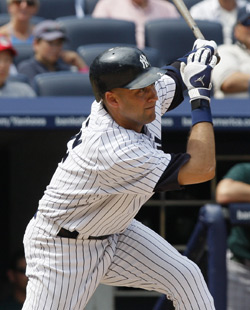 ANOTHER RUN AT AN MVP FOR JETER?
On last night’s broadcast, my fellow YES-man Michael Kay suggested that Derek Jeter is putting together a campaign worthy of the Most Valuable Player award. My first reaction was, “Nah,” first because Jeter’s year seemed to be in the good-not-great category, second because if he didn’t win the award in 1999 or 2006 he’s not going to win it now — voters go wild for RBIs, not runs scored — and third, because there are so many other good candidates. However, on further examination, the idea is not as wild as it at first seemed, though still unlikely.
Thanks to his .402 on-base percentage, fifth in the American League, Jeter is having one of his strongest seasons. He hasn’t reached base 40 percent of the time since 2006, and has gotten there in only two other seasons, 1999 and 2000. He’s also fifth in batting average and second in hits behind Ichiro Suzuki. He ranks ninth in runs scored. He’s not having the best season of any AL shortstop — Jason Bartlett currently ranks him, but that’s going to change over time. Jeter also has had 120 more plate appearances than Bartlett due to the latter’s stint on the disabled list.
Still, the line in front of Jeter is long, and starts with two Twins, Joe Mauer and Justin Morneau. The latter, a past MVP balloting favorite, leads the league in home runs and RBIs, which is usually enough to nab the award. In fairness to Morneau, he’s having a tremendous year, one that is far superior to his 2006, when he last won the award. Mauer has been the best all-around hitter in the league, but he has come back to the pack a bit in July. If the Twins can come back and win the AL Central, still a strong possibility, the M&M Minnesota boys are going to get an extra push, whereas if the Yankees hang on to win the AL East, Jeter will be perceived as one among a cast of talented performers.
Since an April batting line that was indifferent by his own standards, Jeter has hit .337/.418/.459. He’s going to have to top those rates the rest of the way to make a serious dent in the gaudier statistics put up in the Twin Cities. He seems a long-shot to get serious consideration, though it would be only fair if the voters stiffed Morneau to give Jeter an award just as they stiffed Jeter to give Morneau an award in 2006.
BRONSON ARROYO
Rumors surfaced yesterday that Brian Cashman has been burning up cell-phone minutes in calls to Cincinnati, trying to get the richly-salaried Bronson Arroyo for the Yankees’ rotation. The Bronse is under contract next year for $11 million, and there’s also a club option for 2011 at the same price, with a $2 million buyout if Arroyo’s presence is no longer desired. Thus the Yankees would get the right-hander for the remainder of his age-32 season, age 33 and potentially, 34. Arroyo is having a very strange year, in that he’s either unhittable or he has no idea how to pitch. That’s no exaggeration: In his wins he has an ERA of 2.19. In his losses, it’s 11.01. I asked the statistical geniuses at Baseball Prospectus if that differential was particularly dramatic, and indeed it is. Among pitchers with at least 10 decisions, it’s the second-largest spread in baseball this year behind that of Brian Moehler, who has an ERA of 2.62 in his wins and 12.13 in his losses. Felix Hernandez, Jason Marquis and Clayton Kershaw round out the all good/all bad top five. Pitchers with fewer than 10 decisions in this category include Brett Cecil, who has a 1.33 ERA in his wins and a 15.43 ERA in his losses, and Rich Hill, who is at 1.86 in his wins and 15.75 in losses.
If you’re the Yankees, which Arroyo are you going to see most often? There doesn’t seem to be much of a pattern to his periodic lapses into incompetence. This is a deal you might make only if Dave Eiland and the rest of your organizational pitching gurus view hours of tape and say, “We see the problem and we think we can correct it.” If not, the aggregate — a quality start half the time, a sure loss the other half of the time — may not be worth the money and the low-level prospects necessary to spring the pitcher from the Queen City.
MORE OF ME
My take on the Omar Minaya-Tony Bernazard affair can be found in my You Could Look It Up spot.
Thoughts for the weekend
MENTIONED THIS BEFORE, BUT IT’S STILL ON ME MIND
When CC Sabathia goes seven innings and strikes out four batters, I worry. Sabathia has a career rate of 7.5 strikeouts per nine innings pitched. He’s averaging 6.5 strikeouts per nine for the Yankees, which is average for an AL starter this year. Now, none of this matters much if Sabathia can pitch effectively while allowing batters to put more balls in play, and so far he has, in part because (and this is paradoxical given the propensities of Yankee Stadium II) fewer of the fly balls he allows are going over fence walls than they used to. Hand in hand with that is some good breaks on balls in play — coming into this year, batters hit .292 off of Sabathia when they put the ball in play. This year they’re hitting .272.
There are two troublesome aspects to this picture. First, a pitcher’s luck on balls in play can change. Second, when a pitcher’s strikeout range declines, it is sometimes (often) a suggestion that something is wrong — that a crash is coming. Sabathia’s velocity seems to be consistent with previous years, so we’re certainly not seeing any evidence of a physical problem there, but it’s still a difficult thing to accept and with which to be comfortable.
 HOLLIDAY (NOT HALLADAY)
Kudos to the A’s for getting a top prospect in Brett “The Walrus” Wallace from the Cardinals for Matt Holliday. Ever since Eric Chavez’s constitution vanished, the A’s have had a lot of filler at third base. With Chavez signed for one more year (plus an exceedingly painful $3 million buyout), the A’s may feel obligated to keep trotting Chavez out once a year to see if he can remain in an upright position for more than a game at a time, but in the long interim between appearances, they can try Wallace. A first-round pick last year, Wallace has hit .306/.390/.466 in the Minors in about one season’s worth of playing time. He hit .293/.346/.423 at Triple-A Memphis this year, which translates to .272/.321/.397 in the Majors — not great numbers, but then the A’s have gotten only .210/.289/.316 from their third basemen this year.
The problem with Wallace as a third baseman is suggested by the “Walrus” nickname. He’s not fat, he’s just shaped strangely for, well, anyone. He looks like two different people glued together, something like an average-sized person on top and Prince Fielder on the bottom. It’s not a sure thing that someone built like Wallace can play a quality third base in the Majors. So far, though, he’s hanging in, and it would be a huge bonus for the A’s if he can stick at the hot corner.
The A’s also picked up pitcher Clay Mortensen and outfielder Shane Peterson, but neither has the possibilities of the Walrus. Peterson hasn’t much power and unless you’re a plus defensive center fielder, that usually means a life sentence as a fourth outfielder. Mortensen is a starter right now, but given that he’s 24 years old and has had three years of mediocre results, one smells a trip to the bullpen in the near future. He too is a former first-round pick.
WANGERY INFINITY
It seems that Chien-Ming Wang is unlikely to pitch this year. This is sad on one level, and a break for the Yankees on another, because even if he were to pitch again in 2009, it was unlikely that he was going to pitch well, yet the Yankees felt obligated to keep trying. Given the hole in the rotation that Wang’s absence has created when combined with the team’s decision to bolster the bullpen at the expense of the starting rotation (see Phil Hughes and Alfie Aceves), their desperation was understandable, but Wang had reached the point where Sergio Mitre or anyone else would have been a better bet to pitch the team to a win. For the sake of both Wang’s career and the team’s chances in 2009, giving him a pass for the rest of the year is the right thing to do.
Meanwhile, the competition …
 The Red Sox made themselves a nice low-key deal today, picking up first baseman Adam LaRoche from the Pittsburgh Pirates for two lower-echelon prospects. LaRoche is no star, but he does have home run power and has a career-long tradition of being a second-half hitter, batting .296/.357/.544 hitter in the second half. The Sox haven’t hit all that well this year, with Kevin Youkilis and Jason Bay having the team’s only outstanding seasons at bat. In addition, Mike Lowell has been slowed by his recovery from hip surgery and has missed over 20 games. Since Youkilis came through the minors as a third baseman, the Sox can slide him over there and continue to get above-average production at the hot corner, but until now the benefit was small given the options to replace Youkilis at first. Mark Kotsay, Jeff Bailey, and Aaron Bates represent a drastic falloff from the ideal first baseman.
LaRoche should solve that problem, but it will be interesting to see how often he plays when Lowell is available. With David Ortiz locked in at designated hitter (his hot June seems to have bought him more time to live down his horrible first two months), the Sox have no room to get LaRoche at bats anywhere but first base–it’s too bad he can’t take the odd turn in right field for J.D. Drew, who is 6-for-44 over his last 12 games and hasn’t had a hit since before the All-Star break. As LaRoche is a career .249/.308/.435 hitter against lefties, the Red Sox won’t miss much if he sits against them, so there is something like the makings of a three-sided platoon here, with Youkilis bouncing around and Lowell taking some time off against right-handers. The overall upgrade in offense is very minor if LaRoche doesn’t have his usual second-half explosion, but his value would be a lot greater if Lowell must again hit the disabled list.
One alternative scenario could arise if the Sox see part of the benefit of this move as defensive. That is, the team feels Lowell’s defense at third has been so compromised by the surgery that they’re better off with Youkilis, no Mike Schmidt himself, playing there more often. The main thing wrong with that picture is that LaRoche isn’t a great fielder either.
The upshot for the Yankees here, in terms of the division competition, is that the Sox will no longer fall to the replacement level at first when Lowell is out and that they and other Sox opponents will see a few more late-inning at-bats for a left-handed hitter who can put the ball out of the park now and again as opposed to Kotsay, a player who has very little left to give. The impact of this could be small or it could be great. Consider that with Lowell out last October, Kotsay was Boston’s playoffs first baseman, and he killed them, going 10-for-40 in two rounds but failing to take a walk, hit a home run, or drive in a baserunner. In the ALCS, the Rays embarrassed him with good fastballs. If the Sox manage to avoid that fate–assuming the first-place Yankees allow them to get that far–they’ll have accomplished something.
The Sergio Mitre experiment
WHAT IS WRONG WITH THIS PICTURE?
Tim Wakefield hit the DL with back stiffness today, so the Red Sox brought up Clay Buchholz to take his spot. The Yankees had a hole in their rotation, so they brought up Sergio Mitre. There’s a huge gap between a 28-year-old with a 5.36 ERA and a 24-year-old with a 5.35 ERA.
As I wrote about Mitre a few weeks ago, he’s a heavy ground-ball type who has never found consistency in the Majors due in large part to control problems — a pitch-to-contact type can’t walk three or four batters per nine innings and expect to succeed. There are simply too many balls in play with runners on base for the pitcher to garner consistent results. That said, Mitre’s control in the Minors this year has been tremendous, with just seven free passes in 54.1 innings, or 1.2 per nine innings. If he retains that kind of control in the Majors and still has his groundball mojo as well, he can be the late-career Greg Maddux.
The main reason that this will remain just a fantasy is that Mitre almost always showed god control in the Minors. His career rate in 110 games is 2.2 walks per nine innings. In the big leagues he’s either twitchier or more advanced batters manage to lay off his more borderline offerings. When batters have swung, they’ve hit .298/.361/.435. The light power is a token of his groundball approach. Unfortunately, the singles/walks combo has been damaging enough.
The Mitre experiment is worth trying, but if the early results aren’t good the Yankees can’t hang on for as long as they did with pointless reliever Brett Tomko, who was finally DFA’d to make room for Mitre. Pitchers can reinvent themselves, but when it doesn’t happen there’s little point in chasing. That’s something the Red Sox are proving with John Smoltz. Wakefield’s injury buys Smoltz some time, but until today the biggest favor the Sox were doing for the Yankees was pursuing the last ounce the 42-year-old had to give instead of trying to get the first ounce out of Buchholz. Now they’ll do both, still an advantageous situation for the New Yorkers. Should Buchholz establish himself before Wakefield is ready to come back or Daisuke Matsuzaka is ready to give his shoulder another try, the Sox will have enviable depth for the rest of the season.
The future of Carl Crawford
CRAWFORD’S STRIPES
I’ve seen some suggestions, both here in the comments and elsewhere, that the next Yankees left fielder should be Carl Crawford, MVP of last night’s All-Star Game. There is nothing wrong with dreaming about Crawford, who is a terrific, entertaining player, a burner on the bases and in the field. Yet, his path to the Bronx is far from assured.
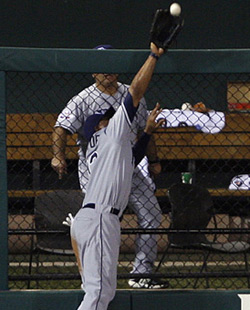 The first problem with projecting Crawford in pinstripes is the assumption that he will be a free agent this winter. That is not necessarily the case. The Rays hold a $10 million club option. If they choose not to exercise it, they would have to pay Crawford a $1.25 million buyout. The marginal cost to the Rays of retaining Crawford, then, is $8.75 million, or just $500,000 more than he’s making his season. That would seem to argue for another year of Crawford in Florida unless the combination of the weak economy and Tampa’s attendance issues — the reigning AL champs’ sales are up, but only by about 2,300 tickets a game — has put the team in a position where it has to cut salary to the bone.
That outcome seems unlikely for two reasons: First, the Rays have a few dollars in useless salaries coming off the books after this season. Troy Percival, Jason Isringhausen and Chad Bradford will combine to make $8 million this year. If the Rays replace them internally, something they’ve already been forced to do with two of the three, then Crawford’s salary is mostly covered. Secondarily, $10 million is high for a left fielder in the present economic environment, but not outlandishly so. It’s less than Raul Ibanez will make next year, or Adam Dunn, and just $1 million more than Milton Bradley. The Rays could absorb the $8.75 million next year, then attempt to re-sign Crawford to a lesser contract based on the new economic realities, or they could pass and take the first-round draft pick. Alternatively, they could pick up Crawford’s option than attempt to trade him a year from now. In short, there is no guarantee that Crawford will even be available to the Yankees.
A more difficult question, but not spectacularly more difficult, is whether the Yankees would really benefit from signing Crawford. Crawford is a very good player who has the potential to be a very bad one. His game is largely based around speed, with only a bit of power and patience thrown in. His batting average is driven by hitting on turf — he’s averaged .302 on the fake stuff versus .285 on grass. Since he doesn’t walk much, his on-base percentage on grass is only .324. His average is also driven by his speed. Nearly 10 percent of Crawford’s hits every year are of the infield variety. At some point, through age or the inevitable knee injury, he’s going to lose half a step, and when he does, close to 20 hits a year will disappear, as will the high stolen base totals, the triples and the stellar outfield defense. That will leave Crawford’s team with a player not too different from the one he was during his injury season last year. Crawford hit .273/.319/.400. That’s not helpful in an offensive era in which the average player can be counted on to do better than that.
You can’t know when Crawford will hit that wall, the one that waits for all players whose productivity is based on speed, but given that the team that signs him as a free agent will have to agree to a multi-year deal that carries the player at least into his early 30s (Crawford turns 28 in August), it’s likely that it will happen on his next employer’s dime. Signing any player, at any stage of his career, is always a gamble, but some gambles are lower percentage risks than others. As much fun as Crawford can be, he seems like one of those, a chance for an acquiring team to get burned. Just Crawford’s career road rates, the non-turf .285/.323/.423 alluded to above, suggests he could retain his speed and still disappoint in the wrong park. In other words, he’s probably more valuable where he is now than he would be almost anywhere else. Before clamoring for Crawford, it would be best to be sure of what one is getting. As the old saying goes, speed kills. In this case, the victims might include those paying a thirty-something Crawford’s salary.
Yankees facing severely depleted Angels
20-GAME WATCH: YANKEES VS. ANGELS
It’s an inevitable part of any season that the Yankees have to go to Anaheim. Sadly, the MLB schedule doesn’t offer any NFL-style options, where you might not see a rival ream for a few years. Over the last five years, the Yankees have gone 7-15 against the former Disney vassals. That’s a fairly amazing number given the Yankees’ overall records in those years. In one ballpark, a team that averages 90-something wins a year becomes a 100-game loser.
Due to injuries and disappointing performances, the Angels have been playing a lineup far different from the one they contemplated at season’s outset. They’ve remained competitive anyway. Let’s look at the 20-game picture:
W-L RS/G RA/G AVG OBP SLG SB CS HR/9 BB/9 K/9
YANKEES 14-6 5.5 3.8 .280 .371 .442 15 7 1.1 3.0 7.9
ANGELS 12-8 6.0 5.3 .275 .352 .440 16 6 1.6 3.6 7.4
 The Yankees aren’t going to see Vladimir Guerrero and Torii Hunter, as they’ve both hit the disabled list. Scot Sheilds is unavailable. Kelvim Escobar is there too, though that’s no surprise — his spot on the DL is a rental with an option to buy. Howie Kendrick is back from the minors but has yet to win his spot back from Maicer Izturis, who is peaking at .302/.352/.422. Catcher Mike Napoli, one of the best surviving bats on the team, doesn’t play every day, although with the DH spot freed up by Guerrero’s absence, the Yankees may get an extra serving. Kendry Morales is having a strong year at first, certainly a stronger year than this page ever expected him to have; Bobby Abreu is doing his usual fine job of getting on base; another former Yankee, Juan Rivera, has been mostly healthy for once and is killing the ball at .313/.353/.531. In his last fifteen games he’s slugging .645 with six home runs.
On the pitching side, the Yankees will see Joe Saunders, Jared Weaver, and John Lackey. Saunders has been hammered in three of his last four starts, allowing 19 runs in 21.1 innings. Most intriguingly for a power-hitting team like the Yankees, he’s allowed nine home runs in those starts. Weaver’s work of late has also been patchy. As recently as June 15, he had an ERA of 2.05. Since then, he’s four starts and been battered to the tune of .296/.358/.510, allowing 20 runs in 23.2 innings. He’s still awfully hard on right-handers at .176/.232/.255, but the Yankees have so many left-handers and switch-hitters that they should be less vulnerable than most other clubs. Finally, Lackey is normally one of the best pitchers in baseball, but has had injury problems and hasn’t been himself all year. He seemed to be coming around in a series of four starts beginning in mid-June, posting a 2.70 ERA in 30 innings, but three of the four starts were against light-hitting teams, the Giants, Diamondbacks (both DH-free games), and Orioles. His last start was against the Rangers, and he was thrashed.
The Yankees are facing a severely depleted Angels club. Neither their starters nor their pen has been particularly effective. Their offense is down to just a few above-average pieces. The defense, normally a plus, is among the least efficient in the game. They may still be winning, but they’re doing it with mirrors. For once, the Yankees may be able to make a strong showing in Anaheim.
 Jeff Francoeur for Ryan Church: Mets bought themselves another fixer-upper opportunity, but Francoeur may be too stubborn to be fixed, in spite of all his great physical tools. As for the Braves, Church is not a great player, and he’s five years older than Francoeur, but he’s an upgrade on the out machine that Francoeur had become. In a light division, small improvements of this nature can help swing the standings in a team’s favor. The Braves really impress with their willingness to reshape their team on the fly this year. They tried to jump Jordan Schafer ahead of schedule. That didn’t work so they dealt for Nate McLouth. Kelly Johnson has been sent down in favor of Martin Prado. Tom Glavine was released so that young Tommy Hanson could pitch, and now they’ve ditched one of baseball’s worst hitters. They’re not living with their failures, they’re deleting them. You can’t ask more from a general manager.
The Mariners picked up two minor league pitchers from the Royals for Yuniesky Betancourt. They had to send some cash along, but still managed to delete a contract that ran through 2011 with a 2012 buyout and promised to do very little for them over that span. Betancourt is a classic triple threat: he doesn’t hit, doesn’t run, and doesn’t field. Even if the pitchers, who are a couple of years off, never develop, they’ve wisely decided that they can pay Ronnie Cedeno less to make the same outs. If they’ve freed up enough cash to add a bat, they might even stay in their divisional race. The Royals might be one of the only teams in baseball that Betancourt can help, although they’ll dearly for the privilege. With Mike Aviles out for the year and spectacularly disappointing before that, they’ve had a parade of shortstops, none of whom has distinguished themselves. Overall, Royals shortstops have batted .208/.234/.281 this year. That’s miserable, and it has no doubt cost the Royals quite a bit in the win column, but you still have to question the deal from their point of view. They’ve gone from pathetic to miserable, which probably isn’t enough of an improvement to win the division, and they’ll be stuck with Betancourt for at least two and a half years. Unless the Mariners are paying all of his contract, it seems like a heavy price to pay for a bid at mere respectability.
How well is Robinson Cano playing?
 GIRARDI VS. CANO
Joe Girardi is a polarizing figure for Yankees fans. It was inevitable that the first manager to guide the Yankees to a finish out of the postseason in what seems like a hundred years would become a lightning rod. Some decry his handling of the bullpen, others his love of small-ball tactics — the Yankees bunt often for a present-day American League team.
These criticisms are debatable; the bullpen has risen in effectiveness throughout the season, as weaker sisters have been weeded out (Tuesday’s game notwithstanding), and those Yankees that Girardi has asked to bunt are either those who don’t generate much offense anyway (Francisco Cervelli) or just might beat one out (Brett Gardner). The place where criticisms of Girardi find a more legitimate place are in his construction of the batting order.
Variations in the batting order are not terribly significant. They won’t ruin your season, but they can cost you a few runs on the margins. Since the manager’s job is to maximize his team’s performance, that is, to capture every run that he can, that the batting order is not a top-priority item is no excuse for putting out the best one possible.
For reasons that aren’t obvious, Girardi has fallen in love with Robinson Cano as his fifth place hitter. Cano has started 46 of the team’s 76 games in the No. 5 spot. In putting Cano there, Girardi has delivered Cano some very special plate appearances with runners on base. Mark Teixeira has seen the most baserunners of any Yankees hitter, but Cano is second, having seen just seven fewer runners. The problem is that despite a .300 average on the season, Cano is hitting only .254/.289/.415 with runners on and .213/.248/.340 with runners in scoring position. The offense is setting Cano up, but he isn’t knocking them down.
 Another way of looking at Cano’s production with runners on is to consider the percentage of baserunners he’s driven in (statistics available at Baseball Prospectus). Cano has scored 30 of the 233 runners he’s seen. That’s 12.8 percent.
The American League average is 14 percent. It’s a small but significant failing. Three more runners driven in would get him to the league average. Were he carrying Jorge Posada’s rate of 17 percent, he would have driven in 10 more runners. Even with all of his struggles, Alex Rodriguez has driven in a greater percentage of his baserunners, 16.4 percent.
Intriguingly, no Yankee is among the league leaders. There are currently 308 hitters who have batted with 75 or more runners on base. The top 10 in percentage of runners driven in:
Posada is the top Yankee, 53rd on the list.
Cano compounds his impatience and failure to hit with runners on base with groundball hitting tendencies that lead to double plays. Cano ranks 11th among Major League hitters who have batted in 30 or more double play situations:
This makes Cano a less than ideal RBI man, but since Girardi chooses to emphasize him in the order, his deficiencies trouble the Yankees far more often than they need to. Of course, it might be hard for Girardi to truly admit the damaging consequences of all those double plays. After all, he holds the team record for hitting into double plays, banging into 17 twin killings in 50 chances in 1999. In the 55 years for which we have records, no one else has come close.
To the mats with reader comments
TO THE MATS WITH READER COMMENTS
Just a couple of quick ones from this morning’s entry:
Frequent correspondent let’sgoyankees says:
Good article, but I want to make one point…Melky should not be taken out in favor of Gardner. Swisher should. He plays awful defense and is a terrible baserunner. Since both he and Melky are slumping, those other two categories have Swishy beat. Swish is a useful player but he should be platooned. He’s exposed playing every day.
And Charlie F responds:
Swisher does NOT play awful defense. He plays incredibly UGLY defense, but he’s actually quite a good defender. His UZR/150 is above average as is his range factor per game. Don’t confuse ungraceful and lumbering for bad.
To which I, your humble servant, will add that there’s not a lot that’s pretty in Swisher’s game, but he’s a productive player and one the Yankees can’t afford to take out of the lineup. Even when his bat went on vacation in May, he still drew 19 walks, making for a .311 on-base percentage despite a .150 batting average. This month he’s hitting .267/.397/.500. You show me a team that benches a guy with those rates and I’ll show you a team that needs its head examined. Swisher has faults, and when a team is not playing well, those faults — the strikeouts, sub-Speaker agility in the outfield, become exaggerated. This happens to every team in a bad place — the urge to punish someone strong, and it frequently seizes on the wrong player. Swisher has been productive against both lefties and righties, has hit well by any reasonable standard, and has left something to be desired only at Yankee Stadium II, where, despite his struggles, he has posted a .373 on-base percentage. He’s part of the solution, not the problem…
…And yet he’s still going to lose playing time to Xavier Nady. That’s the way of things, and it’s depressing.
…If anyone wants to talk about this or anything else, I’m about to begin a chat (1 PM EST) at
Baseball Prospectus.
The trouble with offense … and A-Rod
SO, WHAT HAVE WE GOT?
During the offseason, I frequently argued that though the Yankees had their attention focused overwhelmingly on pitching, the offense might prove to be a bigger problem. Then they signed Mark Teixeira, and I promptly shut up. It seems odd to talk about a team that has averaged more than five runs a game as having offensive deficits to make up, but the truth is that the particular construction of the Yankees means that it’s still a realistic possibility. The Yankees have to guard against being fooled by the numbers they are seeing, many of them distortions caused by their generous new home park. To this point in the season, certain aging Yankees would seem to have found the Fountain of Youth. What they’ve really discovered is a beautifully appointed new ballpark with wide concourses, laptops in the lockers, and a loving right-field power alley.
The home/road splits are damning: Derek Jeter, .295/.364/.381 with two home runs in 239 at-bats. Melky Cabrera, .278/.329/.354 with one home run in 79 at-bats. Johnny Damon, .260/.317/.449 with four home runs in 127 at-bats. Jorge Posada, .253/.348/.440 with three home runs in 75 at-bats. These numbers aren’t terrible, but they’re more realistic than what the players have done at home, more in line with what the players have done in the recent past and what we might have projected them to do this year.
 The Yankees are a .500 team on the road so far this season. Their road production has been, overall, quite good, given that Nick Swisher, Robinson Cano and Hideki Matsui have done the bulk of their hitting while traveling. Teixeira has also done his part. Still, this hasn’t been enough to give the team the same explosiveness that it has had in the Bronx, especially when you throw in Alex Rodriguez’s post-surgical problems. (Likely unrelated to his staying up late. Though I’m sure we all want to jump on Rodriguez for his latest transgression, I’m pretty sure that sitting on a barstool next to Kate Hudson doesn’t stress his hip as much as playing does, which was more the point of his “fatigue” problems than his lack of sleep, dig?)
Insofar as winning the division goes, this bifurcation would present less of a problem if the Yankees had won more than 60 percent of their games at home. The 1987 Minnesota Twins showed that in a soft division you could be a hundred-loss team on the road if you were a 100-win team at home. The Yankees are a few games off the latter pace. Say they were just a few games better in their own park, 25-10, instead of 21-14. That’s asking a lot of the Yankees, but we’re in the land of make-believe just now, so stay with me. Were the Yankees to maintain that kind of pace at home while staying around .500 on the road, they would finish the season with a record of somewhere around 99-63, and be in very good shape to win the Wild Card if not the division. They may win the Wild Card anyway, but you can’t take anything for granted.
There is something to be said for players that can take advantage of the features of your home park. Not every Yankee has popped a home run every 13 at-bats at home, as Damon has. The problem is that the park can’t discriminate. The Yankees have outscored their opponents by just 13 runs at home. Over time, that gap may narrow, perhaps because of the park, or maybe because Brett Tomko is pitching. Or Brett Tomko is pitching in the park. The players who have reaped the extra support might also regress, simply through age, fatigue (to use a dangerous word), injury, or changing weather patterns or other effects of the new park we can’t yet foresee.
In June, the Yankees are batting .247/.342/.424, roughly a league mark. The pitchers have been fine. June’s ERA is 3.85, actually the team’s best of the season. June’s starters have an ERA of 4.40, above-average for the league, and the transformed, Veras-free bullpen has an ERA of 2.87. Assuming that CC Sabathia isn’t hurt in any long-term-kind-of way, the pitching staff may well have achieved stability. It is the offense that should now be the source of worry. The lesson for the Yankees is clearly that if opportunities to upgrade the offense present themselves, any chance to replace a middling 35-year-old bat, they have to take it. If finances mitigate against such a move, that’s one thing, but sentimentality or the belief that Melky Cabrera (injured shoulder or not) is going to achieve consistency or Hideki Matsui is going to turn back the clock need to be ignored.
And most of all, perhaps more than anything else, a day-in, day-out A-Rod substitute must be found. Applicant should be able to out-hit Angel Berroa and outfield both he and the less-than-limber Rodriguez. Rodriguez could struggle all season, even if he takes a vow of celibacy. Again, the Yankees don’t want to take anything for granted.
 Pinstriped Bible