Category: Dailies
In fairness to Teixeira
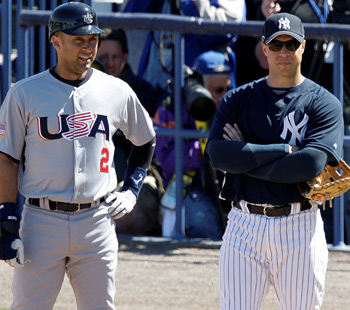 (IF A-ROD CAN’T PLAY LIKE A-ROD)
“Something Shakespeare never said is, ‘You’ve got to be kidding.'” — Robyn Hitchcock
Today the wires are bursting with, “Now the pressure is on you, Mark Teixeira” stories. Those stories couldn’t be more loaded with bull if they mooed. This is a simplistic effort to create a new Yankees scapegoat since Alex Rodriguez’s injury effectively insulates him from criticism. If Rodriguez misses a significant chunk of the season, Teixeira can hit like Lou Gehrig and Don Mattingly put together and still not overcome the basic weakness of the offense.
Let’s go around the diamond:
1B Mark Teixeira: Solid producer, typically scrapes the underside of MVP-level production but could easily rise to that level with a good season.
2B Robinson Cano: Has to hit .300 to contribute. He might do that, he might not.
3B Cody Ransom: Has some pop, but is unlikely to hit for sustainable average (PECOTA: .216/.293/.386).
SS Derek Jeter: Offense has declined in two straight seasons. Average of five projection systems: .300/.368/.419.
LF Johnny Damon: Almost certain to take a giant step back.
CF Brett Gardner and pals: Any production will be a bonus.
RF Nick Swisher: should be productive in a lower echelon kind of way, Xavier Nady less so, either way, not a big plus.
DH Hideki Matsui: should hit decently, but not at an MVP level.
C Jorge Posada: may or may not be ready to open the season, may or may not hit as well as he used to, and will probably have to yield to Jose Molina on a regular basis.
Like the British at Singapore, the Yankees pointed all of their guns in the wrong direction this winter. They went heavy for pitching, but the offense needed an overhaul and the Minor League required needed some of its pitchers converted into position players. That didn’t happen, and as with last season, the Yankees are in the position of having a desperately wounded player (last year it was Posada and Matsui) try to overcome an injury because they just can’t compensate. Without an MVP-level Rodriguez, the offense is very likely to struggle to support the new starting rotation. Unless Cano, Jeter, and the rest rebound in big ways or stave off expected regressions, Teixeira won’t be enough if he hits .180, .280, or .380.
A short list of fill-ins at third base (if need be)
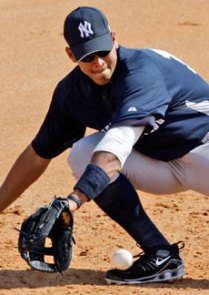 NO SURGERY FOR A-ROD…FOR NOW
Remember how well no surgery for Hideki Matsui worked out? I hope the Yankees have received better advice this time. The Yankees will still need insurance for the position — even if Rodriguez can “play,” we’ve seen what this kind of injury did to Chase Utley and Mike Lowell last season.
DELVING DEEPER
Throughout the evening I’ll be spelunking through the world’s roster flotsam to see if there are any third base possibilities that could provide the Yankees with better depth than they currently possess. This is emphatically a non-systematic look, no better than guesses and random suggestions. I’m sticking with lower echelon guys, because the team is unlikely to try to deal for an All-Star type (if one is even available) until it has a better idea of how much Rodriguez it’s really going to get. Thus the trick is finding someone who will fit on the bench or in the minors if/when Rodriguez becomes available and is also demonstrably more potent than Angel Berroa and Cody Ransom. Fortunately, that group includes everyone. Here’s the first pile.
Ray Durham (Free Agent): Durham, 37, can still hit, having batted .289/.380/.453 for the Giants and Brewers last year. A legitimate switch-hitter at one time, his right-handed stroke seems to have died over the last couple of years. As a career second baseman, the last time he played third base in the majors was… never.
Esteban German (about to be a Free Agent): German was designated for assignment by the Royals a few days ago. He has played a little third base each of the last five years, though he’s not particularly good at it. German was once a useful offensive player, making up for his lack of punch with a high walk rate. Then he stopped walking.
Mark Grudzielanek (Free Agent): Grudz is a career .290 hitter but has never produced much because he doesn’t get on base or hit with any power. Over the last two seasons, he hit .301/.345/.415, though he missed about half of 2008 with injuries. He last played third base in 1995. This would be a desperation pick-up, but “desperate” describes the situation with a high degree of accuracy.
Jeff Keppinger, Danny Richar (Reds 40-Man): The Reds have a legion of infielders in camp and might not mind moving one. Richar will turn 26 this year. He’s a left-handed hitter with a little pop who has spent all but 72 games of his career in the minors, where he has been a .288/.338/.440. PECOTA has a weighted mean projection of .253/.318/.401 for Richar, but that’s as a Red — in another ballpark, that projection would presumably drop. Keppinger is a vet who can usually hit for average, though injuries prevented him from doing so in the second half last year. Keppinger has mostly played short in the majors, but he’s stretched there. Right now he seems to be behind Alex Gonzalez and Jerry Hairston, Jr. on the depth chart.
Kevin Kouzmanoff (Padres 40-Man): This one is likely a reach unless the Yankees want to send a real prospect or two, but the Padres are a financial mess and have a bit of depth at this position as sophomore Chase Headley could take over the hot corner if Kouzmanoff were to leave town. No defensive whiz, Kouzmanoff does have a potent righty bat that has been camouflaged by Petco Park — last year he hit .226/.268/.390 at home, but .292/.329/.473 on the road. He’s impatient and strikes out quite a bit, but the road figures represent the real hitter.
Scott McClain (Giants NRI): The soon to be 37-year-old journeyman, once an expansion Ray, got the call from the Giants last fall and hit .273/.368/.485, which is probably the high upside of his hitting abilities. He’s been a pro since 1990 and has spent some time in Japan as well as the American minors. Including his time overseas, he has hit 405 pro home runs — we’re talking Crash Davis here. As a domestic Minor Leaguer, he’s hit .271/.357/.484, including .300/.388/.553 at Triple-A last season. He’s never been a great fielder, and an optimistic Major League projection would be .240/.320/.420, but that would far surpass the Berroa/Ransom combo.
Dallas McPherson (Marlins 40-man): The former Angels prospect, now 28. A left-handed power hitter, he led the minors in home runs last year, batting .275/.379/.618 with 42 home runs at Triple-A Albuquerque. He also struck out 168 times in 448 at-bats. He’s no fielder and would struggle to reach base 30 percent of the time, but he’d hit a few balls over the fences.
More to come…
A-Rod surgery worst case of bad timing
 INTO THE TWILIGHT ZONE IN SEARCH OF A-ROD’S REPLACEMENT
As the old Leadbelly song goes, “I may be right and I may be wrong, but you know you’re gonna miss me when I’m gone.” No doubt Alex Rodriguez will be singing this song now that hip surgery is apparently going to put him on the shelf for a projected 10 weeks. If the story as reported by ESPN is correct, the Yankees will be without their starting third baseman for something like six weeks of the regular season.
Since the news came through, I’ve been plumbing the depths like Cave Carson looking for replacement possibilities that won’t damage the Yankees’ efforts too badly. The two utility infield types currently in camp, Cody Ransom and Angel Berroa, are not good bets. The latter may be one of the worst bets of all time, a career .260/.305/.378 hitter. Ransom has a little more life in his bat, but despite his nice little September hot streak last fall, he’s not likely to produce at a satisfactory level. His career Minor League batting average is .242 and he’s hit about .250 over the last three seasons. Average isn’t everything, and Ransom has some power, but when you start out with a batting average that low, there’s a good chance you won’t hit safely often enough to reach an acceptable level of production.
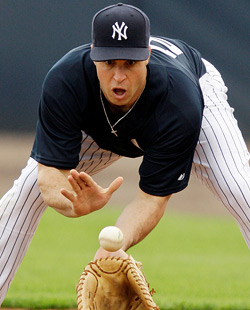
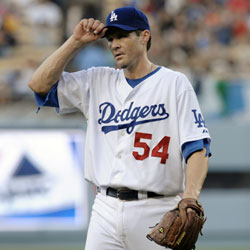
There are a couple of Hail Mary options on the roster — Xavier Nady and Mark Teixeira (pictured) have done the third base thing in the past, Nady very briefly, Teixeira throughout his brief Minor League career. As with many young third basemen, Teixeira was prone to errors at the position, and the Rangers had Hank Blalock locked in at third, so Teix moved across the diamond and proved to be a very good first baseman. Moving Teixeira back to the hot corner now would allow the Yankees to drop Nick Swisher at first base and Nady into right field. Offensively, this is probably the best possible way to paper over Rodriguez’s extended absence. Defensively, it would all depend on Teixeira’s ability to handle a position he hasn’t touched for six years and what you gauge his risk of injury to be (if any), and if he’s even willing to make an attempt at it.
Such a solution could be flexible, depending on the starting pitcher for that day. CC Sabathia can probably stand to pitch with a weaker defense behind him. Chien-Ming Wang cannot, so his starts would have to feature a “real” third baseman, with Teixeira back at first. It’s messy, but it could work … And I can’t resist saying that Casey Stengel would have done it. Heck, down the stretch in 1954, as the Yankees were trying to avoid elimination, Casey put Yogi Berra at third and Mickey Mantle at short so he could get some extra bats into the lineup. Anything for a win, even if it seems outlandish. It should also be pointed out that the offensive damage done by a Ransom or Berroa would almost certainly outweigh the defensive damage done by putting someone like Teixeira at third.
The Minor League options on hand aren’t strong. Eric Duncan is still kicking around, but he has shown no sign of being a Major Leaguer (scratch one more Yankees first-round pick). Kevin Russo, America’s favorite utility choice, won’t hit either and has spent most of his professional life at second base. There are a number of veteran options soaking up bench spots for other teams, like Mike Lamb with the Brewers and Scott McClain with the Giants (an NRI, he’s probably expendable), but these will have to be pried free, however limited their value. The Yankees cannot give up a player of long-term value for a 10-week rental.
Whatever the solution, which at the moment is not obvious, the Yankees are now in some real trouble. The murder weapon used in the demise of last year’s Yankees team was not the shaky pitching but the presence of three replacement-level hitters in the lineup in Jose Molina, Robinson Cano, and Melky Cabrera. The Yankees just took a giant step back in that direction. If Jorge Posada isn’t ready, if Hideki Matsui isn’t ready, if the second baseman or center fielder doesn’t hit, and Rodriguez is out for an extended period, scoring could be a problem. It might have been a problem even with Rodriguez in the lineup, so short of a season-ending injury, this is about the worst news the Yankees could have received right now.
The banter from Beantown
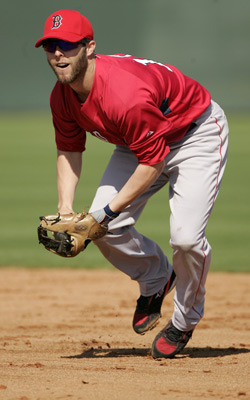
AL
EAST ON THE EDGE OF FOREVER
As you know, I’m up in Boston
on book-tour duty. I’ve had enough train action in recent weeks that I’m
starting to feel like the Joe Biden of the Internet baseball set. Then again, I
shouldn’t complain, as some of my brethren down in Florida are having to scoot to all corners
of the globe to follow both their normal team assignments as well as peek in on
WBC action.
In this part of the woods, the worries are, as you would
expect, oriented around the Red Sox and if their offense will hold up in the
coming season, and if the Yankees have trumped them by adding CC and A.J. There
are few good answers at this point except to flip the switch on the season and
see what happens, but that moment is a month away yet, so we all get to nibble
our fingernails a bit more — Boston fans on their offense (and maybe their
starting pitching, too), Yankees fans on their offense and defense (and defense
is pitching is defense, so this is a bigger issue than is usually acknowledged)
and Rays fans wondering if it was all a dream (it wasn’t, but that doesn’t mean
the sequel will be easy). The WBC gives us an extra week to think about these
things, which now that I think about it, might be good for the collective
mental health. In the same way that Joe DiMaggio’s hitting streak kept a nation
on the edge of war distracted for one last summer, if this year’s baseball
season starts late and drags into November, well, that’s one more week when the
specter of financial ruination can be put off. I hope.
Meanwhile, today’s exhibition action was more exhibition-y
than usual, with the Yankees taking on a team of Major League All-Stars in a
WBC tune-up — not a good day to be Phil Hughes or any of the other young
pitchers required to face Dustin Pedroia, Adam Dunn, Ryan Braun, etcetera, not
to mention Derek Jeter. As such, the story wasn’t really in the pitchers today
but in the hitters — the Yankees hitters. Brett Gardner put together another
strong day, and against real Major League pitchers like Roy Oswalt. If he keeps
up his current pace, it’s going to be very difficult for the Yankees to deny
him the starting center field job. And then, of course, he’ll have to keep it
up, because with his first 0-for-4, someone will be arguing that it’s time to
see if Melky has learned to hit by sitting on the bench.
The Gardner vs. Melky competition may seem like small beer
given that we’re talking about the team’s ninth-place hitter, but given the
probable offensive shortfall the Yankees will see in left and right field, and
potentially other spots on the diamond, getting something rather than nothing
out of that position could make a small but significant difference in what
should be a tough division race, perhaps a swing of two or more wins. That
could be the difference.
More from me when I’m not comatose from doing two AM TV
spots. It’s always shocking to me to see so many people awake and producing
television programs when they should be sleeping. Those of you in the
Boston-New Hampshire-Rhode Island-Vermont-Canada-Atlantis region, I look
forward to seeing you this evening.
More defense on my Jeter stance
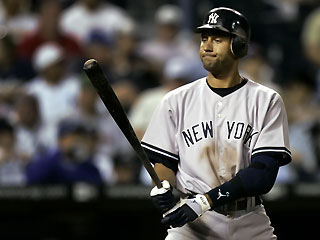 JETER III
I enjoyed the session at the Yogi Berra museum. You were the best in your row. As a Yankee fan, I felt a Pilgrim in an unholy land as Sean Connery said to Harrison Ford in Last Crusade. I thought the panel was sponsored by the Wilpons or the Kill the Evil empire society from Beantown.
There is plenty of baseball left in Derek Jeter. His paint is not peeling. He had a monster start after the last baseball classic. I expect another one. Derek will deliver. This is America. You are entitled to your opinion, but Derek Jeter will go out a Yankee. Be it as a DH or a shortstop. Nothing was better than watching Don Mattingly regain killer form in the 1985 playoffs.
Sports are more than about statistics, It is about heart and love of the game. Jeter is the Yankees, warts and all. So he can’t go to his left, Stop the world. So he is slowing down. Start a movement. He can teach the Yankee way until they pry the bat from his hands and Joe Torre, the right man in the right place at the right time, definitely belongs in the Hall Of Fame. I thank you. The panel was informative and interesting, but I felt I was in Fenway not Yogi Berra.
I have often said that the reason this feature was titled the Pinstriped Bible is that the real Bible is an argument about how to live your life in a moral way and the Pinstriped Bible is an argument about winning baseball. That means making every effort to be objective, regardless of what team or players I rooted for when I was a lad.
To the credit of the three organizations that have played host to the Pinstriped Bible in the past, YES, MLB.com, and the Yankees themselves, none have asked me to be anything less than that. If that means making unpopular but commonsense arguments about the impact of a player’s aging (and three years from now) on the team’s fortunes, so be it. You can get boosterism anywhere.
Modified from the script of Any Given Sunday, it fits right here with Derek Jeter:”
Hopefully some of you (and you, Steve) can appreciate that.
Just to clarify, Jeter isn’t dead and he’s not done, but we’ve been talking about what happens after 2010, not about today (not that today is a sure thing either). The question remains: What is your greatest priority? Seeing the team win, or seeing an aging player do an increasingly vague approximation of the things he did well ten years earlier? Those that choose the latter are the ones guilty of disloyalty, both to the team and to the player. The worst thing that can happen to a self-aware performer like Jeter is to receive applause for something that was previously beneath him. Lou Gehrig understood this, which is why he asked out of the lineup when teammates began congratulating him for making routine plays.
“So you know Albert Pujols, the great Cardinals, first baseman, two-time MVP? Well, he was in a severe car accident. His life was saved, but there was some severe damage. His left leg is permanently shorter than the right one, so he can no longer run around the bases, he hobbles, or lopes. Due to the fact that his right arm was bent into itself like a Möbius strip, his power is all but gone. He’s lucky to hit the ball out of the infield now. Should the Cardinals play him, or let him go?”
“Let him go, obviously.”
“Okay, say the same thing happened to Derek Jeter?”
“Play him!”
As I’ve been writing, rsiciliano added, “The Yanks owe Jeet too much not to resign him.” They owed Babe Ruth even more, but when he couldn’t help anymore they were all too happy to move him on to the Boston Braves. Gehrig wasn’t even offered an office job. The pruning of the roster during the dynasty years of the 40s and 50s was merciless. Players age. Period. Winning requires youth, particularly young shortstops. In the next day or so I’ll complete a little historical survey on the matter, and you’ll find that you can count the number of teams that won with elderly guys at shortstop can be counted on just a few fingers.
Now, Jeter may have an atypical late-career surge in him. He may show you things on defense you’ve never seen before, or come back from last year’s weak (by his standards) offensive performance. Perhaps in October, 2010, we’re talking about whether the Yankees should re-sign a guy who just hit .330. I hope those things happen, but regardless of whether they do or do not, if you’re a Yankee fan, you have to be willing to discuss the consequences of going forward in 2011 or not. It’s not disloyalty. It’s just as acceptance of the facts.
I close this section with that great quote from G.K. Chesterton: “My country, right or wrong,” is a thing that no patriot would think of saying except in a desperate case. It is like saying, “My mother, drunk or sober.” Or like saying, “Derek Jeter, good or bad.”
AND AS IF I DON’T HAVE BOSTON ACCUSATIONS ENOUGH TO DEAL WITH…
Defending my stance on Jeter
 A COUPLE OF QUICK NOTES AS WE HEAD INTO THE WEEKEND…
First, a few reactions to the comments on retaining Derek Jeter after 2010: as I tried to explain this morning, I’m appreciative of Jeter for all he’s done, but I appreciate winning baseball teams more, and I very much doubt that the Yankees will be able to do so with a 37-year-old shortstop, particularly one who doesn’t play great defense now and has visibly slowed the last couple of years.
Baseball puts fans in a very difficult bind: do you love the team or the player? When the player is 25 and at the peak of his powers, it is very easy to love both. When they’re 35 and gimpy, you have to make a decision. The Yankees, and Yankees fans, have gone through this repeatedly: with Babe Ruth, Joe DiMaggio, Mickey Mantle and many others. At some point, it was time for them to move on so the team could make room for fresh faces that could do more to help them win. The alternative is that the team ceases to try to win and becomes a nostalgia show, perpetuating these players far beyond their usefulness just because it’s hard to let go. If that’s what you want, that’s one thing, but you’re going to see a whole lot of losing, not to mention experience a whole lot of embarrassing discomfort along the lines of what old time Willie Mays fans saw when he joined the Mets in 1972 — not the fleet ballplayer of 1954 who could do anything, but a 42-year-old who looked like a tired old guy. If you want to see Derek Jeter look like that, fine — just keep holding on too tight — and don’t
Specific comments: vrod44, the “you didn’t play the game” insult is as old as dirt and about as logical. Whether I played or not, even if I was Lou Gehrig in a previous life, Jeter is aging. That’s an unavoidable fact, but blame the messenger if you want. Yankee7777, it’s odd that you cite Lou Boudreau given that he stopped hitting after age 30, was a part-time player by 32, and retired at 34. No, he wasn’t fast — he was, in fact, legendarily slow, and as you say he was a great defender nonetheless. Unfortunately, none of that serves your point because by the time he was Jeter’s age, he wasn’t playing anymore. I don’t have time to do it now, but over the weekend I’ll try to figure out which teams won with old shortstops. My guess is it’s a short list. I also disagree with your statement, “Anyone who watches Jeter knows he makes all the plays.” He demonstrably does not. I wrote this in the Baseball Prospectus annual four years ago:
For those of us in the performance analysis biz, Jeter is a difficult problem because any realistic evaluation of his skills, no matter how flattering, seems like a slight when compared to his reputation. In the eyes of true believers, Honus Wagner and Superman combined couldn’t do half the things Jeter does. In truth, he’s terrific at going back on shallow pop-ups and executing the jump throw in the hole. Other aspects of the job — fielding grounders to his left for instance — elude him, and it doesn’t take an MS in scouting or statistics to see it. When watching a Yankees game, simply pay attention to the opposing shortstop. He will routinely get to balls that Jeter cannot. As for the Gold Glove, peel back the foil on the award and you’ll find there’s some tasty chocolate underneath. That’s about what it’s worth, though at least Jeter was better this year. On offense, Jeter walked less than ever before and doubled his previous high in sac bunts, perhaps because he lost confidence after a shockingly poor April. Jeter is a Hall of Famer to be, a key player on a great team, an inspirational leader, a fine hitter…and he gives up a lot of singles with his glove. In light of the rest, why is that last part so difficult to accept?
I stand by what I wrote back in the winter of 2004. Every day you can see balls go past Jeter on the left that most other shortstops easily field, and if he’s ever made a play behind second base it must have been back in the Clinton administration. To this point, for the reasons stated above, that deficiency hasn’t been all that important, because on balance, the combination of offense and defense worked out in the Yankees’ favor. That will be less and less the case over time, and if 2008’s reduced offensive output was not an injury-induced fluke but the beginning of an age-inspired trend (and it was the second season in a row that Jeter’s offense dropped, so arguing about said trend may be a moot point), the day of reckoning is here now.
AND FROM TODAY’S GAME…
The Yankees dropped the decision to the Twins, who came back late against some youngsters who aren’t going to be within hailing distance of this year’s staff. There was still plenty of good stuff: a solid two innings for Ian Kennedy; a 2-for-2 with a double and a stolen base for Brett Gardner (and an 0-for-3 for Melky), a 2-for-3 for Jorge Posada and an identical day for Nick Swisher. Xavier Nady went 0-for-3 with an RBI.
Also of interest was an appearance in left field by Kevin Russo. I get a lot of mail about Russo, who hit .316/.363/.416 in half a season at Double-A Trenton last year. Some out there want to see him as a prospect, but I don’t buy it — as a second baseman, he’s going to have to hit more than that to make it — those numbers don’t really translate to anything impressive — and since he doesn’t play shortstop, his chances to be a utility infielder are not good. Last year he got in an odd bit of utility work at third base and the outfield, and it’s interesting to see the Yankees carrying that forward this spring. If Russo starts the season at Scranton, he could be an injury away from a bench job… It’s not like Cody Ransom has an ironclad lock on a job.
THAT’S A WEEK
I hope to see many of you at the Yogi Berra Museum on Sunday (see below for details). I’ll catch the rest of you here on Monday, unless Brian Cashman goes insane and signs Manny Ramirez tomorrow afternoon. In that case, I’ll be posting — a lot.
Another day, more stuff happens
 THAT’S JUST THE WAY IT WORKS
Can’t complain about the Yankees’ exhibition showing against the Rays on Thursday, and can’t get overexcited about it given that the Rays brought not their B or C squad but maybe Squad Q, the squad you turn to when all else has failed and the monsters are at the door, but not any time before that.
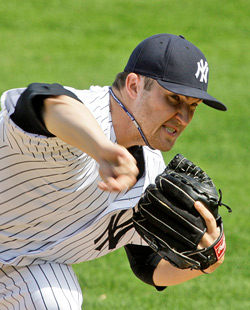
I was excited to see Phil Hughes’ cutter again, but the Yankees denied me, having the lad work on his other pitches, and two barely hit batsmen aside the results were just fine. Ditto bullpen-bound Phil Coke, who with Damaso Marte should give the Yankees a rare set of matched lefty long men, rather than the more ubiquitous pair o’ LOOGYs. Joe Girardi should keep in mind that “long man” is not equivalent to “infinite man” — he forgot with Marte a couple of times last season.
On the offensive side, it was a very good day for Jorge Posada, with a double and a home run, and that means it was a good day for the Yankees, as a resurgent Posada could be decisive in this year’s race. Again, let’s not get too worked up about the results of one game of DH-work and a home run against Chad Orvella, who looked so good a few years ago and looks so lost now. On the bad news side, Brett Gardner went 0-for-2, but then so did Melky Cabrera so we’ll say that Gardner is still ahead based on Wednesday’s home run.
On the Rays side, Squad Q did supply one clue as to why the former underdogs have a chance to repeat in the form of starting pitcher Wade Davis, a 23-year-old who reached Triple-A last year, putting up a 2.72 ERA in 53 innings. He throws in the 90s, he has a full complement of pitches, and there is currently nowhere to put him. The Rays have so many pitching options that unless they suffer an ’87 Mets-like staff-wide breakdown, they should be able to patch pretty easily should anything go wrong. You saw Davis whiff Mark Teixeira, Alex Rodriguez and Robinson Cano on Thursday, and he’s surplus.
A NOTE OF DEREK JETER APPRECIATION
Jeter didn’t do anything special, but seeing him out there, realizing that he’s in the declining days of his career, made me feel a bit like I’ve taken him for granted at times. The cult surrounding Captain Intangibles is so fervid in its hero worship that it provokes the opposite feeling in the realist sector. It has become fashionable to criticize Jeter’s defense, and such criticisms are accurate and entirely fair. Still, the excellence of Jeter’s career should not be missed in the rush to paint a more accurate picture of him, and we should also not fail to acknowledge the sheer miracle of his existence given what the Yankees had at shortstop between 1950, Phil Rizzuto’s MVP season, and 1996, Jeter’s arrival.
With apologies to Tony Kubek, Bucky Dent and even the Scooter himself, the years where shortstop was something the Yankees dragged limply behind them, even when winning, far outnumbered those when they received the kind of all-around contribution that Jeter is capable of providing at his best. I grew up watching the Yankees try Paul Zuvella, Jeff Moronko, Bobby Meacham, and the occasional hotel clerk at short, while at the same time seeing all-time greats like Alan Trammell and Cal Ripken come through and batter the heck out of them whether at the plate or in the field. It seemed like it would never end. If Tony Fernandez hadn’t become injured in 1996, it never would have ended.
As we again debate Jeter’s defensive abilities and remaining offensive capabilities this year, let us remember the good years. And no, this doesn’t mean that the Yankees should sign Jeter to an extension after his current contract is completed. They shouldn’t.
THE AROUND (AND ABOUT)
? Manny Ramirez rejected what seemed like a fair offer from the Dodgers on Thursday. Yesterday I wrote a story about Joe DiMaggio’s 1938 holdout. One thing I came across, but didn’t use in the story, was one of the top Yankees, either owner Jacob Ruppert or general manager Ed Barrow, saying of DiMaggio (I paraphrase), “His demands are just so ridiculous that we don’t really believe he’s holding out, we think he’s just trying to get out of spring training.” That seemed silly when I read it, especially because the Yankees and the Clipper were only $5,000 apart — for whatever reason, the team had decided it wasn’t going to compromise with DiMaggio no matter what, so they were trying to cast the blame on him. With Ramirez, though, I can almost believe it.
? Remember how I complained about Frankie Cervelli leaving Yankees camp to play in the WBC when he really needs the time with the team? The Royals are going to go through the same thing with Mark Teahen, who is heading out even though he’s trying to revive his career by making the transition to second base. That’s just wrong.
? It’s wonderful that the Tigers have a pitcher in camp named Fu-Te Ni. Globalism has its defects, but it’s wonderful to follow the game in the age of universal baseball.
? One more reminder that on Sunday at 2 p.m. I’ll be appearing with Kevin Goldstein, Christina Kahrl, and Cliff Corcoran for a Q&A/signing at the Yogi Berra Museum in Montclair, New Jersey. Come for the baseball talk, stay in Montclair for the Yogi-ness and the great restaurant scene. That’s my plan.
Beat out that rhythm on the horse
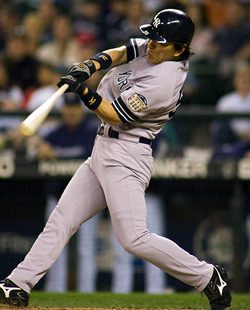 Peter Abraham, live-blogging today’s game, reported that Nick Swisher batted with the bases loaded, was behind in the count 0-2, and came back to work a walk. I got curious as to how often that actually happened in real games, and which Yankees were the best at rescuing a bad situation with patience and selectivity. Working our way around the diamond:
Career walks after down 0-2:
Jorge Posada, 39 in 906 PA (4.3 percent).
Mark Teixeira, 29 in 619 PA (4.7 percent).
Robinson Cano, 7 in 386 PA (1.8 percent).
Alex Rodriguez, 53 in 1597 PA (3.3 percent).
Derek Jeter, 69 in 1442 PA (4.8 percent).
Johnny Damon, 37 in 1445 PA (2.6 percent).
Melky Cabrera, 4 in 269 PA (1.5 percent).
Nick Swisher, 20 in 405 PA (4.9 percent).
Xavier Nady, 10 in 473 PA (2.1 percent).
Hideki Matsui, 24 in 477 PA (5.0 percent).
I don’t know if this tells us much more than that the most patient hitters on the team are able to carry that patience through even the most difficult situations. Before running down the numbers, I had made a little bet with myself that Jeter would be tops in this category, not because he’s the most patient Yankee, but because of how many times I’ve seen him bear down in such situations. My guess was close, but it’s Matsui that takes the prize. Often you hear that clichéd description “professional hitter” applied to players who are no such thing, but what Matsui does, turning lost times at the plate into something positive, is truly deserving of the appellation. Hobbled Godzilla has only hit .220/.262/.342 in his career when down 0-2, but that’s actually a big accomplishment — no-hitter does well when he has only one pitch to work with; last year the American League as a whole batted .185/.217/.274 after an 0-2 count, so Matsui is well ahead of the pack.
I know you’re wondering about Jeter in such situations. He’s been even better than Matsui, batting .230/.283/.340 after 0-2. Hey, you’ve got to do stuff like that to get to the Hall of Fame.
DON’T BURY THE LEAD(OFF HITTER), STEVE!
In this morning’s entry, I wished that Brett Gardner would hit a triple today. Instead, he led off the game with a home run, pulling the second pitch of the game over the right field fence. Your move, Melky. And Kei Igawa pitched well, too, but we’ll pretend that didn’t happen.
TOMKONOMY
According to Mark Feinsand of the New York Daily News, Brett Tomko is in competition with Dan Giese and Alfredo Aceves for a spot as a long man out of the pen. All three of those guys would probably make spot starts as well, should any be necessary. As I suggested this morning, Tomko really has no case to make here, having been roundly pounded every year since 1997, with the exception of 2004. As a starter last year, his ERA was 6.17. He pitched 16 innings as a reliever and slowed 12 runs, including four homers. In 177.1 career innings out of the pen his ERA is 4.92.
The best choice here might actually be Giese. Aceves seems like a very interesting starter, and I’m all for the Yankees embracing what little youth they chose to bring to camp, but I worry about his low strikeout rate and high home run rate in a bullpen role. He may simply be unsuited. It won’t hurt the Yankees to try, of course. Giese didn’t pitch that much between injuries, but was more or less effective when he did, particularly before his post-injury appearances in September. He got hammered in five innings that last month (we should watch out for any carryover to this spring), but to that point his ERA was 2.58 in 38.1 innings. Giese seems to be comfortable in the swingman role, and as a 31-year-old rookie last year is no doubt just happy to be in the majors.
All of that said, we’re talking about the last man on the staff. Given the quality of the Yankees rotation and their other bullpen options, this should be the last important decision Joe Girardi makes. Last year Giese generally relieved in low-leverage situations, and it seems unlikely that Girardi would have to call on him, or Brett Tomko, to protect too many leads. Still, if healthy, the guy knows how to pitch and deserves to have something of an inside track given his incumbency. Tomko does not know how to pitch, or if he does hasn’t translated that into consistent big league success — if he had, he wouldn’t be pitching for the last spot on the Yankees, he’d be in someone’s rotation.
Brett Tomko? Why?
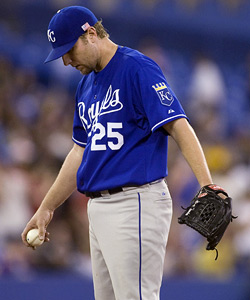 I’ve been meaning to comment on the signing of Brett Tomko, and since he’s starting Wednesday’s game against the Blue Jays, now seems like a good time to do so. Tomko was signed to a Minor League deal back on February 13. The right-hander, who will turn 36 on April 7, is … there’s no good way to say this … terrible. His career ERA is 4.68 despite extensive work in friendly parks like San Francisco, Los Angeles and San Diego. Since his last good ERA in 2004 — it was only the second time in his career he’d posted an ERA below league average — he’s gone 22-41 with a 5.07 ERA in 504.1 innings. Starting, relieving, selling peanuts, it hasn’t mattered, he’s been pounded. The only good thing he’s had going on in that time is a slightly above-average walk rate.
Pitchers are variable, and you never know when you might squeeze some unexpected juice out of one that seemed an irredeemable failure. The possibility seems quite remote in this case, and if Tomko wears a Yankees uniform anywhere but Scranton this year something will have gone quite wrong. The Yankees are trying to save their starters from the longer grind of an extended spring season this year, that’s understood, but starting Tomko and then following him with Kei Igawa in the same game seems like cruel and unusual punishment to Yankees fans.
? It’s quite a drag that Frankie Cervelli is heading out of camp to play in the WBC. Due to last spring’s injury, he hardly played last year, and to date has had only a few at-bats above High-A ball. As well as Jorge Posada seems to be doing with his throwing program, the Yankees really need to have a solid alternative to Jose Molina on hand in case the Iron Jorge breaks down (Kevin Cash ain’t it). The best thing that Cervelli can do for both the Yankees and his own career is to stay around, let the coaching staff see a lot of him, and do what he can to improve his batting stroke, because right now there is very little indication that he can hit in the big leagues. But there are hints in his performance and smatterings of patience and doubles power that hint (at least to me) that there is something alive in Cervelli that could blossom if only nurtured the right way. The WBC is probably not the way to do it.
? With all due respect to my friend Rob Neyer, now that the A’s are out of the Fremont business, they shouldn’t move to Portland, they should move to Central New Jersey. Sure, there are territorial issues with the Mets and Yankees, but it’s a big market and there’s room for all. Imagine the rivalry … imagine the traffic. I haven’t done a demographic comp with Portland, but I bet Jersey’s population density and general affluence wins. Also, thanks to the large Indian population in that part of the state, we’d have the only ballclub to serve samosas. I can hear the cry of the vendor now… “Nan! Hot nan! Getcher nan bread and samosas here!” I could go for some of that now, if only it weren’t 3 AM, and even if it is.
? The reminder: Baseball Prospectus writers Kevin Goldstein, Christina Kahrl, Cliff Corcoran, and I will be at the Yogi Berra Museum Sunday at 2 p.m. for our annual roundtable. Come, ask questions, get answers, and admire the sheer Yogi-ness of the edifice.
I’ll be back with an update after the Yankees break the ice on the spring season. Let’s hope Nick Swisher hits two home runs and Brett Gardner hits a triple and makes a running catch. The outcome of the season may depend on these two players having a better spring than their competitors.
Johnson battling for much more than a roster spot
 ONE MORE CYCLOPS
On Sunday, it was reported that Yankees camp attendee Jason Johnson had been treated for ocular cancer. This information may not have seemed of much significance to most of you, because Johnson is a 35-year-old non-roster invitee with a career major league ERA of 4.99, but it caught my eye–my one functioning eye–because I am a survivor of the same disease. We underwent the same treatment at the same hospital with the same doctors.
Like me, Johnson really shouldn’t have this disease. Statistically, ocular melanoma doesn’t strike anyone with regularity, just five or six cases per million people are afflicted each year, and then it seems to go for blue-eyed guys over 50 years of age. I was about 32, and brown-eyed. I don’t know what color Johnson’s eyes are, but he’s obviously a bit young. Further, ocular cancer doesn’t correspond to your diet, how much sun you get, whether you’ve been smoking asbestos or some other controlled substance in your college dorm room, or overly personal relations with your cat. It just happens.
The process is much like skin cancer: the inside of your eye can develop freckles or moles, just like your skin. Sometimes, those freckles or moles turn evil and will kill you if left alone for too long. If you see a mole on the back of your hand start to change shape or color, it’s a simple matter to head for the dermatologist’s office and have it lopped off and biopsied. If you get to it early, that’s usually the end of it–if the doctor gets clean borders when he removed the thing, that particular threat is gone for good. This same process happens in the eye, but you can’t see it, and the process is otherwise asymptomatic–by the time the cancer gets big enough to start messing with your vision, you could be in real trouble. My tumor was considered to be of medium size–it was only 8 millimeters thick. That’s nothing in the real world, but in the eye it’s a big object, and I had no idea it was there.
I caught mine because my eye doctor made a lucky find while looking for something else. Johnson’s doctor caught his under similar circumstances, while working him up for a new set of contact lenses. We’re both very, very lucky. If you catch the tumor while it’s still contained to the eye, your prognosis is much better than if it’s started to climb out of there. That said, even if the disease is contained to the eye, you’re still in trouble, because first, it has to be cured, and second, the longer it was in your body, the more likely it is that it sent off a colony somewhere. Melanoma is a capricious disease–those cells can hide for years or even decades before coming back to kill you, most likely by invading your liver or your lungs. There is no safe harbor–with some cancers, if you’re free of the disease for five years, you can consider yourself cured. With melanoma, you’ll be going for scans of those two body parts for the rest of your life. I do this every six months.
The good news about ocular melanoma is that it generally responds to being irradiated; not too long ago, the “cure” was enucleation, the removal of the eye. You get to keep it now, for what it’s worth. Johnson and I underwent the same procedure. You’re knocked out, the eye is squished aside, and a radioactive plaque is affixed to the tumor site. You then get to stay in-hospital for as many days as the plaque is affixed–you can’t go home because you’re a danger to others. In my case, the tumor reacted the way it should, shrinking rapidly, and sometime later the doctors baked what was left with a laser, just to make sure it was dead, dead, dead. After these procedures, it is very rare that the cancer recurs at the original site. It’s the colonies you have to be afraid of.
In my case, over time the radiation also took the sight in the afflicted eye. I won’t go into five years of medical treatment trying to save my vision, but in essence, the radiation that wasn’t good for the tumor isn’t good for the healthy parts of your eye either. I can’t speculate on Johnson’s outcome because I don’t know where in the eye his tumor was located. Mine was right near the optic nerve, which means that some important hardware got baked along with the cancer. His might have been off to the side somewhere, and perhaps he’ll have fewer complications than I have had, and he’ll get to retain his vision, or some portion of it, for longer than I did. One would hope that he will retain good vision throughout the remainder of his professional baseball career, as a pitcher who was not able to fully gauge the ball coming off the bat would be a sitting duck and just one bad read away from having his head blown off by a line drive.
I feel ungrateful complaining about my partial blindness. It beats being dead, after all, and that’s pretty much the choice I was offered. You’d trade one eye for the rest of your life any day of the week. Still, there’s rarely a day that goes by that I do not notice it in some way, am not inconvenienced by it. There have been some promising things reported about someday using stem cells to revive the optic nerve. I eagerly await the day such miracles are possible. In the meantime, I regret that I get to welcome Jason Johnson to the club, congratulate him on having his tumor discovered in time for treatment, and wish him many future years of healthy living and successful pitching.
Finally, I hope my story, and Johnson’s, encourages the rest of you to go out and get your eyes checked on a regular basis–not by your mall optometrist, but by a real ophthalmologist. This disease can blind you and it can kill you. Twice a year I head to the Wills Eye hospital in Philadelphia for follow-up examination. There’s some physical discomfort involved, but there’s a whole additional level of pain that results from those who often share the waiting room with me–children. I guess Johnson and I aren’t the only ones for whom eye cancer stepped aside of its preferred group to clutch at. This is, as they say, a word to the wise.
Speaking of Johnson yesterday, Joe Girardi said, “I had never heard of anyone having that.” Very few people have heard of ocular cancer, and most people react with shock and surprise when I first tell them about it. Now you know, so no excuses–keep up those eye exams, and tell them the Pinstriped Bible sent you.
 Pinstriped Bible