Category: Dailies
Landing Big Tex a big win for Yanks
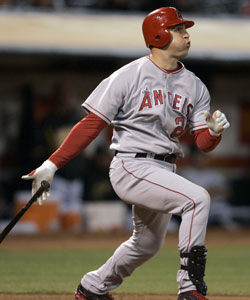 TEIXEIRA!
In the 2004-2005 offseason, the top free agent on the market was Carlos Beltran, the switch-hitting, slugging center fielder. It happened that the Yankees had a need in center field, as Bernie Williams, 35, had just completed his second subpar season in a row, and his defense had long since passed the point of no return. Beltran reportedly had a great deal of interest in playing for the Yankees, but for reasons that were unclear then and remain unclear, the Yankees passed. That meant not only leaving Williams in center for another year, but it also meant that when Williams finally had to be wedged out of center field, they had to go to the best available player, which meant Johnny Damon. Damon has had two good years in three for the Yankees, but he is not the player that Beltran is, is far older, and soon proved that he was no longer a center fielder.
It is no exaggeration to say that the Yankees’ decision to pass on Beltran so as to use their monetary advantages that winter primarily on pitching help–which came in the dubious forms of Carl Pavano and Jaret Wright, plus the aged but still viable (and cranky) Randy Johnson–has played a key part in their failure to win a title in the years since. Had the Yankees passed on Mark Teixeira, a player who perfectly suited (as was suggested here in this space on Monday) three of their needs simultaneously, age,offense, and defense, they would have repeated the same error.
They did not. All credit to Brian Cashman and the Steinbrenner family, to the former for playing it cool and then making his move, to the latter for opening their wallets and spending big–and to all three for not just spending, Wright- and Pavano-style, but for spending it on the right player, maybe the “rightest” player that they’ve acquired since Alex Rodriguez. If only they don’t try to move Teixeira to another position so a defensively inferior player can play first. Nah, that would never happen.
There is one point in the above worth repeating: all the dollars that accrue to sport’s wealthiest organization mean nothing if they are not spent wisely. Too often, the Yankees have settled for something other than the choicest cuts of meat. This time, it’s filet mignon all the way.
The Yankees are not perfect. The defense is still poor. The outfield defense could be very shaky depending on the alignment the Yankees pursue. They could choose to let a meaningless spring training battle decide center field instead of letting the evidence of a full major league season inform their choices. They could give Xavier Nady more playing time in right field than Nick Swisher. Derek Jeter is losing range even as we speak. Jorge Posada may or may not be able to throw–
–And that reminds me to revisit another point, as a major metropolitan newspaper published a column castigating the Yankees for closing off first base to Hideki Matsui, Johnny Damon, and Jorge Posada. Here we go:
This year, major league first basemen hit .272 /.353/.464.
Two years ago, they hit .276/.357/.463.
Three years ago, they hit .285/.363/.488.
Over the last five years, they hit .275/.355/.468.
Over the last ten years, they hit .276/.359/.472.
No doubt you’re starting to get the picture. Now, this is the average. If a team is getting these rates from its first baseman, it’s breaking even in comparison with the league. You could have Albert Pujols and do a lot better. You could have Doug Mientkiewicz and do a lot worse. Heck, your manager could give Miguel Cairo the odd start at first base. Some of these first baseman, like Albert Pujols and New Yankee Teixeira, not only hit but can field the position. While the standards are set where they are, there is no plausible reason that the Yankees should pass on a 29-year-old MVP-level player so they can reserve first base for aging former stars who will struggle to meet even the average level of production for the position and will almost certainly not be defensive assets. That is a formula for losing. And, oh yeah, the contracts of both Damon and Matsui are up at the end of the season. Unless the Yankees are as misguided a year from now as they were intelligent in signing Teixeira, what to do with those players at age 36 and up will be some other club’s problem.
Thus endeth the lecture. For now, suffice it to say that the Yankees have given their fans a great early Christmas present. More importantly, they’ve done the right thing competitively. Before the Red Sox became the favorites in the bidding, Teixeira was a move the Yankees should have made. Once the Red Sox became involved, it was a move they had to make, lest their rivals to the North unveil their own version of Murderer’s Row. As I said above, it was the right-est move the Yankees have made in years.
And with that, I wish you a happy and healthy holiday, whatever holiday is your holiday of choice. Enjoy it, and when you sit down to dinner with your family, don’t forget to scratch out Teixeira-ified batting orders into the mashed potatoes.
Teixeira worth the money now, and later
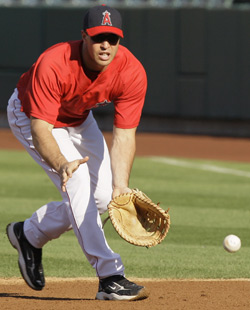 SPRUNG FROM THE BUNKER WITH A BIG FACE
I couldn’t let Friday end with that face at the top of the screen. It’s like a cellulite eclipse. Let’s tear through a few items before breaking for the weekend. Someone write in and remind me to take a break from editing the Baseball Prospectus annual (Pre-order now! I don’t get anything if you do! Not a dime! But you should.) to spend an hour on the treadmill. They’re going to let me go back in the Dot-com Bunker on the next show, Jan. 8, 2009. This time I might sneak onto the main set when no one is looking, just to see what it feels like to sit in one of those comfy chairs the New York Times guys get. I can dream, and yet the positive to not being in the plush chairs is that they don’t issue rations when you’re in the Bunker, so weight loss is pretty much inevitable. I skipped lunch yesterday, and after about two hours in my cell I was getting pretty low. It’s hard to answer questions about CC Sabathia when you’re thinking, “I wonder if Bob Lorenz would be good with barbecue sauce?” Did you see how they cut to me before my second segment? Next time, instead of working at my computer, you might see me opening up a pizza delivery box.
No, no, no. No pizza. Treadmill, Steve. Treadmill.
In yesterday’s Hot Stove show thread there was something of a debate on the subject of Mark Teixeira vs. Manny Ramirez. To me, the most interesting thing about said debate is not the players involved but the apparently universal sense that the Yankees need to bolster the offense. The sense that they need to improve the defense as well is not universal, or no one would be arguing for Manny. The correct answer, though, is “both,” especially if the Yankees want to fully exploit the Scrooge McDuck money they just put into arms. Think of it this way: Teixeira, as a Gold Glove defender at first base and a top hitter, is all positive. He’s not only adding runs above average on offense, he’s taking them away from the bad guys when in the field. Say Teixeira is worth 50 runs over the average player with the bat, and 10 runs above average with the glove, so you could say that his total contribution to the winning effort is 60 runs.
With Ramirez, the math is different. As Rob Neyer wrote this week, under normal conditions he’s such an egregiously indifferent outfielder that most metrics see him as being worth about 20 runs below average. Those runs have to be held against his offensive totals, such that if Ramirez is worth about 60 runs over the average player with the bat, after fielding is considered, he’s really only a 40-run advantage — or less than Teixeira. Another way of looking at it is to say that Teixeira adds about five wins over the average player with his bat, then gives his team another with the glove. Ramirez gives his team six wins with the bat, but also contributes two losses with the leather.
We haven’t even talked about the elephant in the room with Manny, which is, “If he’s paid, will he give a damn?” but we don’t have to, because there’s another consideration, which is that if he’s signed to a three-year deal, his team is buying his age-37, 38 and 39 season. Hall-of-Fame hitter or not, this is a dangerous thing to do. Ramirez’s fielding is already a problem. If he loses a half a step, he’s not just going to be damaging in the field, he’s going to be a visible joke. Sure, he could DH, but the age is still an issue — at some point age is going to set in, and while we don’t know if it will happen during those three years, there’s a good chance that it will. In contrast, the team that buys eight years of Teixeira will get him from age 29 through 36. His contract will end where Ramirez’s begins. That consideration alone should swing the discussion toward Teixeira.
What we still don’t know is the Yankees’ position on all of this. They’ve signed two starters, supposedly don’t want to go crazy with their budget, and yet are rumored to be looking at still one more free-agent pitcher. This last point would almost certainly be overkill. Few teams go five deep in quality starters in their rotation, and the Yankees have sufficient alternatives in, at the very least, Phil Hughes, winter ball-reborn Ian Kennedy, and Alfredo Aceves, that if one falters they can move to Plan B without too much trouble. Foregoing Andy Pettitte at No. 5 would probably be worth half a Teixeira. Establishing Hughes, Kennedy, or Aceves in the rotation would mean a couple of seasons of pre-arbitration, pre-free-agent salaries at that roster position, along with the possibility of buying that now-established player out of their arbitration/free-agent years, such that their costs are controlled for years. This beats going back to the free-agent market for next year’s A.J. Burnett. Plus, you get to save the offense and the defense. To put it another way, send $22.5 million a year on Teixeira now, save $10 million on Pettitte this year, save $17 million on Burnett II next year, and the year after that, and for however long the team controls the young pitcher it puts into the fifth spot in 2009. At that point, Teixeira starts to look darned cheap — $12.5 million for him, plus the $10 million you would have wasted on an old pitcher anyway.
Stay safe and warm this snowy weekend. The Pinstriped Bible rides again on Monday or with breaking news, whichever comes first.
Ten things that are spectacularly annoying to the fat, bearded Pinstriped Bible guy right now
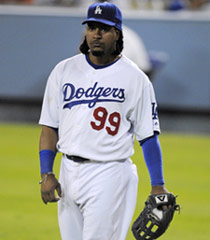 10. Sports radio talk show hosts and callers that endorse $100 million over four years for Manny Ramirez, but not $200 million over eight years for Mark Teixeira.
9. People who can never admit when they’re wrong, even on the brink of disaster. That is, grown-up infants.
8. Those same Manny Ramirez advocates who insist that the Yankees cannot sign Teixeira because they must keep first base open for a superannuated Jorge Posada, as if there’s some equivalence there, as if an elderly Posada would hit and field like a first baseman, any first baseman, in the prime of his career.
7. My complete inability to get a contractor to commit to redoing my front walk. How do these guys make money when they never, ever show up? I’ve had four separate guys give estimates, then disappear.
6. The realistic possibility that the Yankees will have no young players in the lineup or starting rotation to start the season. In the long term this is a recipe for disaster.
5. The guy in this very crowded train who either just expired of a digestive meltdown or is consuming rancid sauerkraut. Also, the woman who, prior to the radioactive cabbage incident, perfumed herself in this same car. You’d think this was a German attack at the Somme. Ladies: spraying your perfume around in enclosed public spaces is just selfish and cruel. A rose by any other name would smell just as rank if its odor had been forced on you.
4. The Baltimore Orioles. The most competitive division in baseball could be one-fifth more exciting with a real team in Maryland. Exception: their automatic Rookie of the Year catcher.
3. So-called collaborators who leave you holding the bag. Also, the Carolina parakeet. You never see them around anymore.
2. The extremely lethargic way the winter market is proceeding. At this pace, half the teams in baseball will be unsettled on the eve of spring training.
1. Tie: Mark Teixeira on the Red Sox/It’s always about you, isn’t it?
HOT STOVE SHOW OPEN THREAD
Your thoughts here, because I want to know. Also, I might have trouble thinking for myself. You wouldn’t want me to freeze up on cable, would you? Bob Lorenz might yell at me. Also, any number of ex-girlfriends might be watching, and if I can’t appear handsome and prosperous, with your help I might at least seem intelligent. I’ll be checking in during the middle segment of the show, when they keep me locked in the closet.
Talent abound in the AL East
 WHEN LAST WE LEFT OUR HEROES …
… We were in the midst of our subjective position-by-position ranking of the teams in the American League East, with the intention of trying to discern, however unscientifically, how these teams rank in terms of talent. We’re using a simple scoring system: if a team’s player ranks first out of five at a position it receives five points. If it ranks fourth, it receives four points, and on down the line. Having reviewed all the fielding positions (scroll down, pilgrims), the score was Red Sox 31, Yankees 26, Rays 25, Orioles 21, Blue Jays 17 with designated hitter and the pitching staffs yet to go.
Designated Hitter:
1. Red Sox: David Ortiz
2. Yankees: Hideki Matsui
3. Orioles: Aubrey Huff
4. Blue Jays: Travis Snider
5. Rays: Free parking
As with many of these entries, there is a great deal of conjecture here. Will Ortiz be completely healthy? He wasn’t half bad when he was hurting. Will Hideki Matsui’s knee problems be a thing of the past? Will Huff revert to his previously mild levels of production for a DH? How will 21-year-old Snider hit over a full season? Who is the Rays’ DH? The correct signing could jump the Rays up to second place or third place on this list. For now, THE SCORE: Red Sox 36, Yankees 30, Rays 26, Orioles 24, Jays 19.
No. 1 Starter:
1. Yankees: CC Sabathia
2. Blue Jays: Roy Halladay
3. Red Sox: Jon Lester
4. Rays: James Shields
5. Orioles: Jeremy Guthrie
You want to take Halladay over Sabathia, I won’t argue with you. THE SCORE: Red Sox 39, Yankees 35, Rays 28, Orioles 25, Jays 23.
No. 2 Starter:
1. Rays: Scott Kazmir
2. Yankees: Joba Chamberlain
3. Red Sox: Josh Beckett
4. Blue Jays: Dustin McGowan?
5. Orioles: Garrett Olson?
These numbered starter designations are somewhat arbitrary, so if you want to debate who should be sorted where that’s fine. Kazmir rates over Chamberlain on the basis of greater experience; Chamberlain rates over Beckett because of the latter’s health problems this season. Speaking of health problems, it’s not quite clear when McGowan will be back from surgery to repair a frayed labrum. Between injuries (Shaun Marcum is likely out for the season) and the free-agent defection of A.J. Burnett, the Jays have really had a hole blown in their starting rotation. As for the Orioles, their rotation is scary anonymous — and likely scary bad.
THE SCORE: Red Sox 42, Yankees 39, Rays 33, Orioles 26, Blue Jays 25.
No. 3 Starter:
1. Red Sox: Daisuke Matsuzaka
2. Yankees: Burnett
3. Rays: Matt Garza
4. Blue Jays: Jesse Litsch
5. Orioles: Chris Waters
The wild card here is Burnett’s health, Matsuzaka’s ability to dance between walks for another year, and if Garza can take the wonderful things he did to the Red Sox in the ALCS into the regular season.
THE SCORE: Red Sox 47, Yankees 43, Rays 36, Blue Jays 27, Orioles 26.
No. 4 Starter:
1. Yankees: Chien-Ming Wang
2. Rays: Andy Sonnanstine
3. Blue Jays: David Purcey
4. Red Sox: Tim Wakefield
5. Orioles: Radhames Liz
I’m going on feel here. It’s all guesswork at this point, except that Wang should trump the lot if he stays healthy — although David Price could be listed here, and perhaps he blows everyone else away. Liz could turn out to be the best Orioles pitcher, or the worst. He certainly has the potential to be good, but the Orioles aren’t very good at tapping potential. Sending an unrefined pitcher to the O’s is like hiring a porpoise to sniff out truffles.
THE SCORE: Red Sox 49, Yankees 48, Rays 40, Blue Jays 30, Orioles 27.
No. 5 Starter:
1. Yankees: Right now it’s probably Phil Hughes, but they could sign anyone.
2. Rays: Price, barring a Spring Training breakdown.
3. Red Sox: Clay Buchholz likely gets first dibs.
4. Blue Jays: I don’t think they know, either.
5. Orioles: Just what do you want from me, already?
Three pitchers with great potential, two unknowns. I think they call that a full house. The top three could shake out in any order, particularly if Hughes is secretly Derek Lowe or Lefty Grove, Price proves to be Wade Davis or Jeff Niemann or someone like that … Or if Buchholz turns back into Charlie Zink.
THE SCORE: Yankees 53, Red Sox 52, Rays 44, Jays 32, Orioles 28.
Closer:
1. Yankees: Mariano Rivera
2. Red Sox: Jonathan Papelbon
3. Blue Jays: B.J. Ryan
4. Rays: Troy Percival
5. Orioles: George Sherrill
No shame in being third in this group. I’m not going to score middle relief because it’s far too volatile, but if I had to rank them right now, I would pick the Yankees, Blue Jays and Rays in some order ahead of the Red Sox and Orioles. That makes our FINAL SCORE: Yankees 58, Red Sox 56, Rays 46, Jays 35, Orioles 29.
So, there you have it. One version of the talent spread among the teams of the AL East. By switching just a few assumptions, you could easily flip the Red Sox over the Yankees, or bring the Rays a lot closer. There are so many moves yet to happen the whole thing could change … except the Orioles being last. That’s set in stone.
TV TIME AGAIN
I’ll again be chatting from the cyber-closet with Bob and the gang on the YES Hot Stove show, 6:30 p.m. EST on Thursday. Once again, I’ll be looking for your input, so feel free to comment here or in our pre-show thread, which we’ll open up tomorrow. I hope you will tune in.
Anything you can do…
 WHO’S BETTER, WHO’S BEST?
As promised in yesterday’s entry, an “if-the-season-started-today” roster comparison of the five teams in the American League East. The goal: to see if the Yankees’ several moves thus far have tipped the balance of talent towards the Bronx. The method: a subjective one, but I will justify my rankings. The scoring is simple: The team whose player ranks first among the five teams receives five points. Having the second-best player is worth four points, and so on. The team with the most points wins.
FIRST BASE
1. Red Sox: Kevin Youkilis
2. Rays: Carlos Pena
3. Yankees: Nick Swisher
4. Blue Jays: Lyle Overbay
5. Orioles: The Great Pumpkin
The Red Sox could put Mark Teixeira here and the rankings would be the same, though the gap between one and two would simply grow larger. The high upside on a Swisher rebound is probably in the neighborhood of .270/.380/.490. That would be very good indeed, but not quite at the level of Youkilis/Teixeira or Pena, the halfway point of whose last two seasons is .264/.394/.560. Overbay hasn’t hit at an appropriate level for a first baseman in two seasons. We don’t know who the Orioles first baseman is going to be. Last season’s placeholder, Kevin Millar, is a free agent, and their pursuit of Teixeira seems unlikely to pay off. They could play DH Aubrey Huff here, which would vault them to fourth, or even third if Huff has another 2008 in him.
SCORE: Red Sox 5, Rays 4, Yankees 3, Jays 2, Orioles 1.
SECOND BASE
1. Red Sox: Dustin Pedroia
2. Orioles: Brian Roberts
3. Yankees: Robinson Cano
4. Blue Jays: Aaron Hill
5. Rays: Akinori Iwamura
As with the placement of Swisher above, this ranking is dependent on a rebound–which Cano should do. The laws of physics almost demand it. The problem is that the two guys ahead of him on this list will probably get on base more often even if he does. The placement of Hill is based on his age and where he seemed to be heading after 2007, a concussion having wiped out the majority of his 2008 season. Iwamura is good for a little offense and a little defense, but not enough of either.
SCORE: Red Sox 10, Yankees 6, Rays 5, Orioles 5, Jays 4.
THIRD BASE
1. Yankees: Alex Rodriguez
2. Rays: Evan Longoria
3. Red Sox: Mike Lowell
4. Blue Jays: Scott Rolen
5. Orioles: Melvin Mora
What a strong group. Even consistency from A-Rod should keep him on top. The ranking of Longoria is speculative based on a full season and a mild improvement. If the Sox sign Teixeira and push Youkilis here, the ranking probably wouldn’t change–the thought here is that Youkilis backslides just slightly. Put Lowell, Rolen, and Mora in a bag and shake ’em up. Mora was actually better than Rolen this year, but Mora is unlikely to have another season like that in him at 37.
SCORE: Red Sox 13, Yankees 11, Rays 9, Orioles 6, Blue Jays 6.
SHORTSTOP
1. Yankees: Derek Jeter
2. Red Sox: Jed Lowrie
3. Rays: Jason Bartlett
4. Orioles: Cesar Izturis
5. Blue Jays: John McDonald
As weak a field after Jeter as the third base collection was strong. Jeter played hurt last year, declined, or both, but he’d have to fall a long way to sink past the glove-men here. The jury is still out on Lowrie, who isn’t a great glove and showed quite few holes in his rookie year, including Fenway-dependent hitting, an aversion to right-handed pitching, and an inability to adjust in September, when pitchers struck him out in about 30 percent of his at bats. The alternative is Julio Lugo, who seems to have come to the end of his abilities. Bartlett saved his season with a strong second half. The other two guys make Rabbit Maranville look like Babe Ruth.
SCORE: Red Sox 17, Yankees 16, Rays 12, Orioles 8, Blue Jays 7.
LEFT FIELD
1. Red Sox: Jason Bay
2. Rays: Carl Crawford
3. Yankees: Johnny Damon
4. Blue Jays: Adam Lind
5. Orioles: Luke Scott/Ryan Freel
The only thing I’m sure about here is that Bay belongs on top. I have the sense that Carl Crawford has a better year in him after hamstring and hand injuries wrecked his season. I feel strongly that Johnny Damon is going to give something back this season. Lind could finally hit like his minor league numbers suggest he should (.318/.379/.509 in the sticks) and if he doesn’t, the Jays could put Travis Snider in his place and get good production. Luke Scott is a good platoon guy and could pop enough home runs to move up a couple of spots.
SCORE: Red Sox 22, Yankees 19, Rays 16, Orioles 9, Blue Jays 9.
CENTER FIELD
1. Rays: B.J. Upton
2. Blue Jays: Vernon Wells
3. Red Sox: Jacoby Ellsbury
4. Orioles: Adam Jones
5. Yankees: Fred C. Dobbs, Duke Mantee, or Philip Francis Queeg
Among the wild cards here: Jones and if he adds power, as is expected; Ellsbury’s ability to hold on to the progress he made at the end of the season; Upton’s health and if the super-powerful version of him that showed up in the playoffs will reappear in April; and, of course, just who will play center for the Yankees. Mike Cameron would not change this ranking and could conceivably increase the gap between fourth and fifth place.
SCORE: Red Sox 25, Rays 21, Yankees 20, Jays 13, Orioles 11.
RIGHT FIELD
1. Orioles: Nick Markakis
2. Red Sox: J.D. Drew
3. Blue Jays: Alexis Rios
4. Yankees: Xavier Nady
5. Rays: Matt Joyce
I suspect this ranking will lead to some argument. Drew is the best all-around hitter here, but you never know if he’ll be in the lineup. Somehow Markakis has yet to make an All-Star team. He will this year. He’s just 25, has improved each season of his career, and is the best all-around player in the group. Rios does a lot of things well without quite reaching the level of production you expect from a right fielder. Joyce is unproven, but he’s a strong glove who should give the Rays some pop from the left side. An unorthodox platoon pairing with switch-hitters Fernando Perez or Ben Zobrist could be reasonably productive and defensively sound. That leaves Nady, who will almost certainly return to his career rates of performance next season. That makes him fourth in this group, fifth if Joyce hits and fields as expected.
SCORE: Red Sox 29, Rays 22, Yankees 22, Orioles 16, Jays 16.
CATCHER
Orioles: Matt Wieters
Yankees: Jorge Posada
Rays: Dioner Navarro
Red Sox: Batman
Blue Jays: Rod Barajas
Some rankings on faith here. Wieters is perhaps the best prospect in baseball, and is presumed to have the Orioles job (Ramon Hernandez was traded for Ryan Freel in anticipation of Wieters’ arrival). Bat-wise, he looks like Mike Piazza II. If Posada can catch regularly and hit anything like old school Jorge, the Yankees will be in very good shape. If not, they’re off-the-charts hopeless, as they were this year. Navarro is an average-driven hitter who holds his own. Boston’s catcher, is, of course, fictional, but we don’t know if Theo Epstein will break down and bring back Jason Varitek, make a deal with the Rangers for one of their extra backstops, or pursue some other option that isn’t yet apparent. It takes some faith to rank a complete unknown ahead of Rod Barajas, but I’m certain that whichever catcher the Red Sox ultimately acquire he will be capable of at least a .300 on-base percentage.
SCORE: Red Sox 31, Yankees 26, Rays 25, Orioles 21, Jays 17.
We will continue in our next entry with designated hitter, starting pitching, closers, and middle relief.
MORE FROM ME…
…As always, at Wholesome Reading, to be updated with Internal Improvements III this evening.
Still in the hunt for Big Tex?
IDLE MUSINGS FOR A
SLOW NEWS DAY
The A.J. Burnett signing continues to be controversial. My
pal Rob
Neyer summed it up as “Too many dollars, too many years.” If reports
that the Yankees are still in on Mark Teixeira prove to be something more than
the usual hot air to bid up the real buyers, I’ll be willing to chalk the whole
thing up to the team placing a bet on the roulette wheel with money which,
after all, they are free to gamble with as they wish. If, on the other hand,
this expense is used to justify the fielding of a degraded offense, it will be
much harder to swallow.
In regards to that offense, Neyer notes, “Yankee Stadium is
(or rather, was) a pitcher’s park. Considering only road games, the Yankees
finished third in the American League in OPS last year. Maybe that doesn’t
qualify as ‘excellent,’ but it’s certainly somewhere between ‘good’ and ‘excellent.’
Granted, everybody’s a year older and we might expect a slight decline next
year. So yes, the Yankees should try to improve their offense … and I’m not at
all convinced they can’t still afford to do exactly that. Has Brian Cashman
suggested that he’s finished spending money? If he has, I missed it.” Taking
the last thing first, Cashman didn’t say he was done, but almost every writer
on the beat seems to have come to the conclusion that the Yankees are out on
the major position players. Sure, they could be wrong, things could change, but
one assumes (perhaps incorrectly) that their conclusions are actually sourced.
Yeah, I know. I’m naïve. As for last year’s offense, with Jason Giambi and
Bobby Abreu deleted, it’s not next year’s offense, and comparisons don’t really
apply.
One other thought about the various Yankees moves thus far
this winter, one that seems to have occurred to many others around the hot
stove: if the Yankees stop now, have they done enough to pass the Rays and the
Red Sox? It’s a difficult question to answer because those teams aren’t done
either, but we’ll try in tomorrow’s Pinstriped Bible.
I love Jamie Moyer’s new two-year contract with the
Phillies, if only because I’d like to see him follow through on his expressed
wish (threat?) to pitch through age 50. As long as Moyer is still pitching, I
am not old. I am less sanguine on the champs’ signing of Chan-Ho
Park, a pitcher who has been around
for 15 years and has never pitched well outside of Los Angeles. His Dodgers career ERA is 3.77
in 275 games. In 103 games with three other teams, it’s 5.63. Career ERA at
Dodger Stadium, 2.96. Everywhere else: 5.16. As for new general manager Ruben
Amaro, Jr.’s decision to buy Raul Ibanez for three years and $30 million, it is
daft. As well as Ibanez has hit in his second stint as a Mariner
(.291/.354/.477), that’s in good-not-great territory, he’s a defensive
liability, and they’ve just bought themselves ages 37 through 39, not usually a
player’s best years. Adam Dunn is a defensive liability too, but he’s more
productive and, at 29, will remain that way for longer. Hell, they could have
gone in on Teixeira and then traded the fun but limited Ryan Howard. You can
see where the Phils might not want to replace a high-strikeout hitter like Pat
Burrell with another high strikeout hitter, but just because the ideal
candidate isn’t available isn’t an excuse to sign a bad one.
JUST A REMINDER ABOUT
THE COMMENTS
I’m reading ’em, so keep ’em coming. I’ll be bringing some
of them up on the air later this week.
MORE FROM ME
After a slow week of being imprisoned on the BP annual (not
that I’ve been paroled), I’m back at work at Wholesome Reading, including the first two
parts of a planned multi-part series on Public Works. Baseball or government,
infrastructure strategy excites me. As always, Warning! Politics!
Is Mike Cameron a good fit for pinstripes?
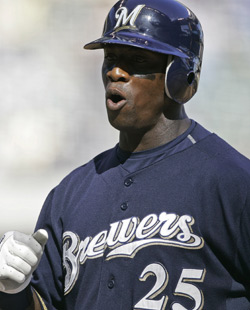 MIKE CAMERON REVISITED
A quick reprise of some words on Mike Cameron from October 23:
Cameron is a low-average hitter with decent selectivity, some power, and a great many strikeouts. He continues to be a good fit in center, if no longer the Gold Glover he used to be. As always, the question with any player of his vintage is, “How long will he be able to stay at his present level?” which in this case would be something like .250/.325/.440. Once again, we must offer this caveat: those numbers are distinctly in the Eh Zone (adjacent to the Twilight Zone, though Rod Serling only went there for later episodes of “Night Gallery”), but the Eh Zone is an upgrade on the Melky Zone, or, as George Harrison once sang, the Sour Melk Sea. “Better” is not the same as “good.”
Cameron’s last two seasons, the most recent of which included a suspension for failing a banned stimulant test, were intriguingly consistent. Here he is against left-handers in 2007 and 2008:
2007: .294/.404/.510
2008: .282/.397/.555
You’re thinking, “Gee whiz, Fonz! That’s pretty good,” right? Let’s move on to the rates against right-handers.
2007: .222/.316/.413
2008: .231/.309/.452
Hrm. Not so good … Everything about Cameron shouts, “Beware! Player in decline!”
A couple of weeks later, I noted:
In a bad luck year, or a year in which age takes hold, Cameron could very easily slide to a below-.300 OBP. And suddenly, having gotten rid of Melky, you’re dealing with his OBP again.
My conclusion in October:
Everything about Cameron shouts, “Beware! Player in decline!” He had a difficult time getting more than a one-year deal last winter. If the Yankees blow him away with two years, they’re going to get burned, if not in year one than definitely in year two, though year one has the distinct odor of possible bust as well.
I would argue that if Brett Gardner hits as he did during his second stint with the Yankees (August 15 on), .294/.333/.412 with eight steals in nine attempts, the Yankees will be in good shape next year given the defensive bonus they should also reap from his range. If Gardner hits only as well as he did in September, .283/.321/.377, they will basically be getting what they got from Melky in his good days, plus speed. It’s not great, but you can live with it given good defense and the thought that Gardner will build with experience and reach greater heights further on, say, .295/.390/.410. Remember, Gardner is a more selective hitter than he showed in the majors this year, and these .320, .330 on-base percentages are a little low.
What the Yankees seem to be missing here is that if they upgrade in right field, they can worry less about bringing in someone expensive to play center. An outfielder-DH in the Adam Dunn mode, combined with reasonable performance from Gardner, would do far more for the team than Cameron plus an Abreu return, or Cameron plus Nady. You can make book right now on a Damon-Cameron-Nady outfield being both defensively bland and offensively subpar. This is a formula for another year of mediocre offense and thousands of words wasted on why the Yankees aren’t “clutch” when they just don’t have the runners on base to be heroic.
The Yankees need to keep thinking outside of the box — their box. The box they’re standing in right now is the 1980s box, the box of indiscriminate application of superior financial resources. It leads to big contracts for the likes of Dave Collins, not to championship rings. They had the right idea last year. They didn’t get good results for a variety of reasons, but that doesn’t mean they were wrong, just that sometimes you have to tinker with a plan before you get it right.
Six weeks later, I stand by that. Another point: Earlier today, Cliff Corcoran pointed out that Jim Edmonds is still available, and he won’t cost the Yankees anything but money. If you take his Cubs numbers (.256/.369/.568) as something he’ll be capable of revisiting at 39, then you have the makings of a pretty good center-field platoon (with someone), one that would almost certainly out-produce Cameron. Edmonds would allow Cabrera to be traded for something else of value, if there’s a market for him beyond Milwaukee, or for that matter, a more valuable Brewer — not an expensive old guy they’re trying to get rid of.
As for Melky, it’s ironic that he might go to the Brewers, because he’s basically Rick Manning, a good defensive outfielder who had a 1500-game Major League career despite doing almost nothing with the bat after his second Major League season. He spent the 4.5 years of his career with the Brewers, coming over just after they went to the 1982 World Series and did his best to impede them from going back. He succeeded. Melky’s timing is uncannily similar.
FAT, BEARDED YANKEES GUY WITH TWO SKINNY GUYS
I dropped by Bronx Banter Breakdown today at the studios of that other local sports network to talk CC Sabathia with Alex Belth and Cliff Corcoran.
Note that I got a self-deprecating “fat guy” joke in there. I think I need to hire a personal trainer to come to my house. Any trainers out there want to shrink me at a discount rate in exchange for frequent endorsements on a well-read baseball blog?
Yanks need to produce for CC to be effective
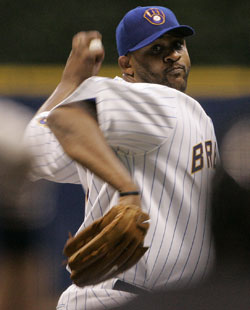 AS WE GO UP WE GO DOWN
Down in the comments, longtime reader/frequent commenter Louis writes:
I have been wanting to make that point about the Blue Jays and their league-leading 3.77 runs per game allowed for awhile, but somehow keep bypassing it, and I thank Louis for reminding me. The Jays scored just 4.41 runs per game The Yankees were almost half a run better, plating 4.87 runners a game. “Better” isn’t “best;” the Yankees ranked only seventh in the league in runs per game.
The question for next year, insofar as any potential Blue Jayism goes, is if the Yankees offense gets better, worse, or stays the same. Brian Cashman is on record as saying “Better.” He bases this on getting a full season out of Jorge Posada; a fixed Robby Cano; a divorced A-Rod; a healthy Matsui. Is he correct? With all respect, probably not:
Posada is a year older and very probably won’t be up to his old 140-game workloads. Whereas almost anything Posada is likely to do will be an improvement on Jose Molina, giving one-fifth or more of the starts behind the plate to Mr. Career .237/.276/.339 is potentially devastating. And if Posada’s shoulder isn’t what it used to be and he can’t catch, look out.
Alex Rodriguez hit at about his career levels last year. Sure, he was well down from 2007, but 2007 was not his typical year. Maybe a more relaxed, Maddona-ified A-Rod will hit better in the clutch, but that adds fewer runs than you might thing.
If Matsui is healthy, he should be reasonably productive at DH, but the Yankees actually did quite well at DH last year thanks to Johnny Damon and Jason Giambi. Overall, Yankees DHs hit .282/.378/.461. Matsui is a career .295/.371/.478 hitter and he’s 35. He’s not likely to give the Yankees a whole lot more than they got last year.
Cashman is probably right about Cano, but we haven’t even gotten to the other aspects of the offense: Johnny Damon will probably lose some production. No one knows what the team will get out of center field. Xavier Nady in right field is a likely step backwards of around 20 runs. Nick Swisher could put first base on a par with what it got last season (.246/.349/.460) or even a little more assuming the return to form we all figure is coming.
So what does that all add up to? Without playing with projected numbers (which I did in a previous entry), it seems like there might be something less than short of a decisive improvement. As for the defense, it’s where it was, and that ain’t good. Figure that if the Yankees want to win 98 games next year, and scoring remains constant or just ticks up a little bit, they would still have to saw nearly 80 runs allowed off of this year’s total. Sabathia replaces Mike Mussina plus (because he pitches further into games) some bullpen innings. Add a healthy Chien-Ming Wang, a full year of Joba Chamberlain, and about 40 starts from pitchers (whoever they are) who should be better than Sidney Ponson, Ian Kennedy, Phil Hughes, and Carl Pavano… It seems doable, but if the offense slips, look out. Things will go backwards as they go forward.
Yankees Inc. Inks
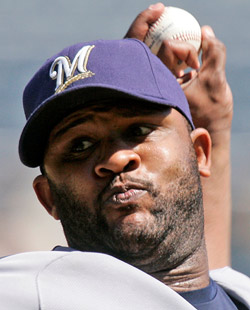 According to rumors widely circulating at this hour, the Yankees have bagged their big man, reaching a preliminary agreement with CC Sabathia on a seven-year, $160 million contract. If the story is true, the Yankees have acquired the heaviest pitcher in team history, or at least the heaviest since Jumbo Brown last titled the Yankee Stadium mound back in 1936, through his age-35 season.
There is no doubt the Yankees are a better team now than they were yesterday; Sabathia is one of the best pitchers in the business and becomes the left-handed ace the Yankees have been missing for some years. While the Yankees should not expect to receive anything close to the 1.65 ERA-run that Sabathia gave the Brewers this fall, some form of what Sabathia did for the Indians over the last five seasons — durability, excellent control, a strong strikeout rate, and an ERA somewhere in the mid-3.00s — should be in the cards.
Now the requisite “but:” All of that requires health, and the Yankees are entering unknown territory when it comes to Sabathia. Over the last two years he’s thrown over 500 innings (regular season and playoffs) and faced well over 2,000 batters. Under normal circumstances, when it comes to that kind of workload, a physical breakdown wouldn’t be a question of “if,” but “when.” The two main complications are that “when” remains undefined (Tuesday? July? July of 2010?) and, perhaps more significantly, we have no idea if a pitcher built like the Incredible Hulk is subject to the same rules that affect everyone else.
Meanwhile, there are reportedly offers out to other pitchers, more questionable pitchers — Derek Lowe, a groundballer going on 36 who the Yankees aren’t capable of supporting defensively, and A.J. Burnett, a pitcher who is good sometimes and is hurt often. Mark Teixeira seems a good bet to go to the Red Sox, where he will improve an already very good club for years. The Yankees will go through the winter having gotten exactly what they wanted, but I can’t help but feel, as I have written throughout this offseason, that the real problems of offense and defense are being neglected.
More to come as details emerge.
Waiting for the big one

WAITING FOR
SOMETHING TO BREAK…
…And hoping it’s not a leg or a Faberge Egg (Hey, A-Rod, how
far can you hit this priceless work of art?) but a deal. So far it seems that
there has been a little gabbing but not much deal-making out Vegas way. In
fact, even some of the gabbing hasn’t happened, as reports of Team A talking to
Team B about Players X and Y are quickly debunked by one of the general
managers in question. “Haven’t seen him,” he might say. “Not yet.” Or, “Sure,
we talked, but only about some very remote Dominican Summer League guys whom
you’ve never heard of, and frankly, neither have I.”
Thus far, Brian Cashman has had a chat with CC Sabathia, one
that seems to have gone better than Gene Michael’s with Greg Maddux under
similar conditions in 1992. Michael brought theatre tickets. Maddux wanted
Nintendo games. A bond was not established. Meanwhile, we have two Detroit deals going down.
The Tigers picked up a good field/no-hit catcher in Gerald Laird, who isn’t going
to help them all that much — compare and contrast: Laird’s .248 career
EqA to Brandon Inge’s .250 and the two catchers’ virtually equal caught-stealing
percentages. Inge’s reluctance to catch may have forced the move on the Tigers,
but that leaves them the problem of what to do with Inge, a very nice fielder
at the hot corner who doesn’t hit enough (.235/.310/.408 over the last three seasons) to
justify a daily place in the lineup. Inge would be worth something in a platoon
role against lefties with additional time as a defensive sub, though probably
not as much as the $12.9 million still due on his contract.
In return, the Rangers received two pitchers, one of whom is
just 17 and thus so far away as to be a shot in the dark, and another,
Guillermo Moscoso, a likely reliever who has put up some very nice strikeout
numbers in the Minors. We can’t know for sure what will happen, but a good rule
of thumb (one in operation here at the PB) is that all trades where the selling
team receives only pitching prospects should be judged guilty until proven
innocent. In eight of 10 cases, the arms fall off, the pitchers don’t progress
or both, and they come to nothing. Position players are always more projectable
than pitchers, and if you want certainty, you’ve got to get one. Again, that
doesn’t mean that the trade won’t be a real winner for the Rangers, but that
the odds are against it.
The Tigers also have reportedly signed punchless shortstop
Adam Everett, a career .246/.298/.355 hitter. If the Tigers’ infield is really
going to be composed of Miguel Cabrera, Placido Polanco, Inge, and Everett,
plus Laird at catcher, it’s going to be a very long year in Detroit, and that’s without considering the implosion
of the automobile companies. No matter what the outfield produces, there’s just
not enough offense there to start a fire.
IN MORE EXCITING NEWS…
There’s another Yankee in the Hall
of Fame. Joe “Flash” Gordon isn’t around to enjoy his enshrinement, but the
Veterans corrected a major oversight by recognizing the slick-fielding slugger
of the 1940s. If it seems as if I’m eliding his qualifications, it’s only
because I’ve written about them so many times, going back to the very
beginnings of my writing career. Gordon’s Hall of Fame case is one of the first
things I was ever paid to write about. Suffice it to say that he was a terrific
glove and a slugger at his position, and of the 18 second basemen in the Hall
of Fame, the only clearly superior players are (in no particular order) Joe
Morgan, Jackie Robinson, Eddie Collins, and Rogers Hornsby. You can argue with
that assessment, and no doubt some of you will, but you’ll find that even if
you want to slip in a Nap Lajoie or Charlie Gehringer ahead of Gordon, he
doesn’t sink too far.
UPDATES
…As events warrant.
MORE FROM ME
Various and sundry updates at Wholesome
Reading,
including psychology’s impact on the economy. Warning! Politics!
 Pinstriped Bible