Tagged: Jorge Posada
A quicky from the comments
 “Remember when the Yanks were winning the World Series that we never had an MVP winner on our team (1996-2000)? We had guys who knew how to perform as a team.”
Steve, could you get your Webmaster to fix it so that any time somebody types some version of those quoted sentiments, they automatically get an electric shock through their Web connection? Thanks! — lorodov
I’m pretty sure your suggestion would have been legal just a few months ago but wouldn’t pass muster with the current Justice Department. Congratulations: you’ve actually made me miss the old guys. I didn’t think that was possible… I’m trying to figure out the best way to say that the MVP vote is just a poll of a bunch of guys who write about baseball and may or may not reflect the best player in the league in a given year, often not. That no Yankees player received an MVP award in the years 1996-2000 is not evidence that they received no MVP-level performances during those years, but that the voters had their heads up their — how to put this politely — fundaments.
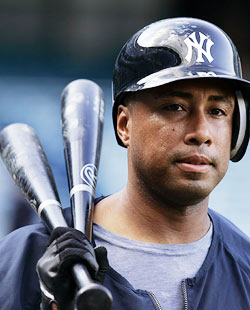
Bernie Williams played at an MVP-level in the four years under examination — a center fielder who hit .324/.410/.551 in the years in question, winning a batting title and (deserved or not) four Gold Gloves as well. In two of those years, 1996 and 1998, the award went to the cranky corner outfielder Juan Gonzalez, who had a ton of home runs and RBIs, but when you look at Williams’ more important defensive position and superior ability to reach base it rapidly becomes apparent that Bernie was the superior player.
Derek Jeter would have been deserving of an MVP award in any of the three years from 1998 to 2000, and I will always contend that he should have won it in 1999 rather than Pudge Rodriguez’s double play machine. Rodriguez was not one of the 10 best hitters in the AL that year. Jeter was, at least by one measure, the best.
Jorge Posada’s 2000 season (.287/.417/.527, 151 games) lacked the RBIs usually associated with an MVP winner, but was of that quality given that it was produced by a catcher. Tino Martinez’s 1997 had all the hallmarks of an MVP season — 44 home runs, 141 RBIs. He finished a distant second in the balloting to Junior Griffey.
There were several players throughout, including Paul O’Neill (through 1998), who made star-level contributions to those Yankees teams. They were very deep clubs, with talent spread nicely around the roster, but they weren’t some gutty version of the Pittsburgh Pirates, grinding it out with a bunch of mediocre players. These were Cadillacs, not K-Cars, and we haven’t yet discussed the pitching or the defense, the latter of which was surprisingly effective in those years, far, far more effective than anything the current unit has done or will do.
Sure, the media liked to celebrate Scott Brosius, Joe Girardi, and the like, and no doubt they played their part, but without the big guys they would have “known how to win” right into fourth place. The Yankees need their stars. In the absence of Alex Rodriguez, the Yankees are down on just one on offense. Citing the 1996-2000 teams as evidence that one is enough fails the exam before you even pick up your pencil.
MORE FROM ME…
…After today’s game. In the meantime, this week my travels take me to Washington, DC, where I’ll be doing two events on Wednesday. First, Jay Jaffe and I will be hosted by the Georgetown Lecture Fund at Georgetown University at 4:30 p.m. This event is open to the public, if public I have. The location is McShain Lounge at McCarthy Hall (Building 42), 27th and O Street NW.
Following rapidly on the heels of that, Jay, Clay Davenport, and I will be traveling to one of my favorite tour events, the great independent Politics & Prose bookstore, for a 7 p.m. chat ‘n’ sign. The address: 5015 Connecticut Avenue NW. They usually have pizza and beer available. I’m not sure that that will be the case this year, but we can hope.
Finally, I’ve continued and will continue to update Wholesome Reading. Warning: Politics (and a Harold Reynolds reference)!
Defending my stance on Jeter
 A COUPLE OF QUICK NOTES AS WE HEAD INTO THE WEEKEND…
First, a few reactions to the comments on retaining Derek Jeter after 2010: as I tried to explain this morning, I’m appreciative of Jeter for all he’s done, but I appreciate winning baseball teams more, and I very much doubt that the Yankees will be able to do so with a 37-year-old shortstop, particularly one who doesn’t play great defense now and has visibly slowed the last couple of years.
Baseball puts fans in a very difficult bind: do you love the team or the player? When the player is 25 and at the peak of his powers, it is very easy to love both. When they’re 35 and gimpy, you have to make a decision. The Yankees, and Yankees fans, have gone through this repeatedly: with Babe Ruth, Joe DiMaggio, Mickey Mantle and many others. At some point, it was time for them to move on so the team could make room for fresh faces that could do more to help them win. The alternative is that the team ceases to try to win and becomes a nostalgia show, perpetuating these players far beyond their usefulness just because it’s hard to let go. If that’s what you want, that’s one thing, but you’re going to see a whole lot of losing, not to mention experience a whole lot of embarrassing discomfort along the lines of what old time Willie Mays fans saw when he joined the Mets in 1972 — not the fleet ballplayer of 1954 who could do anything, but a 42-year-old who looked like a tired old guy. If you want to see Derek Jeter look like that, fine — just keep holding on too tight — and don’t
Specific comments: vrod44, the “you didn’t play the game” insult is as old as dirt and about as logical. Whether I played or not, even if I was Lou Gehrig in a previous life, Jeter is aging. That’s an unavoidable fact, but blame the messenger if you want. Yankee7777, it’s odd that you cite Lou Boudreau given that he stopped hitting after age 30, was a part-time player by 32, and retired at 34. No, he wasn’t fast — he was, in fact, legendarily slow, and as you say he was a great defender nonetheless. Unfortunately, none of that serves your point because by the time he was Jeter’s age, he wasn’t playing anymore. I don’t have time to do it now, but over the weekend I’ll try to figure out which teams won with old shortstops. My guess is it’s a short list. I also disagree with your statement, “Anyone who watches Jeter knows he makes all the plays.” He demonstrably does not. I wrote this in the Baseball Prospectus annual four years ago:
For those of us in the performance analysis biz, Jeter is a difficult problem because any realistic evaluation of his skills, no matter how flattering, seems like a slight when compared to his reputation. In the eyes of true believers, Honus Wagner and Superman combined couldn’t do half the things Jeter does. In truth, he’s terrific at going back on shallow pop-ups and executing the jump throw in the hole. Other aspects of the job — fielding grounders to his left for instance — elude him, and it doesn’t take an MS in scouting or statistics to see it. When watching a Yankees game, simply pay attention to the opposing shortstop. He will routinely get to balls that Jeter cannot. As for the Gold Glove, peel back the foil on the award and you’ll find there’s some tasty chocolate underneath. That’s about what it’s worth, though at least Jeter was better this year. On offense, Jeter walked less than ever before and doubled his previous high in sac bunts, perhaps because he lost confidence after a shockingly poor April. Jeter is a Hall of Famer to be, a key player on a great team, an inspirational leader, a fine hitter…and he gives up a lot of singles with his glove. In light of the rest, why is that last part so difficult to accept?
I stand by what I wrote back in the winter of 2004. Every day you can see balls go past Jeter on the left that most other shortstops easily field, and if he’s ever made a play behind second base it must have been back in the Clinton administration. To this point, for the reasons stated above, that deficiency hasn’t been all that important, because on balance, the combination of offense and defense worked out in the Yankees’ favor. That will be less and less the case over time, and if 2008’s reduced offensive output was not an injury-induced fluke but the beginning of an age-inspired trend (and it was the second season in a row that Jeter’s offense dropped, so arguing about said trend may be a moot point), the day of reckoning is here now.
AND FROM TODAY’S GAME…
The Yankees dropped the decision to the Twins, who came back late against some youngsters who aren’t going to be within hailing distance of this year’s staff. There was still plenty of good stuff: a solid two innings for Ian Kennedy; a 2-for-2 with a double and a stolen base for Brett Gardner (and an 0-for-3 for Melky), a 2-for-3 for Jorge Posada and an identical day for Nick Swisher. Xavier Nady went 0-for-3 with an RBI.
Also of interest was an appearance in left field by Kevin Russo. I get a lot of mail about Russo, who hit .316/.363/.416 in half a season at Double-A Trenton last year. Some out there want to see him as a prospect, but I don’t buy it — as a second baseman, he’s going to have to hit more than that to make it — those numbers don’t really translate to anything impressive — and since he doesn’t play shortstop, his chances to be a utility infielder are not good. Last year he got in an odd bit of utility work at third base and the outfield, and it’s interesting to see the Yankees carrying that forward this spring. If Russo starts the season at Scranton, he could be an injury away from a bench job… It’s not like Cody Ransom has an ironclad lock on a job.
THAT’S A WEEK
I hope to see many of you at the Yogi Berra Museum on Sunday (see below for details). I’ll catch the rest of you here on Monday, unless Brian Cashman goes insane and signs Manny Ramirez tomorrow afternoon. In that case, I’ll be posting — a lot.
Another day, more stuff happens
 THAT’S JUST THE WAY IT WORKS
Can’t complain about the Yankees’ exhibition showing against the Rays on Thursday, and can’t get overexcited about it given that the Rays brought not their B or C squad but maybe Squad Q, the squad you turn to when all else has failed and the monsters are at the door, but not any time before that.
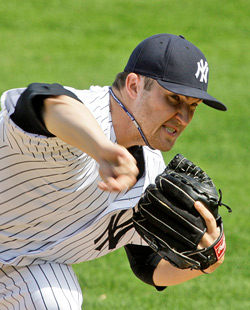
I was excited to see Phil Hughes’ cutter again, but the Yankees denied me, having the lad work on his other pitches, and two barely hit batsmen aside the results were just fine. Ditto bullpen-bound Phil Coke, who with Damaso Marte should give the Yankees a rare set of matched lefty long men, rather than the more ubiquitous pair o’ LOOGYs. Joe Girardi should keep in mind that “long man” is not equivalent to “infinite man” — he forgot with Marte a couple of times last season.
On the offensive side, it was a very good day for Jorge Posada, with a double and a home run, and that means it was a good day for the Yankees, as a resurgent Posada could be decisive in this year’s race. Again, let’s not get too worked up about the results of one game of DH-work and a home run against Chad Orvella, who looked so good a few years ago and looks so lost now. On the bad news side, Brett Gardner went 0-for-2, but then so did Melky Cabrera so we’ll say that Gardner is still ahead based on Wednesday’s home run.
On the Rays side, Squad Q did supply one clue as to why the former underdogs have a chance to repeat in the form of starting pitcher Wade Davis, a 23-year-old who reached Triple-A last year, putting up a 2.72 ERA in 53 innings. He throws in the 90s, he has a full complement of pitches, and there is currently nowhere to put him. The Rays have so many pitching options that unless they suffer an ’87 Mets-like staff-wide breakdown, they should be able to patch pretty easily should anything go wrong. You saw Davis whiff Mark Teixeira, Alex Rodriguez and Robinson Cano on Thursday, and he’s surplus.
A NOTE OF DEREK JETER APPRECIATION
Jeter didn’t do anything special, but seeing him out there, realizing that he’s in the declining days of his career, made me feel a bit like I’ve taken him for granted at times. The cult surrounding Captain Intangibles is so fervid in its hero worship that it provokes the opposite feeling in the realist sector. It has become fashionable to criticize Jeter’s defense, and such criticisms are accurate and entirely fair. Still, the excellence of Jeter’s career should not be missed in the rush to paint a more accurate picture of him, and we should also not fail to acknowledge the sheer miracle of his existence given what the Yankees had at shortstop between 1950, Phil Rizzuto’s MVP season, and 1996, Jeter’s arrival.
With apologies to Tony Kubek, Bucky Dent and even the Scooter himself, the years where shortstop was something the Yankees dragged limply behind them, even when winning, far outnumbered those when they received the kind of all-around contribution that Jeter is capable of providing at his best. I grew up watching the Yankees try Paul Zuvella, Jeff Moronko, Bobby Meacham, and the occasional hotel clerk at short, while at the same time seeing all-time greats like Alan Trammell and Cal Ripken come through and batter the heck out of them whether at the plate or in the field. It seemed like it would never end. If Tony Fernandez hadn’t become injured in 1996, it never would have ended.
As we again debate Jeter’s defensive abilities and remaining offensive capabilities this year, let us remember the good years. And no, this doesn’t mean that the Yankees should sign Jeter to an extension after his current contract is completed. They shouldn’t.
THE AROUND (AND ABOUT)
? Manny Ramirez rejected what seemed like a fair offer from the Dodgers on Thursday. Yesterday I wrote a story about Joe DiMaggio’s 1938 holdout. One thing I came across, but didn’t use in the story, was one of the top Yankees, either owner Jacob Ruppert or general manager Ed Barrow, saying of DiMaggio (I paraphrase), “His demands are just so ridiculous that we don’t really believe he’s holding out, we think he’s just trying to get out of spring training.” That seemed silly when I read it, especially because the Yankees and the Clipper were only $5,000 apart — for whatever reason, the team had decided it wasn’t going to compromise with DiMaggio no matter what, so they were trying to cast the blame on him. With Ramirez, though, I can almost believe it.
? Remember how I complained about Frankie Cervelli leaving Yankees camp to play in the WBC when he really needs the time with the team? The Royals are going to go through the same thing with Mark Teahen, who is heading out even though he’s trying to revive his career by making the transition to second base. That’s just wrong.
? It’s wonderful that the Tigers have a pitcher in camp named Fu-Te Ni. Globalism has its defects, but it’s wonderful to follow the game in the age of universal baseball.
? One more reminder that on Sunday at 2 p.m. I’ll be appearing with Kevin Goldstein, Christina Kahrl, and Cliff Corcoran for a Q&A/signing at the Yogi Berra Museum in Montclair, New Jersey. Come for the baseball talk, stay in Montclair for the Yogi-ness and the great restaurant scene. That’s my plan.
Brett Tomko? Why?
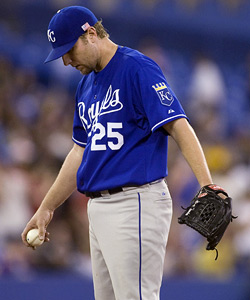 I’ve been meaning to comment on the signing of Brett Tomko, and since he’s starting Wednesday’s game against the Blue Jays, now seems like a good time to do so. Tomko was signed to a Minor League deal back on February 13. The right-hander, who will turn 36 on April 7, is … there’s no good way to say this … terrible. His career ERA is 4.68 despite extensive work in friendly parks like San Francisco, Los Angeles and San Diego. Since his last good ERA in 2004 — it was only the second time in his career he’d posted an ERA below league average — he’s gone 22-41 with a 5.07 ERA in 504.1 innings. Starting, relieving, selling peanuts, it hasn’t mattered, he’s been pounded. The only good thing he’s had going on in that time is a slightly above-average walk rate.
Pitchers are variable, and you never know when you might squeeze some unexpected juice out of one that seemed an irredeemable failure. The possibility seems quite remote in this case, and if Tomko wears a Yankees uniform anywhere but Scranton this year something will have gone quite wrong. The Yankees are trying to save their starters from the longer grind of an extended spring season this year, that’s understood, but starting Tomko and then following him with Kei Igawa in the same game seems like cruel and unusual punishment to Yankees fans.
? It’s quite a drag that Frankie Cervelli is heading out of camp to play in the WBC. Due to last spring’s injury, he hardly played last year, and to date has had only a few at-bats above High-A ball. As well as Jorge Posada seems to be doing with his throwing program, the Yankees really need to have a solid alternative to Jose Molina on hand in case the Iron Jorge breaks down (Kevin Cash ain’t it). The best thing that Cervelli can do for both the Yankees and his own career is to stay around, let the coaching staff see a lot of him, and do what he can to improve his batting stroke, because right now there is very little indication that he can hit in the big leagues. But there are hints in his performance and smatterings of patience and doubles power that hint (at least to me) that there is something alive in Cervelli that could blossom if only nurtured the right way. The WBC is probably not the way to do it.
? With all due respect to my friend Rob Neyer, now that the A’s are out of the Fremont business, they shouldn’t move to Portland, they should move to Central New Jersey. Sure, there are territorial issues with the Mets and Yankees, but it’s a big market and there’s room for all. Imagine the rivalry … imagine the traffic. I haven’t done a demographic comp with Portland, but I bet Jersey’s population density and general affluence wins. Also, thanks to the large Indian population in that part of the state, we’d have the only ballclub to serve samosas. I can hear the cry of the vendor now… “Nan! Hot nan! Getcher nan bread and samosas here!” I could go for some of that now, if only it weren’t 3 AM, and even if it is.
? The reminder: Baseball Prospectus writers Kevin Goldstein, Christina Kahrl, Cliff Corcoran, and I will be at the Yogi Berra Museum Sunday at 2 p.m. for our annual roundtable. Come, ask questions, get answers, and admire the sheer Yogi-ness of the edifice.
I’ll be back with an update after the Yankees break the ice on the spring season. Let’s hope Nick Swisher hits two home runs and Brett Gardner hits a triple and makes a running catch. The outcome of the season may depend on these two players having a better spring than their competitors.
Security behind the plate
 SO, HOW WAS YOUR VALENTINE’S DAY?
My unscientific polling sample of local types was evenly split between couples who believe it’s a cynical holiday manufactured by the greeting-card companies and those who make something of it. I tend to fall into the latter camp, if only because I like an excuse to get my wife a present or two. I don’t buy greeting cards, though. Those are evil, with soul-crushingly banal inscriptions, like:
My Dearest Love
Let me tell you all the ways,
On this special day of days
How you fulfill me in every way
In spite of that disfiguring mark
In the middle of your forehead
That I so easily overlooked when you were 20
But can bug the heck out of me now that we’re older.
Why don’t you get that thing fixed, anyway?
We can finally afford it
Now that we’ve had that bequest from your uncle.
I never thought he would stop kicking
While we held him down
With the fluffy cat pillow
From Wal-Mart.
I guess that’s why I think I love you
Oh, cripes, not “I think,” I mean, “I do.”
Please don’t make a big thing of it.
I wish you wouldn’t cry like that.
You know how I feel better than I do.
You’re always telling me how much I–
Oh, forget it. I can’t talk to you right now.
HAPPY VALENTINES DAY.
On the rare occasions I’m forced to buy a card, I shoot for the blanks and fill in my own inscription. You really don’t want to be going for a lowest common denominator sentiments when expressing yourself to a loved one. That’s lazy, and perhaps, a bit dangerous. No doubt we’ll return to this topic on Mother’s Day and Father’s Day. I was going to crack that on the former the players swing pink bats and on the latter they just hit you with them, but that would make a wider generalization about fathers than would be fair, including to my own, including myself. It’s all comedy folks, it’s just comedy.
RANDOM THOUGHT ON SOUVENIRS AND FEELINGS OF SECURITY
Remember the stuffed Kirby Puckett dolls the Twins used to sell? Think the Yankees might license something similar for CC Sabathia? I know if I were a kid, I wouldn’t be afraid of the dark if I had a stuffed CC in my room. Mr. Scratch comes out of the closet, CC will bean him with a 95-mph fastball. Take that, Ultimate Evil! This tot knows security! You could save thousands in fees to the child psychologist …
PUDGE, AS PLAYERS STRETCH AND PLAY CATCH
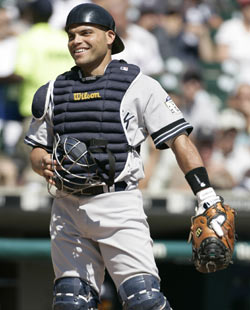
You’ve probably seen the latest from Ivan Rodriguez, who is still out there looking for a job. While I don’t believe Pudge has a lot left (PECOTA says .263/.301/.364), the Yankees would be very foolish not to give him another look. If you believe, as many have suggested, that Jorge Posada, even if ready to start the season, will probably sit for a quarter of the games, then you also have to be praying that the AL East race is not a close one. Simply put: if Jose Molina and Kevin Cash play 40 or more games and the race is at all close, the Yankees will lose it.
The more one considers this possibility, the more stunning it is that the Yankees went through the winter without trying to upgrade at the position — Cash doesn’t qualify; in 557 Major League plate appearances, he’s batted .184/.248/.285, a fair representation of his offensive abilities. I characterized it this way in my most recent chat when I was asked about the possibility of Rodriguez returning:
Eli (Brooklyn): Should the Yankees make a run at Pudge Rodriguez or did him running over Joe Girardi’s dog close that avenue?
Steven Goldman: One of the really disturbing things that Yankees fans will see coming out of Spring Training — well, let me correct that. There are two scenarios, both equally disturbing: (1) Posada is healthy enough to catch, but the Yankees feel nervous enough about this durability that they carry both Jose Molina AND Kevin Cash, or (2) Posada isn’t ready to start the season, so the Yankees start the season with Molina and Cash as their catchers. As such, YES! YES, THEY FREAKING SHOULD BRING IN ANYONE BREATHING! YES!
… I actually raised this point on last night’s Hot Stove show on YES, though somewhat inarticulately: Brian Cashman’s biggest gamble last season was not relying on young pitching, but in going to war with an old catcher and assuming his (to that point) incredible durability would carry them through another year. That he has decided to double up on that bet is really disturbing and will reflect very poorly on him should Posada not be ready to go.
I should have said that it will reflect very poorly on him “should Posada not be ready to go, or if he requires substantial rest to stay healthy — and the latter seems to be inevitable.”
SOME THINGS WORTH READING
? A good MLB.com article on the PECOTA prediction system, which I often site in these here pages and is the backbone of that book I spent the winter editing. How does Bill Pecota feel about inspiring PECOTA? “Hey, any pub is good pub at this point … I definitely didn’t do enough on the field to get people to notice me, so if they’re noticing me now, that’s awesome.” Thank you, Bill. Feel free to come by a book signing. We’ll spot you a copy.
? Sorry for bringing up bad memories, by Joe Posnanski conducts a thoughtful “steroid symphony.”
Pettitte-O-Mania
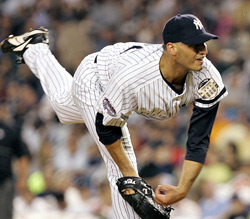 As I take pen in paw here, reports are circulating that the Yankees are close to an agreement with L’il Orphan Andy Pettitte. This will no doubt make Andy’s many fans very happy, and for good reason, as he should be an asset this season. As I’ve written here several times over the course of the offseason, some of his second-half fade was attributable to very poor defensive support. It will also be fun to watch Pettitte add to a career which, while not of Hall of Fame quality, fits nicely into the wider but still relatively exclusive “Hall of the Very Good.”
That said, I do have some trepidation about the Yankees not reserving a spot for youth in the rotation. If Pettitte pitches the Yankees to a pennant, that’s one thing, but if not, at the end of the year he will (presumably) ride off into the sunset, leaving the team with nothing but memories. If Phil Hughes or Alfredo Aceves or anyone young was capable of giving the team something within ten percent of what Pettitte can, then the greater value would be in that pitcher gaining experience rather than the Yankees having a Cadillac in the Pinto part of the rotation.
ONE MORE MOLINA BIT FROM THE COMMENTS
…Before I close this subject until such time as Jorge Posada shows us the condition of his arm. This one is by “amdream23:”
You make two logical fallacies about Molina who would be fine as a full-time catcher with the Yankees, given their other hitting. You say he saved five runs based on throwing out 13 or so baserunners. But he didn’t play a full season so you should project that out further.
Second, what about the baserunners on first that didn’t try to steal since they knew he has a good arm? Isn’t there a deterrence effect? Rather than Molina, look at A-Rod’s failures. He excels in hitting mediocre pitching and padding his stats but chokes against good (never mind great) pitching. He’s another Winfield. The Yankees will never win in the playoffs with A-Rod anchoring the team.
Thanks for taking the time to comment, “am.” I thought a logical fallacy was something like assuming “after therefore because” or saying that fish can swim and so can Derek Jeter, therefore Derek Jeter must be a fish. No? I’m going to ignore the A-Rod bashing because it’s a non-sequitur in a discussion of catching, seems to suggest that we should somehow think Molina a better player than A-Rod. Maybe I’m misreading that, but it’s just weird. Finally, let us say this of Dave Winfield: yes, he had a miserable 1981 World Series, but not too long after leaving the Yankees he drove in the Series-winning runs for the ’92 Jays. Winfield was a terrific player and a lot of fun. His big sin with the Yankees was that he couldn’t pitch.
One logical fallacy I would like to stomp dead is the one in your first sentence: “Molina would be fine as a full-time catcher with the Yankees given their other hitting.” No. We should never look at it like that. It’s the worst kind of complacency, first because it says that a team can settle for mediocrity at a position provided that it did its job at the other positions, and second because it makes an assumption: “given their other hitting.” Every once in awhile, as with the Yankees in 2008, a team will spawn a couple of unexpected replacement-level hitters and suddenly the guy you could tolerate becomes the straw that broke the lineup’s bat — er, back. No, make that “bat.”
Let’s deal with MAD, Molina’s Alleged Deterrence. A full-season workload for most catchers is about 1200 innings, or about 140 full games. Molina caught 737 innings last season, so he got in about 60 percent of a full season. The Yankees played 1441 innings in total, so he took just a fraction over half of the team’s catching load. Now, here’s a very simple way of looking at things, but this is my take on all the baserunners that might not have run because Molina was in the game: they ran anyway. The average AL team saw 129 stolen base attempts last year — 94 steals, 35 caught stealing. Half of that would be roughly 65 attempts — 47 steals, 17 caught. Molina, though, saw 75 stolen base attempts. Another way of looking at it would be to say that the AL least year had .80 stolen base attempts per nine innings. Molina had .92 attempts per nine in the games he caught. Perhaps a lot of that was the pitchers, and had Molina not been catching even more runners might have gone, but that would be pure supposition.
Your request that we give Molina credit for the half-season he didn’t play won’t make him look any better. As above, he played roughly half a season, starting 81 games behind the plate and relieving in 16 more. If we simply double his playing time, we have a player who saved ten runs in dead baserunners and was roughly 30 runs worse than the average catcher and maybe 40 runs worse than the average hitter. Giving you more of Molina doesn’t make him any better; it just increases the damage.
FIXING A HOLE
I have a “Flight of the Conchords” song stuck in my head. I’m off to clear it out with some Beatles.
Some random bits gleaned from the comments
 Jlevy1112 asks: What about the Yankees two highly rated catching prospects in the Minor Leagues, Jesus Montero and Austin Romine? If Posada can’t make his full complement of starts, could one of these two be called up to join the team? I seem to remember they both have nice offensive numbers in the minors. If the Yankees traded for a Saltalamacchia, Teagarden, or Miguel Montero where would that put the aforementioned catching prospects?
Both Montero and Romine are both very far away. As you probably know, Montero may never arrive as a catcher, as he’s a hulking giant of a kid who doesn’t fit very well behind the plate. He has sufficient talent as a hitter that he should be able to make the transfer to first base — I keep thinking of Carlos Delgado, who actually made it to the majors as a catcher before everyone said, “Whoa, that’s not going to work,” and he went over to first base (after a brief stop in left field) and proceeded to hit (to date) 469 home runs. I’m not saying that Montero is going to be a borderline Hall of Famer — that would be premature — but that his career so far has echoes of the Delgado story.
In contrast to Montero, Romine seems to have the defensive tools to remain behind the dish, and he had a terrific finish to his season, punching out eight of his 10 home runs in the final two months of the season. Now, both of these guys are very young. Neither can legally buy a beer, with Montero having turned 19 around Thanksgiving and Romine reaching 20 less than a week earlier. Both finished the year at Low-A Charleston, which means they’re a big three levels from the majors, including the hard jump to Double-A, which many catchers do not survive.
If the Yankees traded for one of the players you mentioned, it wouldn’t harm these players at all given that they seem to be at least two years away, more likely three. As the younger players started to become expensive, the Yankees would have the option of moving them out and starting over. And, of course, Montero might not be a catcher anyway. We’ll soon see what the presence of Mark Teixeira means for his future.
Now, a lot of writers would ignore or ban the following crank, but you know, I find guys like this “42Yankee” kind of amusing.
THIS PORKY SO CALLED SPORTS WRITER NEEDS TO RETIRE AND GO AWAY, FAR,FAR AWAY. THE YANKS SHOULD HAVE NEVER GIVEN POSADA THE BIG CONTRACT, AS ALL HE HAD WAS A LUCKY YEAR AT BAT IN 2007. HE COULDN’T THROW OUT ANYBODY. AS FAR AS MOLINA IS CONCERNED, TELL US US CHUBBO GOLDMAN:::: HOW MANY GAMES DID MOLINA WIN BY THROWING OUT BASE RUNNERS? MORE THAN A MORON LIKE YOU CAN COUNT!!!!! NOW PLEASE RETIRE AND GO AWAY, FAR, FAR AWAY. MAYBE THEN THE YANKEES WILL FIND A REAL SPORTS REPORTER, OR BETTER YET GO JOIN THE REDUX WRITERS TEAM, AS YOU WOULD FIT RIGHT IN AT FENWAY!!!!!
1. “Retire?” Dude, I’m 38 years old. I have a mortgage to pay, two kids to put through college, and most importantly, I’m having way too much fun.
2. “Porky.” Well, that’s not a charitable description, but it’s not unfair. I’ve been working on it, including hiring a personal trainer to develop a workout program for me. Weight has been a thing I’ve fought my whole life. I can show you pictures where I’m kind of svelte and then others that are like, well, now. There are exculpatory medical factors, but they don’t really change the big picture, pun intentional. Anyway, it’s something that bothers me, but unlike “42Yankee” I’m not seven years old. Taunting my physical appearance as a way of attacking my ideas doesn’t really register as anything more than a pathetic, helpless gesture, an Internet wuss’s version of emotional terrorism. Nice try.
Back about my sophomore year of high school I guess I was having one of my heavier seasons. At this time, some friends and I were in the habit of scraping together teams of for pick-up softball or baseball games. We were in a fairly large school, so it wasn’t too difficult to come up with 18 or 20 kids who could show up at the park on a Saturday or Sunday morning and play six innings or so (the scores were usually too lopsided to go nine). One of my best friends threw very hard for a 15-year-old, and he and I made up the battery.
One day after school, he and I went out to a neighborhood park to practice. I was squatting down, catching his fastball. Parenthetically, I never was very good at catching his offspeed stuff, and one day a year or two later he crossed me up and unexpectedly threw something that broke sharply downward, ticking off my mitt and hitting me on the foot, mildly fracturing it. One of our class idiots wandered by — I would like to call him the class idiot, but as I said it was a large class and we had several — and came over to see what we were doing. After a few minutes of watching, for no particular reason he started aiming a series of very weak fat jokes at me, lines that even a third grader, or “42Yankee” here, might find too childish to use.
This was more irritating than effective. The guy had taken up a position a few yards behind me and was endlessly chattering as I caught the ball and flipped it back to my pal, the pitcher. I wasn’t bothered, but my friend was deeply offended on my behalf. He warned Class Idiot, but the babble continued. I remember what happened next vividly. My pal wound up and fired with something extra on the ball. “Sssss” went the ball as it went over my head. Behind me, the Idiot said something like, “Hey, are you an elephant or — aaagh!” I turned around. There was another “Sssss” sound going past me. I ducked, but not before seeing a fastball come within a hair of hitting the idiot in the head.
I’ve rarely been more moved in my life. Here was my friend about to turn this guy into Ray Chapman because he had attacked me. Simultaneously, I also knew that if I cared at all about my friend, that I couldn’t really just watch it happen, because friends don’t let friends go to jail for murder. I shouted that it wasn’t worth it, that the Idiot should be allowed to live, but before the message could sink in, one more fastball lazered just past the bridge of Idiot’s nose, at which point he fled, threatening to tell his mom. How can I be bothered by weight jokes when I have friends like that?
3. “42Yankee” is correct that in an ideal world the Yankees should not have given Posada a four-year deal after 2007, because his age and position made him even riskier than would be typical when you’re booking a player for seasons 36 through 39. That’s the only argument against it, however, and if the deal had been for only two years there wouldn’t be any grounds for criticism at all. However, even the four-year deal has to be excused because Posada had all the leverage in the situation. The Yankees weren’t about to get Joe Mauer away from the Twins, so if they didn’t want to take a big, giant hit at catcher, they had to cater to Posada’s demands. I wrote at the time that they were paying for four years to get two good ones, and perhaps that will still be the case.
4. “42Yankee” is, however, spectacularly wrong when he implies that the Yankees were solely overreacting to Posada’s 2007 season. Yes, he had an unusually belated peak and an uncharacteristically high batting average that season, but he was also a player who had had three other seasons with an OBP above .400, was a five-time All-Star and Silver Slugger winner as the best hitter at his position. Among catchers with 5000 or more career plate appearances, Posada ranks fifth in OPS, trailing only Mike Piazza, Mickey Cochrane, Bill Dickey, and Gabby Hartnett; fifth in on-base percentage (Cochrane, Wally Schang, Dickey, and Piazza are ahead of him); f
ourth in isolated power (behind Piazza, Johnny Bench, Javy Lopez). He even ranks 17th in batting average. If he can hit at all this year, he’ll break into the top 10 in home runs by a catcher, and if he plays something like two more full seasons he’s going to have drawn more walks than any catcher to play the game. Posada may or may not be a Hall of Famer, but as a hitter his peers are all guys with plaques.
I think the most amazing thing about “42Yankee” having written that the Yankees should not have re-signed Posada is that he did so despite having the evidence of what a Posada-less Yankees team looks like. We call it the 2008 Yankees, and they don’t make the playoffs. There you go, “42” — thanks to Posada’s shoulder, they did it your way. Look how it wound up. Congratulations.
5. How many games did Molina win by throwing out baserunners? The easy answer is, not as many as he lost by making outs. First, The Yankees went 43-38 in Molina’s starts, which is a .531 percentage. They were actually a game better with other catchers in the lineup, which says something given how miserable some of the other guys were. Now, I see that one of our correspondents ran through some very simple math for you in the comments, but let me try taking it from a different angle. Last year, Molina caught 44 percent of attempting basestealers, or 33 in 42 attempts. The average stolen base success rate was 27 percent, so in a similar number of attempts, we should have expected the average catcher to catch 20 or 21 baserunners. Right away we have a problem with your valuation of Molina, because his real defensive worth becomes 13 dead baserunners. On average, four or five of those would have scored. That’s what you’re touting here, a defensive benefit of five runs. Given that a generous estimate of his offense would have him worth something like 20 runs less than the average player and 15 runs less than the average catcher, Molina is still deep in the hole. The Yankees didn’t get back to even on those ex-baserunners. Surely, “42,” you can recognize that games won and lost are a matter of those scored and allowed, and that had the Yankees scored 20 more runs in Molina’s plate appearances, but allowed five more, they still would have been close to two wins better off?
6. “Chubbo,” “Moron.” I don’t mind debating with third-graders, Hall of Fame voters, and members of Congress.
7. Here’s that “retire” stuff again. You know, my boss at YES told me that the current caricature on the site made me look too old. Now I believe him. Fortunately, the great Rich Faber will soon be supplying us with some new art. By the way, I’ve never claimed to be a “sports reporter.” Nowadays people tend to call me a blogger, but having opened the Pinstriped Bible in the days before blogs, I’ve always thought of myself as a columnist, although the content here has always been blog-like. My BP colleague likes to use the term “analyst,” and maybe that works too, but in the final analysis I’m just proud to be a writer and happy that I get to engage the public on a regular basis. For now, Chubbo the Columnist is going to retire to the kitchen for some pasta and then do some sit-ups. Thanks for writing, “42.” I look forward to your next note on how Melky Cabrera is more valuable than Mickey Mantle, or perhaps something on how much the team misses Tony Womack’s baserunning capabilities.
Another note on Posada
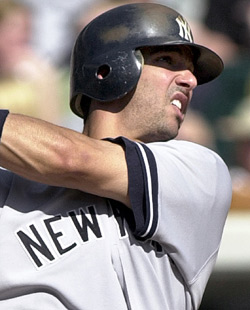 Spurred on by Buster Olney’s mention of this same topic in his blog posting today (I shan’t link; Olney is, shall we say, persnickety about who he links to, so I shall be the same). Olney writes: “If [Jorge Posada] can’t catch, he will have to get the bulk of his at-bats as a designated hitter, compelling the Yankees to press for a trade of one or two veteran hitters, among Xavier Nady, Nick Swisher and Hideki Matsui.”
Seems like they’re working on the latter anyway, as well they should given the declining value of two of the three. As for the designated hitter part of the story, let’s examine that. Last year, the aggregate rates for the DH position were .256/.339/.435, with a home run hit every 24.4 at-bats. The previous season they were .268/.355/.447 with a home run every 25 at-bats.
Parenthetically, the DH numbers always seem to be less than you would expect. The American League as a whole hit .268/.336/.420 in 2008. As a group, the players whose sole job it was to provide offense weren’t a whole lot better. It’s tempting to conclude that AL managers aren’t doing a very good job of designating good hitters, but it that wouldn’t be completely fair; the family of designated hitters had a rough year. Aubrey Huff and Milton Bradley were great, and David Ortiz was good when he wasn’t hurt.
Then there were some rude surprises. Jim Thome struggled early, pulled it together for three months, then slumped again. Matsui was off to a great start when his knees began affecting his production, and his post-injury hitting was even worse. Billy Butler and Jonny Gomes didn’t hit up to their abilities (Butler turned it on in the second half, but it was too late to save his overall numbers). Frank Thomas and Jose Vidro hit the end of the road, and Gary Sheffield hit the Last Rest Stop Before the End of the Road.
The previous year had Ortiz having a monster year, as well as productive seasons from Thome and Jack Cust. There were also some real disasters. I had blocked Shea Hillenbrand out of my memories of the 2007 Angels. He hit .238/.258/.320 as a designated hitter. Whichever team executive thought of Hillenbrand and let him putter on for a quarter of the season should have been cashiered. As planning goes, handing your team a Hillenbrand for its DH is not too dissimilar from those Civil War supply officers who sent their soldiers into battle wearing shoes with soles made out of old cupcake wrappers held together by cat spit.
In the Olney scenario, the Yankees wouldn’t be going with Hillenbrand, or Monty Meigs at DH, but Posada. The question is, if Posada is restricted to DH, can he give the Yankees average or better DH production, something along the lines of the league rates we’ve seen — let’s say a .270 average, .350 on-base percentage, and .440 slugging percentage?
If we go by Posada’s career rates, the answer should be an easy yes. He is, after all, a career .277/.380/.477 hitter. Yet, we’re talking about a Posada that is now 37 years old and is coming off of an injury which affected his swing. As such, Posada’s future is something of a black box. We can look at projections like those at compiled at Fangraphs — Bill James’ system figures .277/.378/.455, CHONE forecasts .266/.363/.434. Posada will hit .285/.374/.466 in Marcel’s prognostication. We should also add PECOTA to that. I can’t tell you exactly what it says just yet, but I will say that it’s a good deal more pessimistic than the rest. It’s also the most conservative on playing time. The projection systems, in the order that I listed them, see something like full-time play, almost full-time play, something like 60 percent play, and, last, PECOTA with something like half a season of playing time.
In Sabermetric circles there is often debate about the relative accuracy of these systems; as a BPer and the co-author and editor of a book which bills itself (tongue in cheek) as the home of the “deadly accurate” PECOTA forecast, I have to dance with the forecaster that brought me. Yet, in this case, I would be prepared to throw it all away, because everything Posada does depends on how he comes back from the surgery. None of these systems know that, although PECOTA has taken last year’s reduction of playing time into account. Posada could do it all, or nothing at all. And suddenly we’re invoking old Frank Sinatra tunes, so it’s probably time to move on.
Teixeira worth the money now, and later
 SPRUNG FROM THE BUNKER WITH A BIG FACE
I couldn’t let Friday end with that face at the top of the screen. It’s like a cellulite eclipse. Let’s tear through a few items before breaking for the weekend. Someone write in and remind me to take a break from editing the Baseball Prospectus annual (Pre-order now! I don’t get anything if you do! Not a dime! But you should.) to spend an hour on the treadmill. They’re going to let me go back in the Dot-com Bunker on the next show, Jan. 8, 2009. This time I might sneak onto the main set when no one is looking, just to see what it feels like to sit in one of those comfy chairs the New York Times guys get. I can dream, and yet the positive to not being in the plush chairs is that they don’t issue rations when you’re in the Bunker, so weight loss is pretty much inevitable. I skipped lunch yesterday, and after about two hours in my cell I was getting pretty low. It’s hard to answer questions about CC Sabathia when you’re thinking, “I wonder if Bob Lorenz would be good with barbecue sauce?” Did you see how they cut to me before my second segment? Next time, instead of working at my computer, you might see me opening up a pizza delivery box.
No, no, no. No pizza. Treadmill, Steve. Treadmill.
In yesterday’s Hot Stove show thread there was something of a debate on the subject of Mark Teixeira vs. Manny Ramirez. To me, the most interesting thing about said debate is not the players involved but the apparently universal sense that the Yankees need to bolster the offense. The sense that they need to improve the defense as well is not universal, or no one would be arguing for Manny. The correct answer, though, is “both,” especially if the Yankees want to fully exploit the Scrooge McDuck money they just put into arms. Think of it this way: Teixeira, as a Gold Glove defender at first base and a top hitter, is all positive. He’s not only adding runs above average on offense, he’s taking them away from the bad guys when in the field. Say Teixeira is worth 50 runs over the average player with the bat, and 10 runs above average with the glove, so you could say that his total contribution to the winning effort is 60 runs.
With Ramirez, the math is different. As Rob Neyer wrote this week, under normal conditions he’s such an egregiously indifferent outfielder that most metrics see him as being worth about 20 runs below average. Those runs have to be held against his offensive totals, such that if Ramirez is worth about 60 runs over the average player with the bat, after fielding is considered, he’s really only a 40-run advantage — or less than Teixeira. Another way of looking at it is to say that Teixeira adds about five wins over the average player with his bat, then gives his team another with the glove. Ramirez gives his team six wins with the bat, but also contributes two losses with the leather.
We haven’t even talked about the elephant in the room with Manny, which is, “If he’s paid, will he give a damn?” but we don’t have to, because there’s another consideration, which is that if he’s signed to a three-year deal, his team is buying his age-37, 38 and 39 season. Hall-of-Fame hitter or not, this is a dangerous thing to do. Ramirez’s fielding is already a problem. If he loses a half a step, he’s not just going to be damaging in the field, he’s going to be a visible joke. Sure, he could DH, but the age is still an issue — at some point age is going to set in, and while we don’t know if it will happen during those three years, there’s a good chance that it will. In contrast, the team that buys eight years of Teixeira will get him from age 29 through 36. His contract will end where Ramirez’s begins. That consideration alone should swing the discussion toward Teixeira.
What we still don’t know is the Yankees’ position on all of this. They’ve signed two starters, supposedly don’t want to go crazy with their budget, and yet are rumored to be looking at still one more free-agent pitcher. This last point would almost certainly be overkill. Few teams go five deep in quality starters in their rotation, and the Yankees have sufficient alternatives in, at the very least, Phil Hughes, winter ball-reborn Ian Kennedy, and Alfredo Aceves, that if one falters they can move to Plan B without too much trouble. Foregoing Andy Pettitte at No. 5 would probably be worth half a Teixeira. Establishing Hughes, Kennedy, or Aceves in the rotation would mean a couple of seasons of pre-arbitration, pre-free-agent salaries at that roster position, along with the possibility of buying that now-established player out of their arbitration/free-agent years, such that their costs are controlled for years. This beats going back to the free-agent market for next year’s A.J. Burnett. Plus, you get to save the offense and the defense. To put it another way, send $22.5 million a year on Teixeira now, save $10 million on Pettitte this year, save $17 million on Burnett II next year, and the year after that, and for however long the team controls the young pitcher it puts into the fifth spot in 2009. At that point, Teixeira starts to look darned cheap — $12.5 million for him, plus the $10 million you would have wasted on an old pitcher anyway.
Stay safe and warm this snowy weekend. The Pinstriped Bible rides again on Monday or with breaking news, whichever comes first.
Ten things that are spectacularly annoying to the fat, bearded Pinstriped Bible guy right now
 10. Sports radio talk show hosts and callers that endorse $100 million over four years for Manny Ramirez, but not $200 million over eight years for Mark Teixeira.
9. People who can never admit when they’re wrong, even on the brink of disaster. That is, grown-up infants.
8. Those same Manny Ramirez advocates who insist that the Yankees cannot sign Teixeira because they must keep first base open for a superannuated Jorge Posada, as if there’s some equivalence there, as if an elderly Posada would hit and field like a first baseman, any first baseman, in the prime of his career.
7. My complete inability to get a contractor to commit to redoing my front walk. How do these guys make money when they never, ever show up? I’ve had four separate guys give estimates, then disappear.
6. The realistic possibility that the Yankees will have no young players in the lineup or starting rotation to start the season. In the long term this is a recipe for disaster.
5. The guy in this very crowded train who either just expired of a digestive meltdown or is consuming rancid sauerkraut. Also, the woman who, prior to the radioactive cabbage incident, perfumed herself in this same car. You’d think this was a German attack at the Somme. Ladies: spraying your perfume around in enclosed public spaces is just selfish and cruel. A rose by any other name would smell just as rank if its odor had been forced on you.
4. The Baltimore Orioles. The most competitive division in baseball could be one-fifth more exciting with a real team in Maryland. Exception: their automatic Rookie of the Year catcher.
3. So-called collaborators who leave you holding the bag. Also, the Carolina parakeet. You never see them around anymore.
2. The extremely lethargic way the winter market is proceeding. At this pace, half the teams in baseball will be unsettled on the eve of spring training.
1. Tie: Mark Teixeira on the Red Sox/It’s always about you, isn’t it?
HOT STOVE SHOW OPEN THREAD
Your thoughts here, because I want to know. Also, I might have trouble thinking for myself. You wouldn’t want me to freeze up on cable, would you? Bob Lorenz might yell at me. Also, any number of ex-girlfriends might be watching, and if I can’t appear handsome and prosperous, with your help I might at least seem intelligent. I’ll be checking in during the middle segment of the show, when they keep me locked in the closet.
 Pinstriped Bible