Tagged: Yankees
Upsetting fact: Yankees have had weak defense
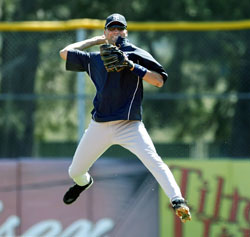 ONE MORE QUICK NOTE ON JETERIAN DEFENSE
Last year, opposition batters put 4,351 balls in play against the Yankees. They turned 68 percent of them into outs, which is a low rate. Boston turned 70 percent of balls in play against them into outs. The Rays turned 71 percent of balls in play against them into outs. These differences may seem small, but over the course of a season they can make a difference in a pennant race. Had the Yankees caught balls at the rate that the Red Sox did, for example, they would have retired an additional 74 batters. Had they fielded them at the Rays’ rate, they would have put out an additional 122 batters. The Yankees only allowed 1,170 fly balls all season long, so you can’t blame the entire shortfall on Bobby Abreu letting balls drop at the base of the wall. Their rate of line drives allowed was actually on the low side. Only so many balls were pulled down the lines past Jason Giambi or Alex Rodriguez. No one is to blame, apparently, and yet the balls weren’t caught. This happens year after year — the Yankees don’t catch as many balls as the opposition does, but no one is to blame.
This isn’t an argument. This isn’t subjective. Weak Yankees defense is a fact. You can choose not to see it when you watch a game. In the end, though, you have to account for what actually happens in those games. If the fielders weren’t at fault, then what happened? Unexpected stadium tilt? The moons of Saturn get in their eyes?
WE KNOW A REMOTE FARM IN LINCOLNSHIRE WHERE MRS. BUCKLEY LIVES… EVERY JULY, PEAS GROW THERE
The moment the Marlins bagged on former Angels’ prospect Dallas McPherson, the 28-year-old who led the minors in home runs last year, his name was circulated as a potential A-Rod sub. McPherson clearly has left-handed power, and the Yankees can use all the power they can get this year. There are two problems: First, McPherson strikes out so much that he would have trouble maintaining a .300 on-base percentage in the majors. Second, his defense at third is suspect. I’ve been skeptical of Cody Ransom’s ability to hit for average as well, but he should be able to field the position and hit a couple of home runs of his own. I figure the added defense makes Ransom a better fit than McPherson, or at least makes the two a wash. Now, you can argue about McPherson being a better bench asset than Angel Berroa or Ramiro Pena, but until Rodriguez comes back you might be forced to actually play him at third base if Derek Jeter leaves a game early, requiring Ransom to slide over to short.
It just occurred to me, reading what I just wrote in the context of our first item, above, that the Yankees worry an awful lot about defense but get very little out it.
FLESH PEDDLERS
If there’s a market for Gary Sheffield’s services, there’s a market for Nick Swisher or Xavier Nady. One also wonders if the Phillies would like to adopt Melky Cabrera — now that Geoff Jenkins has been released, their only reserve outfielder is Matt Stairs. They have rookie John Mayberry on the 40-man as well, but like Stairs he seems to be strictly corner material. Former Yankee Chad Moeller is going to back up Gregg Zaun for the O’s, at least until Matt Wieters comes up. Henry Blanco is going to be the starting backstop for the Padres. Consider those two pieces of information and feel free to speculate about a possible Jose Molina trade market. Say the Yankees brought up Frankie Cervelli halfway through the season, and… but no.
Johnson battling for much more than a roster spot
 ONE MORE CYCLOPS
On Sunday, it was reported that Yankees camp attendee Jason Johnson had been treated for ocular cancer. This information may not have seemed of much significance to most of you, because Johnson is a 35-year-old non-roster invitee with a career major league ERA of 4.99, but it caught my eye–my one functioning eye–because I am a survivor of the same disease. We underwent the same treatment at the same hospital with the same doctors.
Like me, Johnson really shouldn’t have this disease. Statistically, ocular melanoma doesn’t strike anyone with regularity, just five or six cases per million people are afflicted each year, and then it seems to go for blue-eyed guys over 50 years of age. I was about 32, and brown-eyed. I don’t know what color Johnson’s eyes are, but he’s obviously a bit young. Further, ocular cancer doesn’t correspond to your diet, how much sun you get, whether you’ve been smoking asbestos or some other controlled substance in your college dorm room, or overly personal relations with your cat. It just happens.
The process is much like skin cancer: the inside of your eye can develop freckles or moles, just like your skin. Sometimes, those freckles or moles turn evil and will kill you if left alone for too long. If you see a mole on the back of your hand start to change shape or color, it’s a simple matter to head for the dermatologist’s office and have it lopped off and biopsied. If you get to it early, that’s usually the end of it–if the doctor gets clean borders when he removed the thing, that particular threat is gone for good. This same process happens in the eye, but you can’t see it, and the process is otherwise asymptomatic–by the time the cancer gets big enough to start messing with your vision, you could be in real trouble. My tumor was considered to be of medium size–it was only 8 millimeters thick. That’s nothing in the real world, but in the eye it’s a big object, and I had no idea it was there.
I caught mine because my eye doctor made a lucky find while looking for something else. Johnson’s doctor caught his under similar circumstances, while working him up for a new set of contact lenses. We’re both very, very lucky. If you catch the tumor while it’s still contained to the eye, your prognosis is much better than if it’s started to climb out of there. That said, even if the disease is contained to the eye, you’re still in trouble, because first, it has to be cured, and second, the longer it was in your body, the more likely it is that it sent off a colony somewhere. Melanoma is a capricious disease–those cells can hide for years or even decades before coming back to kill you, most likely by invading your liver or your lungs. There is no safe harbor–with some cancers, if you’re free of the disease for five years, you can consider yourself cured. With melanoma, you’ll be going for scans of those two body parts for the rest of your life. I do this every six months.
The good news about ocular melanoma is that it generally responds to being irradiated; not too long ago, the “cure” was enucleation, the removal of the eye. You get to keep it now, for what it’s worth. Johnson and I underwent the same procedure. You’re knocked out, the eye is squished aside, and a radioactive plaque is affixed to the tumor site. You then get to stay in-hospital for as many days as the plaque is affixed–you can’t go home because you’re a danger to others. In my case, the tumor reacted the way it should, shrinking rapidly, and sometime later the doctors baked what was left with a laser, just to make sure it was dead, dead, dead. After these procedures, it is very rare that the cancer recurs at the original site. It’s the colonies you have to be afraid of.
In my case, over time the radiation also took the sight in the afflicted eye. I won’t go into five years of medical treatment trying to save my vision, but in essence, the radiation that wasn’t good for the tumor isn’t good for the healthy parts of your eye either. I can’t speculate on Johnson’s outcome because I don’t know where in the eye his tumor was located. Mine was right near the optic nerve, which means that some important hardware got baked along with the cancer. His might have been off to the side somewhere, and perhaps he’ll have fewer complications than I have had, and he’ll get to retain his vision, or some portion of it, for longer than I did. One would hope that he will retain good vision throughout the remainder of his professional baseball career, as a pitcher who was not able to fully gauge the ball coming off the bat would be a sitting duck and just one bad read away from having his head blown off by a line drive.
I feel ungrateful complaining about my partial blindness. It beats being dead, after all, and that’s pretty much the choice I was offered. You’d trade one eye for the rest of your life any day of the week. Still, there’s rarely a day that goes by that I do not notice it in some way, am not inconvenienced by it. There have been some promising things reported about someday using stem cells to revive the optic nerve. I eagerly await the day such miracles are possible. In the meantime, I regret that I get to welcome Jason Johnson to the club, congratulate him on having his tumor discovered in time for treatment, and wish him many future years of healthy living and successful pitching.
Finally, I hope my story, and Johnson’s, encourages the rest of you to go out and get your eyes checked on a regular basis–not by your mall optometrist, but by a real ophthalmologist. This disease can blind you and it can kill you. Twice a year I head to the Wills Eye hospital in Philadelphia for follow-up examination. There’s some physical discomfort involved, but there’s a whole additional level of pain that results from those who often share the waiting room with me–children. I guess Johnson and I aren’t the only ones for whom eye cancer stepped aside of its preferred group to clutch at. This is, as they say, a word to the wise.
Speaking of Johnson yesterday, Joe Girardi said, “I had never heard of anyone having that.” Very few people have heard of ocular cancer, and most people react with shock and surprise when I first tell them about it. Now you know, so no excuses–keep up those eye exams, and tell them the Pinstriped Bible sent you.
Ending the A-Rod debate
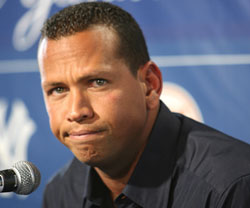 THE A-ROD FILES (DISCOVERED IN A RARELY OPENED BOTTOM DRAWER)
Judging by the comments and email, my reaction to the A-Rod presser didn’t please anyone. The criticism was about evenly split between those who seemed to think I was too hard on the guy and didn’t give him enough credit for being candid, and those that still think that I’m not hard enough on him because I still argue that his usage almost certainly had little effect on his numbers.
Some days you’re better off just staying in bed. Or maybe I could blog recipes. I don’t imagine that those folks get too much hate mail. “You’re calling for too much sugar! Who likes custard, anyway! Obviously you’ve never cooked in a real restaurant.”
Let’s try to deal with both objections, starting with the first. I would very much like to give Rodriguez the benefit of the doubt here, as I have steadfastly defended him over the years from those so-called fans who want to blame every bad bounce of the ball on him, not to mention the declining economy, global warming, and the continued popularity of “American Idol.” Despite this, I think his performance on Tuesday was ludicrous. I can’t sum up his explanations any better than did Joel Sherman in Wednesday’s New York Post:
Lewis Carroll’s White Queen could believe as many as six impossible things before breakfast, and you’d have to be her to buy into this mess. It makes very little sense. Nor does the “youthful indiscretion” thread ring true, given that the guy was 25 when he started. Whatever maturity issues the guy was facing, it’s pretty clear he had a fully developed sense of right and wrong or he wouldn’t have tried to hide what he was doing.
As I said yesterday, this has little to do with my estimation of Alex Rodriguez as a ballplayer. I respect his on-field performances and feel they are legitimate. The same goes for Ty Cobb. Had I been around, I would have paid good money to see Cobb play, but I don’t think I would have wanted to be friends with him or have him over for dinner. Heck, given what I’ve read of Babe Ruth’s table manners, I don’t know that I’d want to have dinner with him either. Ted Williams was not easy to get along with. Mickey Mantle was so good he’s actually underrated, but it seems like his personal character left a lot to be desired. These guys are not my idea of great human beings, but they can play on my all-star team anytime.
As for those on the “steroids corrupt all stats” debate, I remain somewhere between agnostic and outright skeptical. I’d be more willing to believe in a placebo effect than I do in a large-scale impact on home run production. If you feel differently, I’m open to your argument, but we need an argument more solid than, “Look at the home runs, man!” I did a radio spot recently, and the host said — I loosely paraphrase — “You puny stathead, I used to play the game, and I look at how Bongs and Ray-Rod can stay back on the ball and still hit it out — that’s unnatural power that can only come from the juice!” And as I struggled to say something more than, “Wait, what?” he repeated, “I played, I know.” Well, great. Let’s say we accept your argument. These guys hit 50 home runs a year. In how many of them did they “stay back” and still hit it out? What is the recurrence of your little anecdote in a given year? Are there any players who can do that naturally? Is it possible that, given that we’re talking about the top one percent of home run hitters in the game, that they can do some things the average player cannot? That you cannot? We’re talking about people’s lives and good names here. We cannot condemn them based on inference, innuendo, anecdote.
All of this searching for a “natural” production baseline is ridiculous given that there is no such thing. The line drawn between fair and unfair substances is completely arbitrary. No player, in any sport, is competing with only the assets that birth gave him. There’s always something else going into the pot, be it aspirin, absinthe, or amphetamines. During his 56-game hitting streak, Joe DiMaggio chain-smoked cigarettes in the dugout to calm his nerves. That gave him an unfair advantage on Wee Willie Keeler. Heck, genes are unfair and should be banned. Consider Barry Bonds and Jose Cruz, Jr. Bobby Bonds was a very good player. Barry Bonds is better. Jose Cruz was a very good player. Jose Cruz, Jr. is not half the player his old man was. Seems like Barry’s mom brought more to the chromosome hoedown than did Jose Jr.’s mom. Clearly, Barry Bonds is the beneficiary of genetic hypergamy, giving him a competitive advantage unavailable to other players. As such, his records should be stricken from the book. Breeding, intentional or not, makes a mockery of the level playing field.
I’m done. This is over. Let’s move on… at least a couple of yards down the road. At least until the next revelation.
Pinstriped Bible on Yankees Hot Stove
Thank you to everybody who contributed to PinstripedBible.com’s conversation during this week’s Yankees Hot Stove on the YES Network. Here is video from my appearance:
Jan. 29 appearance on Yankees Hot Stove:
Jan. 8 appearance on Yankees Hot Stove:
Dec. 18 appearance on Yankees Hot Stove::
Dec. 4 appearance on Yankees Hot Stove:
What did you think? Leave a comment below.
Yanks should not sit tight
 Shut up, he explained
Now that Mark Teixeira is in the fold, it feels as if the Yankees can settle back, burp loudly, and wait for spring training to begin. No one would blame them if they felt a sense of completion, having picked up the two best players on the free agent market in Teixeira and Sabathia, and clearly some owners would be happier if they took the rest of the winter off, but it would be a mistake. There is still more work to do.
Before we run down the list of items that should still be on the agenda, is it possible we can have a moratorium on owners calling for a salary cap because the Yankees just purchased a player on whom they weren’t seriously bidding? Sabathia could easily have gone to the Dodgers, Teixeira to the Red Sox or even the bleeding Nationals, and these captains of industry wouldn’t have made a peep. The playing field is not even. There are ways of fixing that have little to do with salary caps, which simply transfer dough from the players to the owners without changing the competitive balance even slightly. If redistribution of wealth meant that much, revenue sharing would have already done the job, but we know what those same owners do with the revenue sharing dough–they pocket it, or use it to pay down debt on their leveraged franchises.
Until such time as these owners are ready to truly address the issues of competitive balance, which will require revisions to basic assumptions about territoriality that go back to the business’s earliest days, they can stop trying to fool the public about the need for a cap and try to beat the Yankees, which we’ve seen can be done by virtue of just being smarter. The Yankees spend, they win regular season games, but they haven’t been to a World Series in five years, haven’t won one in eight, and the Joe Torre run of great teams is a little, glorious island in a long sea of trying and failing, despite enough money to keep Steve Kemp in comic books and champagne for his next several lifetimes.
Meanwhile, the Yankees go about the work of trying to craft a winning team. I should stop there, but I won’t, and not just because I get paid to go on at great length. In a winter in which the Yankees have made great strides in pursuing the obvious, like an ace pitcher for a staff that needs an ace and a first baseman to play first base–as opposed to a designated hitter, or a catcher, or a singles-hitting left fielder, or Miguel Cairo–now are looking to get their outfield in order. They don’t have to trade Xavier Nady, but given that he’s not the hitter that Nick Swisher is, or was, given that he’s not the hitter that the average right fielder is, it makes sense to see what they can get for the overvalued corner-man. He’d make a nice reserve/injury insurance policy, but if they can get anything of long-term value for a player of his minor key skill set, arbitration eligibility, and impending free agency, they should certainly go for it. Current rumor has them doing just that. Again, it’s pursuit of the obvious. Do that often enough, and you’ll get better.
In other news…
The Red Sox signed Brad Penny, who had a truly unpleasant year with the Dodgers, concealing an injury before breaking down altogether. His strikeout rates and general career path don’t suggest that he gives the Red Sox much more than above-average depth, but that’s something. What’s most interesting in the signing is the vote of no-confidence it expresses in Clay Buchholz. One wonders if this is an effect of the Yankees’ aggressive work this offseason–it is more typical of this regime to give the tyro pitcher another shot, and just chalk up the fifth spot in their rotation to development. Given other uncertainties in their rotation, such as the health problems of Josh Beckett, the wildness of Daisuke Matsuzaka, the 42-ness of Tim Wakefield, they needed more certainty. They apparently preferred the younger Penny to old hand Derek Lowe, and one supposes that if anyone knows about Lowe they do, but Penny still seems like a gamble. One can see why they wouldn’t want another wild pitcher in Oliver Perez, but Ben Sheets would seem to have a higher upside. Perhaps the Red Sox, like the rest of us, are overleveraged.
Tomorrow…
To the mats with reader mail, so get your queries and comments into oldprofessor@wholesomereading.com.
Landing Big Tex a big win for Yanks
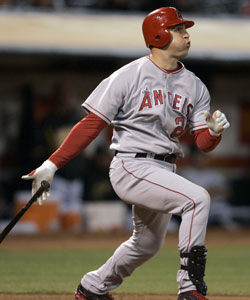 TEIXEIRA!
In the 2004-2005 offseason, the top free agent on the market was Carlos Beltran, the switch-hitting, slugging center fielder. It happened that the Yankees had a need in center field, as Bernie Williams, 35, had just completed his second subpar season in a row, and his defense had long since passed the point of no return. Beltran reportedly had a great deal of interest in playing for the Yankees, but for reasons that were unclear then and remain unclear, the Yankees passed. That meant not only leaving Williams in center for another year, but it also meant that when Williams finally had to be wedged out of center field, they had to go to the best available player, which meant Johnny Damon. Damon has had two good years in three for the Yankees, but he is not the player that Beltran is, is far older, and soon proved that he was no longer a center fielder.
It is no exaggeration to say that the Yankees’ decision to pass on Beltran so as to use their monetary advantages that winter primarily on pitching help–which came in the dubious forms of Carl Pavano and Jaret Wright, plus the aged but still viable (and cranky) Randy Johnson–has played a key part in their failure to win a title in the years since. Had the Yankees passed on Mark Teixeira, a player who perfectly suited (as was suggested here in this space on Monday) three of their needs simultaneously, age,offense, and defense, they would have repeated the same error.
They did not. All credit to Brian Cashman and the Steinbrenner family, to the former for playing it cool and then making his move, to the latter for opening their wallets and spending big–and to all three for not just spending, Wright- and Pavano-style, but for spending it on the right player, maybe the “rightest” player that they’ve acquired since Alex Rodriguez. If only they don’t try to move Teixeira to another position so a defensively inferior player can play first. Nah, that would never happen.
There is one point in the above worth repeating: all the dollars that accrue to sport’s wealthiest organization mean nothing if they are not spent wisely. Too often, the Yankees have settled for something other than the choicest cuts of meat. This time, it’s filet mignon all the way.
The Yankees are not perfect. The defense is still poor. The outfield defense could be very shaky depending on the alignment the Yankees pursue. They could choose to let a meaningless spring training battle decide center field instead of letting the evidence of a full major league season inform their choices. They could give Xavier Nady more playing time in right field than Nick Swisher. Derek Jeter is losing range even as we speak. Jorge Posada may or may not be able to throw–
–And that reminds me to revisit another point, as a major metropolitan newspaper published a column castigating the Yankees for closing off first base to Hideki Matsui, Johnny Damon, and Jorge Posada. Here we go:
This year, major league first basemen hit .272 /.353/.464.
Two years ago, they hit .276/.357/.463.
Three years ago, they hit .285/.363/.488.
Over the last five years, they hit .275/.355/.468.
Over the last ten years, they hit .276/.359/.472.
No doubt you’re starting to get the picture. Now, this is the average. If a team is getting these rates from its first baseman, it’s breaking even in comparison with the league. You could have Albert Pujols and do a lot better. You could have Doug Mientkiewicz and do a lot worse. Heck, your manager could give Miguel Cairo the odd start at first base. Some of these first baseman, like Albert Pujols and New Yankee Teixeira, not only hit but can field the position. While the standards are set where they are, there is no plausible reason that the Yankees should pass on a 29-year-old MVP-level player so they can reserve first base for aging former stars who will struggle to meet even the average level of production for the position and will almost certainly not be defensive assets. That is a formula for losing. And, oh yeah, the contracts of both Damon and Matsui are up at the end of the season. Unless the Yankees are as misguided a year from now as they were intelligent in signing Teixeira, what to do with those players at age 36 and up will be some other club’s problem.
Thus endeth the lecture. For now, suffice it to say that the Yankees have given their fans a great early Christmas present. More importantly, they’ve done the right thing competitively. Before the Red Sox became the favorites in the bidding, Teixeira was a move the Yankees should have made. Once the Red Sox became involved, it was a move they had to make, lest their rivals to the North unveil their own version of Murderer’s Row. As I said above, it was the right-est move the Yankees have made in years.
And with that, I wish you a happy and healthy holiday, whatever holiday is your holiday of choice. Enjoy it, and when you sit down to dinner with your family, don’t forget to scratch out Teixeira-ified batting orders into the mashed potatoes.
State of the Pinstriped Bible: A URL and an experiment
 There are some changes here at the Pinstriped Bible to talk about. The first thing to be aware of is for the first time in a long time we have a steady URL. None of that active server pages stuff: from now on, www.pinstripedbible.com will always point here.
Here’s the experiment: this Thursday, I’ll be making an appearance on the YES Network Hot Stove show. My role will be a bit like that of Mr. McFeely on “Mister Rogers’ Neighborhood” except with more fat and a less impressive moustache. I’ll be bringing the word from the outside, specifically your word. When you come to the Pinstriped Bible, you will also note that for the first time we have comments enabled right here on the page. These comments will form the basis of an exchange between host Bob Lorenz and myself. “What are your readers thinking about this week’s hot stove action?” Bob might say, and I, shot to appear as if I am in a remote bunker (Bob must be protected), will answer, “Well, Bob, we have 142 comments on C.C. Sabathia signing with the Mets!” At that point, Bob will do a spit take, or maybe I will–we haven’t worked out all the details yet.
Hey, don’t panic. C.C. hasn’t signed with the Mets and isn’t going to; that’s just an example. The point is, C.C. supplies the news, I supply the commentary, and you, the loyal readers, supply the 142 comments. It’s not too different from our practice of many years, except that I will be representing your reactions on the air for discussion by Bob and his guests (I am technically not a guest, but a “bunker-dweller”). As such, I’d like to hear from you on the following : What do you think the biggest story of the Yankees’ offseason has been so far?
A. The pursuit of C.C. Sabathia and other free agent pitchers to the possible exclusion of home-grown prospects such as Phil Hughes and Ian Kennedy in next year’s rotation?
B. The team’s apparent lack of interest in Bobby Abreu, to the extent that the team would not even risk a one-year contract through arbitration?
C. The apparent lack of fervor for Mark Teixeira and the corresponding decision to acquire Nick Swisher and anoint him the starting first baseman?
D. The team’s apparent expectation that the offense will be re-inflated by a resurgent Jorge Posada and Robinson Cano?
E. All or None of the Above.
And, of course, you should feel free to explain. I’ll do my best to summarize your responses and present them to Bob this Thursday at 6:30 on YES. If the resultant discussion is fruitful, we’ll do so again in subsequent episodes of Hot Stove–and who knows? They might even let me out of the bunker. Stay tuned.
Not particularly snappy answers to Melky questions
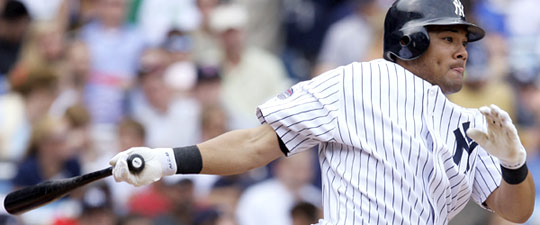 Q: If Melky Cabrera goes 20-for-40 in spring training and Brett Gardner goes 5-for-40, should it change anything about our expectations for either player?
A: No.
Not that anybody asked, but it’s a story we should get out in front of. An even better question is, “If they both go 20-for-40, who do you pick?”
A: Gardner. Even if we assume fielding is a wash, he does other things that Cabrera can’t do.
Q: Could you platoon them?
A: Not in any way that’s going to work. Gardner is a left-handed hitter. Cabrera masquerades as a switch-hitter, but so far he’s been completely ineffective from the right side, hitting .251/319/.329 overall and .213/.279/.299 in 2008. Those rates were fueled by a .227 average on balls in play, which suggests either extraordinary bad luck, extraordinary defense against him when batting right-handed, or the weakest swings in the history of weak swings.
Q: Say Melky does get back on track. What’s his upside?
A: Darned if I know, or anyone else does either. Before this season’s problems, Cabrera seemed headed for a peak of somewhere around .290/.350/.420. That seems crazily optimistic now. To get there, let alone the realm of star quality, he’d have to completely reinvent himself. In his career to date, he’s shown a proclivity for hitting grounders, an approach that makes home runs kind of unlikely. Selectivity seemed to be something that we could project as an asset back in 2006, but that is no longer the case. Then there’s the aforementioned platoon problem. Cabrera hit in some bad luck this year, and if he avoids the lefties his batting average should rebound a bit. That said, batting average isn’t everything. You have to reach base and hit with power too, and the likelihood of Cabrera recovering his patience and learning to elevate his swing seems pretty remote. The chance of even one of them happening seems remote.
Q: So what should the Yankees do?
A: I’m partial to giving Gardner a try. Though he doesn’t profile as a real offensive producer, he should have sufficient patience that if he hits .280 he’ll get on base at an above-average rate. Throw in some stolen bases and good defense and you have a valuable package. If he succeeds, great, and if not, in an ideal world Austin Jackson could challenge for the job before the year is up. Unfortunately, there is a broader problem in that the entire Yankees outfield might not produce next season. Johnny Damon is a near-certainty to regress. If Xavier Nady is the starting right fielder, he represents a 20-run discount on Bobby Abreu while only slightly improving the defense. The Yankees will be asking a great deal of the infield, which makes the center field decision even more important than it seems on the surface. If Cabrera is worth 65 runs of offense to the Yankees next year, and Gardner 75, then they had better go with Gardner because those ten runs are going to count.
 Q: Doesn’t that point up the whole not-offering-arb to Abreu thing?
A: Well, sort of. I can’t speak to the Yankees’ perception of their finances, so let’s stick to this in pure baseball terms. The team is lacking a strong right fielder. It’s not that the Yankees can’t move on from Abreu–there are strong arguments that they should, among them his declining plate judgment and his odd phobia about balls hit to the wall. The problem is that they need to replace that offense. They could theoretically replace it anywhere on the field. If your new right fielder is 20 runs worse (as I suggested above) and your new first baseman is 20 runs better, then at worst you’ve broken even. The problem right now is that Nick Swisher/Xavier Nady isn’t as potent as Jason Giambi/Bobby Abreu, and a country mile off from what Mark Teixeira/Nick Swisher would be.
If all financial matters were equal, then offering Abreu arbitration would have been a win-win scenario for the Yankees. If he declined, the Yankees would pick up some juicy draft picks, picks they can really use. If he accepted, they would have one more year of Abreu, possibly a last good one, without being on the hook for any decline that came later. In that scenario they could also immediately dedicate themselves to trading Nady, whose trade value will never be higher than it is right now (I borrow that last thought from the estimable Cliff Corcoran). There’s a reason that Nady has been with four teams in the last four seasons, and unless the Yankees are careful they’re about to find out what it is.
Q: Hey, Adam Dunn wasn’t offered arbitration. You haven’t mentioned him as a possible acquisition target for the Yankees. Why not?
A: Because my dreams just aren’t that big. A lefty slugger who has popped 40 homers a year for the last five seasons? If the Yankees could clear DH for him they would greatly benefit, but look at the points we’ve just gone over–offense isn’t management’s priority. It’s a shame that economy has brought on an austerity kick now instead of say, 2005, when the Yankees could have banked their money instead of blowing it on Carl Pavano and Jaret Wright. This winter, when the team has legit multiple targets to spend on, they can only afford to have CC Sabathia on the brain. Dunn seems to me to be the kind of player who won’t age well as he hits 33 or so–still five years off–and so does Sabathia, with his hulking frame and heavy workload. Five years from now, Teixeira might be the only one left standing.
A COUPLE OF MORE SITE NOTES
A reminder that as part of our new setting here, there is a handy RSS feed for you to subscribe to. It’s at the bottom of the blue sidebar at the right. We’re also going to be putting a snack bar and a Jacuzzi over there, so keep your trunks handy. Finally, keep those comments coming–I’m paying rapt attention. Finally, tune in to YES on Thursday at 6:30 to see an audio-animatronic version of myself interact in lifelike fashion with the actual Bob Lorenz. A splendid time is guaranteed for all.
 Pinstriped Bible